Respiratory PhysiologyRespiratory Physiology
By- Dr. Ramkrishna Bhue
1st
year P.G.
Dept. of Anesthiology
M.K.C.G. Medcal college
Berhampur
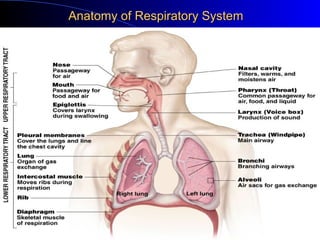
Anatomy of Respiratory SystemAnatomy of Respiratory System
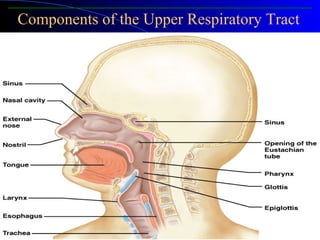
Components of the Upper Respiratory Tract
Figure 10.2
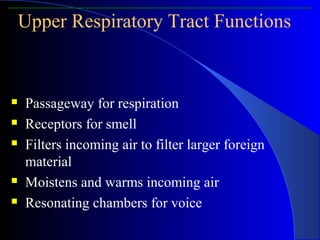
 Passageway for respiration
 Receptors for smell
 Filters incoming air to filter larger foreign
material
 Moistens and warms incoming air
 Resonating chambers for voice
Upper Respiratory Tract Functions
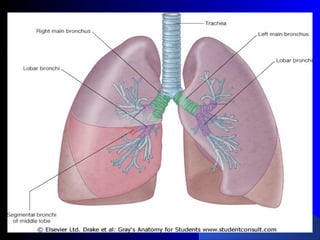
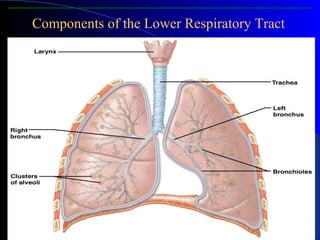
Components of the Lower Respiratory Tract
Figure 10.3
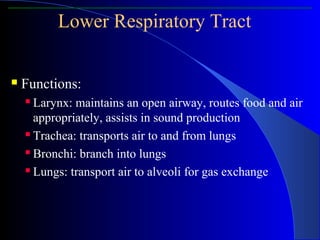
 Functions:
 Larynx: maintains an open airway, routes food and air
appropriately, assists in sound production
 Trachea: transports air to and from lungs
 Bronchi: branch into lungs
 Lungs: transport air to alveoli for gas exchange
Lower Respiratory Tract
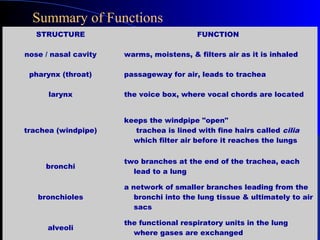
Summary of Functions
STRUCTURE FUNCTION
nose / nasal cavity  warms, moistens, & filters air as it is inhaled
pharynx (throat)  passageway for air, leads to trachea
larynx  the voice box, where vocal chords are located
trachea (windpipe)
 keeps the windpipe "open"
 trachea is lined with fine hairs called cilia
which filter air before it reaches the lungs
bronchi
 two branches at the end of the trachea, each
lead to a lung
bronchioles
 a network of smaller branches leading from the
bronchi into the lung tissue & ultimately to air
sacs
alveoli
 the functional respiratory units in the lung
where gases are exchanged
Defination
Resp is the use of O2 by the living cell for
oxidation of nutrients. This result in
production of CO2.
It can be divided into 4 main events;
1) pulmonary VE
2) gas diffusion
3) gas transport
4) regulation of resp
PULMONARY VENTILATIONPULMONARY VENTILATION
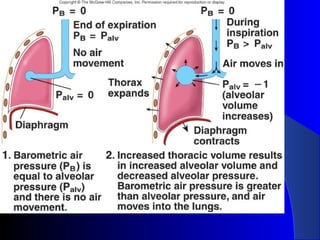
BOYLE’S LAW
Gas pressure in closed container is
inversely proportional to volume of
container
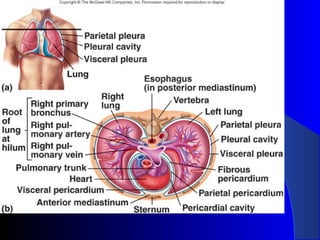
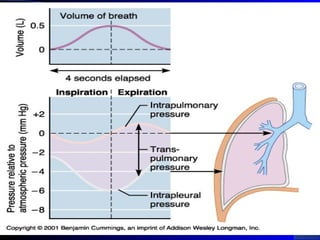
Pressure differences and Air flow
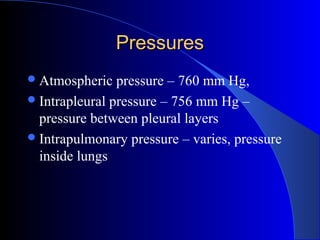
PressuresPressures
Atmospheric pressure – 760 mm Hg,
Intrapleural pressure – 756 mm Hg –
pressure between pleural layers
Intrapulmonary pressure – varies, pressure
inside lungs
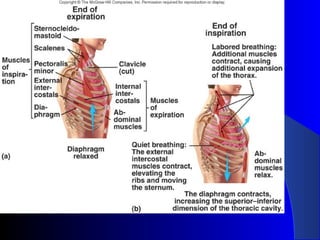
Inspiration/InhalationInspiration/Inhalation
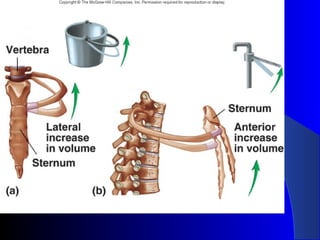
Diaphragm & Intercostal muscles
Increases volume in thoracic cavity as
muscles contract
Volume of lungs increases
Intrapulmonary pressure decreases (758 mm
Hg)
Expiration/ExhalationExpiration/Exhalation
Muscles relax
Volume of thoracic cavity decreases
Volume of lungs decreases
Intrapulmonary pressure increases (763 mm
Hg)
Expiration is active – forced expiration,
inhational anesthetics
0034.exe
Gas transportGas transport
 Most gases transported in the blood in 2 forms;
1- Dissolved in the plasma
2- Combine with Hb
 Under normal circumstances, more than 98% of the O2 in a
given vol of blood is transported in RBCs, bound to Hb.
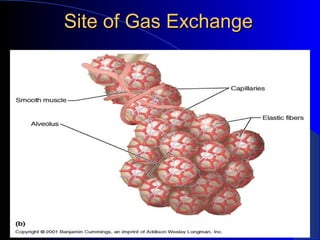
Site of Gas ExchangeSite of Gas Exchange
Gas ExchangeGas Exchange
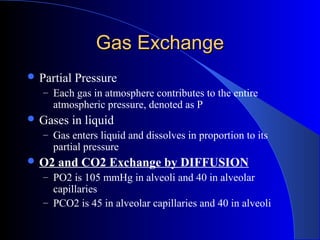
 Partial Pressure
– Each gas in atmosphere contributes to the entire
atmospheric pressure, denoted as P
 Gases in liquid
– Gas enters liquid and dissolves in proportion to its
partial pressure
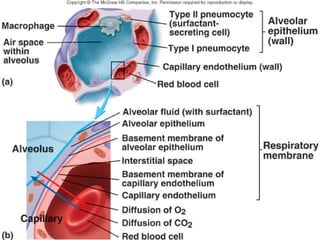
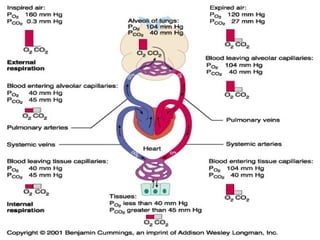
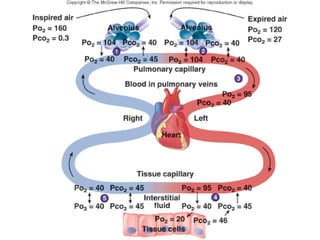
 O2 and CO2 Exchange by DIFFUSION
– PO2 is 105 mmHg in alveoli and 40 in alveolar
capillaries
– PCO2 is 45 in alveolar capillaries and 40 in alveoli
Partial PressuresPartial Pressures
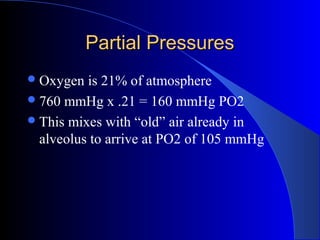
Oxygen is 21% of atmosphere
760 mmHg x .21 = 160 mmHg PO2
This mixes with “old” air already in
alveolus to arrive at PO2 of 105 mmHg
Partial PressuresPartial Pressures
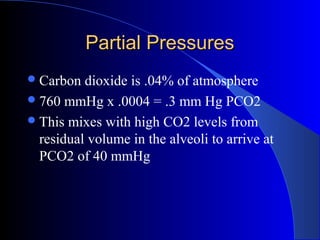
Carbon dioxide is .04% of atmosphere
760 mmHg x .0004 = .3 mm Hg PCO2
This mixes with high CO2 levels from
residual volume in the alveoli to arrive at
PCO2 of 40 mmHg
Gas TransportGas Transport
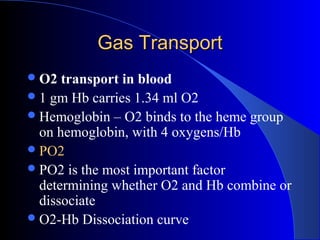
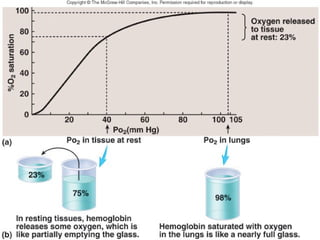
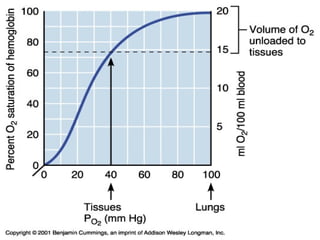
O2 transport in blood
1 gm Hb carries 1.34 ml O2
Hemoglobin – O2 binds to the heme group
on hemoglobin, with 4 oxygens/Hb
PO2
PO2 is the most important factor
determining whether O2 and Hb combine or
dissociate
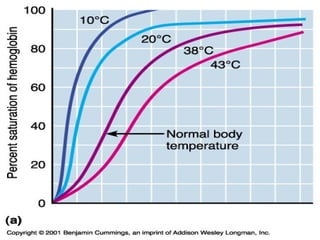
O2-Hb Dissociation curve
Gas TransportGas Transport
pH
CO2
Temperature
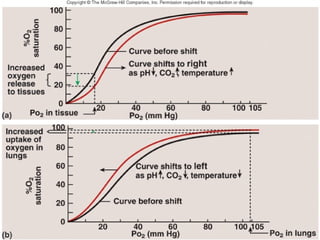
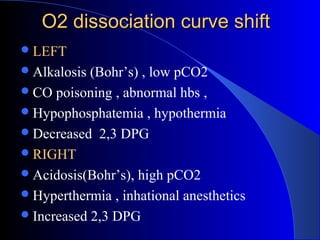
O2 dissociation curve shiftO2 dissociation curve shift
LEFT
Alkalosis (Bohr’s) , low pCO2
CO poisoning , abnormal hbs ,
Hypophosphatemia , hypothermia
Decreased 2,3 DPG
RIGHT
Acidosis(Bohr’s), high pCO2
Hyperthermia , inhational anesthetics
Increased 2,3 DPG
O2 dissociation curveO2 dissociation curve
Cyanosis appears – pO2 < 50-60 mmHg
p50 – partial pressure @ O2 saturat. is 50%
P50 not affected by aneasthesia
O2 flux
amount of O2 leaving left ventricle per min.
Its 1000ml p.m.
Gas TransportGas Transport
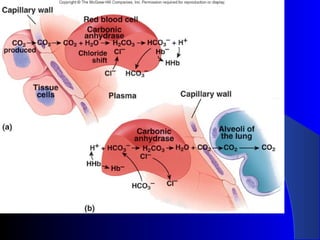
CO2 transport
7% in plasma
23% in carbamino compounds (bound to
globin part of Hb)
70% as Bicarbonate
Carbon DioxideCarbon Dioxide
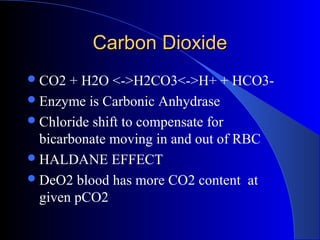
CO2 + H2O <->H2CO3<->H+ + HCO3-
Enzyme is Carbonic Anhydrase
Chloride shift to compensate for
bicarbonate moving in and out of RBC
HALDANE EFFECT
DeO2 blood has more CO2 content at
given pCO2
Tissue respTissue resp
 It means getting energy out of glucose.
 The most efficient form of resp is aerobic (require O2) and
anaerobic resp (does not require O2).
 Aerobic resp: It is the normal process by which food
substances are broken down and oxidized to provide energy.
Glucose + O2 → CO2 + H2O + energy released
 Anaerobic resp: It means that energy can be derived from food
substances without the simultaneous utilization of O2.
Glucose → lactic acid + much less energy released
0035.exe
Factors that influenceFactors that influence
pulmonary air flowpulmonary air flow
F = P/R
Diameter of airways, esp. bronchioles
Sympathetic & Parasympathetic NS
Surface TensionSurface Tension
Lung collapse
Surface tension tends to oppose alveoli
expansion
Pulmonary surfactant reduces surface
tension produced by type II pnuemocytes
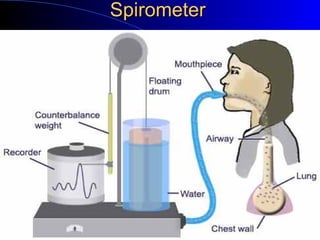
SpirometerSpirometer
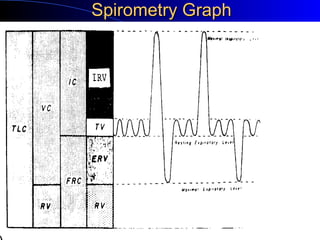
Spirometry GraphSpirometry Graph
Lung Volumes & CapacitiesLung Volumes & Capacities
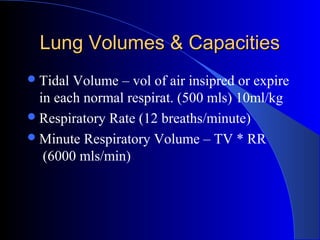
Tidal Volume – vol of air insipred or expire
in each normal respirat. (500 mls) 10ml/kg
Respiratory Rate (12 breaths/minute)
Minute Respiratory Volume – TV * RR
(6000 mls/min)
Lung Volumes & CapacitiesLung Volumes & Capacities
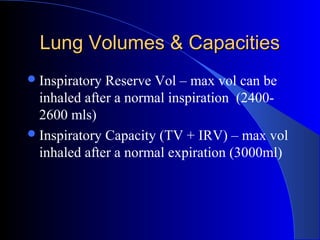
Inspiratory Reserve Vol – max vol can be
inhaled after a normal inspiration (2400-
2600 mls)
Inspiratory Capacity (TV + IRV) – max vol
inhaled after a normal expiration (3000ml)
Lung Volumes & CapacitiesLung Volumes & Capacities
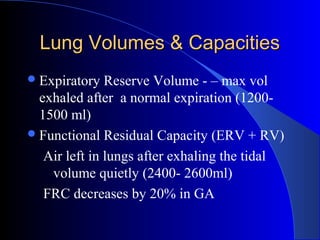
Expiratory Reserve Volume - – max vol
exhaled after a normal expiration (1200-
1500 ml)
Functional Residual Capacity (ERV + RV)
Air left in lungs after exhaling the tidal
volume quietly (2400- 2600ml)
FRC decreases by 20% in GA
Lung Volumes & CapacitiesLung Volumes & Capacities
Vital Capacity – max vol air exhaled after
max inhalation 75- 80 ml/kg
 VC =IRV + TV + ERV = 4200-4500ml
Residual Volume – vol of air still in lungs
after max expiration(1200 mls)
Total Lung Capacity (5900, 4400)
Lung Volumes & CapacitiesLung Volumes & Capacities
Dead Space
Phy. Dead space = anatomical dead space +
alvoelar dead space
Anatomical dead space = 150ml or 2ml/kg
Inrease – old age , neck ext., jaw protru.,
bronchodil., masks , circuits , IPPV &
PEEP
Decrease – intubation, tracheostomy,
hypervent., neck flexion , bronchoconst.
Alveolar dead spaceAlveolar dead space
Ventilation (V) & perfusion (Q) is more at
base than apex
But perfusion @ base >> apex
V/Q @ apex =2.1 & @ base 0.3
This V/P mismatch produce alveolar dead
space i.e. only ventilation no perfusion
pO2 { alveolar – atrial} = 3-5 mmHg
Value = 60 – 80 ml in standing position
Increase- lung patho – pul embol., pul
edema, ARDS, GA, IPPV , PEEP ,
hypotension
Alveolar Ventilation EfficiencyAlveolar Ventilation Efficiency
RR X (TV-DAV) = Alveolar Ventilation =
4200 mls/min
If double RR: AV = 8400 mls/min
If double TV: AV = 10200 mls/min
Matching Alveolar air flow withMatching Alveolar air flow with
blood flowblood flow
Pulmonary vessels
– Vessels can constrict in areas where oxygen
flow is low
Respiratory passageways
– Airways can dilate where carbon dioxide levels
are high
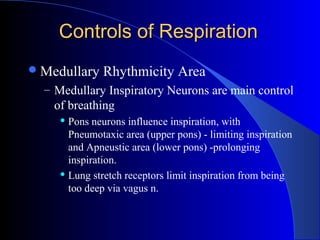
Controls of RespirationControls of Respiration
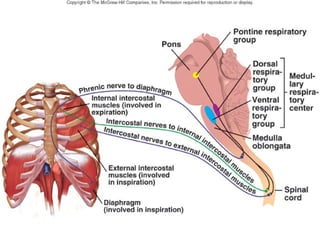
Medullary Rhythmicity Area
– Medullary Inspiratory Neurons are main control
of breathing
 Pons neurons influence inspiration, with
Pneumotaxic area (upper pons) - limiting inspiration
and Apneustic area (lower pons) -prolonging
inspiration.
 Lung stretch receptors limit inspiration from being
too deep via vagus n.
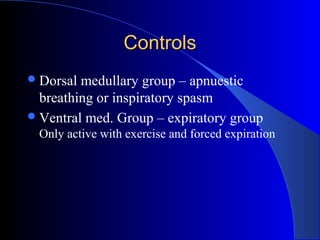
ControlsControls
Dorsal medullary group – apnuestic
breathing or inspiratory spasm
Ventral med. Group – expiratory group
Only active with exercise and forced expiration
Controls of rate and depth ofControls of rate and depth of
respirationrespiration
 Arterial PO2
– When PO2 is VERY low, ventilation increases
 Arterial PCO2
– The most important regulator of ventilation, small increases in
PCO2, greatly increases ventilation
 Arterial pH
– As hydrogen ions increase, alveolar ventilation increases, but
hydrogen ions cannot diffuse into CSF as well as CO2
– ####
Assessment of PatientAssessment of Patient
History – smoking , asthma , TB, chronic
cough , cold or running nose
On exam. – RR, chest expansion,
clubbing, cyanosis, ascultaion of lung fields
for added sound, mouth opening,
Mallampati Grading thyromental
distance(6.5cm) , neck flex – exten. (165-
90)
Invest. – DC, AEC, X ray chest ,
Thank You…

Respiratory physiology by Dr RamKrishna

  • 1.
    Respiratory PhysiologyRespiratory Physiology By-Dr. Ramkrishna Bhue 1st year P.G. Dept. of Anesthiology M.K.C.G. Medcal college Berhampur
  • 2.
    Anatomy of RespiratorySystemAnatomy of Respiratory System
  • 6.
    Components of theUpper Respiratory Tract Figure 10.2
  • 7.
     Passageway forrespiration  Receptors for smell  Filters incoming air to filter larger foreign material  Moistens and warms incoming air  Resonating chambers for voice Upper Respiratory Tract Functions
  • 8.
    Components of theLower Respiratory Tract Figure 10.3
  • 9.
     Functions:  Larynx:maintains an open airway, routes food and air appropriately, assists in sound production  Trachea: transports air to and from lungs  Bronchi: branch into lungs  Lungs: transport air to alveoli for gas exchange Lower Respiratory Tract
  • 10.
    Summary of Functions STRUCTUREFUNCTION nose / nasal cavity  warms, moistens, & filters air as it is inhaled pharynx (throat)  passageway for air, leads to trachea larynx  the voice box, where vocal chords are located trachea (windpipe)  keeps the windpipe "open"  trachea is lined with fine hairs called cilia which filter air before it reaches the lungs bronchi  two branches at the end of the trachea, each lead to a lung bronchioles  a network of smaller branches leading from the bronchi into the lung tissue & ultimately to air sacs alveoli  the functional respiratory units in the lung where gases are exchanged
  • 11.
    Defination Resp is theuse of O2 by the living cell for oxidation of nutrients. This result in production of CO2. It can be divided into 4 main events; 1) pulmonary VE 2) gas diffusion 3) gas transport 4) regulation of resp
  • 12.
    PULMONARY VENTILATIONPULMONARY VENTILATION BOYLE’SLAW Gas pressure in closed container is inversely proportional to volume of container Pressure differences and Air flow
  • 13.
    PressuresPressures Atmospheric pressure –760 mm Hg, Intrapleural pressure – 756 mm Hg – pressure between pleural layers Intrapulmonary pressure – varies, pressure inside lungs
  • 15.
    Inspiration/InhalationInspiration/Inhalation Diaphragm & Intercostalmuscles Increases volume in thoracic cavity as muscles contract Volume of lungs increases Intrapulmonary pressure decreases (758 mm Hg)
  • 18.
    Expiration/ExhalationExpiration/Exhalation Muscles relax Volume ofthoracic cavity decreases Volume of lungs decreases Intrapulmonary pressure increases (763 mm Hg) Expiration is active – forced expiration, inhational anesthetics
  • 22.
  • 23.
    Gas transportGas transport Most gases transported in the blood in 2 forms; 1- Dissolved in the plasma 2- Combine with Hb  Under normal circumstances, more than 98% of the O2 in a given vol of blood is transported in RBCs, bound to Hb.
  • 24.
    Site of GasExchangeSite of Gas Exchange
  • 26.
    Gas ExchangeGas Exchange Partial Pressure – Each gas in atmosphere contributes to the entire atmospheric pressure, denoted as P  Gases in liquid – Gas enters liquid and dissolves in proportion to its partial pressure  O2 and CO2 Exchange by DIFFUSION – PO2 is 105 mmHg in alveoli and 40 in alveolar capillaries – PCO2 is 45 in alveolar capillaries and 40 in alveoli
  • 27.
    Partial PressuresPartial Pressures Oxygenis 21% of atmosphere 760 mmHg x .21 = 160 mmHg PO2 This mixes with “old” air already in alveolus to arrive at PO2 of 105 mmHg
  • 28.
    Partial PressuresPartial Pressures Carbondioxide is .04% of atmosphere 760 mmHg x .0004 = .3 mm Hg PCO2 This mixes with high CO2 levels from residual volume in the alveoli to arrive at PCO2 of 40 mmHg
  • 31.
    Gas TransportGas Transport O2transport in blood 1 gm Hb carries 1.34 ml O2 Hemoglobin – O2 binds to the heme group on hemoglobin, with 4 oxygens/Hb PO2 PO2 is the most important factor determining whether O2 and Hb combine or dissociate O2-Hb Dissociation curve
  • 34.
  • 37.
    O2 dissociation curveshiftO2 dissociation curve shift LEFT Alkalosis (Bohr’s) , low pCO2 CO poisoning , abnormal hbs , Hypophosphatemia , hypothermia Decreased 2,3 DPG RIGHT Acidosis(Bohr’s), high pCO2 Hyperthermia , inhational anesthetics Increased 2,3 DPG
  • 38.
    O2 dissociation curveO2dissociation curve Cyanosis appears – pO2 < 50-60 mmHg p50 – partial pressure @ O2 saturat. is 50% P50 not affected by aneasthesia O2 flux amount of O2 leaving left ventricle per min. Its 1000ml p.m.
  • 39.
    Gas TransportGas Transport CO2transport 7% in plasma 23% in carbamino compounds (bound to globin part of Hb) 70% as Bicarbonate
  • 40.
    Carbon DioxideCarbon Dioxide CO2+ H2O <->H2CO3<->H+ + HCO3- Enzyme is Carbonic Anhydrase Chloride shift to compensate for bicarbonate moving in and out of RBC HALDANE EFFECT DeO2 blood has more CO2 content at given pCO2
  • 42.
    Tissue respTissue resp It means getting energy out of glucose.  The most efficient form of resp is aerobic (require O2) and anaerobic resp (does not require O2).  Aerobic resp: It is the normal process by which food substances are broken down and oxidized to provide energy. Glucose + O2 → CO2 + H2O + energy released  Anaerobic resp: It means that energy can be derived from food substances without the simultaneous utilization of O2. Glucose → lactic acid + much less energy released
  • 43.
  • 44.
    Factors that influenceFactorsthat influence pulmonary air flowpulmonary air flow F = P/R Diameter of airways, esp. bronchioles Sympathetic & Parasympathetic NS
  • 45.
    Surface TensionSurface Tension Lungcollapse Surface tension tends to oppose alveoli expansion Pulmonary surfactant reduces surface tension produced by type II pnuemocytes
  • 46.
  • 47.
  • 48.
    Lung Volumes &CapacitiesLung Volumes & Capacities Tidal Volume – vol of air insipred or expire in each normal respirat. (500 mls) 10ml/kg Respiratory Rate (12 breaths/minute) Minute Respiratory Volume – TV * RR (6000 mls/min)
  • 49.
    Lung Volumes &CapacitiesLung Volumes & Capacities Inspiratory Reserve Vol – max vol can be inhaled after a normal inspiration (2400- 2600 mls) Inspiratory Capacity (TV + IRV) – max vol inhaled after a normal expiration (3000ml)
  • 50.
    Lung Volumes &CapacitiesLung Volumes & Capacities Expiratory Reserve Volume - – max vol exhaled after a normal expiration (1200- 1500 ml) Functional Residual Capacity (ERV + RV) Air left in lungs after exhaling the tidal volume quietly (2400- 2600ml) FRC decreases by 20% in GA
  • 51.
    Lung Volumes &CapacitiesLung Volumes & Capacities Vital Capacity – max vol air exhaled after max inhalation 75- 80 ml/kg  VC =IRV + TV + ERV = 4200-4500ml Residual Volume – vol of air still in lungs after max expiration(1200 mls) Total Lung Capacity (5900, 4400)
  • 52.
    Lung Volumes &CapacitiesLung Volumes & Capacities Dead Space Phy. Dead space = anatomical dead space + alvoelar dead space Anatomical dead space = 150ml or 2ml/kg Inrease – old age , neck ext., jaw protru., bronchodil., masks , circuits , IPPV & PEEP Decrease – intubation, tracheostomy, hypervent., neck flexion , bronchoconst.
  • 53.
    Alveolar dead spaceAlveolardead space Ventilation (V) & perfusion (Q) is more at base than apex But perfusion @ base >> apex V/Q @ apex =2.1 & @ base 0.3 This V/P mismatch produce alveolar dead space i.e. only ventilation no perfusion pO2 { alveolar – atrial} = 3-5 mmHg Value = 60 – 80 ml in standing position Increase- lung patho – pul embol., pul edema, ARDS, GA, IPPV , PEEP , hypotension
  • 54.
    Alveolar Ventilation EfficiencyAlveolarVentilation Efficiency RR X (TV-DAV) = Alveolar Ventilation = 4200 mls/min If double RR: AV = 8400 mls/min If double TV: AV = 10200 mls/min
  • 55.
    Matching Alveolar airflow withMatching Alveolar air flow with blood flowblood flow Pulmonary vessels – Vessels can constrict in areas where oxygen flow is low Respiratory passageways – Airways can dilate where carbon dioxide levels are high
  • 56.
    Controls of RespirationControlsof Respiration Medullary Rhythmicity Area – Medullary Inspiratory Neurons are main control of breathing  Pons neurons influence inspiration, with Pneumotaxic area (upper pons) - limiting inspiration and Apneustic area (lower pons) -prolonging inspiration.  Lung stretch receptors limit inspiration from being too deep via vagus n.
  • 57.
    ControlsControls Dorsal medullary group– apnuestic breathing or inspiratory spasm Ventral med. Group – expiratory group Only active with exercise and forced expiration
  • 59.
    Controls of rateand depth ofControls of rate and depth of respirationrespiration  Arterial PO2 – When PO2 is VERY low, ventilation increases  Arterial PCO2 – The most important regulator of ventilation, small increases in PCO2, greatly increases ventilation  Arterial pH – As hydrogen ions increase, alveolar ventilation increases, but hydrogen ions cannot diffuse into CSF as well as CO2 – ####
  • 60.
    Assessment of PatientAssessmentof Patient History – smoking , asthma , TB, chronic cough , cold or running nose On exam. – RR, chest expansion, clubbing, cyanosis, ascultaion of lung fields for added sound, mouth opening, Mallampati Grading thyromental distance(6.5cm) , neck flex – exten. (165- 90) Invest. – DC, AEC, X ray chest ,
  • 61.