DR NILESH KATE
MBBS,MD
ASSOCIATE PROF
ESIC MEDICAL COLLEGE, GULBARGA.
DEPT. OF PHYSIOLOGY
INSULIN.
OBJECTIVES
 Endocrine Pancreas
 Structure & synthesis.
 Secretion.
 Regulation of secretion.
 Plasma levels, circulation,
degradation.
 Mechanism of action.
 Actions of insulin.
 Applied aspects.
Saturday, March 14, 2015
Endocrine pancreas.
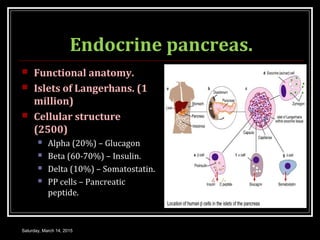
 Functional anatomy.
 Islets of Langerhans. (1
million)
 Cellular structure
(2500)
 Alpha (20%) – Glucagon
 Beta (60-70%) – Insulin.
 Delta (10%) – Somatostatin.
 PP cells – Pancreatic
peptide.
Saturday, March 14, 2015
Endocrine pancreas.
 Gap junctions – link
between cells.
 Vascular arrangements.
– arteriole to capillaries to
venules. Bath each cell
with insulin for local
effect.
 Strategic location -- for
local effect on exocrine
part of pancreas.
Saturday, March 14, 2015
Insulin.
 Firsts to its credits.
 1st
hormone to be isolated, purified, crystallized &
synthesized.
 1st
protein to possess hormonal activity.
 1st
protein sequence for amino acids to determine the
structure.
 1st
protein estimated by RIA (Radio Immuno Assay)
 1st
protein synthesized by Recombinant DNA
technology.
Saturday, March 14, 2015
Structure
 Protein (51 AA)
 2 polypeptide chain
 A (21 AA)
 B (30 AA)
 Connected by interchain
disulphide linkage to A7-
B7,A20-B19, & A6-11.
 IF 2 chains break apart
functional activity lost.
Saturday, March 14, 2015
Biosynthesis.
Saturday, March 14, 2015
Mechanism of insulin
secretion.
Saturday, March 14, 2015
Mechanism of insulin
secretion.
Saturday, March 14, 2015
Mechanism of insulin
secretion.
 By Glucagon.
 By stimulator G protein
via cyclic AMP.
 By Somatostatin.
 By inhibitor G protein
via cyclic AMP.
 By Acetylcholine.
 By G protein linked
Phospholipase C by
producing
 Phospahtidyl Inositol &
Diacyl Glycerol.
Saturday, March 14, 2015
Regulation of secretion.
 Role of exogenous nutrients.
 Role of gastrointestinal & other hormones.
 Role of sympathetic & parasympathetic
nervous system.
Saturday, March 14, 2015
Role of exogenous nutrients.
Saturday, March 14, 2015
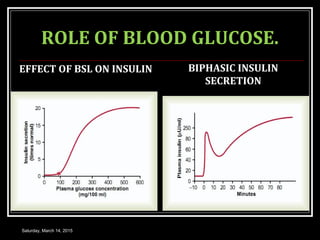
ROLE OF BLOOD GLUCOSE.
EFFECT OF BSL ON INSULIN BIPHASIC INSULIN
SECRETION
Saturday, March 14, 2015
Role of Amino Acids
 Induces secretion of insulin, particularly
after protein rich meal.
 Most potent – Arginine & Lysine.
 Moderate – Leucine, Alanine.
Saturday, March 14, 2015
Role of Gastrointestinal &
other Hormones.
 GIT Hormones –
enhances
 Other hormones –
Growth hormone,
cortisol, glucagon,
progesterone &
estrogen.
 Burning out –
Prolonged secretion of
other hormone causes
use of Islets of
Langerhans leads to
DM.
Saturday, March 14, 2015
Role of sympathetic &
parasympathetic nervous system.
 Sympathetic .
 Rise in blood sugar
level.
 So insulin release
decreased
 Glucagon release
increased.
 Parasympathetic .
 Insulin secretion
increased.
Saturday, March 14, 2015
Plasma levels.
 Basal level – 10 μU/ml.
 After meal –
 Increases 3 -10 times.
 After 30 -60 min.
 Daily Secretion
 0.5 -1.25 units/hr.
 Peripheral delivery 30
units.
 Without 1st pass
metabolism secretion –
2.5 units/hr.
Saturday, March 14, 2015
Circulation & Degradation.
 Circulates unbound to any carrier protein.
 Half life – 5-18 min.
 Metabolic clearance rate – 1000 ml/min.
 “Insulinase” -- Degrade , break disulphide
chains
Saturday, March 14, 2015
Mechanism of action.
 Insulin receptors.(2-3
L)
 Protein kinase
receptors.
 Structure.
 Alpha (α) – outer
surface.
 Beta (β) – across plasma
membrane, have
tyrosine kinase domain.
Saturday, March 14, 2015
STEPS IN MECHANISM OF
ACTION.
Saturday, March 14, 2015
STEPS IN MECHANISM OF
ACTION.
Saturday, March 14, 2015
Actions of Insulin.
 Metabolic effect.
 Ion transport.
 Role in cell growth & development.
Saturday, March 14, 2015
Metabolic effect.
 Carbohydrate
metabolism.(Decreases
blood Glucose levels.)
 Increase glucose uptake
 Promote Glucose
utilization. – Glycolysis &
Glycogen formation.
 Decrease Glucose
production. –
Gluconeogenesis &
Glycogenolysis.
 Insulin Dependent
uptake – muscles,
adipose tissue, WBC &
mammary glands.
 Insulin Independent
– nervous tissue,
kidney, RBC, retina,
blood vessels,
intestinal mucosa.
Saturday, March 14, 2015
Carbohydrate metabolism
 In liver.
 Increase glucose uptake – by
increasing Glucokinase.
 Glycogen synthesis – by
Glycogen synthase enzyme.
 Glycolysis – by
phosphofructokinase &
pyruvate kinase.
 Decrease Glycogenolysis &
Gluconeogenesis.
 In muscles.
 Increase Glucose
uptake (Glut -4)
 Increase Glycolysis.
(Pyruvate
Dehydrogenase)
 Increase Glycogen
synthesis. (Glycogen
synthase)
Saturday, March 14, 2015
Carbohydrate metabolism
 In Adipose tissue.
 Increase Glucose
uptake (translocating
Glut-4)
 Storage as
Triglycerides.
 Converted to FA.
Saturday, March 14, 2015
Lipid metabolism
 Increases Lipogenesis.
 Decrease Lypolysis.
 Reducing ketogenesis.
Saturday, March 14, 2015
Protein metabolism.
 Stimulate protein
synthesis.
 By increasing transport
into cell.
 Translation of
messenger RNA.
 Transcription.
 Inhibit protein
degradation.
 Inhibit proteolysis.
Saturday, March 14, 2015
Ion transport.
 Increases.
K,PO4, Mg uptake
 So insulin effect
causes – Hypokalemia,
Saturday, March 14, 2015
Role in cell growth &
development.
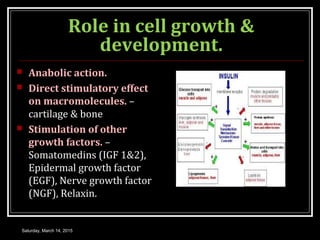
 Anabolic action.
 Direct stimulatory effect
on macromolecules. –
cartilage & bone
 Stimulation of other
growth factors. –
Somatomedins (IGF 1&2),
Epidermal growth factor
(EGF), Nerve growth factor
(NGF), Relaxin.
Saturday, March 14, 2015
Applied aspects.
 Diabetes mellitus.
 Hypoglycemia.
Saturday, March 14, 2015
Diabetes mellitus.
 Diabetes – A clinical syndrome of
hyperglycemia due to deficiency of Insulin.
Saturday, March 14, 2015
TYPES .
PRIMARY DM – cause not known.
IDDM
NIDDM
SECONDARY DM – due to
Pathological conditions,
pancreatitis, cystic fibrosis,
Acromegaly, Cushing syndrome
etc.
STAGES.
•PRE-DIABETICS or Potential
diabetics. – Genetic predisposition.
•Latent diabetics or chemical
diabetics – normal F& PP BSL but
increased after stress.
• Clinical diabetics – C/F without
complications.
• Complicated diabetics.
IDDM & NIDDM.
FEATURES IDDM NIDDM
DEFECT β cell destruction.–
insulin def.
Resistance of target
tissue.
Prevalence 10-20 % 80-90%
Age of onset < 40 yrs > 40 yrs.
Body wt Low High
Gene focus Chromosome 6 Chromosome 1
Family history Mild/moderate Strong.
Acute complication Ketoacidosis Hyperosmolar coma.
Plasma insulin Decreased or absent Normal
Ketonuria Present Absent
Treatment Insulin Oral hypoglymic.
Mortality High Low.
Saturday, March 14, 2015
Pathophysiology of DM.
 Hyperglycemia. –
 Due to decreased peripheral utilization.
 Increased hepatic output of glucose.
 Hypertriglyceridaemia, ketosis .
 Less utilization turns it to FFA
 Excess FFA leads to formation of TG & Ketoacidosis.
 Protein catabolism.
 Insulin --- Anabolic hormone.
 Promote protein synthesis & inhibit proteolysis.
Saturday, March 14, 2015
Hyperglycemia.
 Glycosuria. –
 Glucose in urine above 180 mg/100ml.
 Polyuria (osmotic diuresis), loss of electrolyte, cellular
dehydration, polydipsia, increased caloric loss,
Polyphagia, loss of body weight.
 Impaired Phagocytic function.
 Hyperosmolar effect. (above 375 mOsm/kg)
 Glycosylation of proteins.
 Hemoglobin (HbA1c )
 Tissue proteins – Diabetic Nephropathy, D. Neuropathy,
D. Retinopathy.
Saturday, March 14, 2015
Hypertriglyceridaemia,
Ketosis .
 Hypertriglyceridaemia
– glucose converted to
FFA
 FFA to TG.
 Increase secretion of
VLDL & chylomicrons.
 Leads to
Hypercholesterolemia.
 Ketosis .
 Cellular dehydration.
 Ketoacidosis.
 Dyspnoea, Kussmaul
breathing.
 Breath acetone smell.
 Electrolyte loss
 Hypovolaemia &
hypotension.
 Coma & death
Saturday, March 14, 2015
Protein catabolism.
 Protein catabolism increased & anabolism
suppressed.
 Protein depletion.
 Muscle wasting.
 Negative nitrogen balance.
 Released large amount of amino acids
 Used for energy production.
 Substrate for enhanced gluconeogenesis.
Saturday, March 14, 2015
Clinical features
 Cardinal symptoms –
Polyuria, Polyphagia,
polydipsia, wt loss.
 Biochemical –
Hyperglycemia,
Glycosuria, ketosis,
ketonuria,
Ketoacidosis.
Saturday, March 14, 2015
Complications.
 Predisposition to
infection. – Phagocytic
function, protein depletion
 Acute complication – ketotic
coma, Non-ketotic Hyperosmolar
coma.
 Chronic complication.–
atherosclerosis., Hyperlipidemia,
hypercholesterolemia,
 Microangiopathy – D.
retinopathy, nephropathy,
neuropathy.
Saturday, March 14, 2015
Diagnosis.
 Urine examination for Glycosuria. – exclude
renal Glycosuria.
 Urine examination for ketone bodies. – other
causes starvation, fasting, high fat diet,
repeated vomiting.
 Blood glucose levels – fasting (70-120 mg%)
& postprandial (120-180mg%)
 Glucose tolerance tests (GTT)
Saturday, March 14, 2015
Glucose tolerance
tests (GTT)
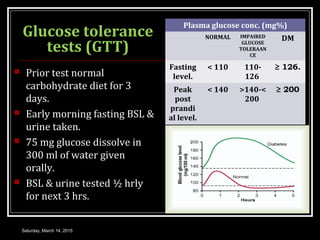
 Prior test normal
carbohydrate diet for 3
days.
 Early morning fasting BSL &
urine taken.
 75 mg glucose dissolve in
300 ml of water given
orally.
 BSL & urine tested ½ hrly
for next 3 hrs.
Plasma glucose conc. (mg%)
NORMAL IMPAIRED
GLUCOSE
TOLERAAN
CE
DM
Fasting
level.
< 110 110-
126
≥ 126.
Peak
post
prandi
al level.
< 140 >140-<
200
≥ 200
Saturday, March 14, 2015
Management of Diabetes
Mellitus.
 Goals of therapy.
 Maintain blood glucose to normal.
 Maintain ideal body weight.
 Symptoms free.
 Retard or prevent complications.
 Treatment modalities.
 Dietary management.
 Oral hypoglycemic agents.
 Insulin along with dietary management.
Saturday, March 14, 2015
Treatment modalities.
 Dietary management.
 Low energy wt reducing diet (for obese
NIDDM)
 Wt maintenance diet (Non obese NIDDM)
 Frequent small meals.
 Oral hypoglycemic agents.
 Sulphonylurea
 Biguanides.
 Insulin along with dietary
management.
 For IDDM.
 For new Ketoacidosis.
 Emergencies with IDDM & NIDDM.
Saturday, March 14, 2015
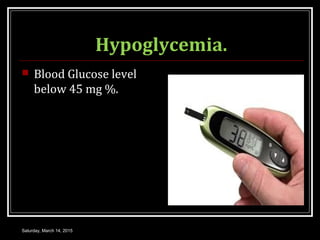
Hypoglycemia.
 Blood Glucose level
below 45 mg %.
Saturday, March 14, 2015
Types & causes of
Hypoglycemia.
 Hypoglycemia in non-
diabetics.
 Postprandial hypoglycemia.
(Reactive)
 Post-absorption or fasting
hypoglycemia. – insulin
secreting tumors leading to
hyperinsulinaemia.
 Hepatic failure.
 Due to alcohol intake. – due
to decreased
Gluconeogenesis.
 Hypoglycemia in
Diabetics.
 Overdose of anti-
diabetic drugs.
 No intake.
 Mismatch between
insulin & food habits.
 Alcohol intake.
Saturday, March 14, 2015
Hypoglycemia signs &
symptoms.
 CNS
 Neuroglycopenic symptoms –
tremors, hallucinations,
extreme nervousness,
convulsions, drowsiness.
 CVS
 Palpitation, tachycardia,
arrhythmias
 GIT – Nausea & vomiting.
 SKIN– sweating,
hypothermia.
Saturday, March 14, 2015
Thank
You

INSULIN

  • 1.
    DR NILESH KATE MBBS,MD ASSOCIATEPROF ESIC MEDICAL COLLEGE, GULBARGA. DEPT. OF PHYSIOLOGY INSULIN.
  • 2.
    OBJECTIVES  Endocrine Pancreas Structure & synthesis.  Secretion.  Regulation of secretion.  Plasma levels, circulation, degradation.  Mechanism of action.  Actions of insulin.  Applied aspects. Saturday, March 14, 2015
  • 3.
    Endocrine pancreas.  Functionalanatomy.  Islets of Langerhans. (1 million)  Cellular structure (2500)  Alpha (20%) – Glucagon  Beta (60-70%) – Insulin.  Delta (10%) – Somatostatin.  PP cells – Pancreatic peptide. Saturday, March 14, 2015
  • 4.
    Endocrine pancreas.  Gapjunctions – link between cells.  Vascular arrangements. – arteriole to capillaries to venules. Bath each cell with insulin for local effect.  Strategic location -- for local effect on exocrine part of pancreas. Saturday, March 14, 2015
  • 5.
    Insulin.  Firsts toits credits.  1st hormone to be isolated, purified, crystallized & synthesized.  1st protein to possess hormonal activity.  1st protein sequence for amino acids to determine the structure.  1st protein estimated by RIA (Radio Immuno Assay)  1st protein synthesized by Recombinant DNA technology. Saturday, March 14, 2015
  • 6.
    Structure  Protein (51AA)  2 polypeptide chain  A (21 AA)  B (30 AA)  Connected by interchain disulphide linkage to A7- B7,A20-B19, & A6-11.  IF 2 chains break apart functional activity lost. Saturday, March 14, 2015
  • 7.
  • 8.
  • 9.
  • 10.
    Mechanism of insulin secretion. By Glucagon.  By stimulator G protein via cyclic AMP.  By Somatostatin.  By inhibitor G protein via cyclic AMP.  By Acetylcholine.  By G protein linked Phospholipase C by producing  Phospahtidyl Inositol & Diacyl Glycerol. Saturday, March 14, 2015
  • 11.
    Regulation of secretion. Role of exogenous nutrients.  Role of gastrointestinal & other hormones.  Role of sympathetic & parasympathetic nervous system. Saturday, March 14, 2015
  • 12.
    Role of exogenousnutrients. Saturday, March 14, 2015
  • 13.
    ROLE OF BLOODGLUCOSE. EFFECT OF BSL ON INSULIN BIPHASIC INSULIN SECRETION Saturday, March 14, 2015
  • 14.
    Role of AminoAcids  Induces secretion of insulin, particularly after protein rich meal.  Most potent – Arginine & Lysine.  Moderate – Leucine, Alanine. Saturday, March 14, 2015
  • 15.
    Role of Gastrointestinal& other Hormones.  GIT Hormones – enhances  Other hormones – Growth hormone, cortisol, glucagon, progesterone & estrogen.  Burning out – Prolonged secretion of other hormone causes use of Islets of Langerhans leads to DM. Saturday, March 14, 2015
  • 16.
    Role of sympathetic& parasympathetic nervous system.  Sympathetic .  Rise in blood sugar level.  So insulin release decreased  Glucagon release increased.  Parasympathetic .  Insulin secretion increased. Saturday, March 14, 2015
  • 17.
    Plasma levels.  Basallevel – 10 μU/ml.  After meal –  Increases 3 -10 times.  After 30 -60 min.  Daily Secretion  0.5 -1.25 units/hr.  Peripheral delivery 30 units.  Without 1st pass metabolism secretion – 2.5 units/hr. Saturday, March 14, 2015
  • 18.
    Circulation & Degradation. Circulates unbound to any carrier protein.  Half life – 5-18 min.  Metabolic clearance rate – 1000 ml/min.  “Insulinase” -- Degrade , break disulphide chains Saturday, March 14, 2015
  • 19.
    Mechanism of action. Insulin receptors.(2-3 L)  Protein kinase receptors.  Structure.  Alpha (α) – outer surface.  Beta (β) – across plasma membrane, have tyrosine kinase domain. Saturday, March 14, 2015
  • 20.
    STEPS IN MECHANISMOF ACTION. Saturday, March 14, 2015
  • 21.
    STEPS IN MECHANISMOF ACTION. Saturday, March 14, 2015
  • 22.
    Actions of Insulin. Metabolic effect.  Ion transport.  Role in cell growth & development. Saturday, March 14, 2015
  • 23.
    Metabolic effect.  Carbohydrate metabolism.(Decreases bloodGlucose levels.)  Increase glucose uptake  Promote Glucose utilization. – Glycolysis & Glycogen formation.  Decrease Glucose production. – Gluconeogenesis & Glycogenolysis.  Insulin Dependent uptake – muscles, adipose tissue, WBC & mammary glands.  Insulin Independent – nervous tissue, kidney, RBC, retina, blood vessels, intestinal mucosa. Saturday, March 14, 2015
  • 24.
    Carbohydrate metabolism  Inliver.  Increase glucose uptake – by increasing Glucokinase.  Glycogen synthesis – by Glycogen synthase enzyme.  Glycolysis – by phosphofructokinase & pyruvate kinase.  Decrease Glycogenolysis & Gluconeogenesis.  In muscles.  Increase Glucose uptake (Glut -4)  Increase Glycolysis. (Pyruvate Dehydrogenase)  Increase Glycogen synthesis. (Glycogen synthase) Saturday, March 14, 2015
  • 25.
    Carbohydrate metabolism  InAdipose tissue.  Increase Glucose uptake (translocating Glut-4)  Storage as Triglycerides.  Converted to FA. Saturday, March 14, 2015
  • 26.
    Lipid metabolism  IncreasesLipogenesis.  Decrease Lypolysis.  Reducing ketogenesis. Saturday, March 14, 2015
  • 27.
    Protein metabolism.  Stimulateprotein synthesis.  By increasing transport into cell.  Translation of messenger RNA.  Transcription.  Inhibit protein degradation.  Inhibit proteolysis. Saturday, March 14, 2015
  • 28.
    Ion transport.  Increases. K,PO4,Mg uptake  So insulin effect causes – Hypokalemia, Saturday, March 14, 2015
  • 29.
    Role in cellgrowth & development.  Anabolic action.  Direct stimulatory effect on macromolecules. – cartilage & bone  Stimulation of other growth factors. – Somatomedins (IGF 1&2), Epidermal growth factor (EGF), Nerve growth factor (NGF), Relaxin. Saturday, March 14, 2015
  • 30.
    Applied aspects.  Diabetesmellitus.  Hypoglycemia. Saturday, March 14, 2015
  • 31.
    Diabetes mellitus.  Diabetes– A clinical syndrome of hyperglycemia due to deficiency of Insulin. Saturday, March 14, 2015 TYPES . PRIMARY DM – cause not known. IDDM NIDDM SECONDARY DM – due to Pathological conditions, pancreatitis, cystic fibrosis, Acromegaly, Cushing syndrome etc. STAGES. •PRE-DIABETICS or Potential diabetics. – Genetic predisposition. •Latent diabetics or chemical diabetics – normal F& PP BSL but increased after stress. • Clinical diabetics – C/F without complications. • Complicated diabetics.
  • 32.
    IDDM & NIDDM. FEATURESIDDM NIDDM DEFECT β cell destruction.– insulin def. Resistance of target tissue. Prevalence 10-20 % 80-90% Age of onset < 40 yrs > 40 yrs. Body wt Low High Gene focus Chromosome 6 Chromosome 1 Family history Mild/moderate Strong. Acute complication Ketoacidosis Hyperosmolar coma. Plasma insulin Decreased or absent Normal Ketonuria Present Absent Treatment Insulin Oral hypoglymic. Mortality High Low. Saturday, March 14, 2015
  • 33.
    Pathophysiology of DM. Hyperglycemia. –  Due to decreased peripheral utilization.  Increased hepatic output of glucose.  Hypertriglyceridaemia, ketosis .  Less utilization turns it to FFA  Excess FFA leads to formation of TG & Ketoacidosis.  Protein catabolism.  Insulin --- Anabolic hormone.  Promote protein synthesis & inhibit proteolysis. Saturday, March 14, 2015
  • 34.
    Hyperglycemia.  Glycosuria. – Glucose in urine above 180 mg/100ml.  Polyuria (osmotic diuresis), loss of electrolyte, cellular dehydration, polydipsia, increased caloric loss, Polyphagia, loss of body weight.  Impaired Phagocytic function.  Hyperosmolar effect. (above 375 mOsm/kg)  Glycosylation of proteins.  Hemoglobin (HbA1c )  Tissue proteins – Diabetic Nephropathy, D. Neuropathy, D. Retinopathy. Saturday, March 14, 2015
  • 35.
    Hypertriglyceridaemia, Ketosis .  Hypertriglyceridaemia –glucose converted to FFA  FFA to TG.  Increase secretion of VLDL & chylomicrons.  Leads to Hypercholesterolemia.  Ketosis .  Cellular dehydration.  Ketoacidosis.  Dyspnoea, Kussmaul breathing.  Breath acetone smell.  Electrolyte loss  Hypovolaemia & hypotension.  Coma & death Saturday, March 14, 2015
  • 36.
    Protein catabolism.  Proteincatabolism increased & anabolism suppressed.  Protein depletion.  Muscle wasting.  Negative nitrogen balance.  Released large amount of amino acids  Used for energy production.  Substrate for enhanced gluconeogenesis. Saturday, March 14, 2015
  • 37.
    Clinical features  Cardinalsymptoms – Polyuria, Polyphagia, polydipsia, wt loss.  Biochemical – Hyperglycemia, Glycosuria, ketosis, ketonuria, Ketoacidosis. Saturday, March 14, 2015
  • 38.
    Complications.  Predisposition to infection.– Phagocytic function, protein depletion  Acute complication – ketotic coma, Non-ketotic Hyperosmolar coma.  Chronic complication.– atherosclerosis., Hyperlipidemia, hypercholesterolemia,  Microangiopathy – D. retinopathy, nephropathy, neuropathy. Saturday, March 14, 2015
  • 39.
    Diagnosis.  Urine examinationfor Glycosuria. – exclude renal Glycosuria.  Urine examination for ketone bodies. – other causes starvation, fasting, high fat diet, repeated vomiting.  Blood glucose levels – fasting (70-120 mg%) & postprandial (120-180mg%)  Glucose tolerance tests (GTT) Saturday, March 14, 2015
  • 40.
    Glucose tolerance tests (GTT) Prior test normal carbohydrate diet for 3 days.  Early morning fasting BSL & urine taken.  75 mg glucose dissolve in 300 ml of water given orally.  BSL & urine tested ½ hrly for next 3 hrs. Plasma glucose conc. (mg%) NORMAL IMPAIRED GLUCOSE TOLERAAN CE DM Fasting level. < 110 110- 126 ≥ 126. Peak post prandi al level. < 140 >140-< 200 ≥ 200 Saturday, March 14, 2015
  • 41.
    Management of Diabetes Mellitus. Goals of therapy.  Maintain blood glucose to normal.  Maintain ideal body weight.  Symptoms free.  Retard or prevent complications.  Treatment modalities.  Dietary management.  Oral hypoglycemic agents.  Insulin along with dietary management. Saturday, March 14, 2015
  • 42.
    Treatment modalities.  Dietarymanagement.  Low energy wt reducing diet (for obese NIDDM)  Wt maintenance diet (Non obese NIDDM)  Frequent small meals.  Oral hypoglycemic agents.  Sulphonylurea  Biguanides.  Insulin along with dietary management.  For IDDM.  For new Ketoacidosis.  Emergencies with IDDM & NIDDM. Saturday, March 14, 2015
  • 43.
    Hypoglycemia.  Blood Glucoselevel below 45 mg %. Saturday, March 14, 2015
  • 44.
    Types & causesof Hypoglycemia.  Hypoglycemia in non- diabetics.  Postprandial hypoglycemia. (Reactive)  Post-absorption or fasting hypoglycemia. – insulin secreting tumors leading to hyperinsulinaemia.  Hepatic failure.  Due to alcohol intake. – due to decreased Gluconeogenesis.  Hypoglycemia in Diabetics.  Overdose of anti- diabetic drugs.  No intake.  Mismatch between insulin & food habits.  Alcohol intake. Saturday, March 14, 2015
  • 45.
    Hypoglycemia signs & symptoms. CNS  Neuroglycopenic symptoms – tremors, hallucinations, extreme nervousness, convulsions, drowsiness.  CVS  Palpitation, tachycardia, arrhythmias  GIT – Nausea & vomiting.  SKIN– sweating, hypothermia. Saturday, March 14, 2015
  • 46.