DR. NILESH KATE (M.D.)DR. NILESH KATE (M.D.)
ASSOCIATE PROFESSORASSOCIATE PROFESSOR
ESIC MEDICAL COLLEGE, GULBARGA.ESIC MEDICAL COLLEGE, GULBARGA.
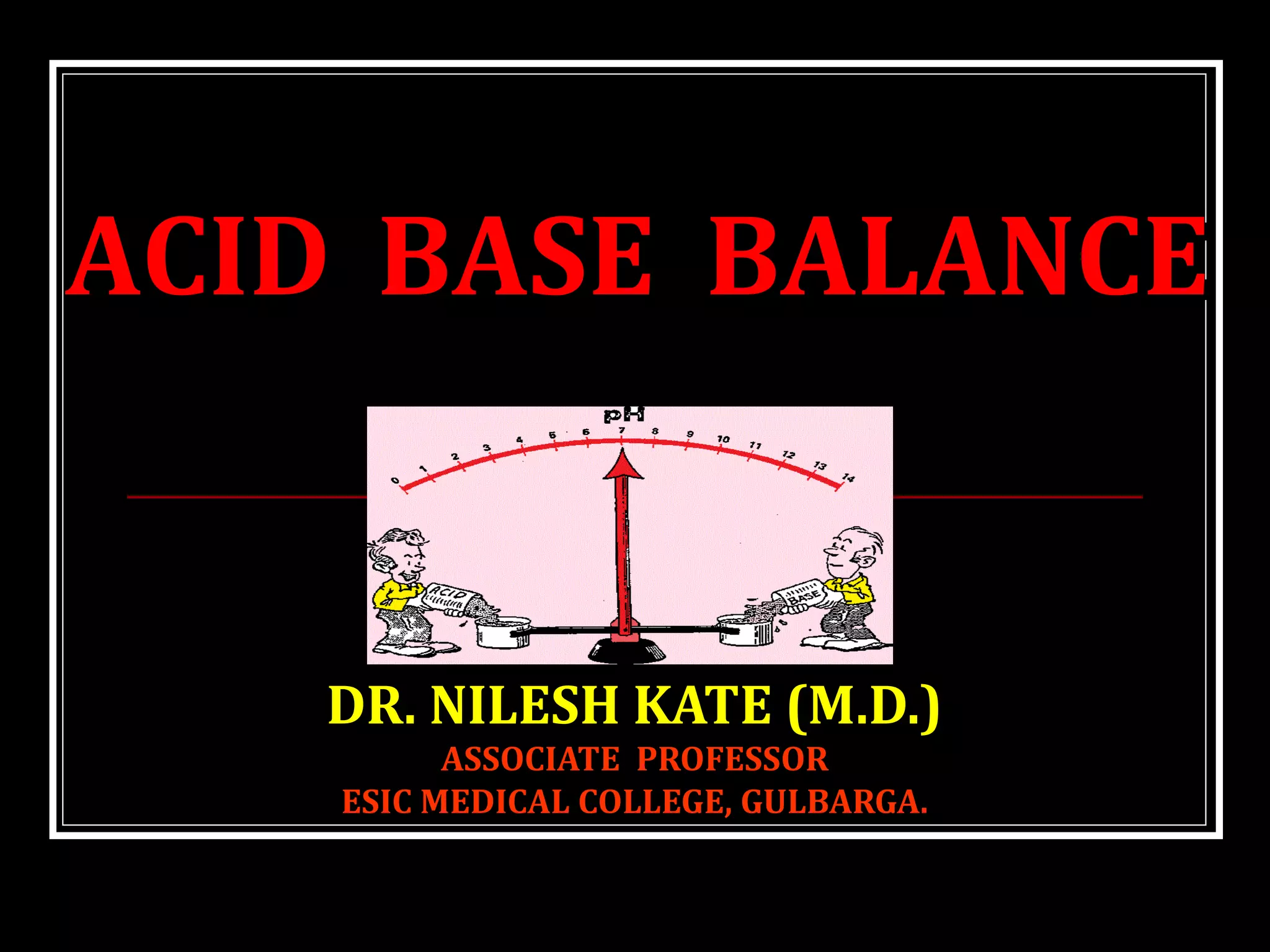
ACIDACID BASEBASE BALANCEBALANCE
Objectives.
 Concept of Acid & base.
 pH and H ion concentration.
 Handerson-Hasselbalch equation.
 Mechanisms to maintain acid base balance.
 Applied aspects.
Saturday, April 18, 2015
ACIDS
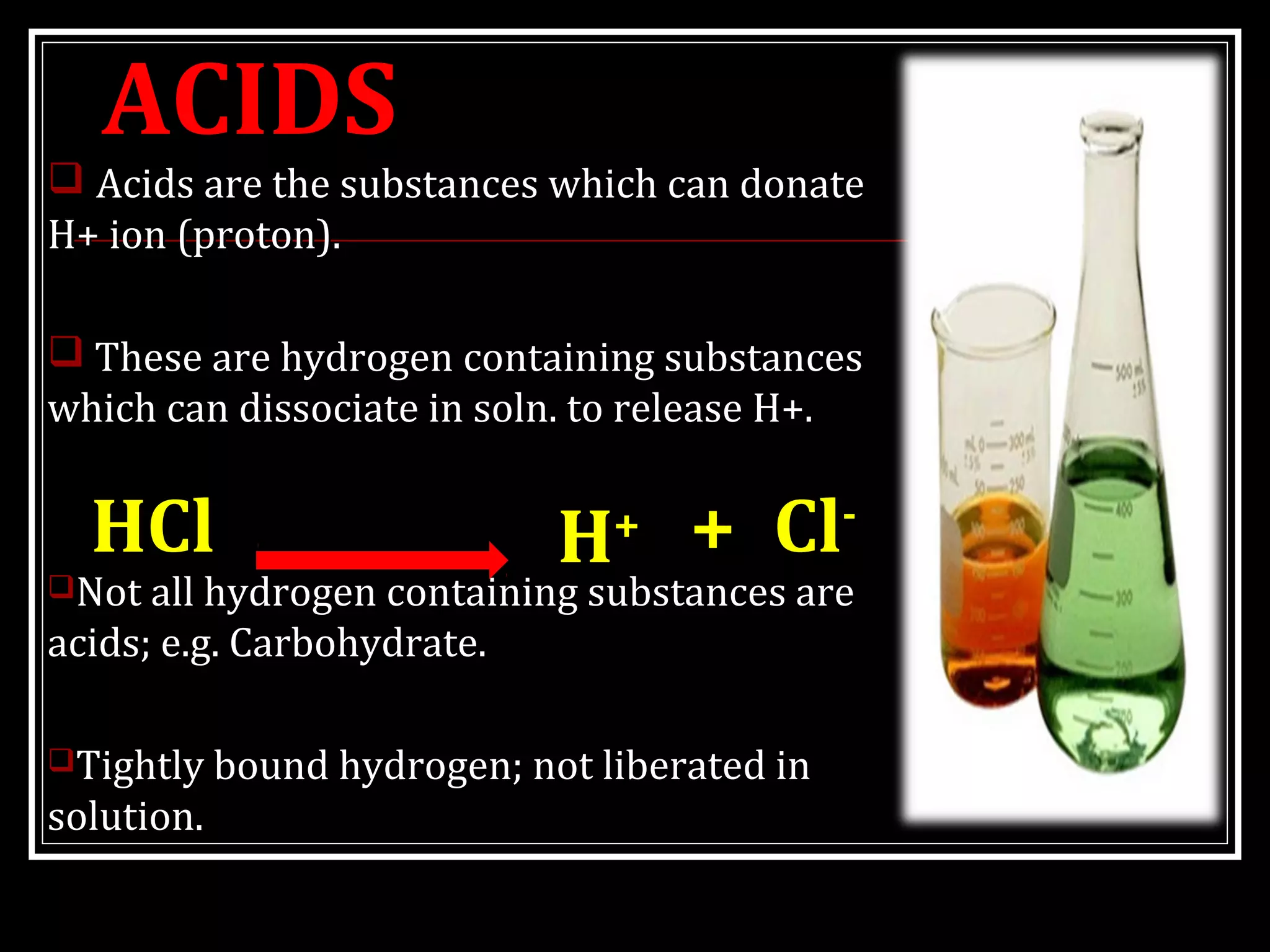
 Acids are the substances which can donateAcids are the substances which can donate
H+ ion (proton).H+ ion (proton).
 These are hydrogen containing substancesThese are hydrogen containing substances
which can dissociate in soln. to release H+.which can dissociate in soln. to release H+.
Not all hydrogen containing substances areNot all hydrogen containing substances are
acids; e.g. Carbohydrate.acids; e.g. Carbohydrate.
Tightly bound hydrogen; not liberated inTightly bound hydrogen; not liberated in
solution.solution.
HClHCl HH++ ++ ClCl--
ACIDSACIDS
 Types of acids in the body:Types of acids in the body:
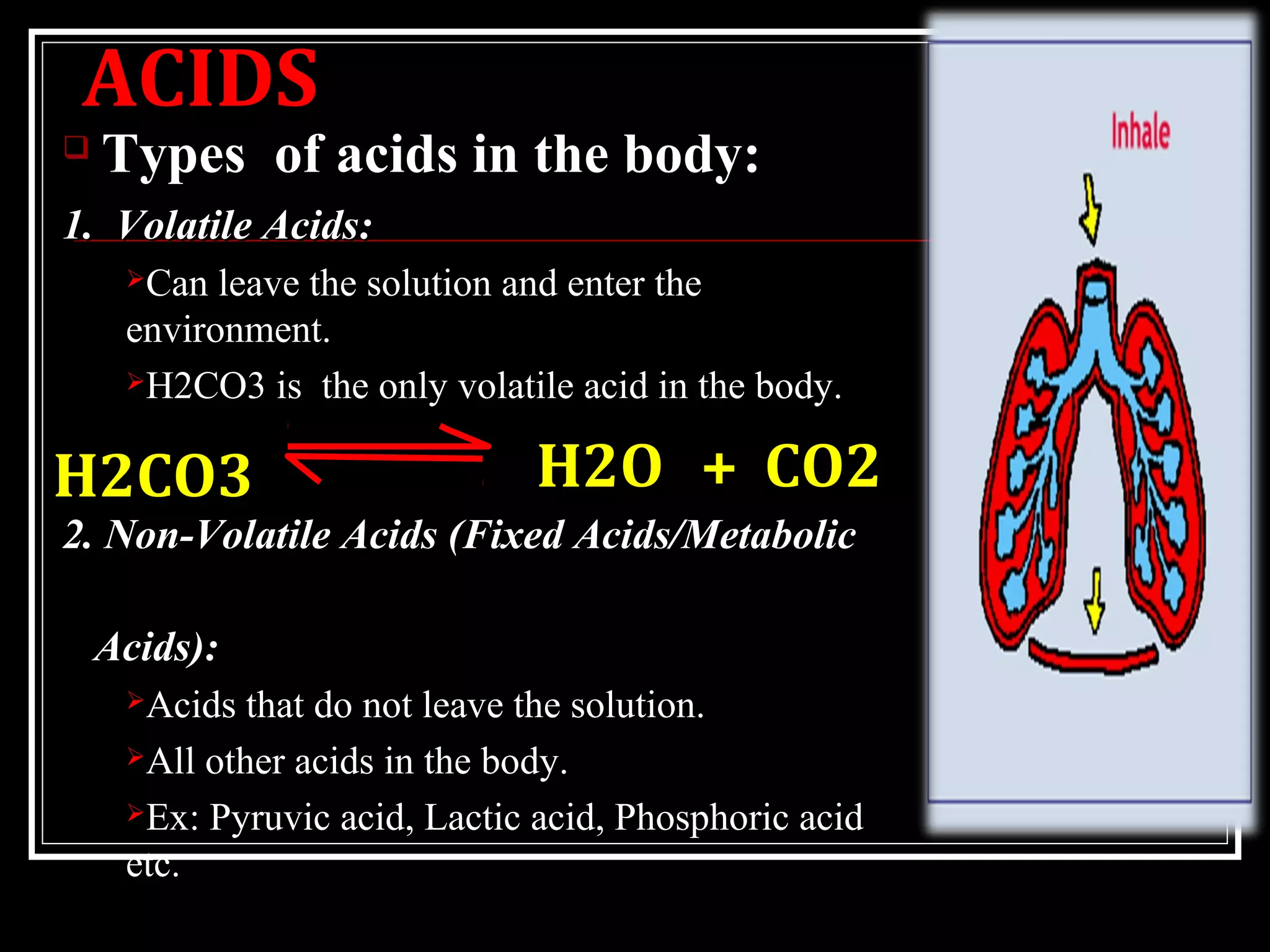
1. Volatile Acids:1. Volatile Acids:
Can leave the solution and enter the
environment.
H2CO3 is the only volatile acid in the body.
2. Non-Volatile Acids (Fixed Acids/Metabolic2. Non-Volatile Acids (Fixed Acids/Metabolic
Acids):Acids):
Acids that do not leave the solution.
All other acids in the body.
Ex: Pyruvic acid, Lactic acid, Phosphoric acid
etc.
H2CO3H2CO3 H2OH2O ++ CO2CO2
ACIDS
 Physiologically important acids:Physiologically important acids:
Carbonic acid (HCarbonic acid (H22COCO33))
Phosphoric acid (HPhosphoric acid (H33POPO44))
Pyruvic acid (CPyruvic acid (C33HH44OO33))
Lactic acid (CLactic acid (C33HH66OO33))
 These acids are products of variousThese acids are products of various
metabolisms in the body.metabolisms in the body.
 Dissolved in body fluids.Dissolved in body fluids.
BASE

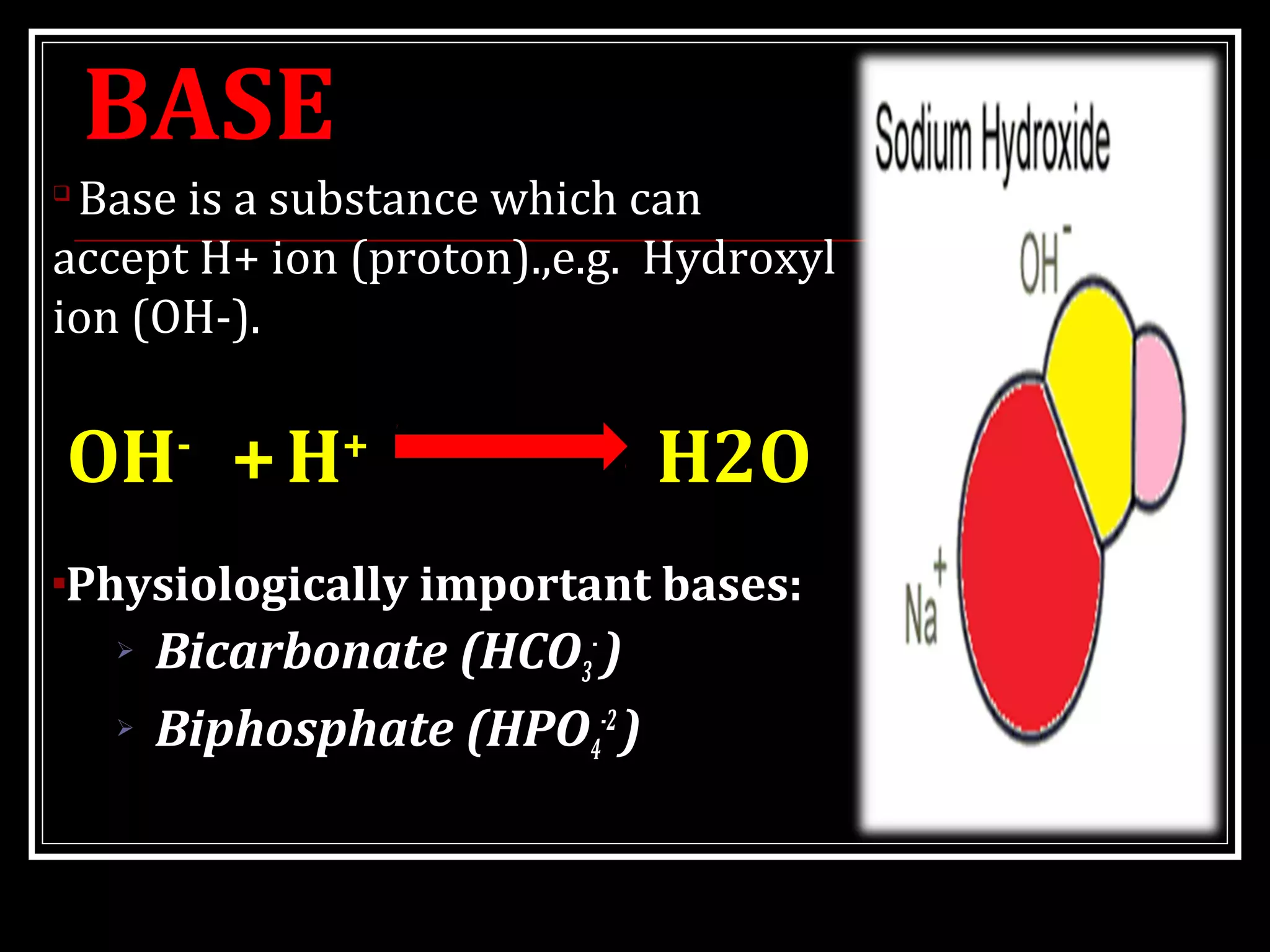
Base is a substance which can
accept H+ ion (proton).,e.g. Hydroxyl
ion (OH-).
■
Physiologically important bases:
➢ Bicarbonate (HCO3
-
)
➢ Biphosphate (HPO4
-2
)
OHOH--
++ HH++
H2OH2O
Alkali
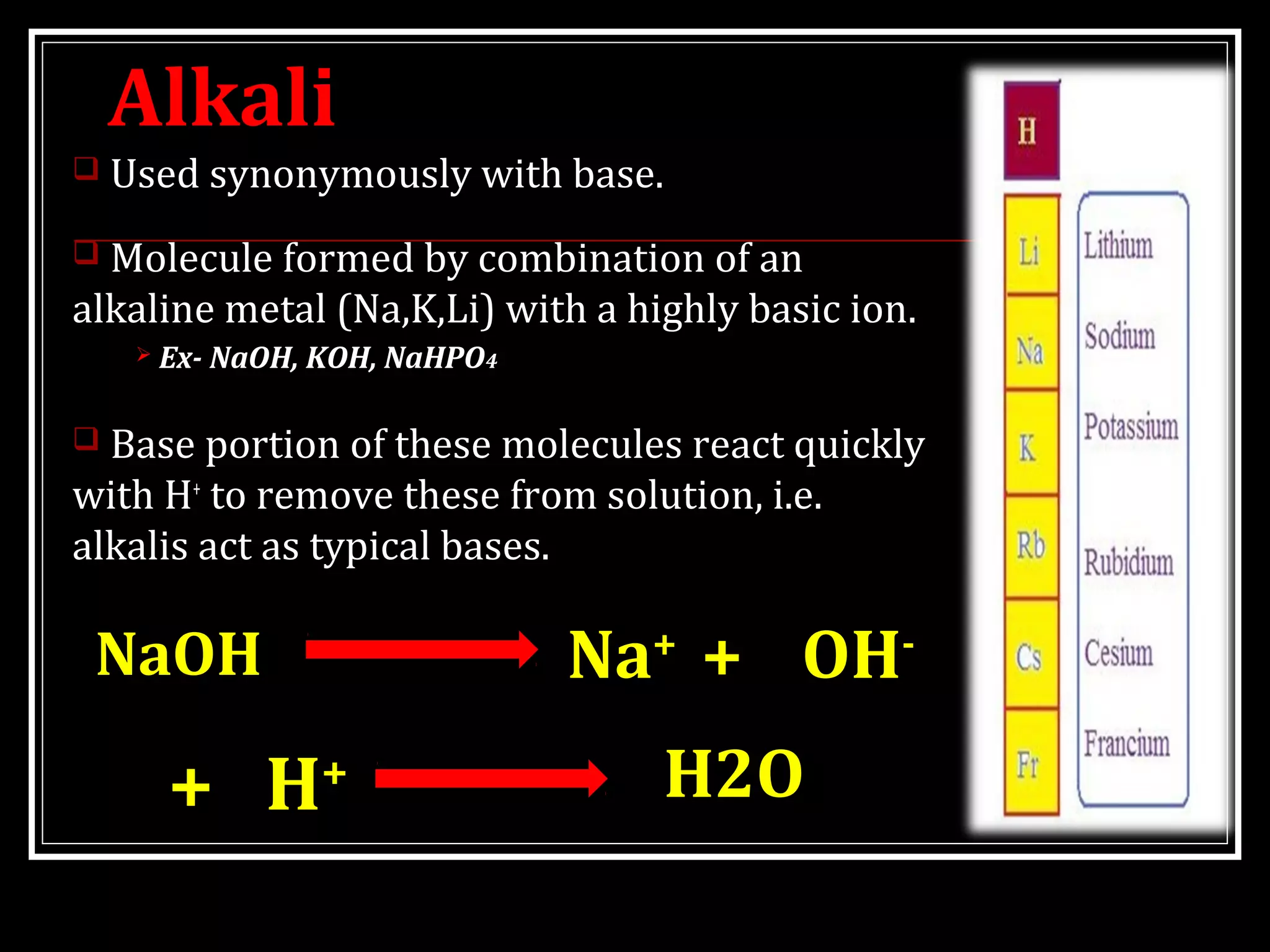
 Used synonymously with base.
 Molecule formed by combination of an
alkaline metal (Na,K,Li) with a highly basic ion.
 Ex- NaOH, KOH, NaHPO4
 Base portion of these molecules react quickly
with H+
to remove these from solution, i.e.
alkalis act as typical bases.
NaOHNaOH NaNa++
++ OHOH--
+ H+ H++ H2OH2O
Acids & Bases can be classified as strong or weak
acid/base
 Strong acid/base:Strong acid/base:
 One that dissociates completely in a solution.
 Ex: HCl, H2SO4, NaOH
 Weak acid/base:Weak acid/base:
 One that dissociates partially in a solution.
 Ex: H2CO3,
HClHCl HH++
++ ClCl--
NaOHNaOH NaNa++
++ OHOH--
H2CO3H2CO3 HH++ ++ HCO3-HCO3-
PH SCALEPH SCALE
 HH++
concentration in extracellular fluid (ECF)concentration in extracellular fluid (ECF)
 Normal blood pH is 7.35 - 7.457.35 - 7.45
 pH range compatible with life is 6.8 - 8.06.8 - 8.0
4 X 10 -8
(0.00000004)
pH = log 1 / HH++
concentration
pH = log 1 / HH++
concentration
pH = log 1/ 4 X 10 -8
pH = 7.2
PH SCALEPH SCALE
pH = - log [HpH = - log [H++
]]
pH = log 1/ [HpH = log 1/ [H++
]]
 pH is inversely related to HpH is inversely related to H++
concentration.concentration.
low pH – indicates high Hlow pH – indicates high H++
concentration.concentration.
high pH – indicates low Hhigh pH – indicates low H++
concentration.concentration.
pH = 4 has 10 times more free HpH = 4 has 10 times more free H++
concentrationconcentration
than pH = 5 and 100 times more free Hthan pH = 5 and 100 times more free H++
concentration than pH = 6concentration than pH = 6
pH range from 1-14.pH range from 1-14.
pH < 7 – AcidicpH < 7 – Acidic
pH > 7 – BasicpH > 7 – Basic
pH = 7 - NeutralpH = 7 - Neutral
PH of the ECF is regulated very precisely
ACIDOSIS ALKALOSISNORMAL
DEATH DEATH
Venous
Blood
Arterial
Blood
7.3 7.57.46.8 8.0
12
EFFECTS OF pH changeEFFECTS OF pH change
 pH changes have dramatic effects on normal cell
function
 1)1) Changes in excitability of nerve and muscle
cells
 2)2) Influences enzyme activity
 3)3) Influences KK++
levels
13
Changes in cell excitabilityChanges in cell excitability
 pH decrease (more acidic) depresses the central
nervous system
 Can lead to loss of consciousness
 pH increase (more basic) can cause over-excitability
 Tingling sensations, nervousness, muscle twitches
pH
pH
Excitability
Excitability
14
Influences on enzyme activityInfluences on enzyme activity
 pH increases or decreases can alter the shape
of the enzyme rendering it non-functional
 Changes in enzyme structure can result in
accelerated or depressed metabolic actions
within the cell
INFLUENCES ON KINFLUENCES ON K++
LEVELSLEVELS
 In kidney Na+
is absorbed
in tubules in exchange of
K+
or H+
(K+
> H+
).
 In acidosis more H+
is
secreted thus preserving
the K+
, causing
hyperkalemia.
15
ACID BASE BALANCEACID BASE BALANCE
 Maintenance of the pH of body fluids at a level that
allow optimal function.
 pH maintenance means maintaining [H[H++
].].
 This involves two important ions which are regulated byThis involves two important ions which are regulated by
various chemical & physiological process:various chemical & physiological process:
H+
HCO3
-
17
■
Chemical processes:Chemical processes:
■
The first line of defence to an acid or base load.
■
Include the extracellular and intracellularextracellular and intracellular
buffers.buffers.
■
Physiologic processes:Physiologic processes:
■
1. Changes in cellular metabolism.
2. Excretion of volatile acids by the lungslungs
3. Excretion of fixed acids by the kidneyskidneys
ACID BASE BALANCEACID BASE BALANCE
18
■
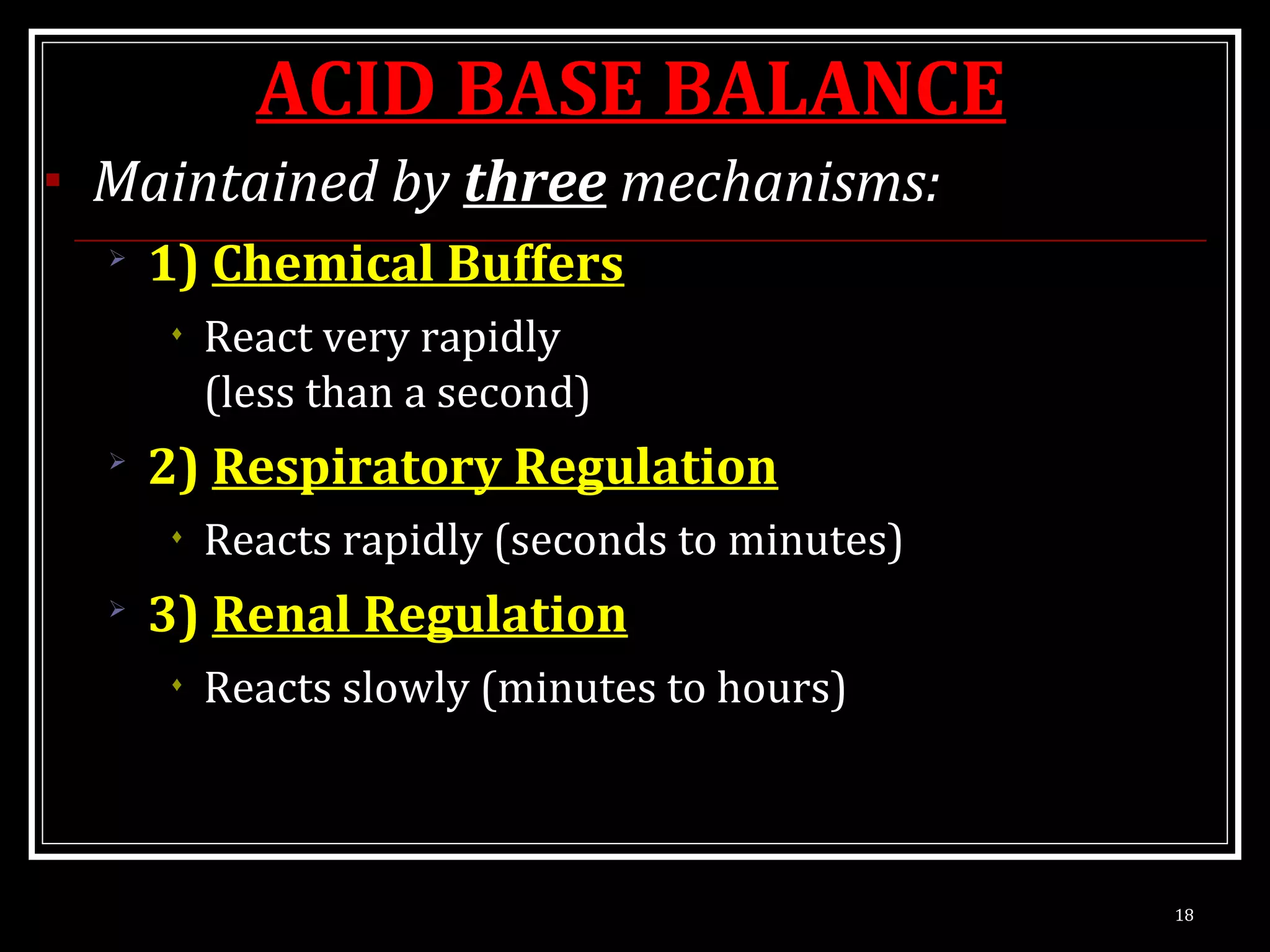
Maintained byMaintained by threethree mechanisms:mechanisms:
➢
1)1) Chemical BuffersChemical Buffers
♦
React very rapidlyReact very rapidly
(less than a second)(less than a second)
➢
2)2) Respiratory RegulationRespiratory Regulation
♦
Reacts rapidly (seconds to minutes)Reacts rapidly (seconds to minutes)
➢
3)3) Renal RegulationRenal Regulation
♦
Reacts slowly (minutes to hours)Reacts slowly (minutes to hours)
ACID BASE BALANCEACID BASE BALANCE
19
1)1) Buffer SystemsBuffer Systems
2) Respiratory Responses
3) Renal Responses
4) Intracellular Shifts of Ions
Buffers.
 Is a solution of weak acid & its salt with a
strong base that prevent change in pH when H+
ions are added or removed from the solution.
 Most effective within 1 pH unit of the pK of the
buffer.
 Depend on absolute concentration of salt &
acid.
Saturday, April 18, 2015
REMEMBER…….
 Buffer cannot remove H+ ions from the body
temporarily reduce free H+ ions
 H+ ions have to be ultimately removed by the
renal mechanism.
Saturday, April 18, 2015
Henderson-Hasselbalch
equation
 HA H+ + A-
 When acid is added, --- H+ ion conc
increases, reaction forced towards right
leads to increase in un dissociated molecules.
 When base is added ---- reaction shift
towards left, more H+ ion released from
buffer to combine with base.
Saturday, April 18, 2015
Most Effective Buffer.
 Henderson-Hasselbalch equation.
 HA H+
+ A-
 By the law of mass action, at equilibrium
K = [H+][A-]/ [HA]
----------- K= Dissociation constant of acid.
Saturday, April 18, 2015
Henderson- Hasselbalch
equation.
 [H+] = K [HA]/[A-]
 pH = log 1/ [H+]
 Log 1/[H+] = log 1/K +log [A-]/[HA]
 pH = pK + log [A-]/[HA]
 Thus pH= pK
 Thus most effective buffers in the body are those with pK
close to the pH in which they operate.
from this equation it is seen that buffering capacity of
buffer system is greatest when amount of anion[A-] and
undissociated acid [HA] is same.
Saturday, April 18, 2015
25
BICARBONATE BUFFER SYSTEM
 Predominates in extracellular fluid (ECF)
HCO3
-
+ added H+
H2CO3
H+
HCOHCO33
--
HH22COCO33
26
BICARBONATE BUFFER SYSTEMBICARBONATE BUFFER SYSTEM
 Hydrogen ions generated by metabolism or by
ingestion react with bicarbonate base to form more
carbonic acid.
HCO3
-
+ H+
H2CO3
HCOHCO33
--
HH22COCO33
27
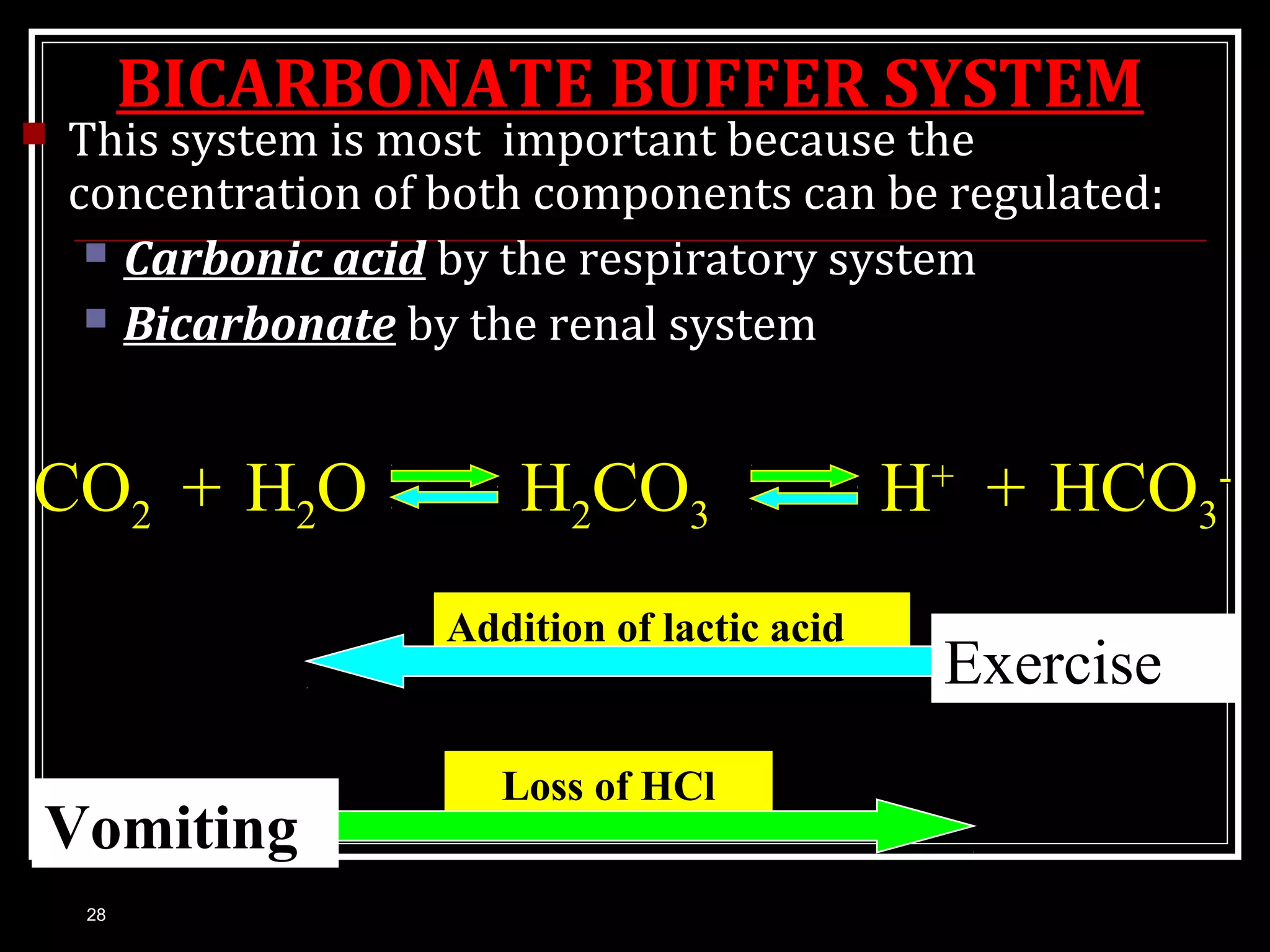
BICARBONATE BUFFER SYSTEM
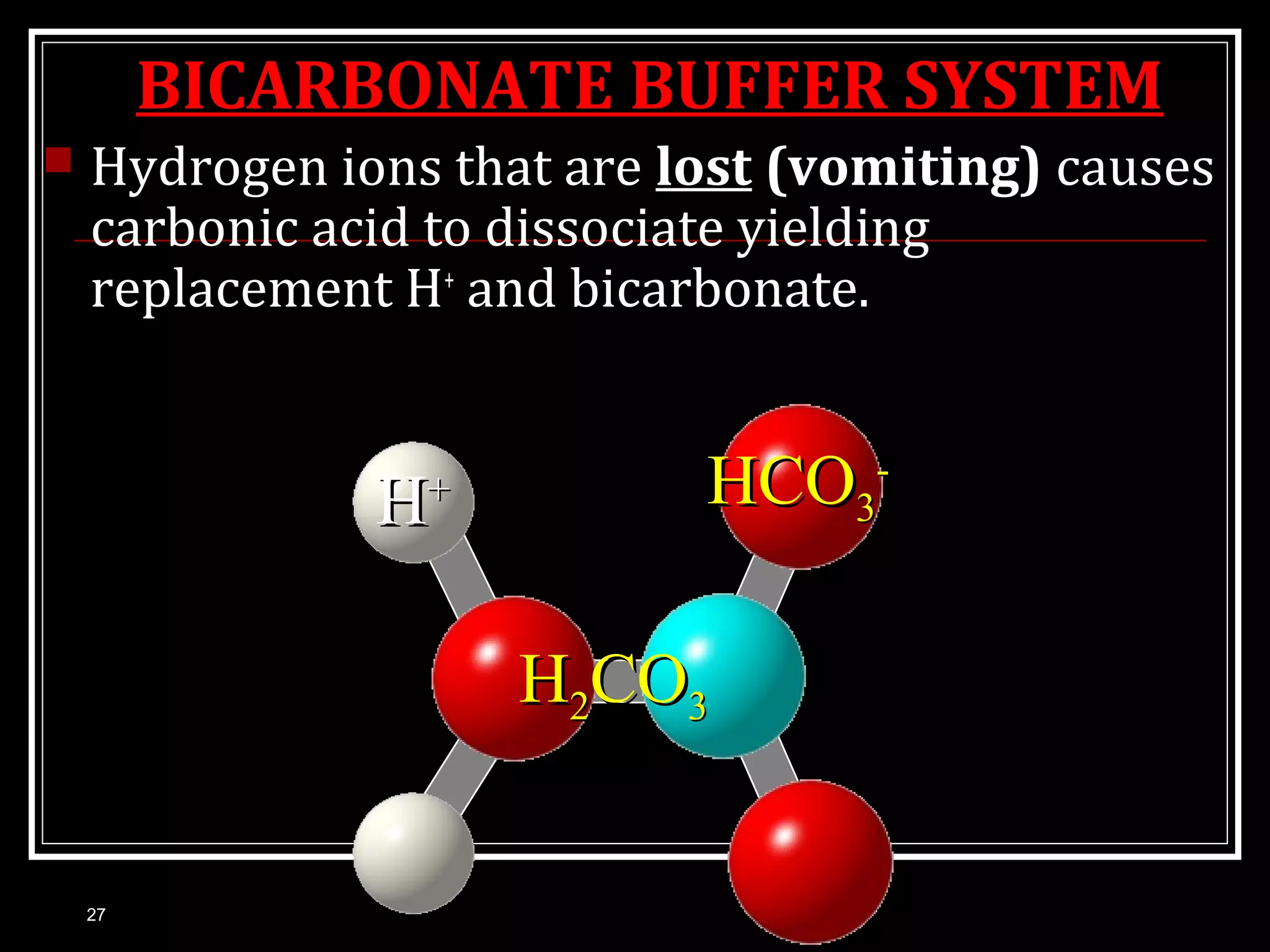
 Hydrogen ions that are lost (vomiting) causes
carbonic acid to dissociate yielding
replacement H+
and bicarbonate.
HH++ HCOHCO33
--
HH22COCO33
28
BICARBONATE BUFFER SYSTEMBICARBONATE BUFFER SYSTEM
 This system is most important because the
concentration of both components can be regulated:
 Carbonic acidCarbonic acid by the respiratory system
 BicarbonateBicarbonate by the renal system
Loss of HCl
Addition of lactic acid
HH++
HCOHCO33
--
HH22COCO33HH22OOCOCO22 + ++
Exercise
Vomiting
29
 Most important in the intracellular system
Na2HPO4+ H+
NaH2PO4+ Na+
PHOSPHATE BUFFER SYSTEM
H+
Na2HPO4+
NaH2PO4
Na++
30
PROTEIN BUFFER SYSTEMPROTEIN BUFFER SYSTEM
 Most important intracellular buffer.Most important intracellular buffer.
 The most abundant buffer of the body.The most abundant buffer of the body.
 Behaves as a buffer in both plasma and cellsBehaves as a buffer in both plasma and cells
 Hemoglobin is by far the most importantHemoglobin is by far the most important
protein buffer.protein buffer.
31
PROTEIN BUFFER SYSTEM
-
-
-
- - - -
-
-
-
-
-
-
--------
-
---
-
-
-
-
- - - -
+
+
++
+
+
+
+
+
+
+
+
+
++ +
+
+
+
+
+
+
+ +
+
OH-
OH-
OH-
OH-
OH-
OH-
OH-
OH-
OH-
OH-
OH-
OH-
H+
H+
H+
H+ H+ H+ H+ H+ H+ H+
H+
H+
H+
H+
H+H+
H+
H+
H+
H+
H+
32
PROTEIN BUFFER SYSTEM
 H+
generated at the tissue level from the dissociation
of H2CO3 produced by the addition of CO2.
 Bound H+
to Hb (Hemoglobin) does not contribute to
the acidity of blood.
HbHb
O2
O2 O2
O2
33
PROTEIN BUFFER SYSTEM
 AsAs HH++
HbHb picks uppicks up OO22 from the lungs thefrom the lungs the HbHb which has awhich has a
higher affinity forhigher affinity for OO22 releasesreleases HH++
and picks upand picks up OO22
 LiberatedLiberated HH++
fromfrom HH22OO combines withcombines with HCOHCO33
--
HCOHCO33
--
HH22COCO33 COCO22 (exhaled)
HbHb
O2
O2 O2
H+
34
1) Buffer Systems
2) Respiratory Responses2) Respiratory Responses
3) Renal Responses
4) Intracellular Shifts of Ions
RESPIRATORY REGULATION
 CO2 +H2O H2CO3 H+ + HCO3
 Respiratory regulation is by increasing or decreasing
the exhalation of CO2 from the body.
 Hyperventilation in response to increased
CO2 or H+
(low pH)
 Hypoventilation in response to decreased
CO2 or H+
(high pH)
36
 Respiratory center in brain is able to detect
blood concentration levels of CO2 and H+
 Increases in CO2 and H+
stimulate the
respiratory center  RR↑
 But the effect
diminishes in
1 - 2 minutes
CO2
CO
CO2
CO2
CO2
CO2
CO2
CO2
RESPIRATORY REGULATION
37
1) Buffer Systems
2) Respiratory Responses
3) Renal Responses3) Renal Responses
4) Intracellular Shifts of Ions
38
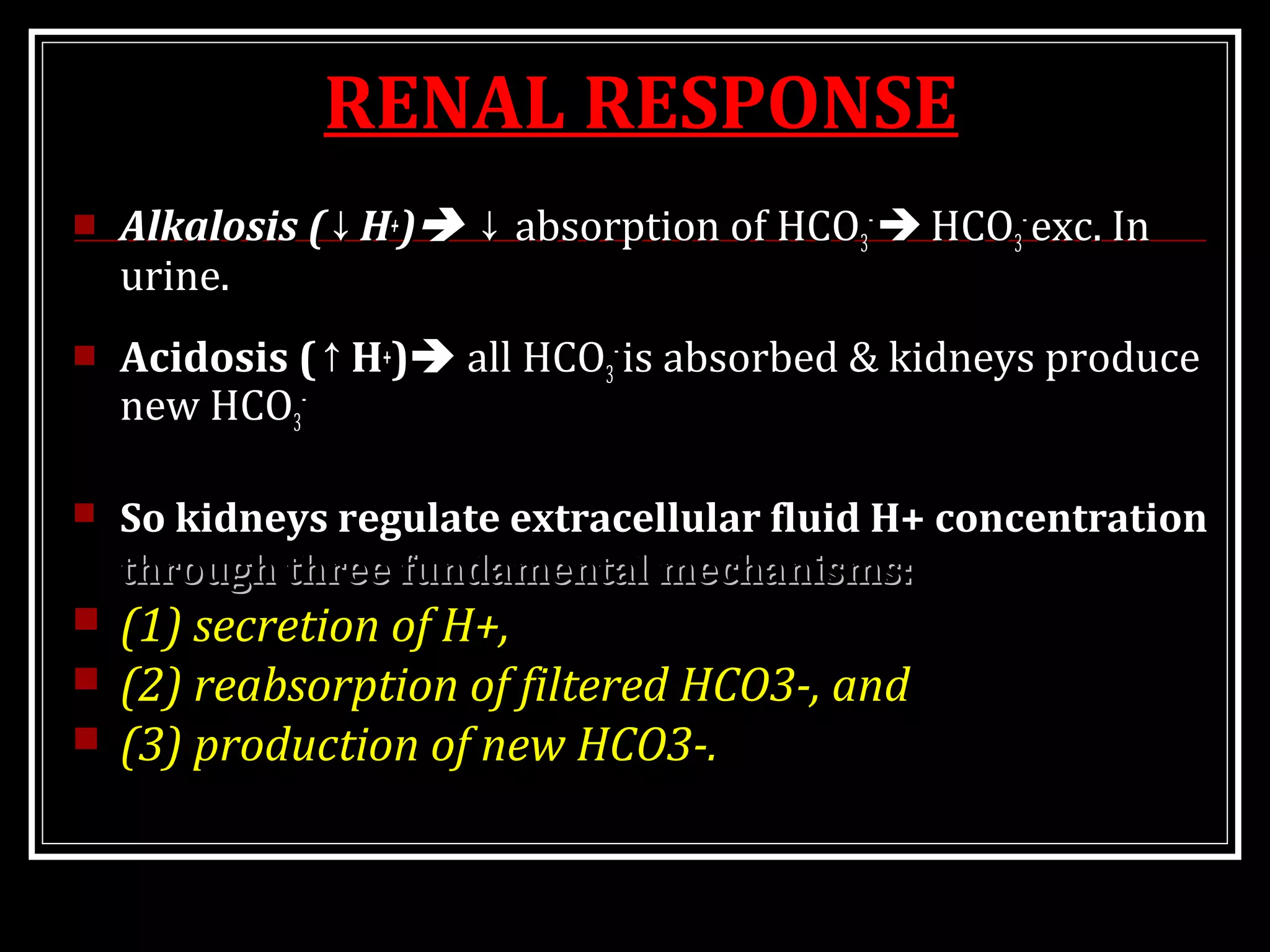
RENAL RESPONSERENAL RESPONSE
 The kidney compensates for Acid - Base imbalance
within 24 hours and is responsible for long term
control.
 The kidney in response:The kidney in response:
 To AcidosisTo Acidosis
 Retains bicarbonate ions and eliminates
hydrogen ions. Produce new bicarbonate.
 To AlkalosisTo Alkalosis
 Eliminates bicarbonate ions and retains
hydrogen ions.
RENAL RESPONSERENAL RESPONSE
 Large amount of HCO3
-
filtered & H+ secreted by
kidneys.
 Almost all (99%) HCO3
-
is absorbed by
combining it with H+.
 H+ secreted = H+ needed to absorb all HCO3
-
+ excess H+
formed in body.
 If filtered HCOfiltered HCO33
--
> secreted H> secreted H++  net loss of base
from blood.
 If filtered HCOfiltered HCO33
--
< secreted H< secreted H++  net loss of acid
from blood.
 Alkalosis ( H↓Alkalosis ( H↓ ++)) absorption of HCO↓ absorption of HCO↓ 33
--
 HCOHCO33
--
exc. Inexc. In
urine.urine.
 Acidosis ( H↑Acidosis ( H↑ ++)) all HCOall HCO33
--
is absorbed & kidneys produceis absorbed & kidneys produce
new HCOnew HCO33
--
 So kidneys regulate extracellular fluid H+ concentrationSo kidneys regulate extracellular fluid H+ concentration
through three fundamental mechanisms:through three fundamental mechanisms:
 (1) secretion of H+,(1) secretion of H+,
 (2) reabsorption of filtered HCO3-, and(2) reabsorption of filtered HCO3-, and
 (3) production of new HCO3-.(3) production of new HCO3-.
RENAL RESPONSERENAL RESPONSE
 Secretion of H+ occurs in all segments of
nephron.
 Secreted H+ is buffered with :Secreted H+ is buffered with :
 HCO3
-
in proximal segments  resulting in
absorption of HCO3-
 Na2HPO4 & NH3 in distal segments  resulting in
production of new HCO3-
RENAL RESPONSERENAL RESPONSE
HCO3- absorption in proximal segment
Production of new HCO3- by phosphate buffer
in distal tubule
Combination of H+ with Ammonia buffer
Combination of H+ with Ammonia in
collecting tubules
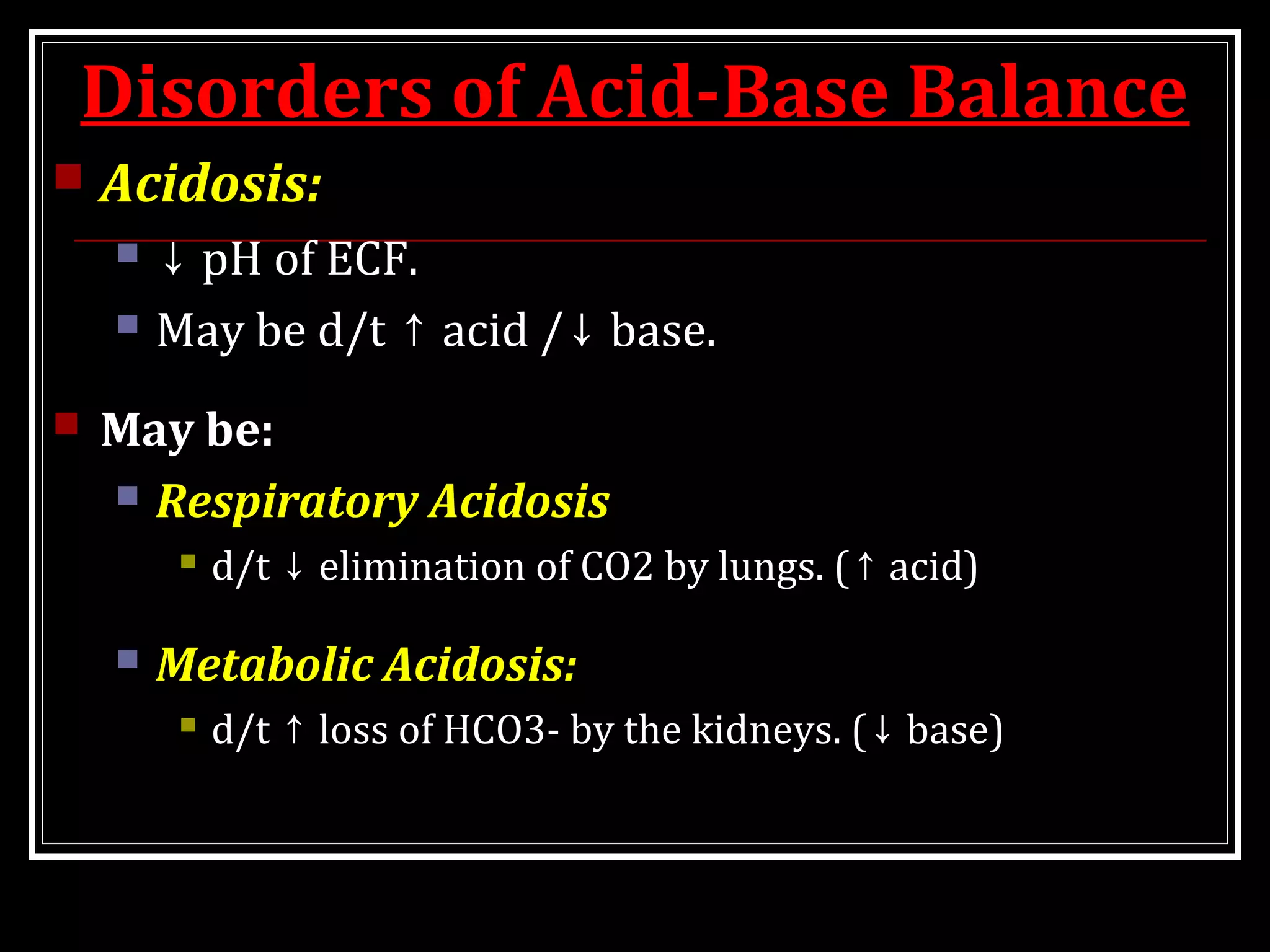
Disorders of Acid-Base Balance
 Acidosis:Acidosis:
 ↓↓ pH of ECF.pH of ECF.
 May be d/t acid / base.↑ ↓May be d/t acid / base.↑ ↓
 May be:May be:
 Respiratory AcidosisRespiratory Acidosis

d/t elimination of CO2 by lungs. ( acid)↓ ↑d/t elimination of CO2 by lungs. ( acid)↓ ↑
 Metabolic Acidosis:Metabolic Acidosis:

d/t loss of HCO3- by the kidneys. ( base)↑ ↓d/t loss of HCO3- by the kidneys. ( base)↑ ↓
47
ACIDOSIS
decreased
removal of
CO2 from
lungs
failure of
kidneys to
excrete
acids
metabolic
acid
production
of keto acids
absorption of
metabolic acids
from GI tract
prolonged
diarrhea
accumulation
of CO2 in blood
accumulation
of acid in blood
excessive loss
of NaHCO3
from blood
metabolic
acidosis
deep
vomiting
from
GI tract
kidney
disease
(uremia)
increase in
plasma H+
concentration
depression of
nervous system
accumulation
of CO2 in blood
accumulation
of acid in blood
excessive loss
of NaHCO3
from blood
respiratory
acidosis
Disorders of Acid-Base BalanceDisorders of Acid-Base Balance
 Alkalosis:
 ↑↑ pH of ECF.pH of ECF.
 May be d/t base / acid.↑ ↓May be d/t base / acid.↑ ↓
 May be:May be:
 Respiratory AlkalosisRespiratory Alkalosis

d/t elimination of CO2 by lungs. ( acid)↑ ↓d/t elimination of CO2 by lungs. ( acid)↑ ↓
 Metabolic Alkalosis:Metabolic Alkalosis:

d/t loss of HCO3- by the kidneys. ( base)↓ ↑d/t loss of HCO3- by the kidneys. ( base)↓ ↑
49
ALKALOSISALKALOSIS
respiratory
alkalosis
anxiety overdose
of certain
drugs
high
altitudes
prolonged
vomiting
ingestion of
excessive
alkaline drugs
excess
aldosterone
hyperventilation
loss of CO2 and
H2CO2 from
blood
loss of acid accumulation
of base
metabolic
alkalosis
decrease
in plasma H+
concentration
overexcitability
of nervous
system
hyperventilation
loss of CO2 and
H2CO2 from
blood
loss of acid accumulation
of base
Diagnosing Acid-Base imbalanceDiagnosing Acid-Base imbalance
 Remember 3 important values:Remember 3 important values:
pH = 7.4pH = 7.4
pCO2 = 40 mm HgpCO2 = 40 mm Hg
HCO3- = 24 mmol/lHCO3- = 24 mmol/l
ACID BASE NORMOGRAM
Today's thought.
Saturday, April 18, 2015

ACID BASE BALANCE

  • 1.
    DR. NILESH KATE(M.D.)DR. NILESH KATE (M.D.) ASSOCIATE PROFESSORASSOCIATE PROFESSOR ESIC MEDICAL COLLEGE, GULBARGA.ESIC MEDICAL COLLEGE, GULBARGA. ACIDACID BASEBASE BALANCEBALANCE
  • 2.
    Objectives.  Concept ofAcid & base.  pH and H ion concentration.  Handerson-Hasselbalch equation.  Mechanisms to maintain acid base balance.  Applied aspects. Saturday, April 18, 2015
  • 3.
    ACIDS  Acids arethe substances which can donateAcids are the substances which can donate H+ ion (proton).H+ ion (proton).  These are hydrogen containing substancesThese are hydrogen containing substances which can dissociate in soln. to release H+.which can dissociate in soln. to release H+. Not all hydrogen containing substances areNot all hydrogen containing substances are acids; e.g. Carbohydrate.acids; e.g. Carbohydrate. Tightly bound hydrogen; not liberated inTightly bound hydrogen; not liberated in solution.solution. HClHCl HH++ ++ ClCl--
  • 4.
    ACIDSACIDS  Types ofacids in the body:Types of acids in the body: 1. Volatile Acids:1. Volatile Acids: Can leave the solution and enter the environment. H2CO3 is the only volatile acid in the body. 2. Non-Volatile Acids (Fixed Acids/Metabolic2. Non-Volatile Acids (Fixed Acids/Metabolic Acids):Acids): Acids that do not leave the solution. All other acids in the body. Ex: Pyruvic acid, Lactic acid, Phosphoric acid etc. H2CO3H2CO3 H2OH2O ++ CO2CO2
  • 5.
    ACIDS  Physiologically importantacids:Physiologically important acids: Carbonic acid (HCarbonic acid (H22COCO33)) Phosphoric acid (HPhosphoric acid (H33POPO44)) Pyruvic acid (CPyruvic acid (C33HH44OO33)) Lactic acid (CLactic acid (C33HH66OO33))  These acids are products of variousThese acids are products of various metabolisms in the body.metabolisms in the body.  Dissolved in body fluids.Dissolved in body fluids.
  • 6.
    BASE  Base is asubstance which can accept H+ ion (proton).,e.g. Hydroxyl ion (OH-). ■ Physiologically important bases: ➢ Bicarbonate (HCO3 - ) ➢ Biphosphate (HPO4 -2 ) OHOH-- ++ HH++ H2OH2O
  • 7.
    Alkali  Used synonymouslywith base.  Molecule formed by combination of an alkaline metal (Na,K,Li) with a highly basic ion.  Ex- NaOH, KOH, NaHPO4  Base portion of these molecules react quickly with H+ to remove these from solution, i.e. alkalis act as typical bases. NaOHNaOH NaNa++ ++ OHOH-- + H+ H++ H2OH2O
  • 8.
    Acids & Basescan be classified as strong or weak acid/base  Strong acid/base:Strong acid/base:  One that dissociates completely in a solution.  Ex: HCl, H2SO4, NaOH  Weak acid/base:Weak acid/base:  One that dissociates partially in a solution.  Ex: H2CO3, HClHCl HH++ ++ ClCl-- NaOHNaOH NaNa++ ++ OHOH-- H2CO3H2CO3 HH++ ++ HCO3-HCO3-
  • 9.
    PH SCALEPH SCALE HH++ concentration in extracellular fluid (ECF)concentration in extracellular fluid (ECF)  Normal blood pH is 7.35 - 7.457.35 - 7.45  pH range compatible with life is 6.8 - 8.06.8 - 8.0 4 X 10 -8 (0.00000004) pH = log 1 / HH++ concentration pH = log 1 / HH++ concentration pH = log 1/ 4 X 10 -8 pH = 7.2
  • 10.
    PH SCALEPH SCALE pH= - log [HpH = - log [H++ ]] pH = log 1/ [HpH = log 1/ [H++ ]]  pH is inversely related to HpH is inversely related to H++ concentration.concentration. low pH – indicates high Hlow pH – indicates high H++ concentration.concentration. high pH – indicates low Hhigh pH – indicates low H++ concentration.concentration. pH = 4 has 10 times more free HpH = 4 has 10 times more free H++ concentrationconcentration than pH = 5 and 100 times more free Hthan pH = 5 and 100 times more free H++ concentration than pH = 6concentration than pH = 6 pH range from 1-14.pH range from 1-14. pH < 7 – AcidicpH < 7 – Acidic pH > 7 – BasicpH > 7 – Basic pH = 7 - NeutralpH = 7 - Neutral
  • 11.
    PH of theECF is regulated very precisely ACIDOSIS ALKALOSISNORMAL DEATH DEATH Venous Blood Arterial Blood 7.3 7.57.46.8 8.0
  • 12.
    12 EFFECTS OF pHchangeEFFECTS OF pH change  pH changes have dramatic effects on normal cell function  1)1) Changes in excitability of nerve and muscle cells  2)2) Influences enzyme activity  3)3) Influences KK++ levels
  • 13.
    13 Changes in cellexcitabilityChanges in cell excitability  pH decrease (more acidic) depresses the central nervous system  Can lead to loss of consciousness  pH increase (more basic) can cause over-excitability  Tingling sensations, nervousness, muscle twitches pH pH Excitability Excitability
  • 14.
    14 Influences on enzymeactivityInfluences on enzyme activity  pH increases or decreases can alter the shape of the enzyme rendering it non-functional  Changes in enzyme structure can result in accelerated or depressed metabolic actions within the cell
  • 15.
    INFLUENCES ON KINFLUENCESON K++ LEVELSLEVELS  In kidney Na+ is absorbed in tubules in exchange of K+ or H+ (K+ > H+ ).  In acidosis more H+ is secreted thus preserving the K+ , causing hyperkalemia. 15
  • 16.
    ACID BASE BALANCEACIDBASE BALANCE  Maintenance of the pH of body fluids at a level that allow optimal function.  pH maintenance means maintaining [H[H++ ].].  This involves two important ions which are regulated byThis involves two important ions which are regulated by various chemical & physiological process:various chemical & physiological process: H+ HCO3 -
  • 17.
    17 ■ Chemical processes:Chemical processes: ■ Thefirst line of defence to an acid or base load. ■ Include the extracellular and intracellularextracellular and intracellular buffers.buffers. ■ Physiologic processes:Physiologic processes: ■ 1. Changes in cellular metabolism. 2. Excretion of volatile acids by the lungslungs 3. Excretion of fixed acids by the kidneyskidneys ACID BASE BALANCEACID BASE BALANCE
  • 18.
    18 ■ Maintained byMaintained bythreethree mechanisms:mechanisms: ➢ 1)1) Chemical BuffersChemical Buffers ♦ React very rapidlyReact very rapidly (less than a second)(less than a second) ➢ 2)2) Respiratory RegulationRespiratory Regulation ♦ Reacts rapidly (seconds to minutes)Reacts rapidly (seconds to minutes) ➢ 3)3) Renal RegulationRenal Regulation ♦ Reacts slowly (minutes to hours)Reacts slowly (minutes to hours) ACID BASE BALANCEACID BASE BALANCE
  • 19.
    19 1)1) Buffer SystemsBufferSystems 2) Respiratory Responses 3) Renal Responses 4) Intracellular Shifts of Ions
  • 20.
    Buffers.  Is asolution of weak acid & its salt with a strong base that prevent change in pH when H+ ions are added or removed from the solution.  Most effective within 1 pH unit of the pK of the buffer.  Depend on absolute concentration of salt & acid. Saturday, April 18, 2015
  • 21.
    REMEMBER…….  Buffer cannotremove H+ ions from the body temporarily reduce free H+ ions  H+ ions have to be ultimately removed by the renal mechanism. Saturday, April 18, 2015
  • 22.
    Henderson-Hasselbalch equation  HA H++ A-  When acid is added, --- H+ ion conc increases, reaction forced towards right leads to increase in un dissociated molecules.  When base is added ---- reaction shift towards left, more H+ ion released from buffer to combine with base. Saturday, April 18, 2015
  • 23.
    Most Effective Buffer. Henderson-Hasselbalch equation.  HA H+ + A-  By the law of mass action, at equilibrium K = [H+][A-]/ [HA] ----------- K= Dissociation constant of acid. Saturday, April 18, 2015
  • 24.
    Henderson- Hasselbalch equation.  [H+]= K [HA]/[A-]  pH = log 1/ [H+]  Log 1/[H+] = log 1/K +log [A-]/[HA]  pH = pK + log [A-]/[HA]  Thus pH= pK  Thus most effective buffers in the body are those with pK close to the pH in which they operate. from this equation it is seen that buffering capacity of buffer system is greatest when amount of anion[A-] and undissociated acid [HA] is same. Saturday, April 18, 2015
  • 25.
    25 BICARBONATE BUFFER SYSTEM Predominates in extracellular fluid (ECF) HCO3 - + added H+ H2CO3 H+ HCOHCO33 -- HH22COCO33
  • 26.
    26 BICARBONATE BUFFER SYSTEMBICARBONATEBUFFER SYSTEM  Hydrogen ions generated by metabolism or by ingestion react with bicarbonate base to form more carbonic acid. HCO3 - + H+ H2CO3 HCOHCO33 -- HH22COCO33
  • 27.
    27 BICARBONATE BUFFER SYSTEM Hydrogen ions that are lost (vomiting) causes carbonic acid to dissociate yielding replacement H+ and bicarbonate. HH++ HCOHCO33 -- HH22COCO33
  • 28.
    28 BICARBONATE BUFFER SYSTEMBICARBONATEBUFFER SYSTEM  This system is most important because the concentration of both components can be regulated:  Carbonic acidCarbonic acid by the respiratory system  BicarbonateBicarbonate by the renal system Loss of HCl Addition of lactic acid HH++ HCOHCO33 -- HH22COCO33HH22OOCOCO22 + ++ Exercise Vomiting
  • 29.
    29  Most importantin the intracellular system Na2HPO4+ H+ NaH2PO4+ Na+ PHOSPHATE BUFFER SYSTEM H+ Na2HPO4+ NaH2PO4 Na++
  • 30.
    30 PROTEIN BUFFER SYSTEMPROTEINBUFFER SYSTEM  Most important intracellular buffer.Most important intracellular buffer.  The most abundant buffer of the body.The most abundant buffer of the body.  Behaves as a buffer in both plasma and cellsBehaves as a buffer in both plasma and cells  Hemoglobin is by far the most importantHemoglobin is by far the most important protein buffer.protein buffer.
  • 31.
    31 PROTEIN BUFFER SYSTEM - - - -- - - - - - - - - -------- - --- - - - - - - - - + + ++ + + + + + + + + + ++ + + + + + + + + + + OH- OH- OH- OH- OH- OH- OH- OH- OH- OH- OH- OH- H+ H+ H+ H+ H+ H+ H+ H+ H+ H+ H+ H+ H+ H+ H+H+ H+ H+ H+ H+ H+
  • 32.
    32 PROTEIN BUFFER SYSTEM H+ generated at the tissue level from the dissociation of H2CO3 produced by the addition of CO2.  Bound H+ to Hb (Hemoglobin) does not contribute to the acidity of blood. HbHb O2 O2 O2 O2
  • 33.
    33 PROTEIN BUFFER SYSTEM AsAs HH++ HbHb picks uppicks up OO22 from the lungs thefrom the lungs the HbHb which has awhich has a higher affinity forhigher affinity for OO22 releasesreleases HH++ and picks upand picks up OO22  LiberatedLiberated HH++ fromfrom HH22OO combines withcombines with HCOHCO33 -- HCOHCO33 -- HH22COCO33 COCO22 (exhaled) HbHb O2 O2 O2 H+
  • 34.
    34 1) Buffer Systems 2)Respiratory Responses2) Respiratory Responses 3) Renal Responses 4) Intracellular Shifts of Ions
  • 35.
    RESPIRATORY REGULATION  CO2+H2O H2CO3 H+ + HCO3  Respiratory regulation is by increasing or decreasing the exhalation of CO2 from the body.  Hyperventilation in response to increased CO2 or H+ (low pH)  Hypoventilation in response to decreased CO2 or H+ (high pH)
  • 36.
    36  Respiratory centerin brain is able to detect blood concentration levels of CO2 and H+  Increases in CO2 and H+ stimulate the respiratory center  RR↑  But the effect diminishes in 1 - 2 minutes CO2 CO CO2 CO2 CO2 CO2 CO2 CO2 RESPIRATORY REGULATION
  • 37.
    37 1) Buffer Systems 2)Respiratory Responses 3) Renal Responses3) Renal Responses 4) Intracellular Shifts of Ions
  • 38.
    38 RENAL RESPONSERENAL RESPONSE The kidney compensates for Acid - Base imbalance within 24 hours and is responsible for long term control.  The kidney in response:The kidney in response:  To AcidosisTo Acidosis  Retains bicarbonate ions and eliminates hydrogen ions. Produce new bicarbonate.  To AlkalosisTo Alkalosis  Eliminates bicarbonate ions and retains hydrogen ions.
  • 39.
    RENAL RESPONSERENAL RESPONSE Large amount of HCO3 - filtered & H+ secreted by kidneys.  Almost all (99%) HCO3 - is absorbed by combining it with H+.  H+ secreted = H+ needed to absorb all HCO3 - + excess H+ formed in body.  If filtered HCOfiltered HCO33 -- > secreted H> secreted H++  net loss of base from blood.  If filtered HCOfiltered HCO33 -- < secreted H< secreted H++  net loss of acid from blood.
  • 40.
     Alkalosis (H↓Alkalosis ( H↓ ++)) absorption of HCO↓ absorption of HCO↓ 33 --  HCOHCO33 -- exc. Inexc. In urine.urine.  Acidosis ( H↑Acidosis ( H↑ ++)) all HCOall HCO33 -- is absorbed & kidneys produceis absorbed & kidneys produce new HCOnew HCO33 --  So kidneys regulate extracellular fluid H+ concentrationSo kidneys regulate extracellular fluid H+ concentration through three fundamental mechanisms:through three fundamental mechanisms:  (1) secretion of H+,(1) secretion of H+,  (2) reabsorption of filtered HCO3-, and(2) reabsorption of filtered HCO3-, and  (3) production of new HCO3-.(3) production of new HCO3-. RENAL RESPONSERENAL RESPONSE
  • 41.
     Secretion ofH+ occurs in all segments of nephron.  Secreted H+ is buffered with :Secreted H+ is buffered with :  HCO3 - in proximal segments  resulting in absorption of HCO3-  Na2HPO4 & NH3 in distal segments  resulting in production of new HCO3- RENAL RESPONSERENAL RESPONSE
  • 42.
    HCO3- absorption inproximal segment
  • 43.
    Production of newHCO3- by phosphate buffer in distal tubule
  • 44.
    Combination of H+with Ammonia buffer
  • 45.
    Combination of H+with Ammonia in collecting tubules
  • 46.
    Disorders of Acid-BaseBalance  Acidosis:Acidosis:  ↓↓ pH of ECF.pH of ECF.  May be d/t acid / base.↑ ↓May be d/t acid / base.↑ ↓  May be:May be:  Respiratory AcidosisRespiratory Acidosis  d/t elimination of CO2 by lungs. ( acid)↓ ↑d/t elimination of CO2 by lungs. ( acid)↓ ↑  Metabolic Acidosis:Metabolic Acidosis:  d/t loss of HCO3- by the kidneys. ( base)↑ ↓d/t loss of HCO3- by the kidneys. ( base)↑ ↓
  • 47.
    47 ACIDOSIS decreased removal of CO2 from lungs failureof kidneys to excrete acids metabolic acid production of keto acids absorption of metabolic acids from GI tract prolonged diarrhea accumulation of CO2 in blood accumulation of acid in blood excessive loss of NaHCO3 from blood metabolic acidosis deep vomiting from GI tract kidney disease (uremia) increase in plasma H+ concentration depression of nervous system accumulation of CO2 in blood accumulation of acid in blood excessive loss of NaHCO3 from blood respiratory acidosis
  • 48.
    Disorders of Acid-BaseBalanceDisorders of Acid-Base Balance  Alkalosis:  ↑↑ pH of ECF.pH of ECF.  May be d/t base / acid.↑ ↓May be d/t base / acid.↑ ↓  May be:May be:  Respiratory AlkalosisRespiratory Alkalosis  d/t elimination of CO2 by lungs. ( acid)↑ ↓d/t elimination of CO2 by lungs. ( acid)↑ ↓  Metabolic Alkalosis:Metabolic Alkalosis:  d/t loss of HCO3- by the kidneys. ( base)↓ ↑d/t loss of HCO3- by the kidneys. ( base)↓ ↑
  • 49.
    49 ALKALOSISALKALOSIS respiratory alkalosis anxiety overdose of certain drugs high altitudes prolonged vomiting ingestionof excessive alkaline drugs excess aldosterone hyperventilation loss of CO2 and H2CO2 from blood loss of acid accumulation of base metabolic alkalosis decrease in plasma H+ concentration overexcitability of nervous system hyperventilation loss of CO2 and H2CO2 from blood loss of acid accumulation of base
  • 52.
    Diagnosing Acid-Base imbalanceDiagnosingAcid-Base imbalance  Remember 3 important values:Remember 3 important values: pH = 7.4pH = 7.4 pCO2 = 40 mm HgpCO2 = 40 mm Hg HCO3- = 24 mmol/lHCO3- = 24 mmol/l
  • 54.
  • 55.