ALVEOLAR VENTILATION
AND DEAD SPACE
DR RASHMI TIWARI
LEARNING OBJECTIVES
• Define ventilation , alveolar ventilation
• Differences in ventilation & perfusion in different
parts of the lungs
• Dead space(DS), anatomical DS, Physiological
DS (Total DS)
• Bohr’s equation to estimate total DS
• Meaning of shunt
• Alveolar gas equation
VENTILATION
• It refers to circulation of replacement of air
or gas in a space.
• In respiratory physiology, ventilation is the
rate at which air enters or leaves the lung.
ALVEOLAR VENTILATION
• Alveolar ventilation is the volume of the
fresh air which reaches the gas exchange
area of the lung each minute.
During inspiration, some of the air inhaled
never reaches the gas exchange areas but
instead fills the non-gas exchange areas
(conducting zone) of the respiratory tract
called the dead space, which is equal to
about 150 mL.
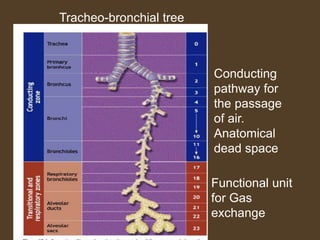
Tracheo-bronchial tree
Functional unit
for Gas
exchange
Conducting
pathway for
the passage
of air.
Anatomical
dead space
• During expiration, out of 500 mL of tidal volume
150 mL of the alveolar expired air remains in
the conducting passages.
• Therefore, of 500 mL air entering the lungs only
350 mL/breath is the fresh air which contributes
to the alveolar ventilation.
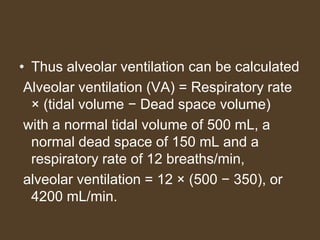
• Thus alveolar ventilation can be calculated
Alveolar ventilation (VA) = Respiratory rate
× (tidal volume − Dead space volume)
with a normal tidal volume of 500 mL, a
normal dead space of 150 mL and a
respiratory rate of 12 breaths/min,
alveolar ventilation = 12 × (500 − 350), or
4200 mL/min.
PHYSIOLOGICAL SIGNIFICANCE
• The physiological significance of alveolar
ventilation can be understood by
comparing the alveolar ventilation of two
subjects with following parameters
• Subject A, having normal breathing with a
tidal volume of 500 mL and respiratory
rate of 12 breaths/min will have:
Pulmonary ventilation = 12 × 500 = 6 L/min
and Alveolar ventilation = 12 × (500 −
150) = 4.2 L/min.
• Subject B, having rapid shallow breathing
with a tidal volume of 200 mL and
respiratory rate 30/min will have:
Pulmonary ventilation = 30 × 200 = 6 L/min
and Alveolar ventilation = 30 × (200 −
150) = 1.5 L/min.
• On comparison, we see that both the
subjects A and B have similar amounts of
pulmonary ventilation (6 L/min), but the
subject B has the alveolar ventilation (1.5
L/min) which is much less than that of
subject A (4.2 L/min).
• Consequently, the subject B is likely to
suffer from hypoxia and hypercapnia.
DEAD SPACE AIR
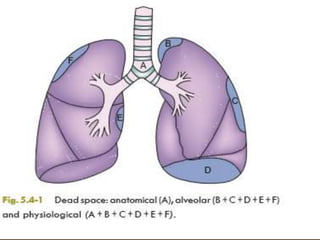
• Dead space air is the portion of minute
ventilation that does not take part in the
exchange of gases. There are three types
of dead spaces
ANATOMICAL DEAD SPACE
• It refers to the volume of air present in the
conducting zone of the respiratory
passage, i.e. from nose to terminal
bronchiole .
• It is approximately 150 mL of air.
ALVEOLAR DEAD SPACE AIR
• It refers to the volume of air present in
those alveoli which do not take part in gas
exchange. Normally, all the alveoli take
part in the gas exchange, but in some lung
diseases, some alveoli do not take part in
the gas exchange.
PHYSIOLOGICAL DEAD
SPACE
• It refers to the total dead space which
includes both the anatomical and alveolar
dead spaces. In a normal healthy person,
physiological dead space nearly equals
the anatomical dead space.
• In certain respiratory disorders with many
non-functioning alveoli, the physiological
dead space may be as much as ten times
the anatomical dead space.
MEASUREMENT OF
ANATOMICAL DEAD SPACE
• Single breath oxygen technique. This
technique is also called Single breath
Nitrogen washout test. In this test, nitrogen
contents in the expired air are used as an
indicator for determining dead space.
PROCEDURE
• The subject is asked to take a deep breath
of pure oxygen (100% O2). Then steadily
exhales into the nitrometer, which
continuously measures N2 contents in the
expired air. The anatomical dead space
can be measured by the analysis of single
breath nitrogen curve . This curve has four
phases labelled by roman letters (I, II, III
and IV)
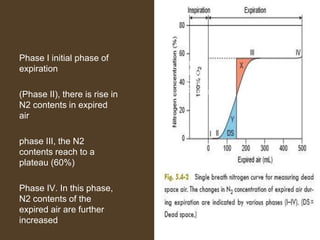
Phase I initial phase of
expiration
(Phase II), there is rise in
N2 contents in expired
air
phase III, the N2
contents reach to a
plateau (60%)
Phase IV. In this phase,
N2 contents of the
expired air are further
increased
initial
phase of
expiration
(Phase I),
• During inspiration, N2 contents are nil (zero
%) as subject has inspired pure O2.
• During initial phase of expiration (Phase I), N2
contents are nil (zero %) as the expired air is
from the dead space (which is filled with pure
O2).
• Subsequently (Phase II), there is rise in N2
contents in expired air because exhaled air
contains mixture of dead space air and alveolar
air.
• In phase III, the N2 contents reach to a
plateau (60%) and phase III of single
breath nitrogen curve ends at closing
volume (CV) and followed by the phase IV.
• Phase IV. In this phase, N2 contents of the
expired air are further increased
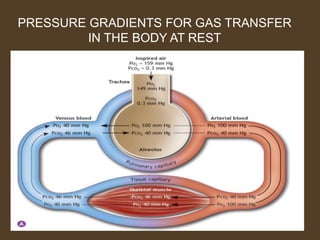
PRESSURE GRADIENTS FOR GAS TRANSFER
IN THE BODY AT REST
• The volume of anatomical dead space is
measured by placing a vertical line on the
record from mid-portion of phase II of
expiration (red area X = blue area Y).
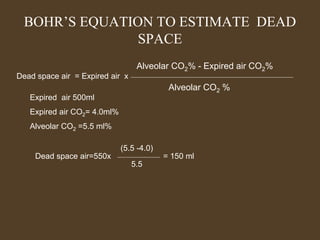
• Measurement of Total dead space is by
Bohr’s equation: Total dead space calculated
by Pco2 of expired air, Pco2 of arterial blood
and the tidal volume.
BOHR’S EQUATION TO ESTIMATE DEAD
SPACE
Dead space air = Expired air x
Alveolar CO2% - Expired air CO2%
Alveolar CO2 %
Expired air 500ml
Expired air CO2= 4.0ml%
Alveolar CO2 =5.5 ml%
Dead space air=550x
(5.5 -4.0)
5.5
= 150 ml
EFFECT OF GRAVITY ON
ALVEOLAR VENTILATION
• Alveolar ventilation is more or less evenly
distributed in the supine position because
hydrostatic effect on the intrapleural
pressure is reduced.
• In a vertical lung the alveolar ventilation is
unevenly distributed because of variation
in compliance in different regions of the
lung
• The alveolar pressure is zero throughout
the lung under static conditions. The
intrapleural pressure shows a gradient of
about 8 cm H2O between apex (−10 cm
H2O) and base (−2 cm H2O).
• So, transpulmonary pressure (intrapleural
pressure – alveolar pressure) also varies
from −10 cm H2O at apex to −2 cm H2O
at the base
• Consequently, the lung compliance (change in
lung volume per unit change in transpulmonary
pressure) also shows corresponding gradient
between apex and base.
• Because of more negative intrapleural
pressure at apex (−10 cm H2O), the apical
alveoli are larger but poorly ventilated.
• While the basal alveoli because of less negative
(−2 cm H2O) intrapleural pressure is smaller
but better ventilated.
• There is a linear reduction in the regional
alveolar ventilation from base to apex in
an erect position
ALVEOLAR VENTILATION–
PERFUSION RATIO
• (VA/Q) is the ratio of alveolar ventilation
per minute to quantity of blood flow to
alveoli per minute.
• Normally, alveolar ventilation (VA)
is4.2−5.0 L/min and the pulmonary blood
flow (equal to cardiac output) is
approximately 5 L/min.
• So, the normal VA/Q is about 0.84−0.9. At
this ratio maximum oxygenation occurs
EFFECT OF GRAVITY ON
VA/Q
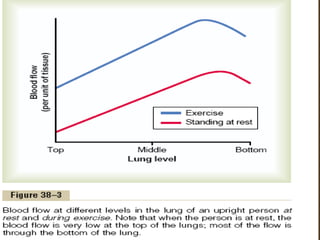
• Because of the effect of gravity, the
basal alveoli are overperfused and apical
alveoli are under perfused.
• There is almost of a linear reduction in the
blood flow from the base to apex .
• The alveolar ventilation also reduces
linearly from the base to apex and thus
the basal alveoli are overventilated and
apical alveoli are under ventilated.
• However, gravity affects perfusion much
more than it affects ventilation. the apical
alveoli are more underperfused than
underventilated. Because of this
relationship, the VA/Q is more than one
EFFECTS OF ALTERATIONS
IN VA/Q RATIO
• Normal VA/Q ratio implies that there is both normal
alveolar ventilation and normal alveolar perfusion.
• The exchange of gases is optimal and the alveolar
pO2 is about 104 mm Hg and pCO2 is about 40 mm
Hg.
INCREASED VA/Q RATIO
• It means that the alveolar ventilation is
more than the perfusion. As a result, the
whole of the alveolar air is not utilized for
gaseous exchange.
• The extra air in the alveoli which goes
waste forms the so-called alveolar dead
space air. There will also be a change in
the composition of alveolar air.
• When VA/Q ratio increases to infinity, i.e.
when alveolar perfusion becomes zero, no
exchange of gases can occur.
• Under such circumstances, the
composition of alveolar air becomes equal
to the humidified inspired air, which has
pO2 of 149 mm Hg and a pCO2 of
0 mm Hg
DECREASED VA/Q RATIO
• It occurs when the rate of blood flow is
more than the rate of alveolar ventilation.
• Since the alveolar ventilation is not
enough to provide oxygen, a fraction of
venous blood passes through the
pulmonary capillaries without becoming
oxygenated.
• This fraction is called shunted blood
• This shunted blood along with the
additional deoxygenated blood from the
bronchial veins to the pulmonary vein
(about 2% of cardiac output) forms the so-
called physiological shunt.
• The greater the physiological shunt, the
greater is the amount of blood that fails to
be oxygenated as it passes through the
lungs.
• When VA/Q becomes zero, there is no
alveolar ventilation, so that the air in the
alveolus comes to equilibrium with O2 and
CO2 in the venous blood flowing through
the pulmonary capillaries.
• So, alveolar air will have a pO2 of 40 mm
Hg and pCO2 of 45 mm Hg.
CAUSES OF UNEVEN
ALVEOLAR VENTILATION
• Bronchial asthma
• Emphysema
• Pulmonary fibrosis
• Pneumothorax and
• Congestive heart failure
CAUSES OF UNEVEN
PULMONARY PERFUSION
• Anatomical shunts, e.g. Fallot’s
tetralogy, Pulmonary embolism.
• Regional decrease in pulmonary vascular
bed in emphysema and
• Increased pulmonary resistance in
conditions like pulmonary fibrosis,
pneumothorax and congestive heart
failure.
ALVEOLAR AIR
• Volume of air which is available for the
exchange of gases in the alveoli per
breath is called alveolar air, which is
equivalent to tidal volume minus dead
space, i.e. (500 − 150) or 350 mL.
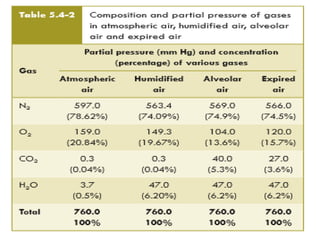
COMPOSITION OF ALVEOLAR
AIR
• Composition of alveolar air can be studied
by an alveolar air sampling that involves
analysis of the last few millilitres of air that
issues from the lungs during expiration.
• Alveolar air composition is considerably
different than that of atmospheric air
because of the following reasons:
• Water vapours dilute the other gases in
the inspired air. Alveolar air is renewed
very slowly by the atmospheric air.
Oxygen is constantly being absorbed from
the alveolar air.
• Carbon dioxide is constantly diffusing from
the pulmonary blood to the alveoli
RESPIRATORY UNIT AND
RESPIRATORY MEMBRANE
• Each respiratory unit is composed of a
respiratory bronchiole, alveolar ducts, atria
and alveoli. There are about 300 million
respiratory units in the two lungs.
• Gas exchange occurs through the
membranes of all the structures forming a
respiratory unit, not merely in the alveoli
themselves.
Respiratory membrane or
pulmonary membrane or the
alveolocapillary membrane
• It is the name given to the tissues which
separate the capillary blood from the
alveolar air.
• The exchange of gases between the
capillary blood and alveolar air requires
diffusion through this membrane.
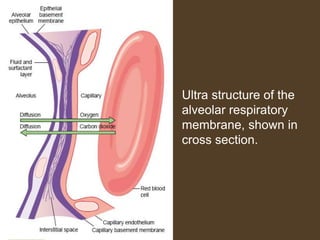
Ultra structure of the
alveolar respiratory
membrane, shown in
cross section.
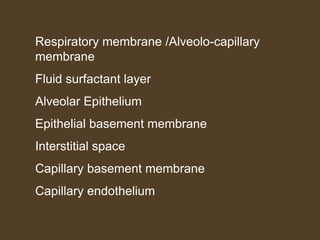
Respiratory membrane /Alveolo-capillary
membrane
Fluid surfactant layer
Alveolar Epithelium
Epithelial basement membrane
Interstitial space
Capillary basement membrane
Capillary endothelium
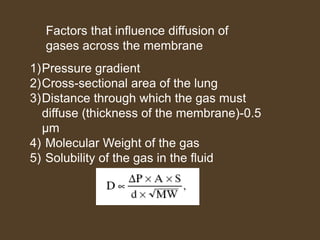
1)Pressure gradient
2)Cross-sectional area of the lung
3)Distance through which the gas must
diffuse (thickness of the membrane)-0.5
µm
4) Molecular Weight of the gas
5) Solubility of the gas in the fluid
Factors that influence diffusion of
gases across the membrane
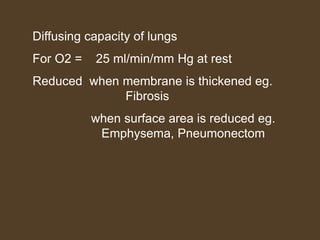
Diffusing capacity of lungs
For O2 = 25 ml/min/mm Hg at rest
Reduced when membrane is thickened eg.
Fibrosis
when surface area is reduced eg.
Emphysema, Pneumonectom
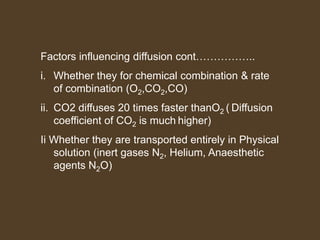
Factors influencing diffusion cont……………..
i. Whether they for chemical combination & rate
of combination (O2,CO2,CO)
ii. CO2 diffuses 20 times faster thanO2 ( Diffusion
coefficient of CO2 is much higher)
Ii Whether they are transported entirely in Physical
solution (inert gases N2, Helium, Anaesthetic
agents N2O)
• Whether or not substance passing from
the alveoli to the capillary blood reach
equilibrium in 0.75 sec that blood takes to
traverse the pulm capillaries depends on
the reaction of the substance with the
blood.
• Eg; N2O does not react with blood, so
reaches equilibrium within 0.1 sec. so it is
not diffusion limited , flow limited.
• CO taken up by RBC at a high rate so it is
diffusion limited.
• O2 and CO2 are intermediate between
N2O & CO, as they are taken up by Hb,
but much less avidly than CO and it
recahes equilibrium with capillary blood in
about 0.3 sec. consdiered as perfusion
limited.
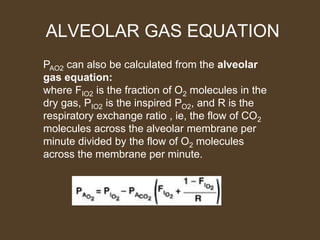
ALVEOLAR GAS EQUATION
PAO2 can also be calculated from the alveolar
gas equation:
where FIO2 is the fraction of O2 molecules in the
dry gas, PIO2 is the inspired PO2, and R is the
respiratory exchange ratio , ie, the flow of CO2
molecules across the alveolar membrane per
minute divided by the flow of O2 molecules
across the membrane per minute.
THANK YOU

ALVEOLAR VENTILATION.ppt

  • 1.
    ALVEOLAR VENTILATION AND DEADSPACE DR RASHMI TIWARI
  • 2.
    LEARNING OBJECTIVES • Defineventilation , alveolar ventilation • Differences in ventilation & perfusion in different parts of the lungs • Dead space(DS), anatomical DS, Physiological DS (Total DS) • Bohr’s equation to estimate total DS • Meaning of shunt • Alveolar gas equation
  • 3.
    VENTILATION • It refersto circulation of replacement of air or gas in a space. • In respiratory physiology, ventilation is the rate at which air enters or leaves the lung.
  • 4.
    ALVEOLAR VENTILATION • Alveolarventilation is the volume of the fresh air which reaches the gas exchange area of the lung each minute. During inspiration, some of the air inhaled never reaches the gas exchange areas but instead fills the non-gas exchange areas (conducting zone) of the respiratory tract called the dead space, which is equal to about 150 mL.
  • 5.
    Tracheo-bronchial tree Functional unit forGas exchange Conducting pathway for the passage of air. Anatomical dead space
  • 6.
    • During expiration,out of 500 mL of tidal volume 150 mL of the alveolar expired air remains in the conducting passages. • Therefore, of 500 mL air entering the lungs only 350 mL/breath is the fresh air which contributes to the alveolar ventilation.
  • 7.
    • Thus alveolarventilation can be calculated Alveolar ventilation (VA) = Respiratory rate × (tidal volume − Dead space volume) with a normal tidal volume of 500 mL, a normal dead space of 150 mL and a respiratory rate of 12 breaths/min, alveolar ventilation = 12 × (500 − 350), or 4200 mL/min.
  • 8.
    PHYSIOLOGICAL SIGNIFICANCE • Thephysiological significance of alveolar ventilation can be understood by comparing the alveolar ventilation of two subjects with following parameters
  • 9.
    • Subject A,having normal breathing with a tidal volume of 500 mL and respiratory rate of 12 breaths/min will have: Pulmonary ventilation = 12 × 500 = 6 L/min and Alveolar ventilation = 12 × (500 − 150) = 4.2 L/min.
  • 10.
    • Subject B,having rapid shallow breathing with a tidal volume of 200 mL and respiratory rate 30/min will have: Pulmonary ventilation = 30 × 200 = 6 L/min and Alveolar ventilation = 30 × (200 − 150) = 1.5 L/min.
  • 11.
    • On comparison,we see that both the subjects A and B have similar amounts of pulmonary ventilation (6 L/min), but the subject B has the alveolar ventilation (1.5 L/min) which is much less than that of subject A (4.2 L/min). • Consequently, the subject B is likely to suffer from hypoxia and hypercapnia.
  • 12.
    DEAD SPACE AIR •Dead space air is the portion of minute ventilation that does not take part in the exchange of gases. There are three types of dead spaces
  • 14.
    ANATOMICAL DEAD SPACE •It refers to the volume of air present in the conducting zone of the respiratory passage, i.e. from nose to terminal bronchiole . • It is approximately 150 mL of air.
  • 15.
    ALVEOLAR DEAD SPACEAIR • It refers to the volume of air present in those alveoli which do not take part in gas exchange. Normally, all the alveoli take part in the gas exchange, but in some lung diseases, some alveoli do not take part in the gas exchange.
  • 16.
    PHYSIOLOGICAL DEAD SPACE • Itrefers to the total dead space which includes both the anatomical and alveolar dead spaces. In a normal healthy person, physiological dead space nearly equals the anatomical dead space. • In certain respiratory disorders with many non-functioning alveoli, the physiological dead space may be as much as ten times the anatomical dead space.
  • 17.
    MEASUREMENT OF ANATOMICAL DEADSPACE • Single breath oxygen technique. This technique is also called Single breath Nitrogen washout test. In this test, nitrogen contents in the expired air are used as an indicator for determining dead space.
  • 18.
    PROCEDURE • The subjectis asked to take a deep breath of pure oxygen (100% O2). Then steadily exhales into the nitrometer, which continuously measures N2 contents in the expired air. The anatomical dead space can be measured by the analysis of single breath nitrogen curve . This curve has four phases labelled by roman letters (I, II, III and IV)
  • 19.
    Phase I initialphase of expiration (Phase II), there is rise in N2 contents in expired air phase III, the N2 contents reach to a plateau (60%) Phase IV. In this phase, N2 contents of the expired air are further increased initial phase of expiration (Phase I),
  • 20.
    • During inspiration,N2 contents are nil (zero %) as subject has inspired pure O2. • During initial phase of expiration (Phase I), N2 contents are nil (zero %) as the expired air is from the dead space (which is filled with pure O2). • Subsequently (Phase II), there is rise in N2 contents in expired air because exhaled air contains mixture of dead space air and alveolar air.
  • 21.
    • In phaseIII, the N2 contents reach to a plateau (60%) and phase III of single breath nitrogen curve ends at closing volume (CV) and followed by the phase IV. • Phase IV. In this phase, N2 contents of the expired air are further increased
  • 22.
    PRESSURE GRADIENTS FORGAS TRANSFER IN THE BODY AT REST
  • 23.
    • The volumeof anatomical dead space is measured by placing a vertical line on the record from mid-portion of phase II of expiration (red area X = blue area Y).
  • 24.
    • Measurement ofTotal dead space is by Bohr’s equation: Total dead space calculated by Pco2 of expired air, Pco2 of arterial blood and the tidal volume.
  • 25.
    BOHR’S EQUATION TOESTIMATE DEAD SPACE Dead space air = Expired air x Alveolar CO2% - Expired air CO2% Alveolar CO2 % Expired air 500ml Expired air CO2= 4.0ml% Alveolar CO2 =5.5 ml% Dead space air=550x (5.5 -4.0) 5.5 = 150 ml
  • 26.
    EFFECT OF GRAVITYON ALVEOLAR VENTILATION • Alveolar ventilation is more or less evenly distributed in the supine position because hydrostatic effect on the intrapleural pressure is reduced. • In a vertical lung the alveolar ventilation is unevenly distributed because of variation in compliance in different regions of the lung
  • 27.
    • The alveolarpressure is zero throughout the lung under static conditions. The intrapleural pressure shows a gradient of about 8 cm H2O between apex (−10 cm H2O) and base (−2 cm H2O). • So, transpulmonary pressure (intrapleural pressure – alveolar pressure) also varies from −10 cm H2O at apex to −2 cm H2O at the base
  • 28.
    • Consequently, thelung compliance (change in lung volume per unit change in transpulmonary pressure) also shows corresponding gradient between apex and base. • Because of more negative intrapleural pressure at apex (−10 cm H2O), the apical alveoli are larger but poorly ventilated. • While the basal alveoli because of less negative (−2 cm H2O) intrapleural pressure is smaller but better ventilated.
  • 29.
    • There isa linear reduction in the regional alveolar ventilation from base to apex in an erect position
  • 30.
    ALVEOLAR VENTILATION– PERFUSION RATIO •(VA/Q) is the ratio of alveolar ventilation per minute to quantity of blood flow to alveoli per minute. • Normally, alveolar ventilation (VA) is4.2−5.0 L/min and the pulmonary blood flow (equal to cardiac output) is approximately 5 L/min. • So, the normal VA/Q is about 0.84−0.9. At this ratio maximum oxygenation occurs
  • 31.
    EFFECT OF GRAVITYON VA/Q • Because of the effect of gravity, the basal alveoli are overperfused and apical alveoli are under perfused. • There is almost of a linear reduction in the blood flow from the base to apex .
  • 32.
    • The alveolarventilation also reduces linearly from the base to apex and thus the basal alveoli are overventilated and apical alveoli are under ventilated. • However, gravity affects perfusion much more than it affects ventilation. the apical alveoli are more underperfused than underventilated. Because of this relationship, the VA/Q is more than one
  • 33.
    EFFECTS OF ALTERATIONS INVA/Q RATIO • Normal VA/Q ratio implies that there is both normal alveolar ventilation and normal alveolar perfusion. • The exchange of gases is optimal and the alveolar pO2 is about 104 mm Hg and pCO2 is about 40 mm Hg.
  • 34.
    INCREASED VA/Q RATIO •It means that the alveolar ventilation is more than the perfusion. As a result, the whole of the alveolar air is not utilized for gaseous exchange. • The extra air in the alveoli which goes waste forms the so-called alveolar dead space air. There will also be a change in the composition of alveolar air.
  • 35.
    • When VA/Qratio increases to infinity, i.e. when alveolar perfusion becomes zero, no exchange of gases can occur. • Under such circumstances, the composition of alveolar air becomes equal to the humidified inspired air, which has pO2 of 149 mm Hg and a pCO2 of 0 mm Hg
  • 36.
    DECREASED VA/Q RATIO •It occurs when the rate of blood flow is more than the rate of alveolar ventilation. • Since the alveolar ventilation is not enough to provide oxygen, a fraction of venous blood passes through the pulmonary capillaries without becoming oxygenated. • This fraction is called shunted blood
  • 37.
    • This shuntedblood along with the additional deoxygenated blood from the bronchial veins to the pulmonary vein (about 2% of cardiac output) forms the so- called physiological shunt.
  • 38.
    • The greaterthe physiological shunt, the greater is the amount of blood that fails to be oxygenated as it passes through the lungs.
  • 39.
    • When VA/Qbecomes zero, there is no alveolar ventilation, so that the air in the alveolus comes to equilibrium with O2 and CO2 in the venous blood flowing through the pulmonary capillaries. • So, alveolar air will have a pO2 of 40 mm Hg and pCO2 of 45 mm Hg.
  • 40.
    CAUSES OF UNEVEN ALVEOLARVENTILATION • Bronchial asthma • Emphysema • Pulmonary fibrosis • Pneumothorax and • Congestive heart failure
  • 41.
    CAUSES OF UNEVEN PULMONARYPERFUSION • Anatomical shunts, e.g. Fallot’s tetralogy, Pulmonary embolism. • Regional decrease in pulmonary vascular bed in emphysema and • Increased pulmonary resistance in conditions like pulmonary fibrosis, pneumothorax and congestive heart failure.
  • 42.
    ALVEOLAR AIR • Volumeof air which is available for the exchange of gases in the alveoli per breath is called alveolar air, which is equivalent to tidal volume minus dead space, i.e. (500 − 150) or 350 mL.
  • 43.
    COMPOSITION OF ALVEOLAR AIR •Composition of alveolar air can be studied by an alveolar air sampling that involves analysis of the last few millilitres of air that issues from the lungs during expiration. • Alveolar air composition is considerably different than that of atmospheric air because of the following reasons:
  • 44.
    • Water vapoursdilute the other gases in the inspired air. Alveolar air is renewed very slowly by the atmospheric air. Oxygen is constantly being absorbed from the alveolar air. • Carbon dioxide is constantly diffusing from the pulmonary blood to the alveoli
  • 46.
    RESPIRATORY UNIT AND RESPIRATORYMEMBRANE • Each respiratory unit is composed of a respiratory bronchiole, alveolar ducts, atria and alveoli. There are about 300 million respiratory units in the two lungs. • Gas exchange occurs through the membranes of all the structures forming a respiratory unit, not merely in the alveoli themselves.
  • 47.
    Respiratory membrane or pulmonarymembrane or the alveolocapillary membrane • It is the name given to the tissues which separate the capillary blood from the alveolar air. • The exchange of gases between the capillary blood and alveolar air requires diffusion through this membrane.
  • 48.
    Ultra structure ofthe alveolar respiratory membrane, shown in cross section.
  • 49.
    Respiratory membrane /Alveolo-capillary membrane Fluidsurfactant layer Alveolar Epithelium Epithelial basement membrane Interstitial space Capillary basement membrane Capillary endothelium
  • 50.
    1)Pressure gradient 2)Cross-sectional areaof the lung 3)Distance through which the gas must diffuse (thickness of the membrane)-0.5 µm 4) Molecular Weight of the gas 5) Solubility of the gas in the fluid Factors that influence diffusion of gases across the membrane
  • 51.
    Diffusing capacity oflungs For O2 = 25 ml/min/mm Hg at rest Reduced when membrane is thickened eg. Fibrosis when surface area is reduced eg. Emphysema, Pneumonectom
  • 52.
    Factors influencing diffusioncont…………….. i. Whether they for chemical combination & rate of combination (O2,CO2,CO) ii. CO2 diffuses 20 times faster thanO2 ( Diffusion coefficient of CO2 is much higher) Ii Whether they are transported entirely in Physical solution (inert gases N2, Helium, Anaesthetic agents N2O)
  • 53.
    • Whether ornot substance passing from the alveoli to the capillary blood reach equilibrium in 0.75 sec that blood takes to traverse the pulm capillaries depends on the reaction of the substance with the blood.
  • 54.
    • Eg; N2Odoes not react with blood, so reaches equilibrium within 0.1 sec. so it is not diffusion limited , flow limited. • CO taken up by RBC at a high rate so it is diffusion limited. • O2 and CO2 are intermediate between N2O & CO, as they are taken up by Hb, but much less avidly than CO and it recahes equilibrium with capillary blood in about 0.3 sec. consdiered as perfusion limited.
  • 55.
    ALVEOLAR GAS EQUATION PAO2can also be calculated from the alveolar gas equation: where FIO2 is the fraction of O2 molecules in the dry gas, PIO2 is the inspired PO2, and R is the respiratory exchange ratio , ie, the flow of CO2 molecules across the alveolar membrane per minute divided by the flow of O2 molecules across the membrane per minute.
  • 57.