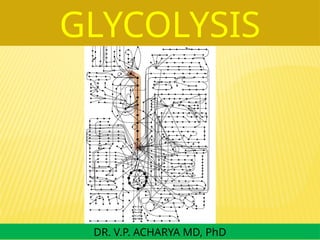
GLYCOLYSIS
DR. V.P. ACHARYA MD, PhD
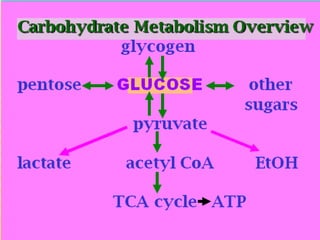
MAJOR METABOLIC PATHWAYS OF GLUCOSE
 Glycolysis
 Glycogenesis
 Glycogenolysis
 Gluconeogenesis
 Pentose phosphate pathway
 Uronic acid pathway.
GLUCOSE IS A FUEL AS WELL AS A PRECURSOR
 Glucose occupies a central position in the
metabolism of plants, animals and microorganisms
 Rich in potential energy- good fuel
 Complete oxidation of glucose- -2840 kJ/mol
 Stored in the form of starch or glycogen- at the
time of need releases. This stockpiling maintains
relatively low cytosolic osmolarity
 Precursor of –AA, nucleic acid, coenzyme, fatty
acids, metabolic intermediates
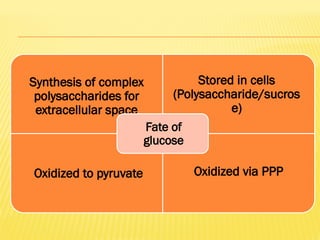
Synthesis of complex
polysaccharides for
extracellular space
Stored in cells
(Polysaccharide/sucros
e)
Oxidized to pyruvate Oxidized via PPP
Fate of
glucose
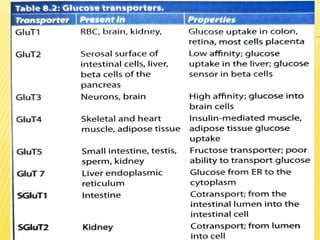
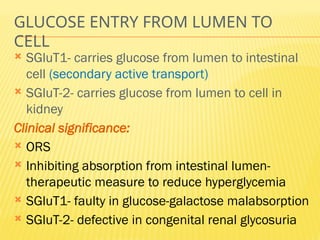
GLUCOSE ENTRY FROM LUMEN TO
CELL
 SGluT1- carries glucose from lumen to intestinal
cell (secondary active transport)
 SGluT-2- carries glucose from lumen to cell in
kidney
Clinical significance:
 ORS
 Inhibiting absorption from intestinal lumen-
therapeutic measure to reduce hyperglycemia
 SGluT1- faulty in glucose-galactose malabsorption
 SGluT-2- defective in congenital renal glycosuria
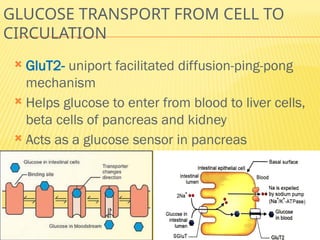
GLUCOSE TRANSPORT FROM CELL TO
CIRCULATION
 GluT2- uniport facilitated diffusion-ping-pong
mechanism
 Helps glucose to enter from blood to liver cells,
beta cells of pancreas and kidney
 Acts as a glucose sensor in pancreas
GLUT-4- SKELETAL MM AND ADIPOSE TISSUES
 Insulin dependent
 Insulin induces movement of intracellular GluT4 to
come to the surface and uptakes glucose
 DM- glucose uptake reduces to half as GluT4 is
unavailable on surface- Insulin resistance
 Metformin- helps in GluT4 translocation on surface
 Ritonavir (anti-HIV drug)- GLUT4 inhibitor, reduces
glucose uptake by GluT4 in cancer cells
OTHER MONOSACCHARIDES
 Glucose and galactose- SGluT1
 Fructose- GluT5
 Other monosaccharides- partially absorbed by
carrier mediated facilitated transport and
hence remaining molecule are fermented by
bacteria
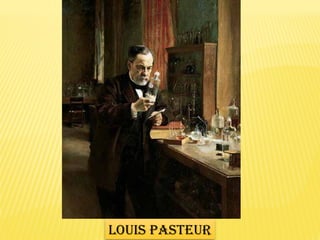
Louis Pasteur
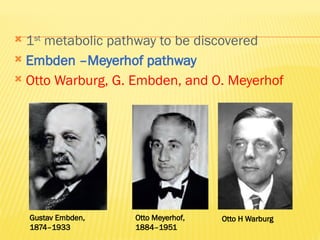
 1st
metabolic pathway to be discovered
 Embden –Meyerhof pathway
 Otto Warburg, G. Embden, and O. Meyerhof
Gustav Embden,
1874–1933
Otto Meyerhof,
1884–1951
Otto H Warburg
 Glycolysis- universal central catabolic pathway
for glucose
 A minimum amount of glucose always required
for normal functioning
 RBC, renal medulla, brain, sperm- solely
depend on glycolysis for energy
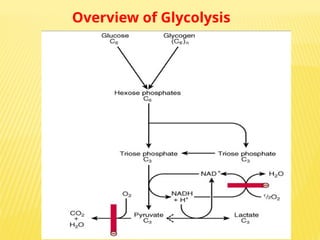
Overview of Glycolysis
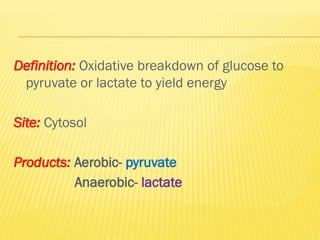
Definition: Oxidative breakdown of glucose to
pyruvate or lactate to yield energy
Site: Cytosol
Products: Aerobic- pyruvate
Anaerobic- lactate
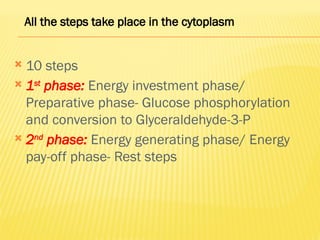
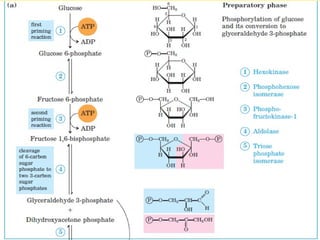
 10 steps
 1st
phase: Energy investment phase/
Preparative phase- Glucose phosphorylation
and conversion to Glyceraldehyde-3-P
 2nd
phase: Energy generating phase/ Energy
pay-off phase- Rest steps
All the steps take place in the cytoplasm
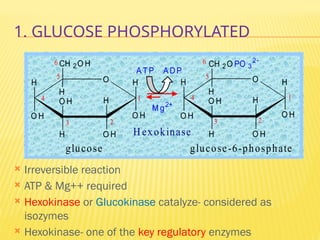
1. GLUCOSE PHOSPHORYLATED
 Irreversible reaction
 ATP & Mg++ required
 Hexokinase or Glucokinase catalyze- considered as
isozymes
 Hexokinase- one of the key regulatory enzymes
H O
O H
H
O H
H
O H
CH 2O H
H
O H
H H O
O H
H
O H
H
O H
CH 2O PO 3
2
H
O H
H
2
3
4
5
6
1 1
6
5
4
3 2
A T P A D P
M g2+
glucose glucose-6-phosphate
H exokinase
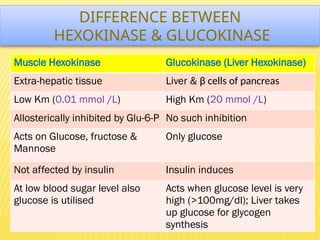
DIFFERENCE BETWEEN
HEXOKINASE & GLUCOKINASE
Muscle Hexokinase Glucokinase (Liver Hexokinase)
Extra-hepatic tissue Liver & β cells of pancreas
Low Km (0.01 mmol /L) High Km (20 mmol /L)
Allosterically inhibited by Glu-6-P No such inhibition
Acts on Glucose, fructose &
Mannose
Only glucose
Not affected by insulin Insulin induces
At low blood sugar level also
glucose is utilised
Acts when glucose level is very
high (>100mg/dl); Liver takes
up glucose for glycogen
synthesis
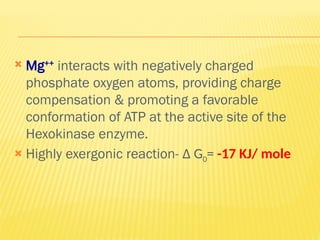
 Mg++
interacts with negatively charged
phosphate oxygen atoms, providing charge
compensation & promoting a favorable
conformation of ATP at the active site of the
Hexokinase enzyme.
 Highly exergonic reaction- ∆ G0= -17 KJ/ mole
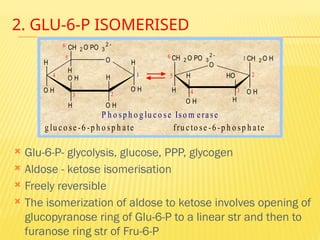
2. GLU-6-P ISOMERISED
 Glu-6-P- glycolysis, glucose, PPP, glycogen
 Aldose - ketose isomerisation
 Freely reversible
 The isomerization of aldose to ketose involves opening of
glucopyranose ring of Glu-6-P to a linear str and then to
furanose ring str of Fru-6-P
H O
O H
H
O H
H
O H
CH 2 O PO 3
2 
H
O H
H
1
6
5
4
3 2
CH 2 O PO 3
2 
O H
CH 2 O H
H
O H H
H HO
O
6
5
4 3
2
1
g lu c o se -6 -p h o sp h a te fru c to se -6 -p h o sp h a te
P h o sp h o g lu co se Iso m e ra se
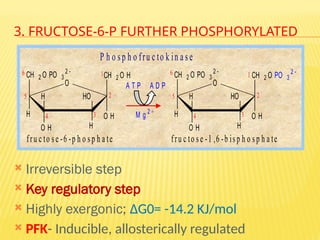
3. FRUCTOSE-6-P FURTHER PHOSPHORYLATED
 Irreversible step
 Key regulatory step
 Highly exergonic; ∆G0= -14.2 KJ/mol
 PFK- Inducible, allosterically regulated
CH 2 O PO 3
2 
O H
CH 2 O H
H
O H H
H HO
O
6
5
4 3
2
1 CH 2 O PO 3
2 
O H
CH 2 O PO 3
2 
H
O H H
H HO
O
6
5
4 3
2
1
A T P A D P
M g 2 +
fru c to s e -6 -p h o s p h a te fru c to s e -1 ,6 -b isp h o sp h a te
P h o sp h o fru c to k in a se
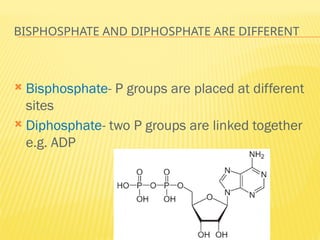
BISPHOSPHATE AND DIPHOSPHATE ARE DIFFERENT
 Bisphosphate- P groups are placed at different
sites
 Diphosphate- two P groups are linked together
e.g. ADP
STEP 1 + 2+ 3 = ENERGY INVESTMENT PHASE
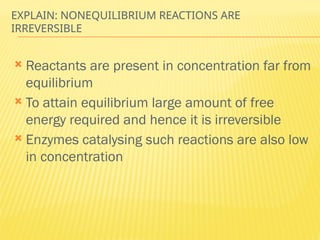
EXPLAIN: NONEQUILIBRIUM REACTIONS ARE
IRREVERSIBLE
 Reactants are present in concentration far from
equilibrium
 To attain equilibrium large amount of free
energy required and hence it is irreversible
 Enzymes catalysing such reactions are also low
in concentration
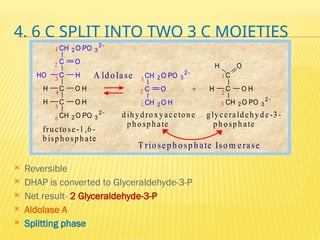
4. 6 C SPLIT INTO TWO 3 C MOIETIES
 Reversible
 DHAP is converted to Glyceraldehyde-3-P
 Net result- 2 Glyceraldehyde-3-P
 Aldolase A
 Splitting phase
6
5
4
3
2
1 CH 2 O PO 3
2 
C
C
C
C
CH 2 O PO 3
2 
O
HO H
H O H
H O H
3
2
1
CH 2 O PO 3
2 
C
CH 2 O H
O
C
C
CH 2 O PO 3
2 
H O
H O H
+
1
2
3
fructose-1,6 -
bisphosphate
A ldo lase
dihydroxyacetone glyceraldehyde -3-
pho sphate phosphate
T riosephosphate Isom erase
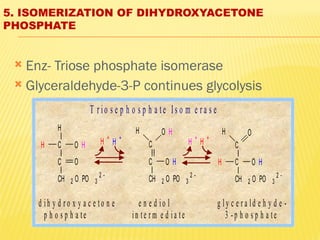
5. ISOMERIZATION OF DIHYDROXYACETONE
PHOSPHATE
 Enz- Triose phosphate isomerase
 Glyceraldehyde-3-P continues glycolysis
C
C
CH 2 O PO 3
2 
O
C
C
CH 2 O PO 3
2 
H O
H O H
C
C
CH 2 O PO 3
2 
H O H
O H
H
H O H H +
H +
H +
H +
d ih y d r o x y a c e to n e e n e d io l g ly c e r a ld e h y d e -
p h o s p h a te in te r m e d ia te 3 -p h o s p h a te
T r io s e p h o s p h a te Is o m e r a s e
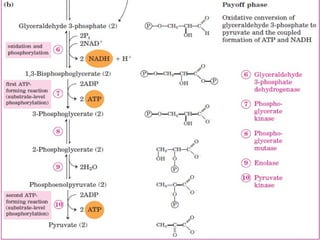
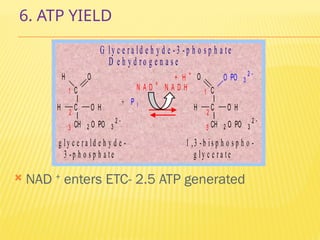
6. ATP YIELD
 NAD +
enters ETC- 2.5 ATP generated
C
C
CH 2 O PO 3
2 
H O
H O H
C
C
CH 2 O PO 3
2 
O O PO 3
2 
H O H
+ P i
+ H +
N A D +
N A D H 1
2
3
2
3
1
g ly c e r a ld e h y d e - 1 ,3 -b is p h o s p h o -
3 -p h o s p h a te g ly c e r a te
G ly c e r a ld e h y d e - 3 - p h o s p h a te
D e h y d r o g e n a s e
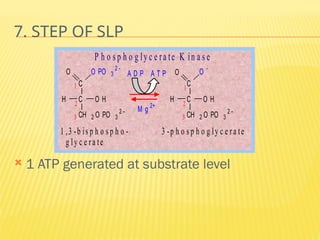
7. STEP OF SLP
 1 ATP generated at substrate level
C
C
CH 2 O PO 3
2 
O O PO 3
2 
H O H
C
C
CH 2 O PO 3
2 
O O 
H O H
A D P A T P
1
2
2
3 3
1
M g 2+
1 ,3 -b is p h o s p h o - 3 -p h o s p h o g ly c e ra te
g ly c e ra te
P h o s p h o g ly c e ra te K in a s e
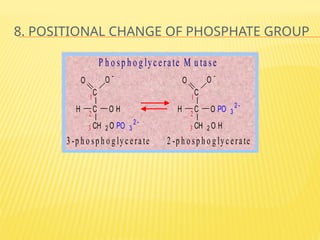
8. POSITIONAL CHANGE OF PHOSPHATE GROUP
C
C
CH 2 O H
O O 
H O PO 3
2 
2
3
1
C
C
CH 2 O PO 3
2 
O O 
H O H
2
3
1
3 -p h o sp h o g ly ce rate 2 -p h o sp h o g ly cerate
P h o sp h o g lycerate M u tase
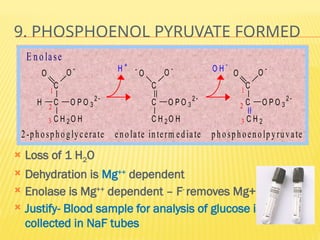
9. PHOSPHOENOL PYRUVATE FORMED
 Loss of 1 H2O
 Dehydration is Mg++
dependent
 Enolase is Mg++
dependent – F-
removes Mg++
 Justify- Blood sample for analysis of glucose is
collected in NaF tubes
C
C
C H 2 O H
O O 
H O P O 3
2 
C
C
C H 2 O H

O O 
O P O 3
2 
C
C
C H 2
O O 
O P O 3
2 
O H 
2
3
1
2
3
1
H 
2-phosphoglycerate enolate interm ediate phosphoenolpyruvate
E nolase
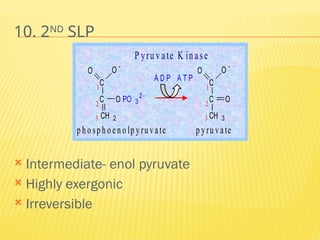
10. 2ND
SLP
 Intermediate- enol pyruvate
 Highly exergonic
 Irreversible
C
C
CH 3
O O 
O
2
3
1
A D P A T P
C
C
CH 2
O O 
O PO 3
2 
2
3
1
p h o sp h o en o lp yru vate p yru vate
P yru v ate K in ase
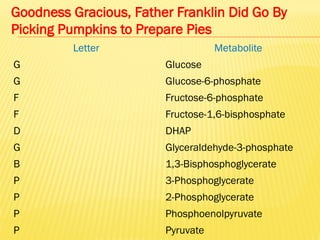
Goodness Gracious, Father Franklin Did Go By
Picking Pumpkins to Prepare Pies
Letter Metabolite
G Glucose
G Glucose-6-phosphate
F Fructose-6-phosphate
F Fructose-1,6-bisphosphate
D DHAP
G Glyceraldehyde-3-phosphate
B 1,3-Bisphosphoglycerate
P 3-Phosphoglycerate
P 2-Phosphoglycerate
P Phosphoenolpyruvate
P Pyruvate
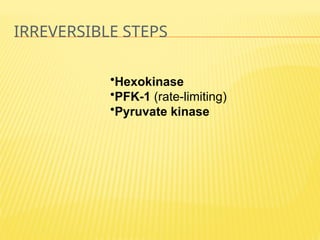
IRREVERSIBLE STEPS
•Hexokinase
•PFK-1 (rate-limiting)
•Pyruvate kinase
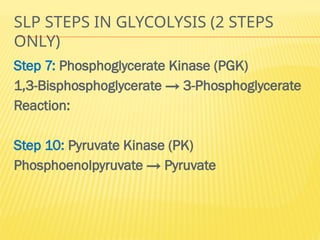
SLP STEPS IN GLYCOLYSIS (2 STEPS
ONLY)
Step 7: Phosphoglycerate Kinase (PGK)
1,3-Bisphosphoglycerate → 3-Phosphoglycerate
Reaction:
Step 10: Pyruvate Kinase (PK)
Phosphoenolpyruvate → Pyruvate
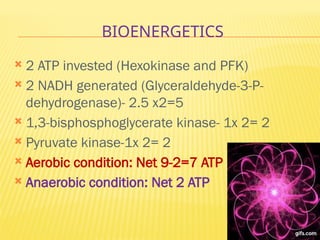
BIOENERGETICS
 2 ATP invested (Hexokinase and PFK)
 2 NADH generated (Glyceraldehyde-3-P-
dehydrogenase)- 2.5 x2=5
 1,3-bisphosphoglycerate kinase- 1x 2= 2
 Pyruvate kinase-1x 2= 2
 Aerobic condition: Net 9-2=7 ATP
 Anaerobic condition: Net 2 ATP
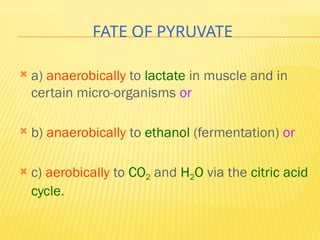
FATE OF PYRUVATE
 a) anaerobically to lactate in muscle and in
certain micro-organisms or
 b) anaerobically to ethanol (fermentation) or
 c) aerobically to CO2 and H2O via the citric acid
cycle.
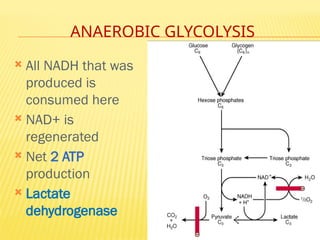
ANAEROBIC GLYCOLYSIS
 All NADH that was
produced is
consumed here
 NAD+ is
regenerated
 Net 2 ATP
production
 Lactate
dehydrogenase
 Helps drive glycolysis by using up NADH
 Reversible so pyruvate can be
regenerated in alternative metabolism
 Lactate fermentation important in
red blood cells, parts of the retina,
and in skeletal muscle cells during
strenuous exercise.
 Important in plants and in microbes
growing in absence of O2.
3 IRREVERSIBLE REACTIONS
Catalysed by:
1. Hexokinase
2. Phosphofructokinase
3. Pyruvate kinase
They are the key regulatory enzymes too
REGULATION OF GLYCOLYSIS
 Insulin- favors glycolysis by activating key
enzymes
 Glucocorticoids - inhibits glycolysis & favors
Gluconeogenesis
HEXOKINASE
 Glucose- 6- P inhibits hexokinase- feedback
inhibition
 Insulin-induces
 Competitive inhibition
 Allosteric inhibition
 PFK inhibition→ Glu -6-P accumulated →
Inhibition of hexokinase
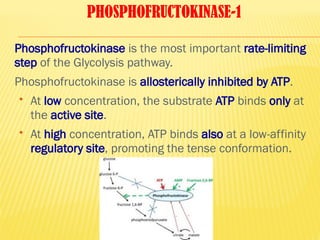
PHOSPHOFRUCTOKINASE-1
Phosphofructokinase is the most important rate-limiting
step of the Glycolysis pathway.
Phosphofructokinase is allosterically inhibited by ATP.
 At low concentration, the substrate ATP binds only at
the active site.
 At high concentration, ATP binds also at a low-affinity
regulatory site, promoting the tense conformation.
 Citrate & Malate- another allosteric
inhibitor of PFK1;
- potentiates inhibitory effect of
PFK
 Low or high pH- inhibitory effect on PFK
 AMP, Fructose-2,6-BP- increase the
activity of PFK- allosteric activation
INHIBITORS
 Glyceraldehyde-3-P dehydrogenase- Iodoacetate &
Arsenic
 Enolase – Fluoride
F binds to Mg++
bound to enolase at the active site and
inhibits the enzyme.
Can F-
also inhibit Hexokinase/ Glucokinase as Mg++
is
involved there too?
Ans: NO- F can’t break the Mg-ATP bond easily; Mg is
not an integral part of the enzyme here.
PFK2
 Fructose-2,6-BP is not an
intermediate of glycolysis
 Allosteric activator of PFK1
 When glucose is in plenty,
PFK-2 is dephosphorylated
and activated- in turn
activate PFK-1 via Fru-2,6-
BP
 PFK-2 and FBPase-
Tandem enzymes-
Phosphorylation of Ser
residue
PASTEUR EFFECT-
IN AEROBIC CONDITION GLYCOLYSIS IS INHIBITED
 Under anaerobic condition rate and
amount of glucose consumption is very
high than aerobic condition
 In presence of O2→ pyruvate enters TCA
cycle
↓
Citrate formed
↓
PFK inhibited
ANEROBIC GLYCOLYSIS CONSUMES 16 TIMES MORE
GLUCOSE THAN AEROBIC GLYCOLYSIS !!
 Anerobic- 2 ATP/mole of glucose
 Aerobic- 32 ATP
 In other words- 16 times more glucose will be
consumed anaerobically to produce the same
amount of ATP aerobically
 In presence of O2- glycolysis will be impeded
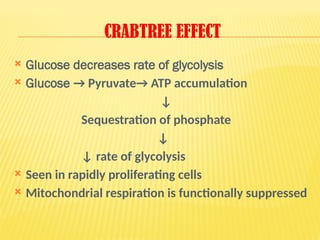
CRABTREE EFFECT
 Glucose decreases rate of glycolysis
 Glucose → Pyruvate→ ATP accumulation
↓
Sequestration of phosphate
↓
↓ rate of glycolysis
 Seen in rapidly proliferating cells
 Mitochondrial respiration is functionally suppressed
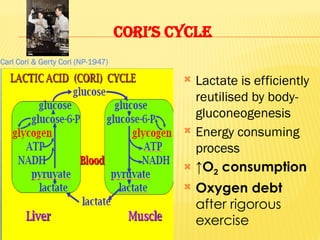
CORI’S CYCLE
 Lactate is efficiently
reutilised by body-
gluconeogenesis
 Energy consuming
process
 ↑O2 consumption
 Oxygen debt
after rigorous
exercise
Carl Cori & Gerty Cori (NP-1947)
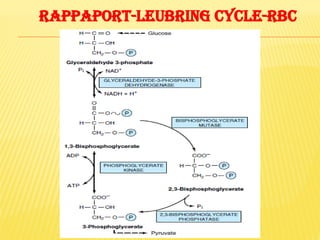
RAPPAPORT-LEUBRING CYCLE-RBC
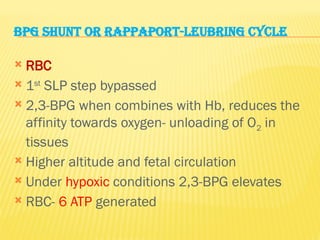
BPG SHUNT OR RAPPAPORT-LEUBRING CYCLE
 RBC
 1st
SLP step bypassed
 2,3-BPG when combines with Hb, reduces the
affinity towards oxygen- unloading of O2 in
tissues
 Higher altitude and fetal circulation
 Under hypoxic conditions 2,3-BPG elevates
 RBC- 6 ATP generated
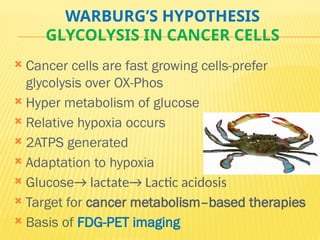
WARBURG’S HYPOTHESIS
GLYCOLYSIS IN CANCER CELLS
 Cancer cells are fast growing cells-prefer
glycolysis over OX-Phos
 Hyper metabolism of glucose
 Relative hypoxia occurs
 2ATPS generated
 Adaptation to hypoxia
 Glucose→ lactate→ Lactic acidosis
 Target for cancer metabolism–based therapies
 Basis of FDG-PET imaging
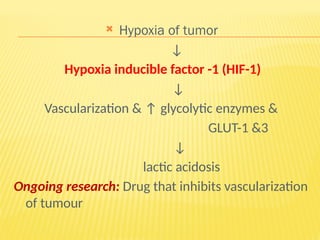
 Hypoxia of tumor
↓
Hypoxia inducible factor -1 (HIF-1)
↓
Vascularization & ↑ glycolytic enzymes &
GLUT-1 &3
↓
lactic acidosis
Ongoing research: Drug that inhibits vascularization
of tumour
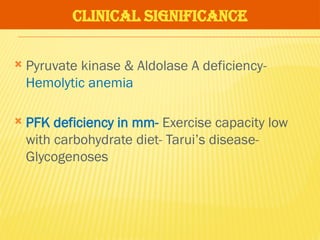
CLINICAL SIGNIFICANCE
 Pyruvate kinase & Aldolase A deficiency-
Hemolytic anemia
 PFK deficiency in mm- Exercise capacity low
with carbohydrate diet- Tarui’s disease-
Glycogenoses
Whether you are right or wrong,
you will always find people who disagree with you
WWW.DRVPACHARYA.COM
For more PPT in Medical Biochemistry