Respiratory Physiology-2
Dr. Sanjaya bharathi
Dept of Anaesthesia ,KMCH.
FRC
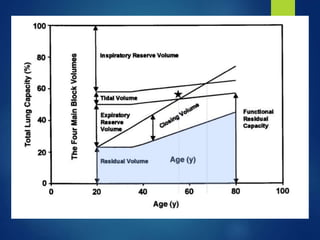
 FRC = ERV + RV(30 ML/KG)
 The FRC is the balance between the tendency of the chest wall to
spring outwards and the tendency of the lung to collapse. FRC is
not the same volume all the time; it can be disrupted by many
factors Factors increasing FRC
 Increasing height of patient
 Erect position – diaphragm and abdominal organs less able to
encroach upon bases of the lungs
 Emphysema – decreased elastic recoil of lung therefore less
tendency of lung to collapse
 Asthma – air trapping
 Factors decreasing FRC
 Age
 Posture – supine position
 Anaesthesia – muscle relaxants
 Surgery – Laparoscopic
 Pulmonary fibrosis
 Pulmonary oedema
 Obesity
 Abdominal Swelling
 Reduced muscle tone – Reduced diaphragm tone will
reduce pull away from the lungs
 Pregnancy – Increased abdominal pressure
CLOSING CAPACITY
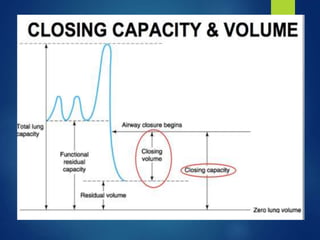
 This is the volume at which the small airways close during
expiration. Under normal circumstances the FRC is always
greater than the CC however if the FRC was to decrease
then this would no longer be the case and the small
airways may close at the end of normal tidal expiration.
This leads to hypoxaemia, atelectasis and worsening gas
exchange due to increasing V/Q mismatch. CC=CV+RV
 Closing capacity increases with age. Typically closing
capacity is equal to FRC at the age of 66 in the erect
position or 44 in the supine position. The application of
PEEP enables the FRC to remain greater then CC and
improves oxygenation
 PEEP maintains the lungs on the steep part of the
compliance curve which lessens collapse at the bases of
the lungs.
• Preoxygenation
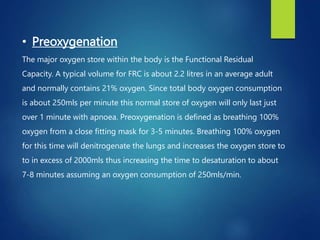
The major oxygen store within the body is the Functional Residual
Capacity. A typical volume for FRC is about 2.2 litres in an average adult
and normally contains 21% oxygen. Since total body oxygen consumption
is about 250mls per minute this normal store of oxygen will only last just
over 1 minute with apnoea. Preoxygenation is defined as breathing 100%
oxygen from a close fitting mask for 3-5 minutes. Breathing 100% oxygen
for this time will denitrogenate the lungs and increases the oxygen store to
to in excess of 2000mls thus increasing the time to desaturation to about
7-8 minutes assuming an oxygen consumption of 250mls/min.
Ventilation Perfusion ratio
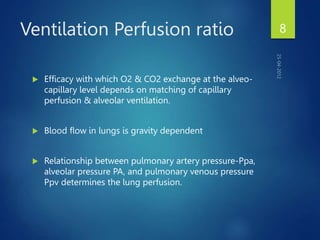
 Efficacy with which O2 & CO2 exchange at the alveo-
capillary level depends on matching of capillary
perfusion & alveolar ventilation.
 Blood flow in lungs is gravity dependent
 Relationship between pulmonary artery pressure-Ppa,
alveolar pressure PA, and pulmonary venous pressure
Ppv determines the lung perfusion.
8
Lung Ventilation/Perfusion
Ratios
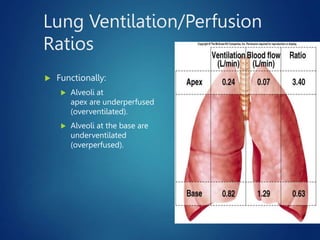
 Functionally:
 Alveoli at
apex are underperfused
(overventilated).
 Alveoli at the base are
underventilated
(overperfused).
www.freelivedoctor.com
Insert fig. 16.24
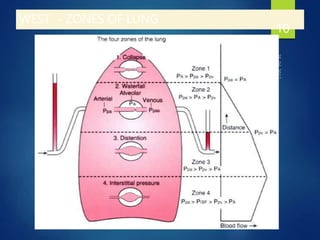
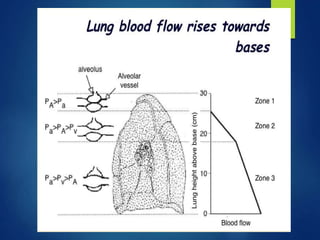
WEST - ZONES OF LUNG
10
West-zones of Lung contd…..
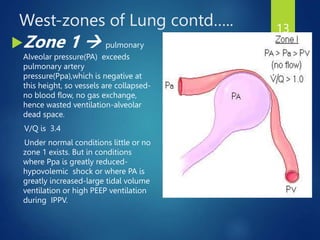
Zone 1  pulmonary
Alveolar pressure(PA) exceeds
pulmonary artery
pressure(Ppa),which is negative at
this height, so vessels are collapsed-
no blood flow, no gas exchange,
hence wasted ventilation-alveolar
dead space.
V/Q is 3.4
Under normal conditions little or no
zone 1 exists. But in conditions
where Ppa is greatly reduced-
hypovolemic shock or where PA is
greatly increased-large tidal volume
ventilation or high PEEP ventilation
during IPPV.
13
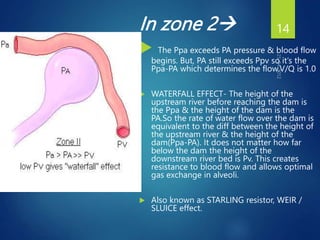
In zone 2
 The Ppa exceeds PA pressure & blood flow
begins. But, PA still exceeds Ppv so it’s the
Ppa-PA which determines the flow.V/Q is 1.0
 WATERFALL EFFECT- The height of the
upstream river before reaching the dam is
the Ppa & the height of the dam is the
PA.So the rate of water flow over the dam is
equivalent to the diff between the height of
the upstream river & the height of the
dam(Ppa-PA). It does not matter how far
below the dam the height of the
downstream river bed is Pv. This creates
resistance to blood flow and allows optimal
gas exchange in alveoli.
 Also known as STARLING resistor, WEIR /
SLUICE effect.
14
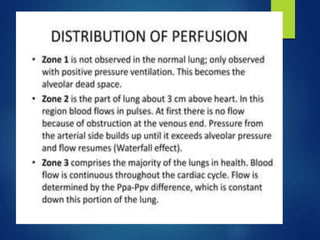
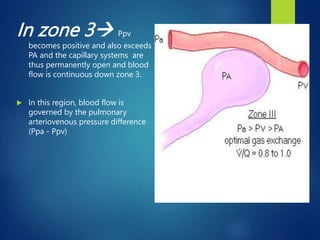
In zone 3 Ppv
becomes positive and also exceeds
PA and the capillary systems are
thus permanently open and blood
flow is continuous down zone 3.
 In this region, blood flow is
governed by the pulmonary
arteriovenous pressure difference
(Ppa - Ppv)
15
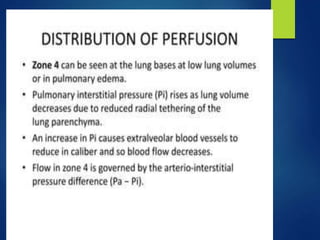
In zone 4 Ppa > PISF > Ppv > PA
 A region of the lung from which a large amount of fluid has
transuded into the pulmonary interstitial compartment or is
possibly at a very low lung volume.
 blood flow is governed by the arteriointerstitial pressure difference
(Ppa - PISF), which is less than Ppa - Ppv difference, and therefore
zone 4 blood flow is less than zone 3.
 This produces positive interstitial pressure, which causes
compression of extra-alveolar vessels, increased extra alveolar
vascular resistance, and decreased regional blood flow.
16
17
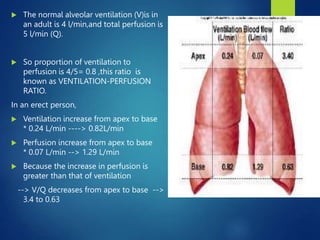
 The normal alveolar ventilation (V)is in
an adult is 4 l/min,and total perfusion is
5 l/min (Q).
 So proportion of ventilation to
perfusion is 4/5= 0.8 ,this ratio is
known as VENTILATION-PERFUSION
RATIO.
In an erect person,
 Ventilation increase from apex to base
* 0.24 L/min ----> 0.82L/min
 Perfusion increase from apex to base
* 0.07 L/min --> 1.29 L/min
 Because the increase in perfusion is
greater than that of ventilation
--> V/Q decreases from apex to base -->
3.4 to 0.63
18
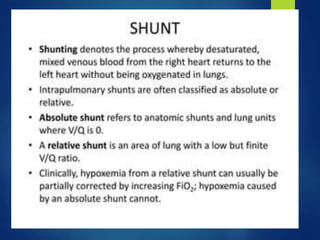
Perfusion without ventilation
(shunting)
 Intra-pulmonary
 Small airways occluded ( e.g asthma, chronic
bronchitis)
 Alveoli are filled with fluid ( e.g pulmonary edema,
pneumonia)
 Alveolar collapse ( e.g atelectasis)
Ventilation without
perfusion(Dead Space)
 Definition of dead space - the volume occupied by gas which
does not participate in gas exchange in lung.
 A few different types, including:
1.anatomical dead space
2.physiological dead space
3.alveolar dead space
4.apparatus dead space
21
Anatomical dead space
 Anatomical dead space is the volume of the conducting airways i.e.
from nostrils and mouth down to respiratory bronchioles.
 => about 150mL in an average adult
 => or 2.2mLs/kg ,it is constant regardless of circulation.
22
Anatomical Dead Space
 Not all of the inspired air reached the alveoli.
 As fresh air is inhaled it is mixed with air in anatomical
dead space.
 Conducting zone and alveoli where [02] is lower than
normal and [C02] is higher than normal.
 Alveolar ventilation = F x (TV- DS).(apprx 5L).
 F = frequency (breaths/min.).
 TV = tidal volume.
 DS = dead space.
www.freelivedoctor.com
Factors influencing anatomical dead space
 Size of subject
=> increases with body size
 Age , sex
=> at infancy, anatomical dead space is higher for body weight (3.3mL/kg)
,it may be 100 ml in young woman and 200 ml in old man.
 Posture
=> sitting 147mL, supine 101mL
 Position of neck and jaw ; Depression of jaw with flexion of head ( as occurs
in respiratory obstruction in anesthetized person) can reduce dead space by
30 ml.on contrary protrusion of jaw with neck extension may increase by 40
ml.
 Lung volume at the end of inspiration
=> anatomical dead space increases by 20mL for each L of lung volume
 Drugs
e.g. bronchodilator will increase dead space
24
Alveolar dead space
 Alveolar dead space is the part of the inspired gas which passes
through the anatomical dead space to mix with gas at the alveolar
level, but does not participate in gas exchange. (i.e. infinite V/Q) This
occurs when areas of the lung are being ventilated but not being
perfused and this leads to what is known as V/Q mismatch.
Factors increasing alveolar dead space
 Low cardiac output can increase alveolar dead space (increasing
West's zone 1)
 Pulmonary embolism,pneumonia,pulmonary edema.
25
Physiological dead space
 Physiological dead space is that part of the tidal volume which does
not participate in gas exchange.
Includes:
 anatomical dead space
 Alveolar dead space,alveoli with no perfusion (i.e. infinite V/Q) (e.g.
West's zone 1)
 In normal man, anatomical & Physiological dead space numerically
remains equal and is about 1/3 of tidal volume.
26
Increase in physiological dead space
 old age,
 upright position,
 large tidal volume,
 high RR,
 after atropine administration,
 during controlled ventilation with
inspiratory time reduced to 0.5 or less,
 in presence of lung diseases,
 pulmonary embolism,
 lung hemorrhage,
 hypotensive anesthesia.
 Chronic bronchitis & asthma
physiological dead space may
rise to 50-80% of tidal volume.
27
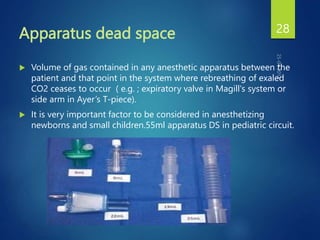
Apparatus dead space
 Volume of gas contained in any anesthetic apparatus between the
patient and that point in the system where rebreathing of exaled
CO2 ceases to occur ( e.g. ; expiratory valve in Magill's system or
side arm in Ayer’s T-piece).
 It is very important factor to be considered in anesthetizing
newborns and small children.55ml apparatus DS in pediatric circuit.
28
29
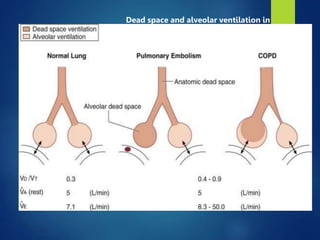
Dead space and alveolar ventilation in
normal and diseased lungs.
Dead space ventilation
 DSV increase:
 Alveolar-capillary interface destroyed e.g emphysema
 Blood flow is reduced e.g CHF, PE
 Overdistended alveoli e.g positive- pressure
ventilation
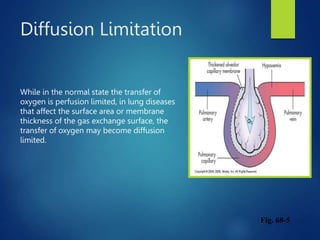
Diffusion Limitation
Fig. 68-5
While in the normal state the transfer of
oxygen is perfusion limited, in lung diseases
that affect the surface area or membrane
thickness of the gas exchange surface, the
transfer of oxygen may become diffusion
limited.
Diffusion limitation
 Severe emphysema
 Recurrent pulmonary emboli
 Pulmonary fibrosis
 Hypoxemia present during exercise
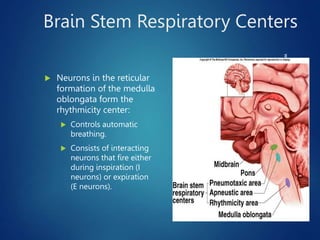
Brain Stem Respiratory Centers
 Neurons in the reticular
formation of the medulla
oblongata form the
rhythmicity center:
 Controls automatic
breathing.
 Consists of interacting
neurons that fire either
during inspiration (I
neurons) or expiration
(E neurons).
www.freelivedoctor.com
Insert fig. 16.25
Brain Stem Respiratory
Centers (continued)
 I neurons project to, and stimulate spinal motor
neurons that innervate respiratory muscles.
 Expiration is a passive process that occurs when the I
neurons are inhibited.
 Activity varies in a reciprocal way.
www.freelivedoctor.com
Rhythmicity Center
 I neurons located primarily in dorsal respiratory group
(DRG):
 Regulate activity of phrenic nerve.
 Project to and stimulate spinal interneurons that innervate
respiratory muscles.
 E neurons located in ventral respiratory group (VRG):
 Passive process.
 Controls motor neurons to the internal intercostal muscles.
 Activity of E neurons inhibit I neurons.
 Rhythmicity of I and E neurons may be due to pacemaker
neurons.
www.freelivedoctor.com
Pons Respiratory Centers
 Activities of medullary rhythmicity center is influenced
by pons.
 Apneustic center:
 Promotes inspiration by stimulating the I neurons in the
medulla.
 Pneumotaxic center:
 Antagonizes the apneustic center.
 Inhibits inspiration.
www.freelivedoctor.com
 The apneustic center in the pons increases the depth and
duration of inspiration, whereas the pneumotaxic center
decreases depth and duration.
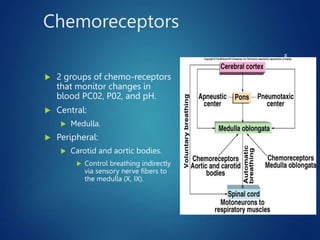
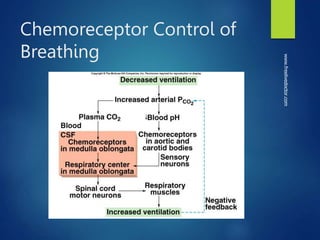
Chemoreceptors
 2 groups of chemo-receptors
that monitor changes in
blood PC02, P02, and pH.
 Central:
 Medulla.
 Peripheral:
 Carotid and aortic bodies.
 Control breathing indirectly
via sensory nerve fibers to
the medulla (X, IX).
www.freelivedoctor.com
Insert fig. 16.27
Effects of Blood PC02 and
pH on Ventilation
 Chemoreceptor input modifies the rate and depth of
breathing.
 Oxygen content of blood decreases more slowly because
of the large “reservoir” of oxygen attached to
hemoglobin.
 Chemoreceptors are sensitive to changes in PO2,ph and
PC02.
 H20 + C02 H2C03 H+ + HC03-
 Rate and depth of ventilation adjusted to maintain
arterial PC02 of 40 mm Hg.
www.freelivedoctor.com
Peripheral chemoreceptors
 They are located in carotid bodies(near common
carotid artery bifurcation) in aortic bodies(along aortic
arch). They are
very sensitive to decrease in PO2,increase in
PCO2,decrease in ph. Decrease of PO2 causes
increase in ventilation which increases heart rate and
cardiac output.
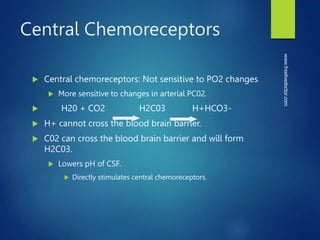
Central Chemoreceptors
 Central chemoreceptors: Not sensitive to PO2 changes
 More sensitive to changes in arterial PC02.
 H20 + CO2 H2C03 H+HCO3-
 H+ cannot cross the blood brain barrier.
 C02 can cross the blood brain barrier and will form
H2C03.
 Lowers pH of CSF.
 Directly stimulates central chemoreceptors.
www.freelivedoctor.com
Chemoreceptor Control of
Breathing
www.freelivedoctor.com
Effects of Blood P02 on
Ventilation
 Blood PO2 affected by breathing indirectly. Decreased
arterial Po2 reflexly stimulates respiratory activity. This
stimulus is particularly strong when arterial Po2 drops
below 60 mm Hg. Above Pao2 of 80 mm Hg, O2 has
little effect on respiratory drive. Normal Pao2 is 95 mm
Hg, so O2 control of respiration is normally of minor
importance.
 Abnormally high PC02 enhances sensitivity of carotid
bodies to fall in P02.
www.freelivedoctor.com
Thoracic Neural Receptors
Mechanoreceptors found in the airways, trachea, lung, and pulmonary vessels
provide sensory information to the respiratory center in the brain with regards
to lung volume, airway stretch, and vascular congestion. There are two
primary types of thoracic sensors: slow adapting stretch spindles and rapid
adapting irritant receptors. The former conveys only volume information while
the latter additionally responds to irritative chemical triggers such as harmful
harmful foreign agents and dust. Both types of mechanoreceptors transmit
information to the respiratory center via cranial nerve X (the vagus nerve) to
increase the breathing rate, the volume of breathing, or to stimulate cough.
A notable example is the Pulmonary stretch reflex, also called the Herring-
Breuer reflex, which prevents the lungs from over-inflating by sending
inhibitory impulses to the inspiration center. Another type of receptor worth
mentioning is the juxta-capillary receptors that respond to vascular
congestion and interstitial edema in the lungs by sending signals to the brain
to increase the breathing rate.
Conditions affecting
respiratory center
 During an acute asthma attack, severe inflammation
occurs, leading to airway narrowing, excess mucus
production, and bronchoconstriction. Subsequently,
hypoxia develops due to impaired gas exchange.
Hypoxia stimulates peripheral chemoreceptors, which,
in turn, transmit the signal to the respiratory control
center in the brain. The respiratory center increases its
firing rate leading to enhanced respiratory rate and
resultant hypocapnia
 COPD patients with an acute exacerbation have
difficulty increasing their minute ventilation to blow off
the excess CO2 and therefore struggle to normalize
PaCO2 in this setting. Regardless of the specific
physiologic mechanism for oxygen-induced
hypercapnia, the relevant consensus is that patients
with acute COPD exacerbation should be given titrated
oxygen therapy with a target of 88-92% oxygen
saturation to reduce both hypoxia and the risk of
hypercapnia.
Congenital Central Hypoventilation Syndrome (CCHS)
• Congenital central hypoventilation syndrome, sometimes known as
Ondine's curse, is a rare genetic disease caused by a mutation that
renders the respiratory center in the brain unresponsive to changes in
PCO2. When breathing fails to happen unconsciously, the patient
becomes dependent on conscious control (cortex). Patients generally
have breathing problems during sleep that tend to get better while
awake . Inhaled anesthetics
decrease response to increased carbon dioxide and decreased
oxygenation, thus blunting respiratory drive adjustments
Obesity hypoventilation syndrome, also known as Pickwickian syndrome, is a
condition that affects morbidly obese individuals. Obesity alters lung and chest
wall mechanics leading to hypoventilation and resultant hypercapnia. The
patient initially compensates by increasing respiratory drive and work of
breathing. However, respiratory fatigue rapidly ensures that hypercapnia and
hypoxia occur . opioid narcotics act on mu-opioid
receptors in the central nervous system. They primarily target the preBötzinger
complex within the pacemaking system of respiration, thus reducing the
underlying drive for breathing .
Respiratory muscle weakness eventually occurs in neuromuscular diseases,
causing hypoventilation and resultant hypoxia and hypercapnia.
WORK OF BREATHING
 Work of breathing (WOB) is the amount of energy or
O2 consumption needed by the respiratory muscles to produce
enough ventilation and respiration to meet the metabolic
demands of the body.
The components include work needed to overcome elastic
recoil of the lung and to displace the chest wall and abdomen
as well as work needed to overcome airway resistance and
lung viscosity and work needed to overcome inertia.
WOB -contd
 With restrictive lung diseases, the inspiratory work of
breathing is increased because of the decreased lung
elasticity. With obstructive diseases, the work of
breathing is increased because of increased airway
resistance. Patients using their accessory muscles may
indicate increased work of breathing
 If used correctly CPAP can reduce the work of
breathing by increasing FRC
Gas Exchange in the Lungs
 Dalton’s Law:
 Total pressure of a gas mixture is = to the sum of the
pressures that each gas in the mixture would exert
independently.
 Partial pressure:
 The pressure that an particular gas exerts independently.
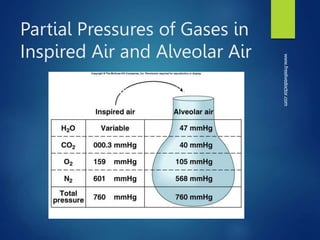
 Patm = PN2 + P02 + PC02 + PH20= 760 mm Hg.
www.freelivedoctor.com
Partial Pressures of Gases in
Inspired Air and Alveolar Air
www.freelivedoctor.com
Insert fig. 16.20
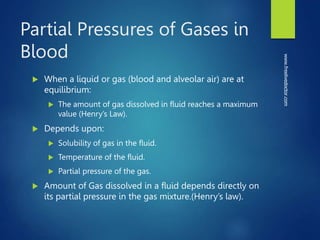
Partial Pressures of Gases in
Blood
 When a liquid or gas (blood and alveolar air) are at
equilibrium:
 The amount of gas dissolved in fluid reaches a maximum
value (Henry’s Law).
 Depends upon:
 Solubility of gas in the fluid.
 Temperature of the fluid.
 Partial pressure of the gas.
 Amount of Gas dissolved in a fluid depends directly on
its partial pressure in the gas mixture.(Henry’s law).
www.freelivedoctor.com
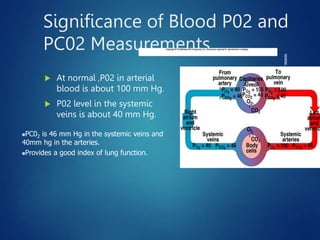
Significance of Blood P02 and
PC02 Measurements
 At normal ,P02 in arterial
blood is about 100 mm Hg.
 P02 level in the systemic
veins is about 40 mm Hg.
www.freelivedoctor.com
PC02 is 46 mm Hg in the systemic veins and
40mm hg in the arteries.
Provides a good index of lung function.
Pulmonary Circulation
 Rate of blood flow through the pulmonary circulation
is = flow rate through the systemic circulation.
 Driving pressure is about 10 mm Hg.
 Pulmonary vascular resistance is low.
 Low pressure pathway produces less net filtration than
produced in the systemic capillaries.
 Avoids pulmonary edema.
 Autoregulation:
 Pulmonary arterioles constrict when alveolar P02
decreases.
 Matches ventilation/perfusion ratio.
www.freelivedoctor.com
Pulmonary Circulation
(continued)
 In a fetus:
 Pulmonary circulation has a higher vascular resistance,
because the lungs are partially collapsed.
 After birth, vascular resistance decreases:
 Opening the vessels as a result of subatmospheric
intrapulmonary pressure.
 Physical stretching of the lungs.
 Dilation of pulmonary arterioles in response to increased
alveolar P02.
www.freelivedoctor.com
Respiratory Physiology-2 sanjay.pptx good

Respiratory Physiology-2 sanjay.pptx good

  • 1.
    Respiratory Physiology-2 Dr. Sanjayabharathi Dept of Anaesthesia ,KMCH.
  • 2.
    FRC  FRC =ERV + RV(30 ML/KG)  The FRC is the balance between the tendency of the chest wall to spring outwards and the tendency of the lung to collapse. FRC is not the same volume all the time; it can be disrupted by many factors Factors increasing FRC  Increasing height of patient  Erect position – diaphragm and abdominal organs less able to encroach upon bases of the lungs  Emphysema – decreased elastic recoil of lung therefore less tendency of lung to collapse  Asthma – air trapping
  • 3.
     Factors decreasingFRC  Age  Posture – supine position  Anaesthesia – muscle relaxants  Surgery – Laparoscopic  Pulmonary fibrosis  Pulmonary oedema  Obesity  Abdominal Swelling  Reduced muscle tone – Reduced diaphragm tone will reduce pull away from the lungs  Pregnancy – Increased abdominal pressure
  • 4.
    CLOSING CAPACITY  Thisis the volume at which the small airways close during expiration. Under normal circumstances the FRC is always greater than the CC however if the FRC was to decrease then this would no longer be the case and the small airways may close at the end of normal tidal expiration. This leads to hypoxaemia, atelectasis and worsening gas exchange due to increasing V/Q mismatch. CC=CV+RV  Closing capacity increases with age. Typically closing capacity is equal to FRC at the age of 66 in the erect position or 44 in the supine position. The application of PEEP enables the FRC to remain greater then CC and improves oxygenation  PEEP maintains the lungs on the steep part of the compliance curve which lessens collapse at the bases of the lungs.
  • 7.
    • Preoxygenation The majoroxygen store within the body is the Functional Residual Capacity. A typical volume for FRC is about 2.2 litres in an average adult and normally contains 21% oxygen. Since total body oxygen consumption is about 250mls per minute this normal store of oxygen will only last just over 1 minute with apnoea. Preoxygenation is defined as breathing 100% oxygen from a close fitting mask for 3-5 minutes. Breathing 100% oxygen for this time will denitrogenate the lungs and increases the oxygen store to to in excess of 2000mls thus increasing the time to desaturation to about 7-8 minutes assuming an oxygen consumption of 250mls/min.
  • 8.
    Ventilation Perfusion ratio Efficacy with which O2 & CO2 exchange at the alveo- capillary level depends on matching of capillary perfusion & alveolar ventilation.  Blood flow in lungs is gravity dependent  Relationship between pulmonary artery pressure-Ppa, alveolar pressure PA, and pulmonary venous pressure Ppv determines the lung perfusion. 8
  • 9.
    Lung Ventilation/Perfusion Ratios  Functionally: Alveoli at apex are underperfused (overventilated).  Alveoli at the base are underventilated (overperfused). www.freelivedoctor.com Insert fig. 16.24
  • 10.
    WEST - ZONESOF LUNG 10
  • 13.
    West-zones of Lungcontd….. Zone 1  pulmonary Alveolar pressure(PA) exceeds pulmonary artery pressure(Ppa),which is negative at this height, so vessels are collapsed- no blood flow, no gas exchange, hence wasted ventilation-alveolar dead space. V/Q is 3.4 Under normal conditions little or no zone 1 exists. But in conditions where Ppa is greatly reduced- hypovolemic shock or where PA is greatly increased-large tidal volume ventilation or high PEEP ventilation during IPPV. 13
  • 14.
    In zone 2 The Ppa exceeds PA pressure & blood flow begins. But, PA still exceeds Ppv so it’s the Ppa-PA which determines the flow.V/Q is 1.0  WATERFALL EFFECT- The height of the upstream river before reaching the dam is the Ppa & the height of the dam is the PA.So the rate of water flow over the dam is equivalent to the diff between the height of the upstream river & the height of the dam(Ppa-PA). It does not matter how far below the dam the height of the downstream river bed is Pv. This creates resistance to blood flow and allows optimal gas exchange in alveoli.  Also known as STARLING resistor, WEIR / SLUICE effect. 14
  • 15.
    In zone 3Ppv becomes positive and also exceeds PA and the capillary systems are thus permanently open and blood flow is continuous down zone 3.  In this region, blood flow is governed by the pulmonary arteriovenous pressure difference (Ppa - Ppv) 15
  • 16.
    In zone 4Ppa > PISF > Ppv > PA  A region of the lung from which a large amount of fluid has transuded into the pulmonary interstitial compartment or is possibly at a very low lung volume.  blood flow is governed by the arteriointerstitial pressure difference (Ppa - PISF), which is less than Ppa - Ppv difference, and therefore zone 4 blood flow is less than zone 3.  This produces positive interstitial pressure, which causes compression of extra-alveolar vessels, increased extra alveolar vascular resistance, and decreased regional blood flow. 16
  • 17.
  • 18.
     The normalalveolar ventilation (V)is in an adult is 4 l/min,and total perfusion is 5 l/min (Q).  So proportion of ventilation to perfusion is 4/5= 0.8 ,this ratio is known as VENTILATION-PERFUSION RATIO. In an erect person,  Ventilation increase from apex to base * 0.24 L/min ----> 0.82L/min  Perfusion increase from apex to base * 0.07 L/min --> 1.29 L/min  Because the increase in perfusion is greater than that of ventilation --> V/Q decreases from apex to base --> 3.4 to 0.63 18
  • 20.
    Perfusion without ventilation (shunting) Intra-pulmonary  Small airways occluded ( e.g asthma, chronic bronchitis)  Alveoli are filled with fluid ( e.g pulmonary edema, pneumonia)  Alveolar collapse ( e.g atelectasis)
  • 21.
    Ventilation without perfusion(Dead Space) Definition of dead space - the volume occupied by gas which does not participate in gas exchange in lung.  A few different types, including: 1.anatomical dead space 2.physiological dead space 3.alveolar dead space 4.apparatus dead space 21
  • 22.
    Anatomical dead space Anatomical dead space is the volume of the conducting airways i.e. from nostrils and mouth down to respiratory bronchioles.  => about 150mL in an average adult  => or 2.2mLs/kg ,it is constant regardless of circulation. 22
  • 23.
    Anatomical Dead Space Not all of the inspired air reached the alveoli.  As fresh air is inhaled it is mixed with air in anatomical dead space.  Conducting zone and alveoli where [02] is lower than normal and [C02] is higher than normal.  Alveolar ventilation = F x (TV- DS).(apprx 5L).  F = frequency (breaths/min.).  TV = tidal volume.  DS = dead space. www.freelivedoctor.com
  • 24.
    Factors influencing anatomicaldead space  Size of subject => increases with body size  Age , sex => at infancy, anatomical dead space is higher for body weight (3.3mL/kg) ,it may be 100 ml in young woman and 200 ml in old man.  Posture => sitting 147mL, supine 101mL  Position of neck and jaw ; Depression of jaw with flexion of head ( as occurs in respiratory obstruction in anesthetized person) can reduce dead space by 30 ml.on contrary protrusion of jaw with neck extension may increase by 40 ml.  Lung volume at the end of inspiration => anatomical dead space increases by 20mL for each L of lung volume  Drugs e.g. bronchodilator will increase dead space 24
  • 25.
    Alveolar dead space Alveolar dead space is the part of the inspired gas which passes through the anatomical dead space to mix with gas at the alveolar level, but does not participate in gas exchange. (i.e. infinite V/Q) This occurs when areas of the lung are being ventilated but not being perfused and this leads to what is known as V/Q mismatch. Factors increasing alveolar dead space  Low cardiac output can increase alveolar dead space (increasing West's zone 1)  Pulmonary embolism,pneumonia,pulmonary edema. 25
  • 26.
    Physiological dead space Physiological dead space is that part of the tidal volume which does not participate in gas exchange. Includes:  anatomical dead space  Alveolar dead space,alveoli with no perfusion (i.e. infinite V/Q) (e.g. West's zone 1)  In normal man, anatomical & Physiological dead space numerically remains equal and is about 1/3 of tidal volume. 26
  • 27.
    Increase in physiologicaldead space  old age,  upright position,  large tidal volume,  high RR,  after atropine administration,  during controlled ventilation with inspiratory time reduced to 0.5 or less,  in presence of lung diseases,  pulmonary embolism,  lung hemorrhage,  hypotensive anesthesia.  Chronic bronchitis & asthma physiological dead space may rise to 50-80% of tidal volume. 27
  • 28.
    Apparatus dead space Volume of gas contained in any anesthetic apparatus between the patient and that point in the system where rebreathing of exaled CO2 ceases to occur ( e.g. ; expiratory valve in Magill's system or side arm in Ayer’s T-piece).  It is very important factor to be considered in anesthetizing newborns and small children.55ml apparatus DS in pediatric circuit. 28
  • 29.
    29 Dead space andalveolar ventilation in normal and diseased lungs.
  • 30.
    Dead space ventilation DSV increase:  Alveolar-capillary interface destroyed e.g emphysema  Blood flow is reduced e.g CHF, PE  Overdistended alveoli e.g positive- pressure ventilation
  • 31.
    Diffusion Limitation Fig. 68-5 Whilein the normal state the transfer of oxygen is perfusion limited, in lung diseases that affect the surface area or membrane thickness of the gas exchange surface, the transfer of oxygen may become diffusion limited.
  • 32.
    Diffusion limitation  Severeemphysema  Recurrent pulmonary emboli  Pulmonary fibrosis  Hypoxemia present during exercise
  • 33.
    Brain Stem RespiratoryCenters  Neurons in the reticular formation of the medulla oblongata form the rhythmicity center:  Controls automatic breathing.  Consists of interacting neurons that fire either during inspiration (I neurons) or expiration (E neurons). www.freelivedoctor.com Insert fig. 16.25
  • 34.
    Brain Stem Respiratory Centers(continued)  I neurons project to, and stimulate spinal motor neurons that innervate respiratory muscles.  Expiration is a passive process that occurs when the I neurons are inhibited.  Activity varies in a reciprocal way. www.freelivedoctor.com
  • 35.
    Rhythmicity Center  Ineurons located primarily in dorsal respiratory group (DRG):  Regulate activity of phrenic nerve.  Project to and stimulate spinal interneurons that innervate respiratory muscles.  E neurons located in ventral respiratory group (VRG):  Passive process.  Controls motor neurons to the internal intercostal muscles.  Activity of E neurons inhibit I neurons.  Rhythmicity of I and E neurons may be due to pacemaker neurons. www.freelivedoctor.com
  • 36.
    Pons Respiratory Centers Activities of medullary rhythmicity center is influenced by pons.  Apneustic center:  Promotes inspiration by stimulating the I neurons in the medulla.  Pneumotaxic center:  Antagonizes the apneustic center.  Inhibits inspiration. www.freelivedoctor.com  The apneustic center in the pons increases the depth and duration of inspiration, whereas the pneumotaxic center decreases depth and duration.
  • 37.
    Chemoreceptors  2 groupsof chemo-receptors that monitor changes in blood PC02, P02, and pH.  Central:  Medulla.  Peripheral:  Carotid and aortic bodies.  Control breathing indirectly via sensory nerve fibers to the medulla (X, IX). www.freelivedoctor.com Insert fig. 16.27
  • 38.
    Effects of BloodPC02 and pH on Ventilation  Chemoreceptor input modifies the rate and depth of breathing.  Oxygen content of blood decreases more slowly because of the large “reservoir” of oxygen attached to hemoglobin.  Chemoreceptors are sensitive to changes in PO2,ph and PC02.  H20 + C02 H2C03 H+ + HC03-  Rate and depth of ventilation adjusted to maintain arterial PC02 of 40 mm Hg. www.freelivedoctor.com
  • 39.
    Peripheral chemoreceptors  Theyare located in carotid bodies(near common carotid artery bifurcation) in aortic bodies(along aortic arch). They are very sensitive to decrease in PO2,increase in PCO2,decrease in ph. Decrease of PO2 causes increase in ventilation which increases heart rate and cardiac output.
  • 40.
    Central Chemoreceptors  Centralchemoreceptors: Not sensitive to PO2 changes  More sensitive to changes in arterial PC02.  H20 + CO2 H2C03 H+HCO3-  H+ cannot cross the blood brain barrier.  C02 can cross the blood brain barrier and will form H2C03.  Lowers pH of CSF.  Directly stimulates central chemoreceptors. www.freelivedoctor.com
  • 41.
  • 42.
    Effects of BloodP02 on Ventilation  Blood PO2 affected by breathing indirectly. Decreased arterial Po2 reflexly stimulates respiratory activity. This stimulus is particularly strong when arterial Po2 drops below 60 mm Hg. Above Pao2 of 80 mm Hg, O2 has little effect on respiratory drive. Normal Pao2 is 95 mm Hg, so O2 control of respiration is normally of minor importance.  Abnormally high PC02 enhances sensitivity of carotid bodies to fall in P02. www.freelivedoctor.com
  • 43.
    Thoracic Neural Receptors Mechanoreceptorsfound in the airways, trachea, lung, and pulmonary vessels provide sensory information to the respiratory center in the brain with regards to lung volume, airway stretch, and vascular congestion. There are two primary types of thoracic sensors: slow adapting stretch spindles and rapid adapting irritant receptors. The former conveys only volume information while the latter additionally responds to irritative chemical triggers such as harmful harmful foreign agents and dust. Both types of mechanoreceptors transmit information to the respiratory center via cranial nerve X (the vagus nerve) to increase the breathing rate, the volume of breathing, or to stimulate cough. A notable example is the Pulmonary stretch reflex, also called the Herring- Breuer reflex, which prevents the lungs from over-inflating by sending inhibitory impulses to the inspiration center. Another type of receptor worth mentioning is the juxta-capillary receptors that respond to vascular congestion and interstitial edema in the lungs by sending signals to the brain to increase the breathing rate.
  • 44.
    Conditions affecting respiratory center During an acute asthma attack, severe inflammation occurs, leading to airway narrowing, excess mucus production, and bronchoconstriction. Subsequently, hypoxia develops due to impaired gas exchange. Hypoxia stimulates peripheral chemoreceptors, which, in turn, transmit the signal to the respiratory control center in the brain. The respiratory center increases its firing rate leading to enhanced respiratory rate and resultant hypocapnia
  • 45.
     COPD patientswith an acute exacerbation have difficulty increasing their minute ventilation to blow off the excess CO2 and therefore struggle to normalize PaCO2 in this setting. Regardless of the specific physiologic mechanism for oxygen-induced hypercapnia, the relevant consensus is that patients with acute COPD exacerbation should be given titrated oxygen therapy with a target of 88-92% oxygen saturation to reduce both hypoxia and the risk of hypercapnia.
  • 46.
    Congenital Central HypoventilationSyndrome (CCHS) • Congenital central hypoventilation syndrome, sometimes known as Ondine's curse, is a rare genetic disease caused by a mutation that renders the respiratory center in the brain unresponsive to changes in PCO2. When breathing fails to happen unconsciously, the patient becomes dependent on conscious control (cortex). Patients generally have breathing problems during sleep that tend to get better while awake . Inhaled anesthetics decrease response to increased carbon dioxide and decreased oxygenation, thus blunting respiratory drive adjustments
  • 47.
    Obesity hypoventilation syndrome,also known as Pickwickian syndrome, is a condition that affects morbidly obese individuals. Obesity alters lung and chest wall mechanics leading to hypoventilation and resultant hypercapnia. The patient initially compensates by increasing respiratory drive and work of breathing. However, respiratory fatigue rapidly ensures that hypercapnia and hypoxia occur . opioid narcotics act on mu-opioid receptors in the central nervous system. They primarily target the preBötzinger complex within the pacemaking system of respiration, thus reducing the underlying drive for breathing . Respiratory muscle weakness eventually occurs in neuromuscular diseases, causing hypoventilation and resultant hypoxia and hypercapnia.
  • 48.
    WORK OF BREATHING Work of breathing (WOB) is the amount of energy or O2 consumption needed by the respiratory muscles to produce enough ventilation and respiration to meet the metabolic demands of the body. The components include work needed to overcome elastic recoil of the lung and to displace the chest wall and abdomen as well as work needed to overcome airway resistance and lung viscosity and work needed to overcome inertia.
  • 49.
    WOB -contd  Withrestrictive lung diseases, the inspiratory work of breathing is increased because of the decreased lung elasticity. With obstructive diseases, the work of breathing is increased because of increased airway resistance. Patients using their accessory muscles may indicate increased work of breathing  If used correctly CPAP can reduce the work of breathing by increasing FRC
  • 50.
    Gas Exchange inthe Lungs  Dalton’s Law:  Total pressure of a gas mixture is = to the sum of the pressures that each gas in the mixture would exert independently.  Partial pressure:  The pressure that an particular gas exerts independently.  Patm = PN2 + P02 + PC02 + PH20= 760 mm Hg. www.freelivedoctor.com
  • 51.
    Partial Pressures ofGases in Inspired Air and Alveolar Air www.freelivedoctor.com Insert fig. 16.20
  • 52.
    Partial Pressures ofGases in Blood  When a liquid or gas (blood and alveolar air) are at equilibrium:  The amount of gas dissolved in fluid reaches a maximum value (Henry’s Law).  Depends upon:  Solubility of gas in the fluid.  Temperature of the fluid.  Partial pressure of the gas.  Amount of Gas dissolved in a fluid depends directly on its partial pressure in the gas mixture.(Henry’s law). www.freelivedoctor.com
  • 53.
    Significance of BloodP02 and PC02 Measurements  At normal ,P02 in arterial blood is about 100 mm Hg.  P02 level in the systemic veins is about 40 mm Hg. www.freelivedoctor.com PC02 is 46 mm Hg in the systemic veins and 40mm hg in the arteries. Provides a good index of lung function.
  • 54.
    Pulmonary Circulation  Rateof blood flow through the pulmonary circulation is = flow rate through the systemic circulation.  Driving pressure is about 10 mm Hg.  Pulmonary vascular resistance is low.  Low pressure pathway produces less net filtration than produced in the systemic capillaries.  Avoids pulmonary edema.  Autoregulation:  Pulmonary arterioles constrict when alveolar P02 decreases.  Matches ventilation/perfusion ratio. www.freelivedoctor.com
  • 55.
    Pulmonary Circulation (continued)  Ina fetus:  Pulmonary circulation has a higher vascular resistance, because the lungs are partially collapsed.  After birth, vascular resistance decreases:  Opening the vessels as a result of subatmospheric intrapulmonary pressure.  Physical stretching of the lungs.  Dilation of pulmonary arterioles in response to increased alveolar P02. www.freelivedoctor.com