A
Presentation
on
Prosite
in
Biotechnology
By
Rashi Srivastava
Roll No.: 1900520545007
Institute of Engineering & Technology
An Autonomous Constituent Institute of Dr A.P.J. Abdul
Kalam Technical University ,
Lucknow, U.P.
February, 2020
Introduction
• PROSITE is a method of determining what is
the function of uncharacterized proteins
translated from genomic or cDNA sequences.
• It consists of a database of biologically
significant sites and patterns formulated in
such a way that with appropriate
computational tools it can rapidly and reliably
identify which known family of protein (if any)
the new sequence belongs to.
Continued...
• In some cases the sequence of an unknown protein
is too distantly related to any protein of known
structure to detect its resemblance by overall
sequence alignment, but it can be identified by the
occurrence in its sequence of a particular cluster of
residue types which is variously known as a
pattern, motif, signature, or fingerprint.
• Currently, most of the new PROSITE entries are
centered around profiles and are developed by the
PROSITE collaborators at the SIB Swiss Institute of
Bioinformatics in Geneva and Lausanne.
Database convention
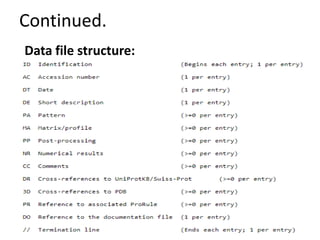
• General structure: The PROSITE database is
composed of two ASCII (text) files. The first file
(PROSITE.DAT) is a computer readable file that
contains all the information necessary to
programs that will scan sequence(s) with
patterns and/or matrices. The second file
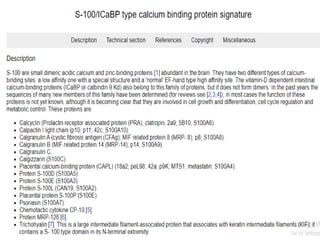
(PROSITE.DOC) contains textual information
that fully documents each pattern and profile
Continued.
Data file structure:
Methodology
Prosite
methodology
Patterns
development
Patterns from
the literature
Steps in the
development of
a new pattern
Profiles
development
Repeat
identification
Prosite
Prosite
Prosite