Supercritical Fluid Chromatography
A Concise Presentation
By
Mr. Deepak Sarangi M.Pharm
1
CONTENTS
1.Introduction
2.Definition
3.Principle
4.Instrumentation
5.Advantages
6.Disadvantages
7.Applications
8.Conclusion
9.References
2
INTRODUCTION
• Supercritical fluid chromatography(SFC) was first
proposed in 1958 by J. Lovelock.
• First used in1962 by Klesper.
• It is used for the analysis & purification of low
moderate molecular weight, thermally liable
molecules.
3
DEFINITION
A supercritical fluid chromatography is a
material that can be either liquid or gas used in
state above critical temperature or critical
pressure where gases or liquid can co exist.
4
PRINCIPLE
 Principles are similar to those of High Performance Liquid
Chromatography (HPLC), however SFC typically utilizes
carbon dioxide as the mobile phase; therefore the entire
chromatographic flow path must be pressurized. Because the
supercritical phase represents a state in which liquid and gas
properties converge, supercritical fluid chromatography is
sometimes called "convergence chromatography."
5
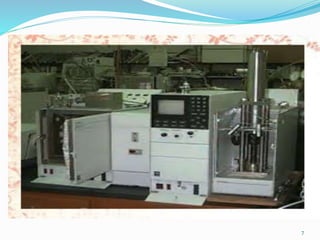
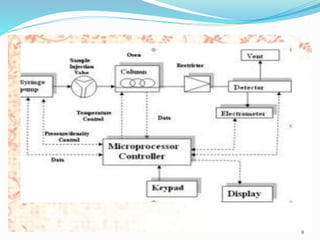
INSTRUMENTATION
1.Stationaryphase
2.Mobile phase
3.Pumps
4.Injectors
5.Ovens
6.Columns
7.Detectors
6
7
8
STATIONARY PHASE
• Both packed and open tubular columns are used.
• Packed columns can provide more theoretical plates and
handle large volume than open tubular columns.
• Because of low viscosity of super critical media.
• The column length is 10 to 20m. and inside the diameter
is 50 to 100mm common in open tubular columns.
9
Cont…
• For difficult separation column 60m (or) large have been used.
• Packed column usually made up of stainless steel,10 to 25cm.
• More than 100,000 plates have been achieved in plate column.
• Many of column coating used in LC have been applied to SFC
as well.
• Typically their are polysiloxane chemically bounded wall of
capillary tubing .
10
MOBILE PHASE
 The mobile phase is composed primarily of super critical
carbon dioxide, but since CO2 on its own is too non-polar to
effectively elute many analytes, co-solvents are added to
modify the mobile phase polarity.
 Co-solvents are typically simple alcohols like methanol,
ethanol or isopropyl alcohol. Other solvents such as
acetonitrile, chloroform or ethyl acetate can be used as
modifiers.
11
Cont …
 Modify valves for analytes ,ethane, pentane, diethyl
ether, ammonia.
 Pressure maintained is 72.9 atm, temperature is 35ºc.
12
PUMPS
Here mainly flow control is necessary so syringe
pumps are used for capillary SFC for consistent
pressure and for packed columns for easier blending
of the mobile phase or introduction of modifier fluids
reciprocating pumps are used.
13
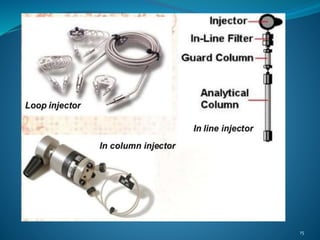
INJECTORS
 In capillary SFC small sample should be quickly
injected into the column and so pneumatically driven
valves are used.
 For packed SFC a typical injection valve is commonly
used.
14
15
OVENS
Conventional GAS chromatography & liquid
chromatography ovens are used.
16
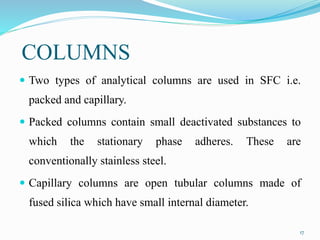
COLUMNS
 Two types of analytical columns are used in SFC i.e.
packed and capillary.
 Packed columns contain small deactivated substances to
which the stationary phase adheres. These are
conventionally stainless steel.
 Capillary columns are open tubular columns made of
fused silica which have small internal diameter.
17
DETECTORS
Flame ionization detectors and flame photometry
detector, liquid-phase detectors like refractive
index detector, ultraviolet-visible spectro-
photometric detectors and light scattering detectors
have been employed for SFC.
18
ADVANTAGES
 SFC is emerging as a separation technique that is superior
to both gas chromatography and liquid chromatography
for analysis of thermal liable or non volatile compounds.
 Low viscosity.
 Lower operating temperature.
 High diffusion co efficient.
 High resolution at low temperature.
19
DISADVANTAGES
 SFC is pressure operating conditions. High-pressure
vessels are expensive and bulky.
 Maintaining pressure in SFC is difficult.
 supercritical fluids are highly compressible and their
physical properties change with pressure.
 Cleaning will be time consuming.
20
APPLICATIONS
 SFC is used in industry primarily for separation of
chiral molecules.
 SFC now commonly used for chiral separation and
purification in the pharmaceutical industry.
 SFC technique has been applied to wide verity of
materials, including natural products, drugs, food
and polymers etc.
21
CONCLUSION
 In overall ranking of chromatographic techniques it
can be judges that SFC falls somewhere between
HPLC and GC.
 In field of pharmaceutical chemistry and
bioanalytical applications SFC gained its applications.
22
REFERENSES
 Muneo Saito (2008), [pdf Supercritical Fluid
Chromatography: A New Technology?], Packed
Column SFC 2008, Switzerland.
 Super critical fluid chromatography “Skoog”
instrumental analysis pg: 935 to 940.
 Supplement and Cumulative Index, Edited by Bryant
W. Rossiter and Roger C. Baetzold. Physical Methods
of Chemistry Series, 2nd ed., Vol. X. ISBN 0-471-
57086-9 0 1993 John Wiley & Sons, Inc.
23
24
THANKS for viewing the ppt
For more ppts
on pharma related topics plz contact
sarangi.dipu@gmail.com
Or find me at following link
www.facebook.com/sarangi.dipu

Super crtical fluid chromatography ppt

  • 1.
    Supercritical Fluid Chromatography AConcise Presentation By Mr. Deepak Sarangi M.Pharm 1
  • 2.
  • 3.
    INTRODUCTION • Supercritical fluidchromatography(SFC) was first proposed in 1958 by J. Lovelock. • First used in1962 by Klesper. • It is used for the analysis & purification of low moderate molecular weight, thermally liable molecules. 3
  • 4.
    DEFINITION A supercritical fluidchromatography is a material that can be either liquid or gas used in state above critical temperature or critical pressure where gases or liquid can co exist. 4
  • 5.
    PRINCIPLE  Principles aresimilar to those of High Performance Liquid Chromatography (HPLC), however SFC typically utilizes carbon dioxide as the mobile phase; therefore the entire chromatographic flow path must be pressurized. Because the supercritical phase represents a state in which liquid and gas properties converge, supercritical fluid chromatography is sometimes called "convergence chromatography." 5
  • 6.
  • 7.
  • 8.
  • 9.
    STATIONARY PHASE • Bothpacked and open tubular columns are used. • Packed columns can provide more theoretical plates and handle large volume than open tubular columns. • Because of low viscosity of super critical media. • The column length is 10 to 20m. and inside the diameter is 50 to 100mm common in open tubular columns. 9
  • 10.
    Cont… • For difficultseparation column 60m (or) large have been used. • Packed column usually made up of stainless steel,10 to 25cm. • More than 100,000 plates have been achieved in plate column. • Many of column coating used in LC have been applied to SFC as well. • Typically their are polysiloxane chemically bounded wall of capillary tubing . 10
  • 11.
    MOBILE PHASE  Themobile phase is composed primarily of super critical carbon dioxide, but since CO2 on its own is too non-polar to effectively elute many analytes, co-solvents are added to modify the mobile phase polarity.  Co-solvents are typically simple alcohols like methanol, ethanol or isopropyl alcohol. Other solvents such as acetonitrile, chloroform or ethyl acetate can be used as modifiers. 11
  • 12.
    Cont …  Modifyvalves for analytes ,ethane, pentane, diethyl ether, ammonia.  Pressure maintained is 72.9 atm, temperature is 35ºc. 12
  • 13.
    PUMPS Here mainly flowcontrol is necessary so syringe pumps are used for capillary SFC for consistent pressure and for packed columns for easier blending of the mobile phase or introduction of modifier fluids reciprocating pumps are used. 13
  • 14.
    INJECTORS  In capillarySFC small sample should be quickly injected into the column and so pneumatically driven valves are used.  For packed SFC a typical injection valve is commonly used. 14
  • 15.
  • 16.
    OVENS Conventional GAS chromatography& liquid chromatography ovens are used. 16
  • 17.
    COLUMNS  Two typesof analytical columns are used in SFC i.e. packed and capillary.  Packed columns contain small deactivated substances to which the stationary phase adheres. These are conventionally stainless steel.  Capillary columns are open tubular columns made of fused silica which have small internal diameter. 17
  • 18.
    DETECTORS Flame ionization detectorsand flame photometry detector, liquid-phase detectors like refractive index detector, ultraviolet-visible spectro- photometric detectors and light scattering detectors have been employed for SFC. 18
  • 19.
    ADVANTAGES  SFC isemerging as a separation technique that is superior to both gas chromatography and liquid chromatography for analysis of thermal liable or non volatile compounds.  Low viscosity.  Lower operating temperature.  High diffusion co efficient.  High resolution at low temperature. 19
  • 20.
    DISADVANTAGES  SFC ispressure operating conditions. High-pressure vessels are expensive and bulky.  Maintaining pressure in SFC is difficult.  supercritical fluids are highly compressible and their physical properties change with pressure.  Cleaning will be time consuming. 20
  • 21.
    APPLICATIONS  SFC isused in industry primarily for separation of chiral molecules.  SFC now commonly used for chiral separation and purification in the pharmaceutical industry.  SFC technique has been applied to wide verity of materials, including natural products, drugs, food and polymers etc. 21
  • 22.
    CONCLUSION  In overallranking of chromatographic techniques it can be judges that SFC falls somewhere between HPLC and GC.  In field of pharmaceutical chemistry and bioanalytical applications SFC gained its applications. 22
  • 23.
    REFERENSES  Muneo Saito(2008), [pdf Supercritical Fluid Chromatography: A New Technology?], Packed Column SFC 2008, Switzerland.  Super critical fluid chromatography “Skoog” instrumental analysis pg: 935 to 940.  Supplement and Cumulative Index, Edited by Bryant W. Rossiter and Roger C. Baetzold. Physical Methods of Chemistry Series, 2nd ed., Vol. X. ISBN 0-471- 57086-9 0 1993 John Wiley & Sons, Inc. 23
  • 24.
    24 THANKS for viewingthe ppt For more ppts on pharma related topics plz contact sarangi.dipu@gmail.com Or find me at following link www.facebook.com/sarangi.dipu