Homology Modeling
of Proteins
Homology Modeling Process
 Template recognition
 Alignment
 Determining structurally conserved regions
 Backbone generation
 Building loops or variable regions
 Conformational search for side chains
 Refinement of structure
 Validating structures
Template Recognition
 First we search the related proteins sequence(templates) to the
target sequence in any structural database of proteins
 The accuracy of model depends on the selection of proper
template
 FASTA and BLAST from EMBL-EBI and NCBI can be used
 This gives a probable set of templates but the final one is not yet
decided
 After intial aligments and finding structurally conserved regions
among templates, we choose the final template
Alignment in Homology
Modeling
Sequence alignment is central technique in
homology modeling
 Used in determining which areas of the reference
proteins are conserved in sequence
 Hence suggesting where the reference proteins may
also be structurally conserved
 After SCRs are found,it is used to establish one to one
correspondence between the amino acids of
reference proteins and the target in SCRs
 Thus providing basis of the transforming of
coordinates from the reference to the model
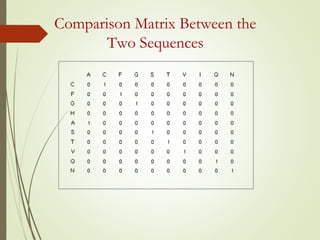
Comparison Matrix Between the
Two Sequences
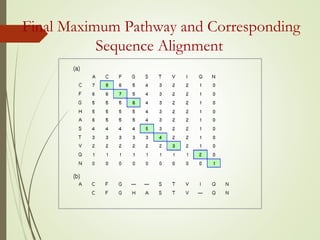
Final Maximum Pathway and Corresponding
Sequence Alignment
Main Heuristic Approaches
 Progressive multiple Alignment –
example - ClustalW and ClustalX
 Iterative Multiple Alignment –
example SAGA
Alignment of Target Protein
with SCR
 After doing alignments and finding SCRs
 We align the unknown sequence with the aligned reference proteins
with the knowledge of SCRs
 Since SCR cant contain insertions and deletions
 The enhancement of standard alignmnet algorithm is used
 After finding the suitable template and aligning the unknown
sequence with the template
 Assignment of coordinates within conserved regions is done
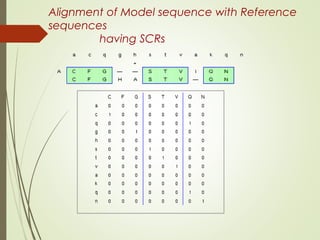
Alignment of Model sequence with Reference
sequences
having SCRs
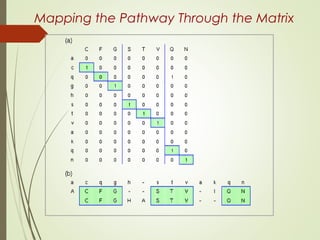
Mapping the Pathway Through the Matrix
Assignment of coordinates
within conserved region
 Once the correspondence between amino acids in
the reference and model sequences has been made,
the coordinates for an SCR can be assigned
 The reference proteins' coordinates are used as a
basis for this assignment
 Where the side chains of the reference and model
proteins are the same at corresponding locations
along the sequence, all the coordinates for the amino
acid are transferred
 Where they differ, the backbone coordinates are
transferred , but the side chain atoms are
automatically replaced to preserve the model
protein's residue types
Assignment of coordinates in
loop or variable region
Two main methods
 Finding similar peptide segments in other proteins
 Generating a segment de-novo
Finding similar peptide segment in other proteins
 Advantage: all loops found are guaranteed to have
reasonable internal geometries and conformations
 Disadvantage: may not fit properly into the given model
protein’s framework
In this case, de-novo method is advisable
Selection Of Loops
 Check the loops on the basis of steric overlaps
 A specified degree of overlap can be tolerated
 Check the atoms within the loop agains each other
 Then check loop atoms against rest of the protein’s
atoms
Side Chain Conformation
Search
 With bond lengths, bond angles and two rotable backbone
bonds per residue φ and ψ, its very difficult to find the best
conformation of a side chain
 In addition, side chains of many residues have one or more
degree of freedom.
 Hence Side chain conformational search in loop regions is
must
 Side chain residues replaced during coordinate
transformations should also be checked
Selection Of Good Rotamer
 Fortunately, statstical studies show side chain
adopt only a small number of many possible
conformations
 The correct rotamer of a particular residue is
mainly determined by local environment
 Side chain generally adopt conformations where
they are closely packed
Optimisation Approaches
 Energy Minimisation is used to produce a chemically
and conformationally reasonable model protein
structure
Two mainly used optimisation algorithms are
 Steepest Descent
 Conjugate Gradients
 Molecular Dynamics is used to explore the
conformational space a molecule could visit
Model Validation
 Every homology model contains errors.Two
main reasons
 % sequence identity between reference and
model
 The number of errors in templates
 Hence it is essential to check the correctness
of overall fold/ structure, errors of localized
regions and stereochemical parameters: bond
lengths, angles, geometries
Presentation homolgy modeling

Presentation homolgy modeling

  • 1.
  • 2.
    Homology Modeling Process Template recognition  Alignment  Determining structurally conserved regions  Backbone generation  Building loops or variable regions  Conformational search for side chains  Refinement of structure  Validating structures
  • 3.
    Template Recognition  Firstwe search the related proteins sequence(templates) to the target sequence in any structural database of proteins  The accuracy of model depends on the selection of proper template  FASTA and BLAST from EMBL-EBI and NCBI can be used  This gives a probable set of templates but the final one is not yet decided  After intial aligments and finding structurally conserved regions among templates, we choose the final template
  • 4.
    Alignment in Homology Modeling Sequencealignment is central technique in homology modeling  Used in determining which areas of the reference proteins are conserved in sequence  Hence suggesting where the reference proteins may also be structurally conserved  After SCRs are found,it is used to establish one to one correspondence between the amino acids of reference proteins and the target in SCRs  Thus providing basis of the transforming of coordinates from the reference to the model
  • 5.
    Comparison Matrix Betweenthe Two Sequences
  • 6.
    Final Maximum Pathwayand Corresponding Sequence Alignment
  • 7.
    Main Heuristic Approaches Progressive multiple Alignment – example - ClustalW and ClustalX  Iterative Multiple Alignment – example SAGA
  • 8.
    Alignment of TargetProtein with SCR  After doing alignments and finding SCRs  We align the unknown sequence with the aligned reference proteins with the knowledge of SCRs  Since SCR cant contain insertions and deletions  The enhancement of standard alignmnet algorithm is used  After finding the suitable template and aligning the unknown sequence with the template  Assignment of coordinates within conserved regions is done
  • 9.
    Alignment of Modelsequence with Reference sequences having SCRs
  • 10.
    Mapping the PathwayThrough the Matrix
  • 11.
    Assignment of coordinates withinconserved region  Once the correspondence between amino acids in the reference and model sequences has been made, the coordinates for an SCR can be assigned  The reference proteins' coordinates are used as a basis for this assignment  Where the side chains of the reference and model proteins are the same at corresponding locations along the sequence, all the coordinates for the amino acid are transferred  Where they differ, the backbone coordinates are transferred , but the side chain atoms are automatically replaced to preserve the model protein's residue types
  • 12.
    Assignment of coordinatesin loop or variable region Two main methods  Finding similar peptide segments in other proteins  Generating a segment de-novo Finding similar peptide segment in other proteins  Advantage: all loops found are guaranteed to have reasonable internal geometries and conformations  Disadvantage: may not fit properly into the given model protein’s framework In this case, de-novo method is advisable
  • 13.
    Selection Of Loops Check the loops on the basis of steric overlaps  A specified degree of overlap can be tolerated  Check the atoms within the loop agains each other  Then check loop atoms against rest of the protein’s atoms
  • 14.
    Side Chain Conformation Search With bond lengths, bond angles and two rotable backbone bonds per residue φ and ψ, its very difficult to find the best conformation of a side chain  In addition, side chains of many residues have one or more degree of freedom.  Hence Side chain conformational search in loop regions is must  Side chain residues replaced during coordinate transformations should also be checked
  • 15.
    Selection Of GoodRotamer  Fortunately, statstical studies show side chain adopt only a small number of many possible conformations  The correct rotamer of a particular residue is mainly determined by local environment  Side chain generally adopt conformations where they are closely packed
  • 16.
    Optimisation Approaches  EnergyMinimisation is used to produce a chemically and conformationally reasonable model protein structure Two mainly used optimisation algorithms are  Steepest Descent  Conjugate Gradients  Molecular Dynamics is used to explore the conformational space a molecule could visit
  • 17.
    Model Validation  Everyhomology model contains errors.Two main reasons  % sequence identity between reference and model  The number of errors in templates  Hence it is essential to check the correctness of overall fold/ structure, errors of localized regions and stereochemical parameters: bond lengths, angles, geometries