
Department of Zoology, GACW (2018-2019)
Swiss-PDB Viewer
Introduction:
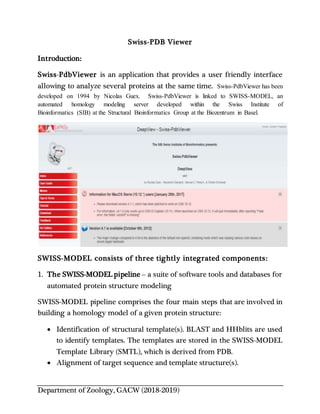
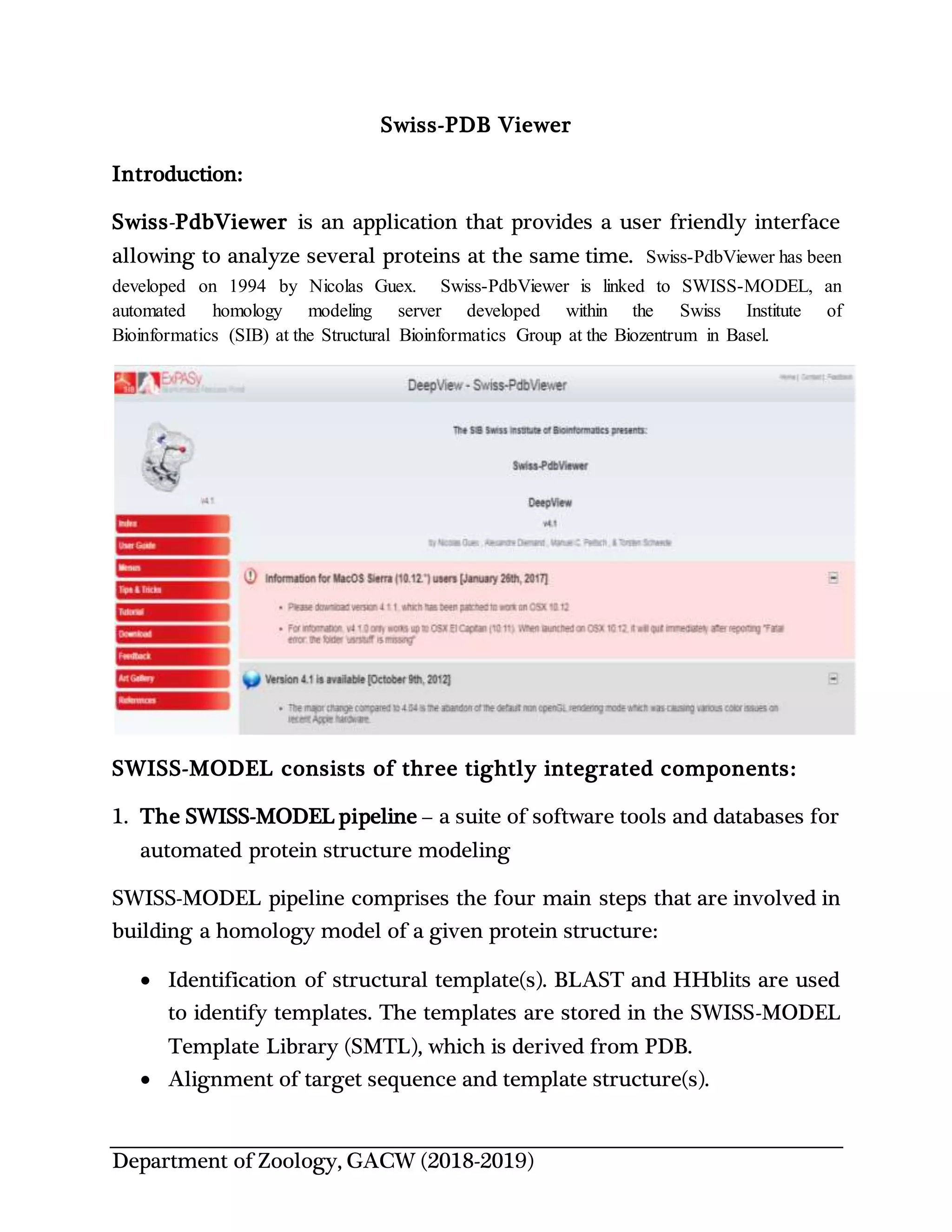
Swiss-PdbViewer is an application that provides a user friendly interface
allowing to analyze several proteins at the same time. Swiss-PdbViewer has been
developed on 1994 by Nicolas Guex. Swiss-PdbViewer is linked to SWISS-MODEL, an
automated homology modeling server developed within the Swiss Institute of
Bioinformatics (SIB) at the Structural Bioinformatics Group at the Biozentrum in Basel.
SWISS-MODEL consists of three tightly integrated components:
1. The SWISS-MODEL pipeline – a suite of software tools and databases for
automated protein structure modeling
SWISS-MODEL pipeline comprises the four main steps that are involved in
building a homology model of a given protein structure:
 Identification of structural template(s). BLAST and HHblits are used
to identify templates. The templates are stored in the SWISS-MODEL
Template Library (SMTL), which is derived from PDB.
 Alignment of target sequence and template structure(s).
Department of Zoology, GACW (2018-2019)
 Model building and energy minimization. SWISS-MODEL
implements a rigid fragment assembly approach for modelling.
 Assessment of the model's quality using QMEAN, a statistical
potential of mean force.
2. The SWISS-MODEL Workspace(A web-based graphical user workbench)
In this mode the input is a project file that can be generated by the
DeepView (Swiss Pdb Viewer) visualization and structural analysis tool, to
allow the user to examine and manipulate the target-template alignment in
its structural context.
3. The SWISS-MODEL Repository
The SWISS-MODEL Repository provides access to an up-to-date
collection of annotated three-dimensional protein models for a set of model
organisms of high general interest. SWISS-MODEL Repository is integrated
with several external resources, such as UniProt, InterPro, STRING, and
Nature PSI SBKB.
Uses:
 To find hydrogen bonds within proteins and between proteins and
ligands.
 To view several protein structures simultaneously and superimpose
them to align their structures and sequences.
 To examine electron-density maps from crystallographic structure
determination
 To judge the quality of maps and models, and to identify many
common problems in protein models.
 It computes electrostatic potentials and molecular surfaces, and
carries out energy minimization.
Department of Zoology, GACW (2018-2019)

Swiss pdb viewer

  • 1.
    Department of Zoology,GACW (2018-2019) Swiss-PDB Viewer Introduction: Swiss-PdbViewer is an application that provides a user friendly interface allowing to analyze several proteins at the same time. Swiss-PdbViewer has been developed on 1994 by Nicolas Guex. Swiss-PdbViewer is linked to SWISS-MODEL, an automated homology modeling server developed within the Swiss Institute of Bioinformatics (SIB) at the Structural Bioinformatics Group at the Biozentrum in Basel. SWISS-MODEL consists of three tightly integrated components: 1. The SWISS-MODEL pipeline – a suite of software tools and databases for automated protein structure modeling SWISS-MODEL pipeline comprises the four main steps that are involved in building a homology model of a given protein structure:  Identification of structural template(s). BLAST and HHblits are used to identify templates. The templates are stored in the SWISS-MODEL Template Library (SMTL), which is derived from PDB.  Alignment of target sequence and template structure(s).
  • 2.
    Department of Zoology,GACW (2018-2019)  Model building and energy minimization. SWISS-MODEL implements a rigid fragment assembly approach for modelling.  Assessment of the model's quality using QMEAN, a statistical potential of mean force. 2. The SWISS-MODEL Workspace(A web-based graphical user workbench) In this mode the input is a project file that can be generated by the DeepView (Swiss Pdb Viewer) visualization and structural analysis tool, to allow the user to examine and manipulate the target-template alignment in its structural context. 3. The SWISS-MODEL Repository The SWISS-MODEL Repository provides access to an up-to-date collection of annotated three-dimensional protein models for a set of model organisms of high general interest. SWISS-MODEL Repository is integrated with several external resources, such as UniProt, InterPro, STRING, and Nature PSI SBKB. Uses:  To find hydrogen bonds within proteins and between proteins and ligands.  To view several protein structures simultaneously and superimpose them to align their structures and sequences.  To examine electron-density maps from crystallographic structure determination  To judge the quality of maps and models, and to identify many common problems in protein models.  It computes electrostatic potentials and molecular surfaces, and carries out energy minimization.
  • 3.
    Department of Zoology,GACW (2018-2019)