Statistical methods in
Bioinformatics
Dot Matrix
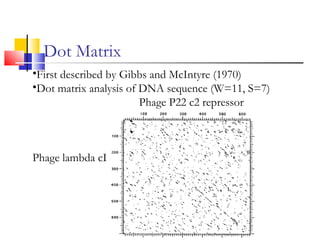
•First described by Gibbs and McIntyre (1970)
•Dot matrix analysis of DNA sequence (W=11, S=7)
Phage P22 c2 repressor
Phage lambda cI
Dot Matrix
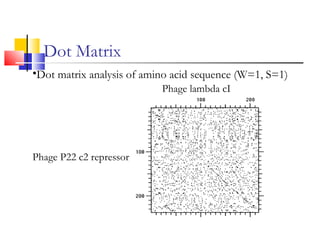
•Dot matrix analysis of amino acid sequence (W=1, S=1)
Phage lambda cI
Phage P22 c2 repressor
Filtering in Dot Matrix
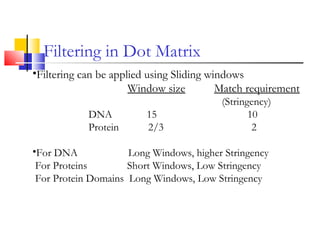
•Filtering can be applied using Sliding windows
Window size Match requirement
(Stringency)
DNA 15 10
Protein 2/3 2
•For DNA Long Windows, higher Stringency
For Proteins Short Windows, Low Stringency
For Protein Domains Long Windows, Low Stringency
Dot Matrix Programs
•DNA strider
•DOTTER
•COMPARE
•DOPLOT
For sequence repeats,
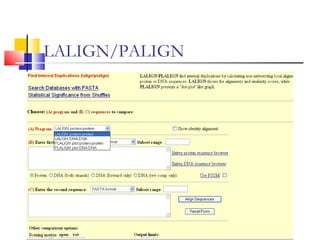
•LALIGN
•PLALIGN
LALIGN/PALIGN
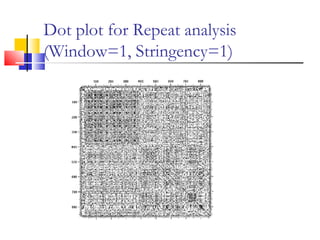
Dot plot for Repeat analysis
(Window=1, Stringency=1)
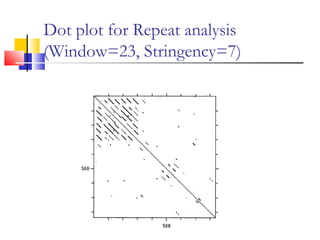
Dot plot for Repeat analysis
(Window=23, Stringency=7)
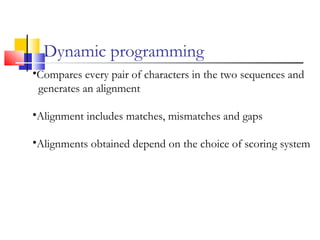
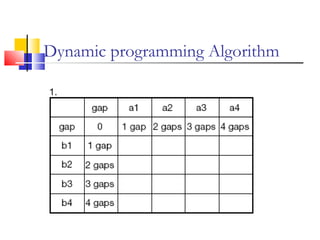
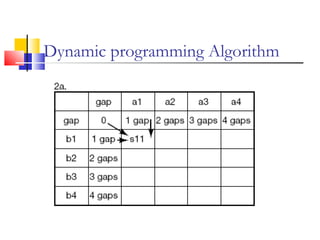
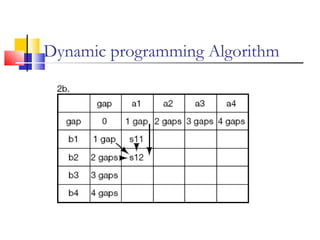
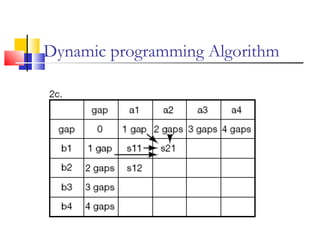
Dynamic programming
•Compares every pair of characters in the two sequences and
generates an alignment
•Alignment includes matches, mismatches and gaps
•Alignments obtained depend on the choice of scoring system
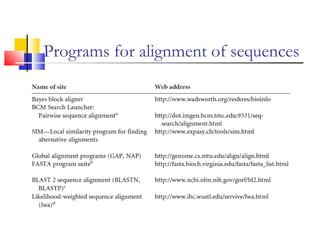
Programs for alignment of sequences
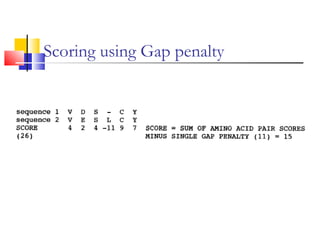
Scoring using Gap penalty
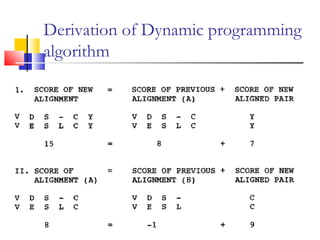
Derivation of Dynamic programming
algorithm
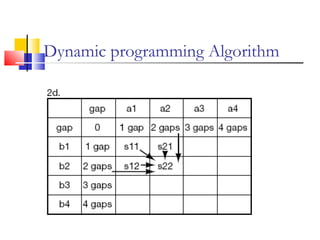
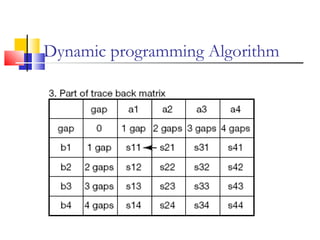
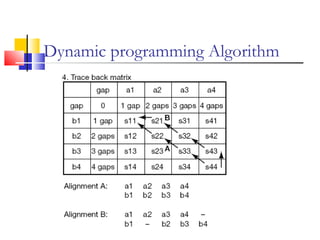
Dynamic programming Algorithm
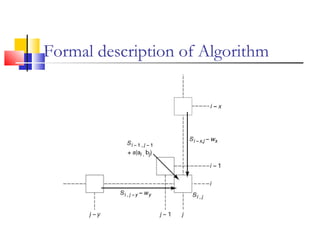
Formal description of Algorithm
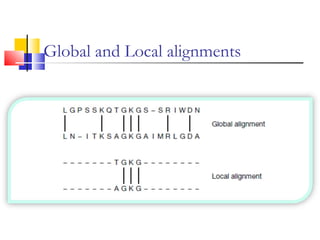
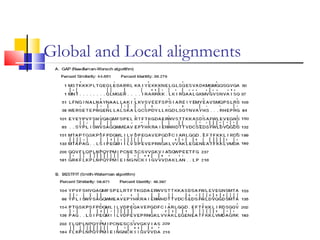
Global and Local alignments
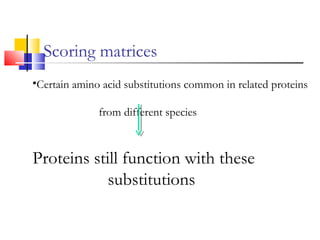
Scoring matrices
•Certain amino acid substitutions common in related proteins
from different species
Proteins still function with these
substitutions
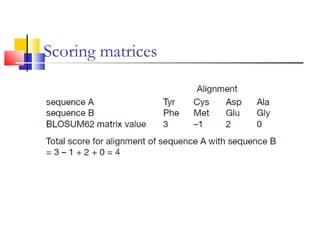
Scoring matrices
Scoring matrices
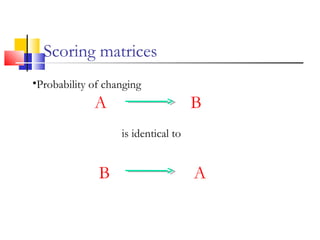
•Probability of changing
A B
is identical to
B A
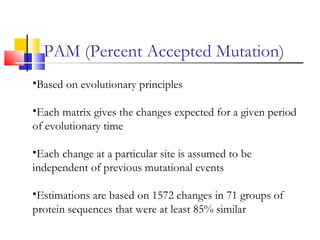
PAM (Percent Accepted Mutation)
•Based on evolutionary principles
•Each matrix gives the changes expected for a given period
of evolutionary time
•Each change at a particular site is assumed to be
independent of previous mutational events
•Estimations are based on 1572 changes in 71 groups of
protein sequences that were at least 85% similar
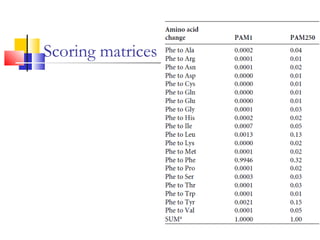
Scoring matrices
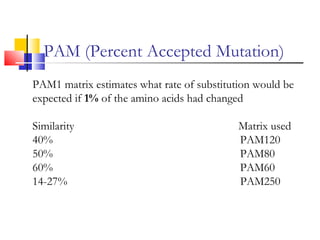
PAM (Percent Accepted Mutation)
PAM1 matrix estimates what rate of substitution would be
expected if 1% of the amino acids had changed
Similarity Matrix used
40% PAM120
50% PAM80
60% PAM60
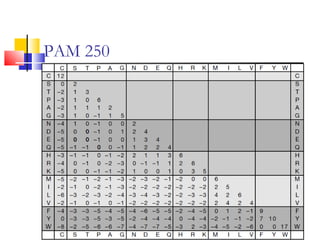
14-27% PAM250
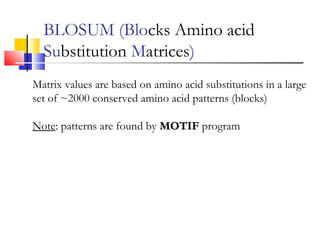
BLOSUM (Blocks Amino acid
Substitution Matrices)
Matrix values are based on amino acid substitutions in a large
set of ~2000 conserved amino acid patterns (blocks)
Note: patterns are found by MOTIFMOTIF program
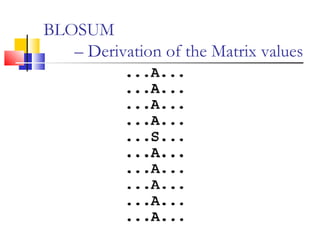
BLOSUM
– Derivation of the Matrix values
PAM 250
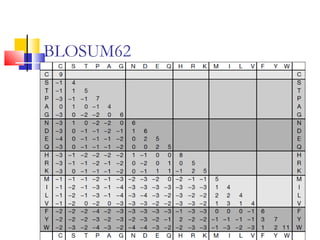
BLOSUM62
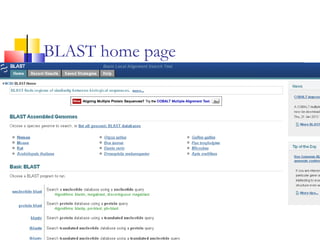
BLAST home page
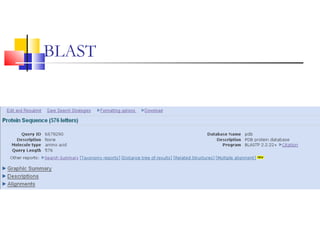
BLAST
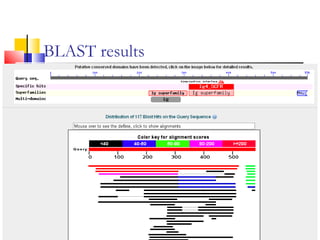
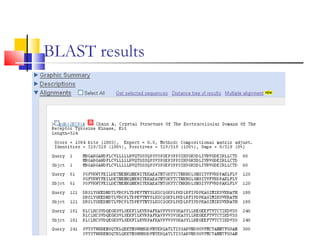
BLAST results
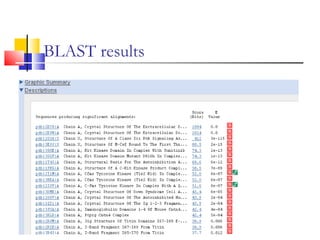
BLAST results
BLAST results

Bio info statistical-methods[1]