MOISTURIZING
LOTION
DEFINITION
Moisturizers or emollients are 
complex mixtures of chemical 
agents specially designed to 
make the external layers of the 
skin softer and more liable. 
• They increase the skin's hydration 
(water content) by reducing evaporation. 
Naturally occurring skin lipids and sterols, as 
well as artificial or natural oils, humictants, 
emollients, lubricants, etc., may be part of the 
composition of commercial skin moisturizers.
• They usually are available as commercial 
products for cosmetic and therapeutic uses, but 
can also be made at home using 
common pharmacy ingredients.
BENEFITS OF
MOISTURIZING LOTION
• These available homemade non greasy 
lotions are best for moisturizing skin on 
daily basis as almond or grape seed oil are 
readily absorbed by the skin, without letting 
it feel oily. 
• They help in keeping the skin soft and 
supple. 
• Lotions made using aloe vera gel are not alone 
perfect for winter months, but can continue 
moisturizing the skin through summer season as 
well without being greasy.
• Moreover, these nourishing lotions are free from 
any chemicals and purely healthy for the skin. 
• One would love applying it over skin again and 
again, without having any fear of damaging the 
skin. 
• It comes at a fractional cost compared to 
commercially available chemically treated 
moisturizing lotions
TYPES OF SKINS
• Normal Skin
• Dry Skin
• Oily skin
• Aging Skin
• Sensitive Skin
PRESERVATIVE
METHODS
Normal skin
• Moisturizers can be used to prevent the skin 
from becoming too dry or oily, such as with 
light, non-greasy water-based moisturizers. 
Such moisturizers often contain lightweight 
oils, such as cetyl alcohol, or silicone-derived 
ingredients
• Eg- cyclomethicone.
Dry skin
• For treating skin dryness, the most appropriate 
moisturizers are heavier, oil-based 
moisturizers that contain ingredients such 
as antioxidants, grape seed 
oil or dimethicone. For very dry, cracked 
skin, petrolatum-based products are 
preferable, as they are more lasting than 
creams and are more effective in preventing 
water evaporation.
Oily skin
• For oily skin, moisturizers can still be useful after
activities causing skin dryness, such as other skin care
products and washing.[1]
For oily skin, water-based
moisturizers that are specifically non-comedogenic are
preferable, as there is less risk of comedo formation.
Aging skin
• Appropriate moisturizers to keep aging skin soft and
well hydrated are oil-based ones that
contain petrolatum as the base, along
with antioxidants or alpha hydrox
acids against wrinkles.
Sensitive skin
On sensitive skin (which otherwise is 
susceptible to skin irritations, redness, 
itching or rashes), it is preferable to use 
moisturizers which contain soothing 
ingredients such as chamomile or aloe, and 
that minimize potential allergens such as 
fragrances or dyes, as well as irritants such 
as acids.
FORMULATONS
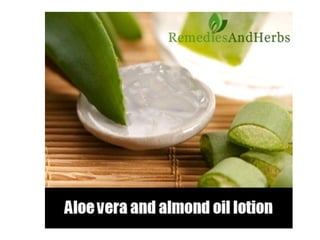
ALOEVERA AND ALMOND OIL
LOTION
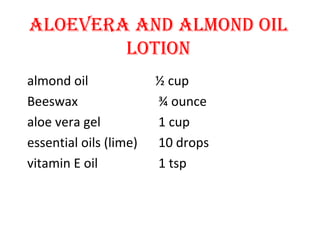
almond oil ½ cup
Beeswax ¾ ounce
aloe vera gel 1 cup
essential oils (lime) 10 drops
vitamin E oil 1 tsp
ALOEVERA AND ALMOND OIL
LOTION
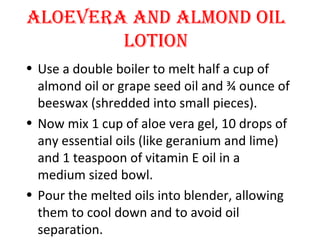
• Use a double boiler to melt half a cup of
almond oil or grape seed oil and ¾ ounce of
beeswax (shredded into small pieces).
• Now mix 1 cup of aloe vera gel, 10 drops of
any essential oils (like geranium and lime)
and 1 teaspoon of vitamin E oil in a
medium sized bowl.
• Pour the melted oils into blender, allowing
them to cool down and to avoid oil
separation.
• After oils get cooled, blend them on low speed, 
while pouring aloe vera mixture slowly into it 
in a continuous fashion.
• Run the rubber spatula to mix all ingredients 
properly and blend till mixture attains a feel 
and look of a lotion.
•  Alternatively, this mixing and blending step 
can be performed in a mixing bowl, using a 
handheld electric mixer.
•  Pour the prepared non greasy lotion in 
sterilized jars and store them in refrigerator, 
which can then stay fine for period of 6 weeks.
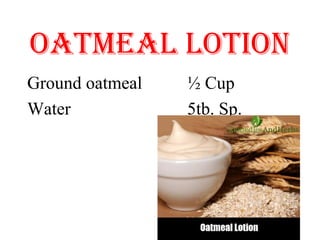
OATMEAL LOTION
Ground oatmeal ½ Cup
Water 5tb. Sp.
OAT MEAL LOTION
• Use ground oatmeal and grind it properly in a 
food processor. 
• Just by mixing it with minimal amount of 
water will give it a slippery touch that can 
then be used directly as an effective lotion. 
• It not alone moisturizes the face, but also 
serves as a good exfoliating agent (removes 
the dead skin cells) when scrubbed gently 
over the skin surface. 
• This non greasy lotion is equally useful as 
primer, for putting make up every morning 
and also for removing stubborn eye makeup 
at end of the day.
• Just put a little amount of the lotion on to 
the cotton ball and clean off the face. 
• The same oatmeal lotion can serve more 
beneficial, if coconut and grapefruit 
essential oil are also added to it. 
• Coconut oil aids in fighting off bacterial 
infection of the skin and grapefruit 
essential oil improves the skin clarity.
•  Additionally, it adds on to the fragrance 
and still remains non greasy and light 
weight lotion, safe and healthy for daily 
usage without making hands buttery or 
greasy.
The effluence of structure of moisturizing lotion (texture
parameter) on its use properties, and control of its
physical properties
• 1. Factors influencing the lotion physical
parameter
• 2. The effects on the behavior of lotion
during lotion processing
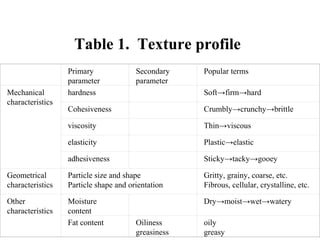
Table 1. Texture profile
  Primary 
parameter
Secondary 
parameter
Popular terms
Mechanical 
characteristics
hardness   Soft→firm→hard
Cohesiveness   Crumbly→crunchy→brittle
viscosity   Thin→viscous
elasticity   Plastic→elastic
adhesiveness   Sticky→tacky→gooey
Geometrical 
characteristics
Particle size and shape
Particle shape and orientation
Gritty, grainy, coarse, etc.
Fibrous, cellular, crystalline, etc.
Other 
characteristics
Moisture 
content
  Dry→moist→wet→watery
Fat content Oiliness
greasiness
oily
greasy
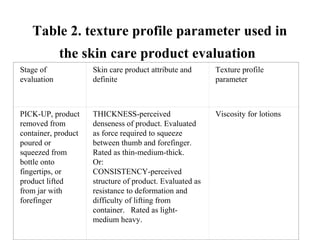
Table 2. texture profile parameter used in
the skin care product evaluation
Stage of 
evaluation
Skin care product attribute and 
definite
Texture profile 
parameter
PICK-UP, product 
removed from 
container, product 
poured or 
squeezed from 
bottle onto 
fingertips, or 
product lifted 
from jar with 
forefinger
THICKNESS-perceived 
denseness of product. Evaluated 
as force required to squeeze 
between thumb and forefinger. 
Rated as thin-medium-thick.
Or: 
CONSISTENCY-perceived 
structure of product. Evaluated as 
resistance to deformation and 
difficulty of lifting from 
container.   Rated as light-
medium heavy.
Viscosity for lotions
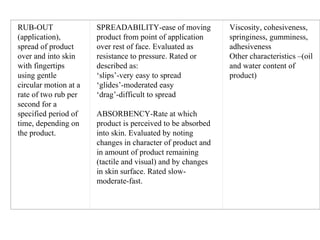
RUB-OUT 
(application), 
spread of product 
over and into skin 
with fingertips 
using gentle 
circular motion at a 
rate of two rub per 
second for a 
specified period of 
time, depending on 
the product.
SPREADABILITY-ease of moving 
product from point of application 
over rest of face. Evaluated as 
resistance to pressure. Rated or 
described as:
‘slips’-very easy to spread
‘glides’-moderated easy
‘drag’-difficult to spread
 
ABSORBENCY-Rate at which 
product is perceived to be absorbed 
into skin. Evaluated by noting 
changes in character of product and 
in amount of product remaining 
(tactile and visual) and by changes 
in skin surface. Rated slow-
moderate-fast.
Viscosity, cohesiveness, 
springiness, gumminess, 
adhesiveness
Other characteristics –(oil 
and water content of 
product)
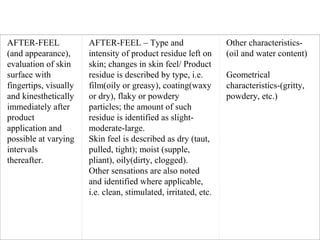
AFTER-FEEL 
(and appearance), 
evaluation of skin 
surface with 
fingertips, visually 
and kinesthetically 
immediately after 
product 
application and 
possible at varying 
intervals 
thereafter.
AFTER-FEEL – Type and 
intensity of product residue left on 
skin; changes in skin feel/ Product 
residue is described by type, i.e. 
film(oily or greasy), coating(waxy 
or dry), flaky or powdery 
particles; the amount of such 
residue is identified as slight-
moderate-large.
Skin feel is described as dry (taut, 
pulled, tight); moist (supple, 
pliant), oily(dirty, clogged).
Other sensations are also noted 
and identified where applicable, 
i.e. clean, stimulated, irritated, etc.
Other characteristics-
(oil and water content)
 
Geometrical 
characteristics-(gritty, 
powdery, etc.)
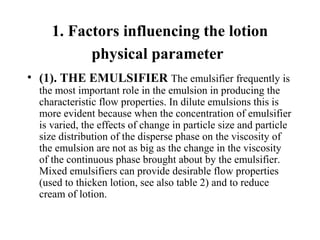
1. Factors influencing the lotion
physical parameter
• (1). THE EMULSIFIER The emulsifier frequently is 
the most important role in the emulsion in producing the 
characteristic flow properties. In dilute emulsions this is 
more evident because when the concentration of emulsifier 
is varied, the effects of change in particle size and particle 
size distribution of the disperse phase on the viscosity of 
the emulsion are not as big as the change in the viscosity 
of the continuous phase brought about by the emulsifier. 
Mixed emulsifiers can provide desirable flow properties 
(used to thicken lotion, see also table 2) and to reduce 
cream of lotion.
(2) THE DISPERSE PHASE
• There are many parameters related to the disperse phase or 
internal phase that exert rheological changes in emulsions, 
including: nature of the oil; viscosity of the oil; particle 
size; particle size distribution; and particle shape. Particle 
size and particle size distribution also depend on the 
emulsifier concentration.
• The nature of the oil in O/W emulsion exerts its effect on 
the emulsion via its interaction with the emulsifier. The 
viscosity of the aqueous medium and the particle size 
distribution are related to differences in the state of 
aggregation of the globules.
(2) THE DISPERSE PHASE 
• The mean particle size and particle size 
distribution can exert profound effects on the 
rheological parameters of an emulsion. The 
viscosity of dilute O/W emulsions are influenced 
by mean particle size variation of 3 to0.7 microns, 
but in concentrated emulsions the product of 
relative viscosity and mean particle size did not 
change if the distribution  of particle size about the 
mean value was not very wide. 
(3) THE CONTINUOUS PHASE
• The rheological behavior of a lotion is most often 
determined by the rheology of the continuous 
phase. The rheological behavior of the continuous 
phase of O/W emulsions is frequently controlled 
by the use of hydrocolloids, which have been 
already been discussed. The rheological behavior 
properties of the emulsion, in turn, are dependent 
on the stability of the hydrocolloidal system 
(4) PHASE VOLUME RATIO
• The rheological patterns of dilute emulsions are often 
markedly different than those for concentrated emulsions.  
Therefore, it is useful to have information concerning the 
viscosity dependence on the phase volume ratio in both 
areas. Generally, it has been found that the rheological 
parameters of an emulsion increase with crease in the 
phase volume ratio. It is expected that the limit of φ before 
inversion occurs will vary depending on the characteristics 
of the system and, in particular, the nature of the 
emulsifying agent and its solubility in the continuous 
phase of the emulsion 
2. The effects on the behavior of lotion
during lotion processing
• (1) Mixing
• (2) Heating and cooling
• (3) Shearing
• (4) Homogenizing
(1) Mixing
• Mixing is a basic step to the compounding and
processing of lotion in the cosmetic industry.
Mixing is necessary to blend a water phase and oil
phase into an emulsion, but consider the potential
effect of the degree of mixing on the product
viscosity. First of all, a minimum of energy must
be used to evenly mix the two phases and other
additives. A high amount of mixing energy,
however, can decrease the particle size of the
dispersed phase and hence affecting the emulsion
viscosity.
• In case of heat transfer, viscous lotions are usually
handled with a contrarotating agitator.
• Mixing is so basic to the formation of the lotion
and can have such an important effect on product
rheology that the smart formulator will learn to
work with it in achieving the desired end
properties instead of fighting against it in a
dogmatic scaleup from benchtop to plant.
Cosmetic lotion may be shear sensitive to some
degree and mixing can be used as a tool in
achieving the desired product viscosity by
properly manipulating the mixing variables.
(2) Heating and cooling
• Heating is generally less of a problem in cosmetic
processing because the product or phase is usually
fluid at elevated temperatures (viscosity being
inversely proportional to temperature for
emulsions commonly encountered in the cosmetic
industry). The rate of heating is not usually
considered an important parameter, assuming that
the desired end point is not overshot.
• Cooling is more commonly a problem with
cosmetic emulsion because it generally increases
product viscosity greatly.
• In summary, a lotion is usually heated after it has
been formed to reduce its viscosity for filling.
Cooling has a more important relationship to final
product viscosity because of its effect on
crystallite size and dispersion, and because of the
interrelationship of work input and product
viscosity.
(3) Shearing
• Many lotions are shear-thining. In a typical
operation, a finished lotion is cooled to room
temperature in a compounding vessel, and then
pumped through a filter to a storage tank where it
is held for filling. The viscosity of lotion will have
been reduced by this step. Then the product may
be pumped to the filling line. The product usually
has a chance to build a network of bonds. A
portion of these bonds, if broken, are sometimes
permanently destroyed
(4) Homogenizing
• Homogenization, or the reduction of
particles to a small and uniform size and
their even distribution in a medium, is
related to shearing in that frequently
used to create the particle breakdown.
• The cosmetic industry usually resorts to
homogenization for dispersing solids
and insoluble liquids in a liquid phase
and reducing the dispersed particles to a
minimum size.
• The reasons for doing this are numerous and include
the desire to increase stability by minimizing globule
size and hence decrease the chances of coalescence, to
reduce particle size of the disperse phase so as to
inhibit settling, and to increase viscosity by forming a
finer emulsion.
• If while the emulsion is hot and both phases still liquid,
homogenization will tend to reduce the disperse phase
to a minimum size distribution which will impart
certain properties (such as increased stability) to the
final product when it is cooled down and packaged.
• If the product is homogenized after some
cooling has taken place and viscosity has
already started to build, however, the
viscosity of the finished product may be
permanently reduced.
• Timing and process step must be considered
in developing a process to make a product
with the desired end properties.
THANK YOU