Non-aqueous acid base titrimetry
Md : Obydulla Al Mamun
Id:131-29-500
9th(B)
Department Of Pharmacy
Daffodil International University
almamundcc94@gmail.com
Non-aqueous acid base titrimetry
Non- aqueous titrations are those in which the
titrations of too weakly acidic or basic
substances are carried out using non-aqueous
solvents so as to get sharp end point.
Such titrations can also be used for the titration
of the substances not soluble in water.
The speed, precision and accuracy of the non-
aqueous method are close to those of classical
acidimetric and alkalimetric titrations.
REASONS FOR PERFORMING NON – AQUEOUS ACID – BASE
TITRATION
 Non – aqueous Acid – Base Titration is
performed to eliminate 2 problems
encountered during the aqueous titration of
weakly acidic or weakly basic analyte by a
Strong Acid or Strong Base Titrant
respectively.
 The 2 problems are –
 Interaction of the Titrant with H2O
 Poor Solubility of Weakly Acidic (WA) or Weakly
Basic (WB) Analyte in H2O
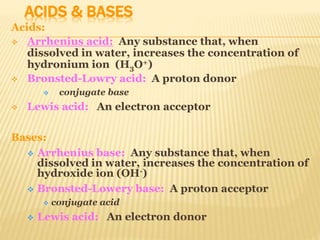
ACIDS & BASES
Acids:
 Arrhenius acid: Any substance that, when
dissolved in water, increases the concentration of
hydronium ion (H3O+)
 Bronsted-Lowry acid: A proton donor
 conjugate base
 Lewis acid: An electron acceptor
Bases:
 Arrhenius base: Any substance that, when
dissolved in water, increases the concentration of
hydroxide ion (OH-)
 Bronsted-Lowery base: A proton acceptor
 conjugate acid
 Lewis acid: An electron donor
Solvents
Non-aqueous solvents are classified into the 4
groups:
- Protophilic solvents
- Protogenic solvents
- Amphiprotic solvents
- Aprotic solvents
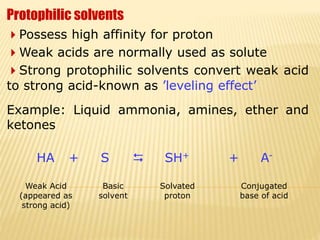
Protophilic solvents
Possess high affinity for proton
Weak acids are normally used as solute
Strong protophilic solvents convert weak acid
to strong acid-known as ’leveling effect’
Example: Liquid ammonia, amines, ether and
ketones
HA + S  SH+ + A-
Weak Acid
(appeared as
strong acid)
Basic
solvent
Solvated
proton
Conjugated
base of acid
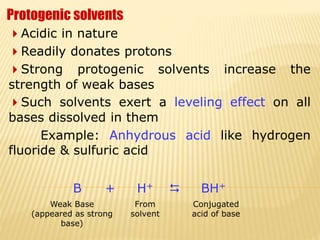
Protogenic solvents
Acidic in nature
Readily donates protons
Strong protogenic solvents increase the
strength of weak bases
Such solvents exert a leveling effect on all
bases dissolved in them
Example: Anhydrous acid like hydrogen
fluoride & sulfuric acid
B + H+  BH+
Weak Base
(appeared as strong
base)
From
solvent
Conjugated
acid of base
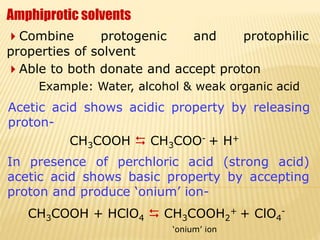
Amphiprotic solvents
Combine protogenic and protophilic
properties of solvent
Able to both donate and accept proton
Example: Water, alcohol & weak organic acid
Acetic acid shows acidic property by releasing
proton-
CH3COOH  CH3COO- + H+
In presence of perchloric acid (strong acid)
acetic acid shows basic property by accepting
proton and produce ‘onium’ ion-
CH3COOH + HClO4  CH3COOH2
+ + ClO4
-
‘onium’ ion
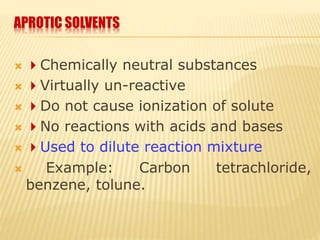
APROTIC SOLVENTS
 Chemically neutral substances
 Virtually un-reactive
 Do not cause ionization of solute
 No reactions with acids and bases
 Used to dilute reaction mixture
 Example: Carbon tetrachloride,
benzene, tolune.
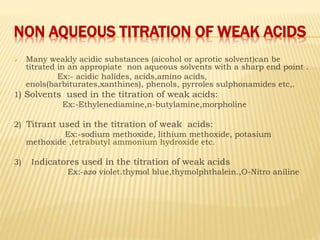
NON AQUEOUS TITRATION OF WEAK ACIDS
 Many weakly acidic substances (aicohol or aprotic solvent)can be
titrated in an appropiate non aqueous solvents with a sharp end point .
Ex:- acidic halides, acids,amino acids,
enols(barbiturates,xanthines), phenols, pyrroles sulphonamides etc,.
1) Solvents used in the titration of weak acids:
Ex:-Ethylenediamine,n-butylamine,morpholine
2) Titrant used in the titration of weak acids:
Ex:-sodium methoxide, lithium methoxide, potasium
methoxide ,tetrabutyl ammonium hydroxide etc.
3) Indicatores used in the titration of weak acids
Ex:-azo violet.thymol blue,thymolphthalein.,O-Nitro aniline
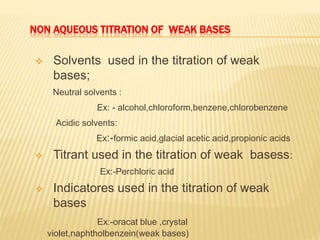
NON AQUEOUS TITRATION OF WEAK BASES
 Solvents used in the titration of weak
bases;
Neutral solvents :
Ex: - alcohol,chloroform,benzene,chlorobenzene
Acidic solvents:
Ex:-formic acid,glacial acetic acid,propionic acids
 Titrant used in the titration of weak basess:
Ex:-Perchloric acid
 Indicatores used in the titration of weak
bases
Ex:-oracat blue ,crystal
violet,naphtholbenzein(weak bases)
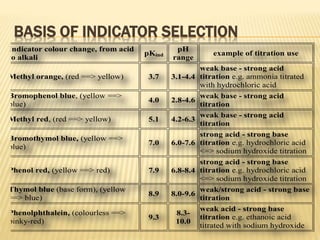
BASIS OF INDICATOR SELECTION
Indicator colour change, from acid
to alkali
pKind
pH
range
example of titration use
Methyl orange, (red ==> yellow) 3.7 3.1-4.4
weak base - strong acid
titration e.g. ammonia titrated
with hydrochloric acid
Bromophenol blue, (yellow ==>
blue)
4.0 2.8-4.6
weak base - strong acid
titration
Methyl red, (red ==> yellow) 5.1 4.2-6.3
weak base - strong acid
titration
Bromothymol blue, (yellow ==>
blue)
7.0 6.0-7.6
strong acid - strong base
titration e.g. hydrochloric acid
<=> sodium hydroxide titration
Phenol red, (yellow ==> red) 7.9 6.8-8.4
strong acid - strong base
titration e.g. hydrochloric acid
<=> sodium hydroxide titration
Thymol blue (base form), (yellow
==> blue)
8.9 8.0-9.6
weak/strong acid - strong base
titration
Phenolphthalein, (colourless ==>
pinky-red)
9.3
8.3-
10.0
weak acid - strong base
titration e.g. ethanoic acid
titrated with sodium hydroxide
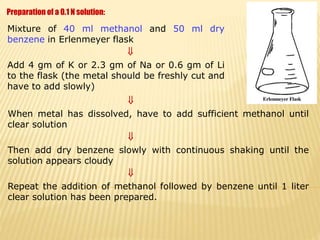
Preparation of a 0.1 N solution:

When metal has dissolved, have to add sufficient methanol until
clear solution

Then add dry benzene slowly with continuous shaking until the
solution appears cloudy

Repeat the addition of methanol followed by benzene until 1 liter
clear solution has been prepared.
Mixture of 40 ml methanol and 50 ml dry
benzene in Erlenmeyer flask

Add 4 gm of K or 2.3 gm of Na or 0.6 gm of Li
to the flask (the metal should be freshly cut and
have to add slowly)
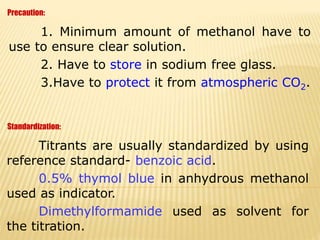
1. Minimum amount of methanol have to
use to ensure clear solution.
2. Have to store in sodium free glass.
3.Have to protect it from atmospheric CO2.
Precaution:
Titrants are usually standardized by using
reference standard- benzoic acid.
0.5% thymol blue in anhydrous methanol
used as indicator.
Dimethylformamide used as solvent for
the titration.
Standardization:
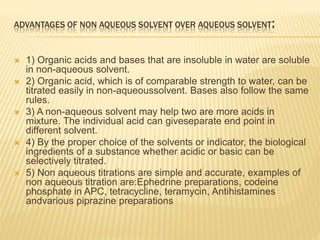
ADVANTAGES OF NON AQUEOUS SOLVENT OVER AQUEOUS SOLVENT:
 1) Organic acids and bases that are insoluble in water are soluble
in non-aqueous solvent.
 2) Organic acid, which is of comparable strength to water, can be
titrated easily in non-aqueoussolvent. Bases also follow the same
rules.
 3) A non-aqueous solvent may help two are more acids in
mixture. The individual acid can giveseparate end point in
different solvent.
 4) By the proper choice of the solvents or indicator, the biological
ingredients of a substance whether acidic or basic can be
selectively titrated.
 5) Non aqueous titrations are simple and accurate, examples of
non aqueous titration are:Ephedrine preparations, codeine
phosphate in APC, tetracycline, teramycin, Antihistamines
andvarious piprazine preparations
DISADVANTAGES NON-AQUEOUS ACID BASE
TITRATION
 Temperature ,moisture,co2 should be control.
 Solvents are expensive.
 Volatile solvents can polute environment
 Indicator must be prepare in non aquous
medium.
Non-aqueous acid base titrimetry

Non-aqueous acid base titrimetry

  • 1.
    Non-aqueous acid basetitrimetry Md : Obydulla Al Mamun Id:131-29-500 9th(B) Department Of Pharmacy Daffodil International University almamundcc94@gmail.com
  • 2.
    Non-aqueous acid basetitrimetry Non- aqueous titrations are those in which the titrations of too weakly acidic or basic substances are carried out using non-aqueous solvents so as to get sharp end point. Such titrations can also be used for the titration of the substances not soluble in water. The speed, precision and accuracy of the non- aqueous method are close to those of classical acidimetric and alkalimetric titrations.
  • 3.
    REASONS FOR PERFORMINGNON – AQUEOUS ACID – BASE TITRATION  Non – aqueous Acid – Base Titration is performed to eliminate 2 problems encountered during the aqueous titration of weakly acidic or weakly basic analyte by a Strong Acid or Strong Base Titrant respectively.  The 2 problems are –  Interaction of the Titrant with H2O  Poor Solubility of Weakly Acidic (WA) or Weakly Basic (WB) Analyte in H2O
  • 4.
    ACIDS & BASES Acids: Arrhenius acid: Any substance that, when dissolved in water, increases the concentration of hydronium ion (H3O+)  Bronsted-Lowry acid: A proton donor  conjugate base  Lewis acid: An electron acceptor Bases:  Arrhenius base: Any substance that, when dissolved in water, increases the concentration of hydroxide ion (OH-)  Bronsted-Lowery base: A proton acceptor  conjugate acid  Lewis acid: An electron donor
  • 5.
    Solvents Non-aqueous solvents areclassified into the 4 groups: - Protophilic solvents - Protogenic solvents - Amphiprotic solvents - Aprotic solvents
  • 6.
    Protophilic solvents Possess highaffinity for proton Weak acids are normally used as solute Strong protophilic solvents convert weak acid to strong acid-known as ’leveling effect’ Example: Liquid ammonia, amines, ether and ketones HA + S  SH+ + A- Weak Acid (appeared as strong acid) Basic solvent Solvated proton Conjugated base of acid
  • 7.
    Protogenic solvents Acidic innature Readily donates protons Strong protogenic solvents increase the strength of weak bases Such solvents exert a leveling effect on all bases dissolved in them Example: Anhydrous acid like hydrogen fluoride & sulfuric acid B + H+  BH+ Weak Base (appeared as strong base) From solvent Conjugated acid of base
  • 8.
    Amphiprotic solvents Combine protogenicand protophilic properties of solvent Able to both donate and accept proton Example: Water, alcohol & weak organic acid Acetic acid shows acidic property by releasing proton- CH3COOH  CH3COO- + H+ In presence of perchloric acid (strong acid) acetic acid shows basic property by accepting proton and produce ‘onium’ ion- CH3COOH + HClO4  CH3COOH2 + + ClO4 - ‘onium’ ion
  • 9.
    APROTIC SOLVENTS  Chemicallyneutral substances  Virtually un-reactive  Do not cause ionization of solute  No reactions with acids and bases  Used to dilute reaction mixture  Example: Carbon tetrachloride, benzene, tolune.
  • 10.
    NON AQUEOUS TITRATIONOF WEAK ACIDS  Many weakly acidic substances (aicohol or aprotic solvent)can be titrated in an appropiate non aqueous solvents with a sharp end point . Ex:- acidic halides, acids,amino acids, enols(barbiturates,xanthines), phenols, pyrroles sulphonamides etc,. 1) Solvents used in the titration of weak acids: Ex:-Ethylenediamine,n-butylamine,morpholine 2) Titrant used in the titration of weak acids: Ex:-sodium methoxide, lithium methoxide, potasium methoxide ,tetrabutyl ammonium hydroxide etc. 3) Indicatores used in the titration of weak acids Ex:-azo violet.thymol blue,thymolphthalein.,O-Nitro aniline
  • 11.
    NON AQUEOUS TITRATIONOF WEAK BASES  Solvents used in the titration of weak bases; Neutral solvents : Ex: - alcohol,chloroform,benzene,chlorobenzene Acidic solvents: Ex:-formic acid,glacial acetic acid,propionic acids  Titrant used in the titration of weak basess: Ex:-Perchloric acid  Indicatores used in the titration of weak bases Ex:-oracat blue ,crystal violet,naphtholbenzein(weak bases)
  • 12.
    BASIS OF INDICATORSELECTION Indicator colour change, from acid to alkali pKind pH range example of titration use Methyl orange, (red ==> yellow) 3.7 3.1-4.4 weak base - strong acid titration e.g. ammonia titrated with hydrochloric acid Bromophenol blue, (yellow ==> blue) 4.0 2.8-4.6 weak base - strong acid titration Methyl red, (red ==> yellow) 5.1 4.2-6.3 weak base - strong acid titration Bromothymol blue, (yellow ==> blue) 7.0 6.0-7.6 strong acid - strong base titration e.g. hydrochloric acid <=> sodium hydroxide titration Phenol red, (yellow ==> red) 7.9 6.8-8.4 strong acid - strong base titration e.g. hydrochloric acid <=> sodium hydroxide titration Thymol blue (base form), (yellow ==> blue) 8.9 8.0-9.6 weak/strong acid - strong base titration Phenolphthalein, (colourless ==> pinky-red) 9.3 8.3- 10.0 weak acid - strong base titration e.g. ethanoic acid titrated with sodium hydroxide
  • 13.
    Preparation of a0.1 N solution:  When metal has dissolved, have to add sufficient methanol until clear solution  Then add dry benzene slowly with continuous shaking until the solution appears cloudy  Repeat the addition of methanol followed by benzene until 1 liter clear solution has been prepared. Mixture of 40 ml methanol and 50 ml dry benzene in Erlenmeyer flask  Add 4 gm of K or 2.3 gm of Na or 0.6 gm of Li to the flask (the metal should be freshly cut and have to add slowly)
  • 14.
    1. Minimum amountof methanol have to use to ensure clear solution. 2. Have to store in sodium free glass. 3.Have to protect it from atmospheric CO2. Precaution: Titrants are usually standardized by using reference standard- benzoic acid. 0.5% thymol blue in anhydrous methanol used as indicator. Dimethylformamide used as solvent for the titration. Standardization:
  • 15.
    ADVANTAGES OF NONAQUEOUS SOLVENT OVER AQUEOUS SOLVENT:  1) Organic acids and bases that are insoluble in water are soluble in non-aqueous solvent.  2) Organic acid, which is of comparable strength to water, can be titrated easily in non-aqueoussolvent. Bases also follow the same rules.  3) A non-aqueous solvent may help two are more acids in mixture. The individual acid can giveseparate end point in different solvent.  4) By the proper choice of the solvents or indicator, the biological ingredients of a substance whether acidic or basic can be selectively titrated.  5) Non aqueous titrations are simple and accurate, examples of non aqueous titration are:Ephedrine preparations, codeine phosphate in APC, tetracycline, teramycin, Antihistamines andvarious piprazine preparations
  • 16.
    DISADVANTAGES NON-AQUEOUS ACIDBASE TITRATION  Temperature ,moisture,co2 should be control.  Solvents are expensive.  Volatile solvents can polute environment  Indicator must be prepare in non aquous medium.

Editor's Notes