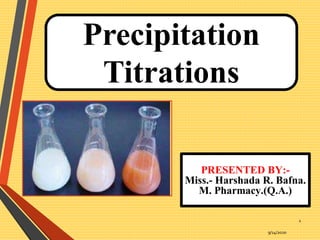
Precipitation
Titrations
9/14/2020
1
PRESENTED BY:-
Miss.- Harshada R. Bafna.
M. Pharmacy.(Q.A.)
9/14/2020Precipitation titration.(HRB) 2
Mohr’s method.
Volhard’s method.
Modified Volhard’s method.
Fajans method.
Estimation of sodium chloride.
Contents -
9/14/2020Precipitation titration.(HRB) 3
Precipitation titrations
 Precipitation titration is a type of titration which involves
the formation of precipitate during the titration technique.
 In precipitation titration, the titrant reacts with analyte and
forms an insoluble substance called precipitate.
 It continues till the last amount of analyte is consumed.
 Silver nitrate (AgNO3) is most important and mainly used
precipitating agent.
 Titrations in which use silver nitrate as a precipitating agent
is called as Aregentimetric titrations.
 Application-
1. It is used in the determination of chloride, bromide and
iodide ions (singly or in a mixture) by precipitation of silver
salts
9/14/2020Precipitation titration.(HRB) 4
Principle of Precipitation titrations
 The main principle of the precipitation titrations is that the
quantity of the added precipitating reagent or precipitant is
equivalent to the substance being precipitated.
 Precipitation titrations are mainly based on the solubility
product.
9/14/2020Precipitation titration.(HRB) 5
Factors affecting the solubility of precipitate
1. Effect of tempreature : with increased temperature solubility
of precipitate increases.
Example-
The solubility of
a) AgCl at 10°C and 100°C is 1.72 and 21.1 mg/liter.
b) BaSO4 at 10°C and 100°C is 2.2 and 3.9 mg/ liter.
2. Effect of solvent:
a) Solubility of inorganic salt is reduced by addition of organic
solvent such as ethanol, methanol, propanol, and acetone.
b) but in presence of only water, hydration of ions of salt
increases due to the high dipole moment of water molecule.
9/14/2020
Precipitation titration.(HRB)
6
3. Effect of pH on solubility:
a) Solubility of a salt will be increased by decrease in pH, if the
anion of salt is a conjugate base of a weak acid.
4. Effect of acid:
The solubility of the salt of weak acid is affected by the
addition of acid.
Example-
a) Hydrogen ion of added acid combines with the anions of
the salt and forms weak acid thereby increasing the
solubility of the salt.
5. Formation of complex ions :
The increase in solubility of a precipitate upon adding excess
precipitating agent is frequently due to the formation of
complex ion
9/14/2020Precipitation titration.(HRB) 7
Methods of Precipitation Titration
 According to end point detection method, three main
procedures are widely used depending on the type of
application.
 These are :
1. Mohr Method.
2. Volhard Method.
3. Fajans Method.
9/14/2020Precipitation titration.(HRB) 8
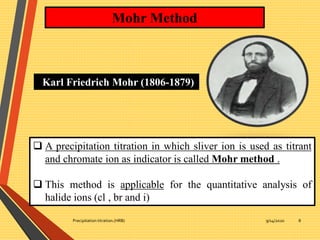
Mohr Method
Karl Friedrich Mohr (1806-1879)
 A precipitation titration in which sliver ion is used as titrant
and chromate ion as indicator is called Mohr method .
 This method is applicable for the quantitative analysis of
halide ions (cl , br and i)
9/14/2020Precipitation titration.(HRB) 9
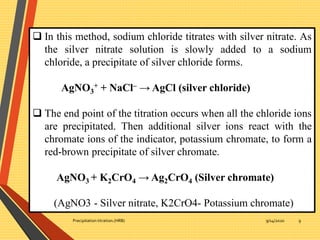
 In this method, sodium chloride titrates with silver nitrate. As
the silver nitrate solution is slowly added to a sodium
chloride, a precipitate of silver chloride forms.
AgNO3
+ + NaCl– → AgCl (silver chloride)
 The end point of the titration occurs when all the chloride ions
are precipitated. Then additional silver ions react with the
chromate ions of the indicator, potassium chromate, to form a
red-brown precipitate of silver chromate.
AgNO3 + K2CrO4 → Ag2CrO4 (Silver chromate)
(AgNO3 - Silver nitrate, K2CrO4- Potassium chromate)
9/14/2020Precipitation titration.(HRB) 10
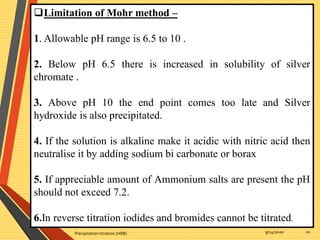
Limitation of Mohr method –
1. Allowable pH range is 6.5 to 10 .
2. Below pH 6.5 there is increased in solubility of silver
chromate .
3. Above pH 10 the end point comes too late and Silver
hydroxide is also precipitated.
4. If the solution is alkaline make it acidic with nitric acid then
neutralise it by adding sodium bi carbonate or borax
5. If appreciable amount of Ammonium salts are present the pH
should not exceed 7.2.
6.In reverse titration iodides and bromides cannot be titrated.
9/14/2020Precipitation titration.(HRB) 11
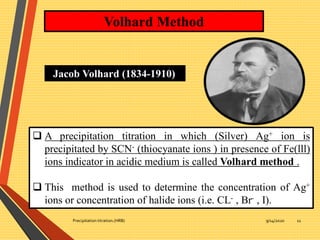
Volhard Method
Jacob Volhard (1834-1910)
 A precipitation titration in which (Silver) Ag+ ion is
precipitated by SCN- (thiocyanate ions ) in presence of Fe(lll)
ions indicator in acidic medium is called Volhard method .
 This method is used to determine the concentration of Ag+
ions or concentration of halide ions (i.e. CL- , Br- , I).
9/14/2020Precipitation titration.(HRB) 12
 In this method, there is formation of colored compound at
the end point.
Silver ion is titrated with thiocyanate in an acid solution
using ferric ion as an indicator.
Ag+ (aq) + SCN– (aq) → AgSCN(s)
Initially silver thiocyanate is precipitated. After the
equivalence point, when no Ag+ is present, the excess of
thiocyanate added reacts with Fe3+ to give reddish brown
ferric thiocyanate.
Fe3+ (aq) + SCN– (aq) → [FeSCN]2
+ (aq)
9/14/2020Precipitation titration.(HRB) 13
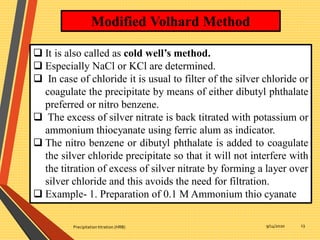
Modified Volhard Method
 It is also called as cold well’s method.
 Especially NaCl or KCl are determined.
 In case of chloride it is usual to filter of the silver chloride or
coagulate the precipitate by means of either dibutyl phthalate
preferred or nitro benzene.
 The excess of silver nitrate is back titrated with potassium or
ammonium thiocyanate using ferric alum as indicator.
 The nitro benzene or dibutyl phthalate is added to coagulate
the silver chloride precipitate so that it will not interfere with
the titration of excess of silver nitrate by forming a layer over
silver chloride and this avoids the need for filtration.
 Example- 1. Preparation of 0.1 M Ammonium thio cyanate
9/14/2020Precipitation titration.(HRB) 14
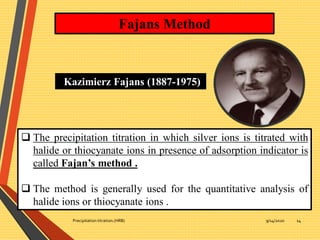
Fajans Method
Kazimierz Fajans (1887-1975)
 The precipitation titration in which silver ions is titrated with
halide or thiocyanate ions in presence of adsorption indicator is
called Fajan’s method .
 The method is generally used for the quantitative analysis of
halide ions or thiocyanate ions .
9/14/2020Precipitation titration.(HRB) 15
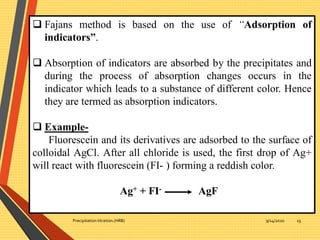
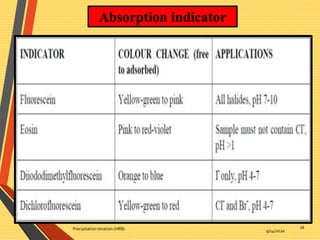
 Fajans method is based on the use of “Adsorption of
indicators”.
 Absorption of indicators are absorbed by the precipitates and
during the process of absorption changes occurs in the
indicator which leads to a substance of different color. Hence
they are termed as absorption indicators.
 Example-
Fluorescein and its derivatives are adsorbed to the surface of
colloidal AgCl. After all chloride is used, the first drop of Ag+
will react with fluorescein (FI- ) forming a reddish color.
Ag+ + FI- AgF
9/14/2020Precipitation titration.(HRB) 16
Absorption indicator
9/14/2020Precipitation titration.(HRB) 17
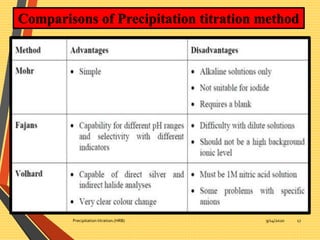
Comparisons of Precipitation titration method
9/14/2020Precipitation titration.(HRB) 18
Limitations of Precipitation Titration
A few number of ions such as halide ions (Cl- , Br- , l - )
can be titrated by precipitation method.
Co-precipitation may be occurred.
It is very difficult to detect the end point.
9/14/2020 19
References
1. A Textbook of Pharmaceutical Analysis (volume – I) by DR A
V Kasture, DR H N More, DR K R Mahadik, DR S G
Wadodkar, Nirali Prakashan, Pg.no. 85-98.
2. A Textbook of Pharmaceutical Analysis by David. G. Watson,
Churchill Livingstone, Pg.no. – 58.
3. www.google.com.
PA-I Precipitation titration (HRB)

PA-I Precipitation titration (HRB)

  • 1.
  • 2.
    9/14/2020Precipitation titration.(HRB) 2 Mohr’smethod. Volhard’s method. Modified Volhard’s method. Fajans method. Estimation of sodium chloride. Contents -
  • 3.
    9/14/2020Precipitation titration.(HRB) 3 Precipitationtitrations  Precipitation titration is a type of titration which involves the formation of precipitate during the titration technique.  In precipitation titration, the titrant reacts with analyte and forms an insoluble substance called precipitate.  It continues till the last amount of analyte is consumed.  Silver nitrate (AgNO3) is most important and mainly used precipitating agent.  Titrations in which use silver nitrate as a precipitating agent is called as Aregentimetric titrations.  Application- 1. It is used in the determination of chloride, bromide and iodide ions (singly or in a mixture) by precipitation of silver salts
  • 4.
    9/14/2020Precipitation titration.(HRB) 4 Principleof Precipitation titrations  The main principle of the precipitation titrations is that the quantity of the added precipitating reagent or precipitant is equivalent to the substance being precipitated.  Precipitation titrations are mainly based on the solubility product.
  • 5.
    9/14/2020Precipitation titration.(HRB) 5 Factorsaffecting the solubility of precipitate 1. Effect of tempreature : with increased temperature solubility of precipitate increases. Example- The solubility of a) AgCl at 10°C and 100°C is 1.72 and 21.1 mg/liter. b) BaSO4 at 10°C and 100°C is 2.2 and 3.9 mg/ liter. 2. Effect of solvent: a) Solubility of inorganic salt is reduced by addition of organic solvent such as ethanol, methanol, propanol, and acetone. b) but in presence of only water, hydration of ions of salt increases due to the high dipole moment of water molecule.
  • 6.
    9/14/2020 Precipitation titration.(HRB) 6 3. Effectof pH on solubility: a) Solubility of a salt will be increased by decrease in pH, if the anion of salt is a conjugate base of a weak acid. 4. Effect of acid: The solubility of the salt of weak acid is affected by the addition of acid. Example- a) Hydrogen ion of added acid combines with the anions of the salt and forms weak acid thereby increasing the solubility of the salt. 5. Formation of complex ions : The increase in solubility of a precipitate upon adding excess precipitating agent is frequently due to the formation of complex ion
  • 7.
    9/14/2020Precipitation titration.(HRB) 7 Methodsof Precipitation Titration  According to end point detection method, three main procedures are widely used depending on the type of application.  These are : 1. Mohr Method. 2. Volhard Method. 3. Fajans Method.
  • 8.
    9/14/2020Precipitation titration.(HRB) 8 MohrMethod Karl Friedrich Mohr (1806-1879)  A precipitation titration in which sliver ion is used as titrant and chromate ion as indicator is called Mohr method .  This method is applicable for the quantitative analysis of halide ions (cl , br and i)
  • 9.
    9/14/2020Precipitation titration.(HRB) 9 In this method, sodium chloride titrates with silver nitrate. As the silver nitrate solution is slowly added to a sodium chloride, a precipitate of silver chloride forms. AgNO3 + + NaCl– → AgCl (silver chloride)  The end point of the titration occurs when all the chloride ions are precipitated. Then additional silver ions react with the chromate ions of the indicator, potassium chromate, to form a red-brown precipitate of silver chromate. AgNO3 + K2CrO4 → Ag2CrO4 (Silver chromate) (AgNO3 - Silver nitrate, K2CrO4- Potassium chromate)
  • 10.
    9/14/2020Precipitation titration.(HRB) 10 Limitationof Mohr method – 1. Allowable pH range is 6.5 to 10 . 2. Below pH 6.5 there is increased in solubility of silver chromate . 3. Above pH 10 the end point comes too late and Silver hydroxide is also precipitated. 4. If the solution is alkaline make it acidic with nitric acid then neutralise it by adding sodium bi carbonate or borax 5. If appreciable amount of Ammonium salts are present the pH should not exceed 7.2. 6.In reverse titration iodides and bromides cannot be titrated.
  • 11.
    9/14/2020Precipitation titration.(HRB) 11 VolhardMethod Jacob Volhard (1834-1910)  A precipitation titration in which (Silver) Ag+ ion is precipitated by SCN- (thiocyanate ions ) in presence of Fe(lll) ions indicator in acidic medium is called Volhard method .  This method is used to determine the concentration of Ag+ ions or concentration of halide ions (i.e. CL- , Br- , I).
  • 12.
    9/14/2020Precipitation titration.(HRB) 12 In this method, there is formation of colored compound at the end point. Silver ion is titrated with thiocyanate in an acid solution using ferric ion as an indicator. Ag+ (aq) + SCN– (aq) → AgSCN(s) Initially silver thiocyanate is precipitated. After the equivalence point, when no Ag+ is present, the excess of thiocyanate added reacts with Fe3+ to give reddish brown ferric thiocyanate. Fe3+ (aq) + SCN– (aq) → [FeSCN]2 + (aq)
  • 13.
    9/14/2020Precipitation titration.(HRB) 13 ModifiedVolhard Method  It is also called as cold well’s method.  Especially NaCl or KCl are determined.  In case of chloride it is usual to filter of the silver chloride or coagulate the precipitate by means of either dibutyl phthalate preferred or nitro benzene.  The excess of silver nitrate is back titrated with potassium or ammonium thiocyanate using ferric alum as indicator.  The nitro benzene or dibutyl phthalate is added to coagulate the silver chloride precipitate so that it will not interfere with the titration of excess of silver nitrate by forming a layer over silver chloride and this avoids the need for filtration.  Example- 1. Preparation of 0.1 M Ammonium thio cyanate
  • 14.
    9/14/2020Precipitation titration.(HRB) 14 FajansMethod Kazimierz Fajans (1887-1975)  The precipitation titration in which silver ions is titrated with halide or thiocyanate ions in presence of adsorption indicator is called Fajan’s method .  The method is generally used for the quantitative analysis of halide ions or thiocyanate ions .
  • 15.
    9/14/2020Precipitation titration.(HRB) 15 Fajans method is based on the use of “Adsorption of indicators”.  Absorption of indicators are absorbed by the precipitates and during the process of absorption changes occurs in the indicator which leads to a substance of different color. Hence they are termed as absorption indicators.  Example- Fluorescein and its derivatives are adsorbed to the surface of colloidal AgCl. After all chloride is used, the first drop of Ag+ will react with fluorescein (FI- ) forming a reddish color. Ag+ + FI- AgF
  • 16.
  • 17.
  • 18.
    9/14/2020Precipitation titration.(HRB) 18 Limitationsof Precipitation Titration A few number of ions such as halide ions (Cl- , Br- , l - ) can be titrated by precipitation method. Co-precipitation may be occurred. It is very difficult to detect the end point.
  • 19.
    9/14/2020 19 References 1. ATextbook of Pharmaceutical Analysis (volume – I) by DR A V Kasture, DR H N More, DR K R Mahadik, DR S G Wadodkar, Nirali Prakashan, Pg.no. 85-98. 2. A Textbook of Pharmaceutical Analysis by David. G. Watson, Churchill Livingstone, Pg.no. – 58. 3. www.google.com.