NON-AQUEOUS TITRATIONS
Prepared by
G. Nikitha, M.Pharmacy
Assistant Professor
Department of Pharmaceutical Chemistry
Sree Dattha Institute Of Pharmacy
Hyderabad
CONTENTS
 Learning objectives
 Introduction
 Types of solvents
 Acidimetry in non aqueous medium
 Alkalimetry in non aqueous medium
 Estimation of Sodium benzoate and Ephedrine HCl
 Applications of non aqueous titrations in pharmacy
 Conclusion
 Reference
LEARNING OBJECTIVES
In these topic we will discuss about
 Brief introduction of Non aqueous titration, definition
 Indicators used in Non aqueous titration
 Applications of non aqueous titrations in pharmacy
 Acidimetry in non aqueous medium
 Alkalimetry in non aqueous medium
 Types of solvents
 Estimation of Sodium benzoate and Ephedrine HCl
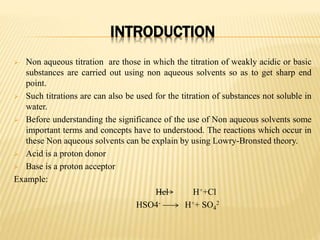
INTRODUCTION
 Non aqueous titration are those in which the titration of weakly acidic or basic
substances are carried out using non aqueous solvents so as to get sharp end
point.
 Such titrations are can also be used for the titration of substances not soluble in
water.
 Before understanding the significance of the use of Non aqueous solvents some
important terms and concepts have to understood. The reactions which occur in
these Non aqueous solvents can be explain by using Lowry-Bronsted theory.
 Acid is a proton donor
 Base is a proton acceptor
Example:
Hcl H++Cl
HSO4- H++ SO4
2
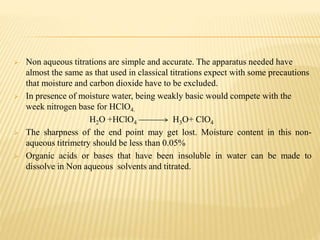
 Non aqueous titrations are simple and accurate. The apparatus needed have
almost the same as that used in classical titrations expect with some precautions
that moisture and carbon dioxide have to be excluded.
 In presence of moisture water, being weakly basic would compete with the
week nitrogen base for HClO4.
H2O +HClO4 H3O+ ClO4
 The sharpness of the end point may get lost. Moisture content in this non-
aqueous titrimetry should be less than 0.05%
 Organic acids or bases that have been insoluble in water can be made to
dissolve in Non aqueous solvents and titrated.
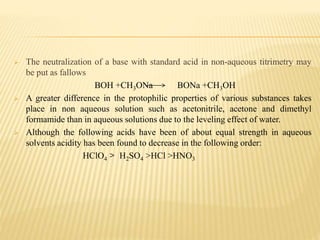
 The neutralization of a base with standard acid in non-aqueous titrimetry may
be put as fallows
BOH +CH3ONa BONa +CH3OH
 A greater difference in the protophilic properties of various substances takes
place in non aqueous solution such as acetonitrile, acetone and dimethyl
formamide than in aqueous solutions due to the leveling effect of water.
 Although the following acids have been of about equal strength in aqueous
solvents acidity has been found to decrease in the following order:
HClO4 > H2SO4 >HCl >HNO3
INDICATORS
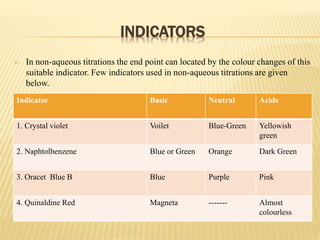
 In non-aqueous titrations the end point can located by the colour changes of this
suitable indicator. Few indicators used in non-aqueous titrations are given
below.
Indicator Basic Neutral Acids
1. Crystal violet Voilet Blue-Green Yellowish
green
2. Naphtolbenzene Blue or Green Orange Dark Green
3. Oracet Blue B Blue Purple Pink
4. Quinaldine Red Magneta ------- Almost
colourless
TYPES OF SOLVENTS
Solvents are classified according to their properties as fallows
1. Aprotic solvents
2. Protogenic solvents
3. Protophilic solvents
4. Amphiprotic solvents
1. Aprotic solvents:
These are solvents which are chemically inert and are not involved in any chemical
reaction.
Example: Chloroform, Benzene.
2. Protogenic solvents:
These are acidic substances and yield protons.
Example: sulphuric acid, Hydrochloric acid, Nitric acid etc
3. Protophilic solvents:
These solvents are of two types. They are strongly basic or weakly basic in nature.
A strongly basic solvent has stronger tendency to accept the proton. A weekly basic
solvent has weaker tendency to accept the proton.
A strongly basic solvents is called as a “Leveling solvent” (for weak and strong
acids) because it can abstract proton from any acid. Whether it is strong acid or
weak acid. This effect is called “Leveling effect”. As it does not differentiate
between strong or weak acid.
On the other hand a weakly basic solvent has weak tendency to accept the proton.
Hence this solvent is tendency to accept the proton called a “Differentiating
solvent”. Because it can abstract proton from strongly acidic substances and
from weak acids. This effect is called “Differentiating effect”. Differentiating
solvents are not useful in non-aqueous titrations.
Similarly strongly acidic solvents are leveling solvents for weak bases and strong
bases. strongly acidic solvents can donate proton to strong bases as well as
weak bases.
Example: Perchloric acid, acetic acid etc.
4. Amphiprotic solvents:
These have both protogenic and protophillic properties
Example: water, acetic acid, alcohols.
Water has both protogenic and protophillic properties. It can behave as a base or
acid.
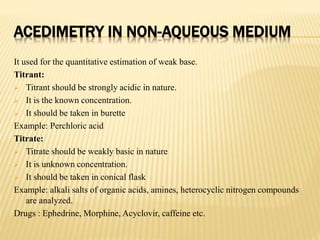
ACEDIMETRY IN NON-AQUEOUS MEDIUM
It used for the quantitative estimation of weak base.
Titrant:
 Titrant should be strongly acidic in nature.
 It is the known concentration.
 It should be taken in burette
Example: Perchloric acid
Titrate:
 Titrate should be weakly basic in nature
 It is unknown concentration.
 It should be taken in conical flask
Example: alkali salts of organic acids, amines, heterocyclic nitrogen compounds
are analyzed.
Drugs : Ephedrine, Morphine, Acyclovir, caffeine etc.
Solvents:
The solvents are either neutral such as alcohol, chloroform, benzene etc or acidic
solvents such as acetic acid etc. solvents should be protogenic in nature.
Indicator:
Crystal violet, Quinoline red, thymol blue.
Reactions:
B+CH3COOH ⇌ BH++CH3COO
Here B= Base
CH3COOH= Acetic acid
BH+ = conjugate acid of base
CH3COO = conjugate base
Titrant reacts with the solvent and gets promoted as follows
HClO4+CH3COOH ⇌ CH3COO H2+ClO4
-
Here
HClO4 = Perchloric Acid
CH3COOH= Acetic acid
ClO4
- = Perchlorate
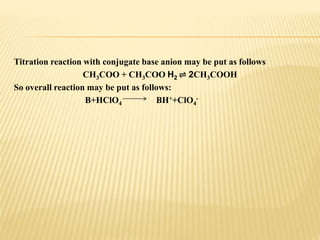
Titration reaction with conjugate base anion may be put as follows
CH3COO + CH3COO H2 ⇌ 2CH3COOH
So overall reaction may be put as follows:
B+HClO4 BH++ClO4
-
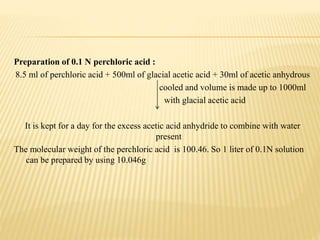
Preparation of 0.1 N perchloric acid :
8.5 ml of perchloric acid + 500ml of glacial acetic acid + 30ml of acetic anhydrous
cooled and volume is made up to 1000ml
with glacial acetic acid
It is kept for a day for the excess acetic acid anhydride to combine with water
present
The molecular weight of the perchloric acid is 100.46. So 1 liter of 0.1N solution
can be prepared by using 10.046g
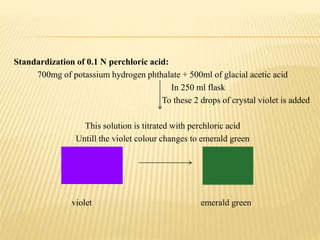
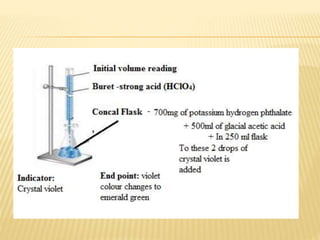
Standardization of 0.1 N perchloric acid:
700mg of potassium hydrogen phthalate + 500ml of glacial acetic acid
In 250 ml flask
To these 2 drops of crystal violet is added
This solution is titrated with perchloric acid
Untill the violet colour changes to emerald green
violet emerald green
potassium hydrogen phthalate is reacted with perchloric acid to get Phthalic acid and potassium
perchlorate. Here Potassium (K) from potassium hydrogen phthalate is removed and replaced
with hydrogen (H) from perchloric acid .
1ml of 0.1N HClO4 ≡ 20.48 mg of C8H5KO4
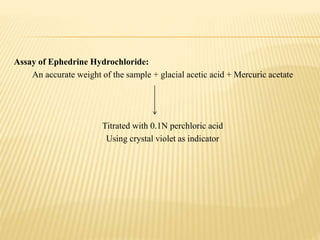
Assay of Ephedrine Hydrochloride:
An accurate weight of the sample + glacial acetic acid + Mercuric acetate
Titrated with 0.1N perchloric acid
Using crystal violet as indicator
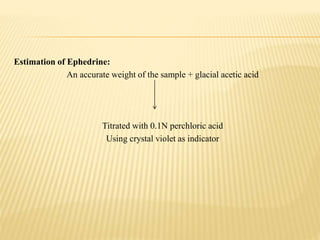
Estimation of Ephedrine:
An accurate weight of the sample + glacial acetic acid
Titrated with 0.1N perchloric acid
Using crystal violet as indicator
Estimation of Sodium benzoate
Preparation of 0.1N solution of HClO4 and its standardization:
8.5 ml of perchloric acid + 500ml of glacial acetic acid + 30ml of acetic anhydrous
cooled and volume is made up to 1000ml
with glacial acetic acid
It is kept for a day for the excess acetic acid anhydride to combine with water
present
The molecular weight of the perchloric acid is 100.46. So 1 liter of 0.1N solution
can be prepared by using 10.046g
Standardization of 0.1 N perchloric acid:
500mg of potassium hydrogen phthalate + 25ml of glacial acetic acid
In 250 ml flask
To these 2 drops of crystal violet is added
This solution is titrated with perchloric acid
Untill the blue colour changes to blue green
blue blue green
Assay Procedure :
Weigh accurately about 0.25 g of Sodium Benzoate +20 ml of anhydrous glacial
acetic acid
warming to 50º if necessary, cool
Titrate with 0.1 M perchloric acid, using 0.05 ml of 1-naphtholbenzein solution as
indicator. Carry out a blank titration.
ALKALIMETRY IN NON-AQUEOUS MEDIUM
It used for the quantitative estimation of weak acid.
Titrant:
 Titrant should be strongly basic in nature.
 It is the known concentration.
 It should be taken in burette
Example: sodium methoxide, Lithium methoxide , sodium amino methoxide,
sodium triphenyl methane
Titrate:
 Titrate should be weakly acidic in nature
 It is unknown concentration.
 It should be taken in conical flask
Example: Benzoic acid etc
Drugs : Nalidix acid, Acetazolamide, Allopurine, Mercaptopurine etc
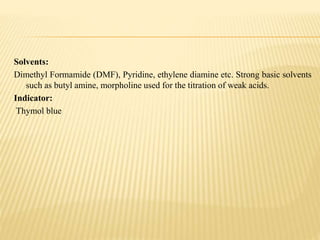
Solvents:
Dimethyl Formamide (DMF), Pyridine, ethylene diamine etc. Strong basic solvents
such as butyl amine, morpholine used for the titration of weak acids.
Indicator:
Thymol blue
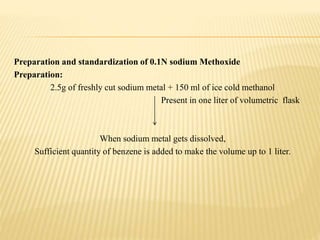
Preparation and standardization of 0.1N sodium Methoxide
Preparation:
2.5g of freshly cut sodium metal + 150 ml of ice cold methanol
Present in one liter of volumetric flask
When sodium metal gets dissolved,
Sufficient quantity of benzene is added to make the volume up to 1 liter.
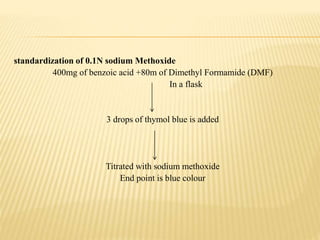
standardization of 0.1N sodium Methoxide
400mg of benzoic acid +80m of Dimethyl Formamide (DMF)
In a flask
3 drops of thymol blue is added
Titrated with sodium methoxide
End point is blue colour
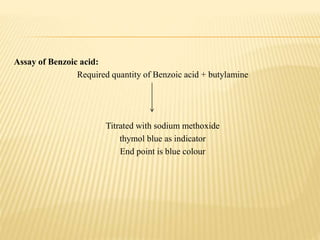
Assay of Benzoic acid:
Required quantity of Benzoic acid + butylamine
Titrated with sodium methoxide
thymol blue as indicator
End point is blue colour
APPLICATIONS
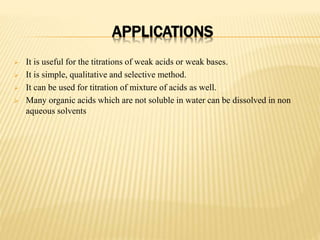
 It is useful for the titrations of weak acids or weak bases.
 It is simple, qualitative and selective method.
 It can be used for titration of mixture of acids as well.
 Many organic acids which are not soluble in water can be dissolved in non
aqueous solvents
CONCLUSION
In these topic we have discussed about
 Brief introduction of Non aqueous titration, definition
 Indicators used in Non aqueous titration
 Applications of non aqueous titrations in pharmacy
 Acidimetry in non aqueous medium
 Alkalimetry in non aqueous medium
 Types of solvents
 Estimation of Sodium benzoate and Ephedrine HCl
REFERENCE
 Pharmaceutical Chemistry -Inorganic Volume-1 by G. R. Chatwal.
 Essentials of Inorganic Chemistry by Katja A. Strohfeldt.
 Indian Pharmacopoeia.
 M.L Schroff, Inorganic Pharmaceutical Chemistry.
 P. GunduRao, Inorganic Pharmaceutical Chemistry, 3rd Edition
 A.I. Vogel, Text Book of Quantitative Inorganic analysis.
 Bentley and Driver's Textbook of Pharmaceutical Chemistry.
THANK YOU

5. non aqueous titrations

  • 1.
    NON-AQUEOUS TITRATIONS Prepared by G.Nikitha, M.Pharmacy Assistant Professor Department of Pharmaceutical Chemistry Sree Dattha Institute Of Pharmacy Hyderabad
  • 2.
    CONTENTS  Learning objectives Introduction  Types of solvents  Acidimetry in non aqueous medium  Alkalimetry in non aqueous medium  Estimation of Sodium benzoate and Ephedrine HCl  Applications of non aqueous titrations in pharmacy  Conclusion  Reference
  • 3.
    LEARNING OBJECTIVES In thesetopic we will discuss about  Brief introduction of Non aqueous titration, definition  Indicators used in Non aqueous titration  Applications of non aqueous titrations in pharmacy  Acidimetry in non aqueous medium  Alkalimetry in non aqueous medium  Types of solvents  Estimation of Sodium benzoate and Ephedrine HCl
  • 4.
    INTRODUCTION  Non aqueoustitration are those in which the titration of weakly acidic or basic substances are carried out using non aqueous solvents so as to get sharp end point.  Such titrations are can also be used for the titration of substances not soluble in water.  Before understanding the significance of the use of Non aqueous solvents some important terms and concepts have to understood. The reactions which occur in these Non aqueous solvents can be explain by using Lowry-Bronsted theory.  Acid is a proton donor  Base is a proton acceptor Example: Hcl H++Cl HSO4- H++ SO4 2
  • 5.
     Non aqueoustitrations are simple and accurate. The apparatus needed have almost the same as that used in classical titrations expect with some precautions that moisture and carbon dioxide have to be excluded.  In presence of moisture water, being weakly basic would compete with the week nitrogen base for HClO4. H2O +HClO4 H3O+ ClO4  The sharpness of the end point may get lost. Moisture content in this non- aqueous titrimetry should be less than 0.05%  Organic acids or bases that have been insoluble in water can be made to dissolve in Non aqueous solvents and titrated.
  • 6.
     The neutralizationof a base with standard acid in non-aqueous titrimetry may be put as fallows BOH +CH3ONa BONa +CH3OH  A greater difference in the protophilic properties of various substances takes place in non aqueous solution such as acetonitrile, acetone and dimethyl formamide than in aqueous solutions due to the leveling effect of water.  Although the following acids have been of about equal strength in aqueous solvents acidity has been found to decrease in the following order: HClO4 > H2SO4 >HCl >HNO3
  • 7.
    INDICATORS  In non-aqueoustitrations the end point can located by the colour changes of this suitable indicator. Few indicators used in non-aqueous titrations are given below. Indicator Basic Neutral Acids 1. Crystal violet Voilet Blue-Green Yellowish green 2. Naphtolbenzene Blue or Green Orange Dark Green 3. Oracet Blue B Blue Purple Pink 4. Quinaldine Red Magneta ------- Almost colourless
  • 8.
    TYPES OF SOLVENTS Solventsare classified according to their properties as fallows 1. Aprotic solvents 2. Protogenic solvents 3. Protophilic solvents 4. Amphiprotic solvents
  • 9.
    1. Aprotic solvents: Theseare solvents which are chemically inert and are not involved in any chemical reaction. Example: Chloroform, Benzene. 2. Protogenic solvents: These are acidic substances and yield protons. Example: sulphuric acid, Hydrochloric acid, Nitric acid etc
  • 10.
    3. Protophilic solvents: Thesesolvents are of two types. They are strongly basic or weakly basic in nature. A strongly basic solvent has stronger tendency to accept the proton. A weekly basic solvent has weaker tendency to accept the proton. A strongly basic solvents is called as a “Leveling solvent” (for weak and strong acids) because it can abstract proton from any acid. Whether it is strong acid or weak acid. This effect is called “Leveling effect”. As it does not differentiate between strong or weak acid. On the other hand a weakly basic solvent has weak tendency to accept the proton. Hence this solvent is tendency to accept the proton called a “Differentiating solvent”. Because it can abstract proton from strongly acidic substances and from weak acids. This effect is called “Differentiating effect”. Differentiating solvents are not useful in non-aqueous titrations.
  • 11.
    Similarly strongly acidicsolvents are leveling solvents for weak bases and strong bases. strongly acidic solvents can donate proton to strong bases as well as weak bases. Example: Perchloric acid, acetic acid etc. 4. Amphiprotic solvents: These have both protogenic and protophillic properties Example: water, acetic acid, alcohols. Water has both protogenic and protophillic properties. It can behave as a base or acid.
  • 12.
    ACEDIMETRY IN NON-AQUEOUSMEDIUM It used for the quantitative estimation of weak base. Titrant:  Titrant should be strongly acidic in nature.  It is the known concentration.  It should be taken in burette Example: Perchloric acid Titrate:  Titrate should be weakly basic in nature  It is unknown concentration.  It should be taken in conical flask Example: alkali salts of organic acids, amines, heterocyclic nitrogen compounds are analyzed. Drugs : Ephedrine, Morphine, Acyclovir, caffeine etc.
  • 13.
    Solvents: The solvents areeither neutral such as alcohol, chloroform, benzene etc or acidic solvents such as acetic acid etc. solvents should be protogenic in nature. Indicator: Crystal violet, Quinoline red, thymol blue.
  • 14.
    Reactions: B+CH3COOH ⇌ BH++CH3COO HereB= Base CH3COOH= Acetic acid BH+ = conjugate acid of base CH3COO = conjugate base Titrant reacts with the solvent and gets promoted as follows HClO4+CH3COOH ⇌ CH3COO H2+ClO4 - Here HClO4 = Perchloric Acid CH3COOH= Acetic acid ClO4 - = Perchlorate
  • 15.
    Titration reaction withconjugate base anion may be put as follows CH3COO + CH3COO H2 ⇌ 2CH3COOH So overall reaction may be put as follows: B+HClO4 BH++ClO4 -
  • 17.
    Preparation of 0.1N perchloric acid : 8.5 ml of perchloric acid + 500ml of glacial acetic acid + 30ml of acetic anhydrous cooled and volume is made up to 1000ml with glacial acetic acid It is kept for a day for the excess acetic acid anhydride to combine with water present The molecular weight of the perchloric acid is 100.46. So 1 liter of 0.1N solution can be prepared by using 10.046g
  • 18.
    Standardization of 0.1N perchloric acid: 700mg of potassium hydrogen phthalate + 500ml of glacial acetic acid In 250 ml flask To these 2 drops of crystal violet is added This solution is titrated with perchloric acid Untill the violet colour changes to emerald green violet emerald green
  • 20.
    potassium hydrogen phthalateis reacted with perchloric acid to get Phthalic acid and potassium perchlorate. Here Potassium (K) from potassium hydrogen phthalate is removed and replaced with hydrogen (H) from perchloric acid . 1ml of 0.1N HClO4 ≡ 20.48 mg of C8H5KO4
  • 21.
    Assay of EphedrineHydrochloride: An accurate weight of the sample + glacial acetic acid + Mercuric acetate Titrated with 0.1N perchloric acid Using crystal violet as indicator
  • 23.
    Estimation of Ephedrine: Anaccurate weight of the sample + glacial acetic acid Titrated with 0.1N perchloric acid Using crystal violet as indicator
  • 24.
    Estimation of Sodiumbenzoate Preparation of 0.1N solution of HClO4 and its standardization: 8.5 ml of perchloric acid + 500ml of glacial acetic acid + 30ml of acetic anhydrous cooled and volume is made up to 1000ml with glacial acetic acid It is kept for a day for the excess acetic acid anhydride to combine with water present The molecular weight of the perchloric acid is 100.46. So 1 liter of 0.1N solution can be prepared by using 10.046g
  • 25.
    Standardization of 0.1N perchloric acid: 500mg of potassium hydrogen phthalate + 25ml of glacial acetic acid In 250 ml flask To these 2 drops of crystal violet is added This solution is titrated with perchloric acid Untill the blue colour changes to blue green blue blue green
  • 26.
    Assay Procedure : Weighaccurately about 0.25 g of Sodium Benzoate +20 ml of anhydrous glacial acetic acid warming to 50º if necessary, cool Titrate with 0.1 M perchloric acid, using 0.05 ml of 1-naphtholbenzein solution as indicator. Carry out a blank titration.
  • 27.
    ALKALIMETRY IN NON-AQUEOUSMEDIUM It used for the quantitative estimation of weak acid. Titrant:  Titrant should be strongly basic in nature.  It is the known concentration.  It should be taken in burette Example: sodium methoxide, Lithium methoxide , sodium amino methoxide, sodium triphenyl methane Titrate:  Titrate should be weakly acidic in nature  It is unknown concentration.  It should be taken in conical flask Example: Benzoic acid etc Drugs : Nalidix acid, Acetazolamide, Allopurine, Mercaptopurine etc
  • 28.
    Solvents: Dimethyl Formamide (DMF),Pyridine, ethylene diamine etc. Strong basic solvents such as butyl amine, morpholine used for the titration of weak acids. Indicator: Thymol blue
  • 30.
    Preparation and standardizationof 0.1N sodium Methoxide Preparation: 2.5g of freshly cut sodium metal + 150 ml of ice cold methanol Present in one liter of volumetric flask When sodium metal gets dissolved, Sufficient quantity of benzene is added to make the volume up to 1 liter.
  • 31.
    standardization of 0.1Nsodium Methoxide 400mg of benzoic acid +80m of Dimethyl Formamide (DMF) In a flask 3 drops of thymol blue is added Titrated with sodium methoxide End point is blue colour
  • 32.
    Assay of Benzoicacid: Required quantity of Benzoic acid + butylamine Titrated with sodium methoxide thymol blue as indicator End point is blue colour
  • 33.
    APPLICATIONS  It isuseful for the titrations of weak acids or weak bases.  It is simple, qualitative and selective method.  It can be used for titration of mixture of acids as well.  Many organic acids which are not soluble in water can be dissolved in non aqueous solvents
  • 34.
    CONCLUSION In these topicwe have discussed about  Brief introduction of Non aqueous titration, definition  Indicators used in Non aqueous titration  Applications of non aqueous titrations in pharmacy  Acidimetry in non aqueous medium  Alkalimetry in non aqueous medium  Types of solvents  Estimation of Sodium benzoate and Ephedrine HCl
  • 35.
    REFERENCE  Pharmaceutical Chemistry-Inorganic Volume-1 by G. R. Chatwal.  Essentials of Inorganic Chemistry by Katja A. Strohfeldt.  Indian Pharmacopoeia.  M.L Schroff, Inorganic Pharmaceutical Chemistry.  P. GunduRao, Inorganic Pharmaceutical Chemistry, 3rd Edition  A.I. Vogel, Text Book of Quantitative Inorganic analysis.  Bentley and Driver's Textbook of Pharmaceutical Chemistry.
  • 36.