Non aqueous titration
Mr. ShashankShekharMishra
Why Non aqueous titration is used??
1. Reactants are insoluble in water.
2. Reactants are reactive with water.
3. Reactants are very weak acids and very weak
bases in nature (because 100% dissociation is
not possible).
Estimation is not possible by aqueous
acid-base titration.
Non aqueous titration
Weak acid and weak base can not be easily titrated
in aqueous solution due to dual behaviour of
water. So, water is replaced by other solvent
such as Perchloric acid, this type of titration is
called as Non aqueous titration .
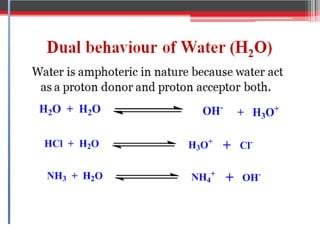
Dual behaviour of Water (H2O)
Water is amphoteric in nature because water act
as a proton donor and proton acceptor both.
Solvents
The solvents are classified into four types-
1. Protogenic solvents
2. Protophilic solvents
3. Aprotic solvents
4. Amphoteric solvents
Protogenic solvents
These are acidic solvents which easily donate protons and
are used to enhance the basicity of weak base.
Ex. Glacial Acetic acid, etc.
Protophilic solvents
These solvents are basic in nature, having a high affinity for
H+ , they enhance the acidity of weak acid.
Ex. Pyridene, dimethyl formamide, ethylene diamine.
Aprotic solvents
These solvents are neither accept the proton nor donate the
proton. They are useful to dissolved the water insoluble
drugs.
Ex. Benzene, Toluene, Carbon tetra chloride.
Amphoteric solvents
This group of solvents behave as acid as well as base
depending on the substance dissolve in it. They can
accept or donate proton and have lavelling effect.
Ex. Water, Ethanol, Alcohols.
Selection of Solvents
1. The analyte must be soluble in solvents.
2. Nature of the drug
Weak acid- Basic solvents
Weak base – Acidic solvents
3. Unreactivity – There should not be side
reaction between solvent with drug or titrand.
Types of Non aqueous titration
1. Acidimetry
2. Alkalimetry
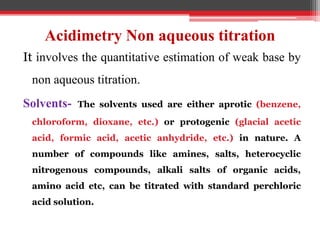
Acidimetry Non aqueous titration
It involves the quantitative estimation of weak base by
non aqueous titration.
Solvents- The solvents used are either aprotic (benzene,
chloroform, dioxane, etc.) or protogenic (glacial acetic
acid, formic acid, acetic anhydride, etc.) in nature. A
number of compounds like amines, salts, heterocyclic
nitrogenous compounds, alkali salts of organic acids,
amino acid etc, can be titrated with standard perchloric
acid solution.
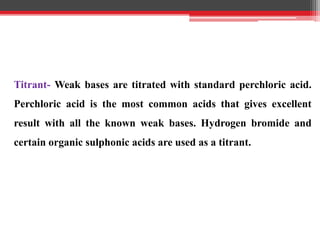
Titrant- Weak bases are titrated with standard perchloric acid.
Perchloric acid is the most common acids that gives excellent
result with all the known weak bases. Hydrogen bromide and
certain organic sulphonic acids are used as a titrant.
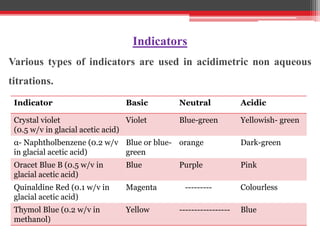
Indicators
Various types of indicators are used in acidimetric non aqueous
titrations.
Indicator Basic Neutral Acidic
Crystal violet
(0.5 w/v in glacial acetic acid)
Violet Blue-green Yellowish- green
α- Naphtholbenzene (0.2 w/v
in glacial acetic acid)
Blue or blue-
green
orange Dark-green
Oracet Blue B (0.5 w/v in
glacial acetic acid)
Blue Purple Pink
Quinaldine Red (0.1 w/v in
glacial acetic acid)
Magenta --------- Colourless
Thymol Blue (0.2 w/v in
methanol)
Yellow ----------------- Blue
Examples of Acidimetric Non aqueous titration
A. Estimation of Ephedrine hydrochloride
- Weigh accurately 0.5 gm of Ephedrine hydrochloride and
dissolve in glacial acetic acid (25 ml).
- Add mercuric acetate 10 ml and add few drops of crystal
violet indicator.
- Titrate the solution against 0.1 M perchloric acid solution
until colour changes from blue to greenish blue.
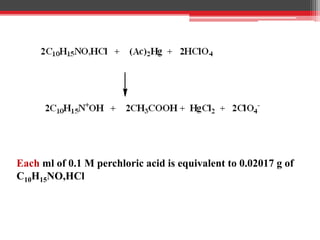
Each ml of 0.1 M perchloric acid is equivalent to 0.02017 g of
C10H15NO,HCl
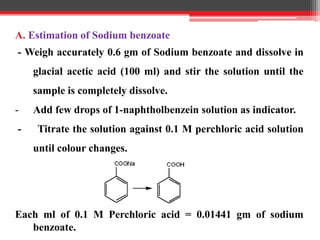
A. Estimation of Sodium benzoate
- Weigh accurately 0.6 gm of Sodium benzoate and dissolve in
glacial acetic acid (100 ml) and stir the solution until the
sample is completely dissolve.
- Add few drops of 1-naphtholbenzein solution as indicator.
- Titrate the solution against 0.1 M perchloric acid solution
until colour changes.
Each ml of 0.1 M Perchloric acid = 0.01441 gm of sodium
benzoate.
Alkalimetry in Non aqueous titration
Weak acidic substances such as barbiturates, aromatic
acid etc. are quantitatively estimated by alkalimetry
in non aqueous titration.
Solvents- Most commonly used solvents are ethylene
diamine, chloroform, acetone, morpholine. They
increase the acidity of weak acid and do not interfere
in the reaction.
Titrant- Sodium methoxide is a commonly used titrant but where it
forms gelatinous products it is replaced by lithium methoxide.
Indicators-
Commonly used indicators are-
Thymol blue
Azoviolet solution
O-nitroaniline solution

Non aqueous titration

  • 1.
    Non aqueous titration Mr.ShashankShekharMishra
  • 2.
    Why Non aqueoustitration is used?? 1. Reactants are insoluble in water. 2. Reactants are reactive with water. 3. Reactants are very weak acids and very weak bases in nature (because 100% dissociation is not possible). Estimation is not possible by aqueous acid-base titration.
  • 3.
    Non aqueous titration Weakacid and weak base can not be easily titrated in aqueous solution due to dual behaviour of water. So, water is replaced by other solvent such as Perchloric acid, this type of titration is called as Non aqueous titration .
  • 4.
    Dual behaviour ofWater (H2O) Water is amphoteric in nature because water act as a proton donor and proton acceptor both.
  • 5.
    Solvents The solvents areclassified into four types- 1. Protogenic solvents 2. Protophilic solvents 3. Aprotic solvents 4. Amphoteric solvents
  • 6.
    Protogenic solvents These areacidic solvents which easily donate protons and are used to enhance the basicity of weak base. Ex. Glacial Acetic acid, etc. Protophilic solvents These solvents are basic in nature, having a high affinity for H+ , they enhance the acidity of weak acid. Ex. Pyridene, dimethyl formamide, ethylene diamine.
  • 7.
    Aprotic solvents These solventsare neither accept the proton nor donate the proton. They are useful to dissolved the water insoluble drugs. Ex. Benzene, Toluene, Carbon tetra chloride. Amphoteric solvents This group of solvents behave as acid as well as base depending on the substance dissolve in it. They can accept or donate proton and have lavelling effect. Ex. Water, Ethanol, Alcohols.
  • 8.
    Selection of Solvents 1.The analyte must be soluble in solvents. 2. Nature of the drug Weak acid- Basic solvents Weak base – Acidic solvents 3. Unreactivity – There should not be side reaction between solvent with drug or titrand.
  • 9.
    Types of Nonaqueous titration 1. Acidimetry 2. Alkalimetry
  • 10.
    Acidimetry Non aqueoustitration It involves the quantitative estimation of weak base by non aqueous titration. Solvents- The solvents used are either aprotic (benzene, chloroform, dioxane, etc.) or protogenic (glacial acetic acid, formic acid, acetic anhydride, etc.) in nature. A number of compounds like amines, salts, heterocyclic nitrogenous compounds, alkali salts of organic acids, amino acid etc, can be titrated with standard perchloric acid solution.
  • 11.
    Titrant- Weak basesare titrated with standard perchloric acid. Perchloric acid is the most common acids that gives excellent result with all the known weak bases. Hydrogen bromide and certain organic sulphonic acids are used as a titrant.
  • 12.
    Indicators Various types ofindicators are used in acidimetric non aqueous titrations. Indicator Basic Neutral Acidic Crystal violet (0.5 w/v in glacial acetic acid) Violet Blue-green Yellowish- green α- Naphtholbenzene (0.2 w/v in glacial acetic acid) Blue or blue- green orange Dark-green Oracet Blue B (0.5 w/v in glacial acetic acid) Blue Purple Pink Quinaldine Red (0.1 w/v in glacial acetic acid) Magenta --------- Colourless Thymol Blue (0.2 w/v in methanol) Yellow ----------------- Blue
  • 13.
    Examples of AcidimetricNon aqueous titration A. Estimation of Ephedrine hydrochloride - Weigh accurately 0.5 gm of Ephedrine hydrochloride and dissolve in glacial acetic acid (25 ml). - Add mercuric acetate 10 ml and add few drops of crystal violet indicator. - Titrate the solution against 0.1 M perchloric acid solution until colour changes from blue to greenish blue.
  • 14.
    Each ml of0.1 M perchloric acid is equivalent to 0.02017 g of C10H15NO,HCl
  • 15.
    A. Estimation ofSodium benzoate - Weigh accurately 0.6 gm of Sodium benzoate and dissolve in glacial acetic acid (100 ml) and stir the solution until the sample is completely dissolve. - Add few drops of 1-naphtholbenzein solution as indicator. - Titrate the solution against 0.1 M perchloric acid solution until colour changes. Each ml of 0.1 M Perchloric acid = 0.01441 gm of sodium benzoate.
  • 16.
    Alkalimetry in Nonaqueous titration Weak acidic substances such as barbiturates, aromatic acid etc. are quantitatively estimated by alkalimetry in non aqueous titration. Solvents- Most commonly used solvents are ethylene diamine, chloroform, acetone, morpholine. They increase the acidity of weak acid and do not interfere in the reaction.
  • 17.
    Titrant- Sodium methoxideis a commonly used titrant but where it forms gelatinous products it is replaced by lithium methoxide. Indicators- Commonly used indicators are- Thymol blue Azoviolet solution O-nitroaniline solution