NON AQUEOUS
TITRATION
INTRODUCTION
• Non- aqueous titrations are the titrations in which
weakly acidic or basic substances are carried out
using non–aqueous solvents to get sharp end point.
• The moisture content in non–aqueous titrations
should not be more than 0.05%.
• Moisture and carbon dioxide are to be avoided in
non– aqueous methods
THEORY
• Lowry-Bronsted theory
HB ↔ H+
+ B-
(ACID) (CONJUGATE BASE)
B + H+
↔ HB+
(BASE) (CONJUGATE ACID)
• The ability of substances to act as acids or
bases depend on the choice of solvent
system.
SOLVENTS
• Protogenic solvents: on dissociation yield a H+
Ex:H2SO4,,CH3COOH
• Protophilic Solvents: high affinity for H+
Ex:(CH3CO)2O,ether,pyridine
• Amphiprotic Solvents : donate protons and accept
protons
Ex:H2O,alcohols
• Aprotic Solvents: no tendency to yield and accept H+
Ex:CCl4,hydrocarbons
ASSAY BY NON-AQUEOUS
TITRATIONS
• Acidimetry in Non-aqueous Titrations—It can
be further sub-divided into two heads, namely :
(i) Titration of primary, secondary and tertiary
amines, and
(ii) Titration of halogen acid salts of bases.
• Alkalimetry in Non-aqueous Titrations—
titration of acidic substances
ACIDIMETRY IN
NON AQUEOUS TITRATIONS
Example : Primary amines
METHODOLOGY: four steps
• (i) Preparation of 0.1 N Perchloric acid,
• (ii) Standardization of 0.1 N Perchloric Acid,
• (iii) Choice of Indicators, and
• (iv) Effect of Temperature on Assays
PREPARATION OF 0.1 N PERCHLORIC
ACID
• Materials Required : 8.5 ml of perchloric acid (70.0 to 72.0%) ;
1 Litre of glacial acetic acid ; 30ml of acetic anhydride.
• Procedure : Gradually mix 8.5 ml of perchloric acid to 900 ml of
glacial acetic acid with vigorous and continuous stirring. Now
add 30 ml acetic anhydride and make up the volume to 1 litre
with glacialacetic acid and allow to stand for 24 hours before use.
• The acetic anhydride reacts with the water (approx. 30%) in
perchloric acid and some traces in glacialacetic acid thereby
making the resulting mixture practically anhydrous. Thus, we
have :
H2O + (CH3CO)2O → 2CH3COOH
Acetic anhydride Acetic acid
STANDARDIZATION OF 0.1 N
PERCHLORIC ACID
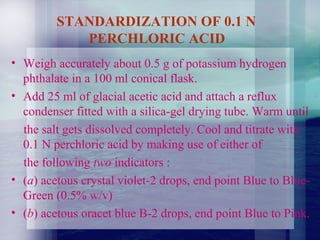
• Weigh accurately about 0.5 g of potassium hydrogen
phthalate in a 100 ml conical flask.
• Add 25 ml of glacial acetic acid and attach a reflux
condenser fitted with a silica-gel drying tube. Warm until
the salt gets dissolved completely. Cool and titrate with
0.1 N perchloric acid by making use of either of
the following two indicators :
• (a) acetous crystal violet-2 drops, end point Blue to Blue-
Green (0.5% w/v)
• (b) acetous oracet blue B-2 drops, end point Blue to Pink.
REACTIONS
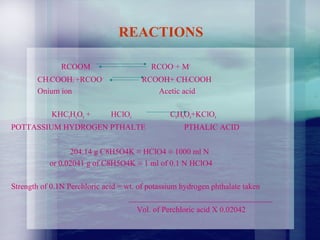
RCOOM RCOO–
+ M+
CH3COOH2
+
+RCOO–
RCOOH+ CH3COOH
Onium ion Acetic acid
KHC8H4O4 + HClO4 C8H6O4+KClO4
POTTASSIUM HYDROGEN PTHALTE PTHALIC ACID
204.14 g C8H5O4K ≡ HClO4 ≡ 1000 ml N
or 0.02041 g of C8H5O4K ≡ 1 ml of 0.1 N HClO4
Strength of 0.1N Perchloric acid = wt. of potassium hydrogen phthalate taken
____________________________________
Vol. of Perchloric acid X 0.02042
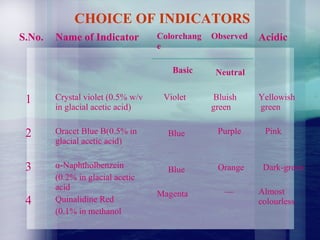
CHOICE OF INDICATORS
S.No. Name of Indicator Colorchang
e
Basic
Observed
Neutral
Acidic
1
2
3
4
Crystal violet (0.5% w/v
in glacial acetic acid)
Oracet Blue B(0.5% in
glacial acetic acid)
α-Naphtholbenzein
(0.2% in glacial acetic
acid
Quinalidine Red
(0.1% in methanol
Violet
Blue
Blue
Magenta
Bluish
green
Purple
Orange
—
Yellowish
green
Pink
Dark-green
Almost
colourless
EFFECT OF TEMPERATURE ON
ASSAYS
• Non-aqueous solvents possess greater coefficients of
expansion as compared to water, so there is effect of
temperature.
• The volume of titrant may be corrected by the
application of the following formula :
Vc = V [1 + 0.001 (tl + t2)]
Vc = Corrected volume of titrant,
V = Volume of titrant measured,
tl = Temperature at which titrant was standardized,
t2 = Temperature at which titration was performed.
Titration of primary amines
• Ex: Methlyldopa
R.NH2 + HClO4 → [R.NH3]+
+ ClO4
-
• Specific reaction between methyldopa and perchloric
acid is expressed by the following equation
• Materials Required : Methyldopa 0.2 g ;
anhydrous formic acid : 15 ml ; glacial acetic
acid : 30 ml ;dioxane : 30 ml ; 0.1 N perchloric
acid and crystal violet solution.
• Procedure : Weigh accurately about 0.2 g and
dissolve in 15 ml of anhydrous formic acid, 30
ml of glacial acetic acid and 30 ml of dioxane.
Add 0.1 ml of crystal violet solution and titrate
with 0.1 N perchloric acid. Perform a blank
determination and make any necessary
correction.
Calculations
211.24 g of Cl0Hl3NO4 ≡ HClO4
or 0.02112 g C10H13NO4 ≡ 1 ml of 0.1 N HClO4
• The percentage of methyldopa present in the sample is given by
:
% Methyldopa = ml × 0.1 × 0.02112× 100
wt. of sample
PRECAUTIONS
(a) Perchloric acid is usually available as a 70 to 72% mixture with water .It
usually undergoes a spontaneous explosive decomposition and, therefore, it is
available always in the form of a solution.
(b) Conversion of acetic anhydride to acetic acid requires 40-45 minutes for its
completion. It being an exothermic reaction, the solution must be allowed to
cool to room temperature before adding glacial acetic acid to volume,
(c) Avoid adding an excess of acetic anhydride especially when primary and
secondary amines are to be assayed, because these may be converted rapidly
to their corresponding acetylated non-basic products :
R—NH2 + (CH3CO)2O → R.NH.(CH3CO) + CH3COOH
Primary amine Acetylated product
(d) Perchloric acid is not only a powerful oxidising agent but also a strong
acid. Hence, it must be handled very carefully.
ADVANTAGES OF NON AQUEOUS
TITRATIONS
• 1) Organic acids and bases that are insoluble in water are soluble
in non-aqueous solvent.
• 2) Organic acid, which is of comparable strength to water, can be
titrated easily in non-aqueous solvent. Bases also follow the same
rules.
• 3) A non-aqueous solvent may help two are more acids in mixture.
The individual acid can give separate end point in different solvent.
• 4) By the proper choice of the solvents or indicator, the biological
ingredients of a substance whether acidic or basic can be selectively
titrated.
• 5) Non aqueous titrations are simple and accurate, examples of non
aqueous titration are: Ephedrine preparations, codeine phosphate in
APC, tetracycline, teramycin, Antihistamines and various piperazine
preparations.
OTHER EXAMPLES
S.No. Name of Substance Indicator Employed
1
2
3
4
5
Amantadine
hydrochloride
Chlorpromazine
hydrochloride
Clonidine hydrochloride
Cyproheptadiene.HCl
Ephedrinehydrochloride
Crystal violet
Methyl orange
α -Naphthol benzein
Crystal violet
-do-
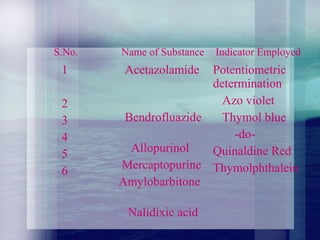
S.No. Name of Substance Indicator Employed
1
2
3
4
5
6
Acetazolamide
Bendrofluazide
Allopurinol
Mercaptopurine
Amylobarbitone
Nalidixic acid
Potentiometric
determination
Azo violet
Thymol blue
-do-
Quinaldine Red
Thymolphthalein

Non aqueous titration

  • 1.
  • 2.
    INTRODUCTION • Non- aqueoustitrations are the titrations in which weakly acidic or basic substances are carried out using non–aqueous solvents to get sharp end point. • The moisture content in non–aqueous titrations should not be more than 0.05%. • Moisture and carbon dioxide are to be avoided in non– aqueous methods
  • 3.
    THEORY • Lowry-Bronsted theory HB↔ H+ + B- (ACID) (CONJUGATE BASE) B + H+ ↔ HB+ (BASE) (CONJUGATE ACID) • The ability of substances to act as acids or bases depend on the choice of solvent system.
  • 4.
    SOLVENTS • Protogenic solvents:on dissociation yield a H+ Ex:H2SO4,,CH3COOH • Protophilic Solvents: high affinity for H+ Ex:(CH3CO)2O,ether,pyridine • Amphiprotic Solvents : donate protons and accept protons Ex:H2O,alcohols • Aprotic Solvents: no tendency to yield and accept H+ Ex:CCl4,hydrocarbons
  • 5.
    ASSAY BY NON-AQUEOUS TITRATIONS •Acidimetry in Non-aqueous Titrations—It can be further sub-divided into two heads, namely : (i) Titration of primary, secondary and tertiary amines, and (ii) Titration of halogen acid salts of bases. • Alkalimetry in Non-aqueous Titrations— titration of acidic substances
  • 6.
    ACIDIMETRY IN NON AQUEOUSTITRATIONS Example : Primary amines METHODOLOGY: four steps • (i) Preparation of 0.1 N Perchloric acid, • (ii) Standardization of 0.1 N Perchloric Acid, • (iii) Choice of Indicators, and • (iv) Effect of Temperature on Assays
  • 7.
    PREPARATION OF 0.1N PERCHLORIC ACID • Materials Required : 8.5 ml of perchloric acid (70.0 to 72.0%) ; 1 Litre of glacial acetic acid ; 30ml of acetic anhydride. • Procedure : Gradually mix 8.5 ml of perchloric acid to 900 ml of glacial acetic acid with vigorous and continuous stirring. Now add 30 ml acetic anhydride and make up the volume to 1 litre with glacialacetic acid and allow to stand for 24 hours before use. • The acetic anhydride reacts with the water (approx. 30%) in perchloric acid and some traces in glacialacetic acid thereby making the resulting mixture practically anhydrous. Thus, we have : H2O + (CH3CO)2O → 2CH3COOH Acetic anhydride Acetic acid
  • 8.
    STANDARDIZATION OF 0.1N PERCHLORIC ACID • Weigh accurately about 0.5 g of potassium hydrogen phthalate in a 100 ml conical flask. • Add 25 ml of glacial acetic acid and attach a reflux condenser fitted with a silica-gel drying tube. Warm until the salt gets dissolved completely. Cool and titrate with 0.1 N perchloric acid by making use of either of the following two indicators : • (a) acetous crystal violet-2 drops, end point Blue to Blue- Green (0.5% w/v) • (b) acetous oracet blue B-2 drops, end point Blue to Pink.
  • 9.
    REACTIONS RCOOM RCOO– + M+ CH3COOH2 + +RCOO– RCOOH+CH3COOH Onium ion Acetic acid KHC8H4O4 + HClO4 C8H6O4+KClO4 POTTASSIUM HYDROGEN PTHALTE PTHALIC ACID 204.14 g C8H5O4K ≡ HClO4 ≡ 1000 ml N or 0.02041 g of C8H5O4K ≡ 1 ml of 0.1 N HClO4 Strength of 0.1N Perchloric acid = wt. of potassium hydrogen phthalate taken ____________________________________ Vol. of Perchloric acid X 0.02042
  • 10.
    CHOICE OF INDICATORS S.No.Name of Indicator Colorchang e Basic Observed Neutral Acidic 1 2 3 4 Crystal violet (0.5% w/v in glacial acetic acid) Oracet Blue B(0.5% in glacial acetic acid) α-Naphtholbenzein (0.2% in glacial acetic acid Quinalidine Red (0.1% in methanol Violet Blue Blue Magenta Bluish green Purple Orange — Yellowish green Pink Dark-green Almost colourless
  • 11.
    EFFECT OF TEMPERATUREON ASSAYS • Non-aqueous solvents possess greater coefficients of expansion as compared to water, so there is effect of temperature. • The volume of titrant may be corrected by the application of the following formula : Vc = V [1 + 0.001 (tl + t2)] Vc = Corrected volume of titrant, V = Volume of titrant measured, tl = Temperature at which titrant was standardized, t2 = Temperature at which titration was performed.
  • 12.
    Titration of primaryamines • Ex: Methlyldopa R.NH2 + HClO4 → [R.NH3]+ + ClO4 - • Specific reaction between methyldopa and perchloric acid is expressed by the following equation
  • 13.
    • Materials Required: Methyldopa 0.2 g ; anhydrous formic acid : 15 ml ; glacial acetic acid : 30 ml ;dioxane : 30 ml ; 0.1 N perchloric acid and crystal violet solution. • Procedure : Weigh accurately about 0.2 g and dissolve in 15 ml of anhydrous formic acid, 30 ml of glacial acetic acid and 30 ml of dioxane. Add 0.1 ml of crystal violet solution and titrate with 0.1 N perchloric acid. Perform a blank determination and make any necessary correction.
  • 14.
    Calculations 211.24 g ofCl0Hl3NO4 ≡ HClO4 or 0.02112 g C10H13NO4 ≡ 1 ml of 0.1 N HClO4 • The percentage of methyldopa present in the sample is given by : % Methyldopa = ml × 0.1 × 0.02112× 100 wt. of sample
  • 15.
    PRECAUTIONS (a) Perchloric acidis usually available as a 70 to 72% mixture with water .It usually undergoes a spontaneous explosive decomposition and, therefore, it is available always in the form of a solution. (b) Conversion of acetic anhydride to acetic acid requires 40-45 minutes for its completion. It being an exothermic reaction, the solution must be allowed to cool to room temperature before adding glacial acetic acid to volume, (c) Avoid adding an excess of acetic anhydride especially when primary and secondary amines are to be assayed, because these may be converted rapidly to their corresponding acetylated non-basic products : R—NH2 + (CH3CO)2O → R.NH.(CH3CO) + CH3COOH Primary amine Acetylated product (d) Perchloric acid is not only a powerful oxidising agent but also a strong acid. Hence, it must be handled very carefully.
  • 16.
    ADVANTAGES OF NONAQUEOUS TITRATIONS • 1) Organic acids and bases that are insoluble in water are soluble in non-aqueous solvent. • 2) Organic acid, which is of comparable strength to water, can be titrated easily in non-aqueous solvent. Bases also follow the same rules. • 3) A non-aqueous solvent may help two are more acids in mixture. The individual acid can give separate end point in different solvent. • 4) By the proper choice of the solvents or indicator, the biological ingredients of a substance whether acidic or basic can be selectively titrated. • 5) Non aqueous titrations are simple and accurate, examples of non aqueous titration are: Ephedrine preparations, codeine phosphate in APC, tetracycline, teramycin, Antihistamines and various piperazine preparations.
  • 17.
    OTHER EXAMPLES S.No. Nameof Substance Indicator Employed 1 2 3 4 5 Amantadine hydrochloride Chlorpromazine hydrochloride Clonidine hydrochloride Cyproheptadiene.HCl Ephedrinehydrochloride Crystal violet Methyl orange α -Naphthol benzein Crystal violet -do-
  • 18.
    S.No. Name ofSubstance Indicator Employed 1 2 3 4 5 6 Acetazolamide Bendrofluazide Allopurinol Mercaptopurine Amylobarbitone Nalidixic acid Potentiometric determination Azo violet Thymol blue -do- Quinaldine Red Thymolphthalein