Non-aqueous Titrations
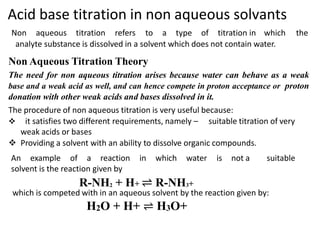
Acid base titration in non aqueous solvants
Non aqueous titration refers to a type of titration in which the
analyte substance is dissolved in a solvent which does not contain water.
Non Aqueous Titration Theory
The need for non aqueous titration arises because water can behave as a weak
base and a weak acid as well, and can hence compete in proton acceptance or proton
donation with other weak acids and bases dissolved in it.
The procedure of non aqueous titration is very useful because:
 it satisfies two different requirements, namely – suitable titration of very
weak acids or bases
 Providing a solvent with an ability to dissolve organic compounds.
An example of a reaction in which water is not a suitable
solvent is the reaction given by
R-NH2 + H+ ⇌ R-NH3+
which is competed with in an aqueous solvent by the reaction given by:
H2O + H+ ⇌ H3O+
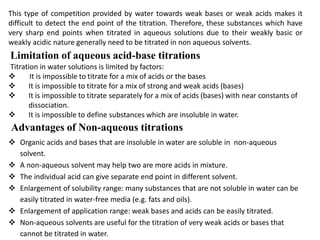
This type of competition provided by water towards weak bases or weak acids makes it
difficult to detect the end point of the titration. Therefore, these substances which have
very sharp end points when titrated in aqueous solutions due to their weakly basic or
weakly acidic nature generally need to be titrated in non aqueous solvents.
Limitation of aqueous acid-base titrations
Titration in water solutions is limited by factors:
 It is impossible to titrate for a mix of acids or the bases
 It is impossible to titrate for a mix of strong and weak acids (bases)
 It is impossible to titrate separately for a mix of acids (bases) with near constants of
dissociation.
 It is impossible to define substances which are insoluble in water.
 Organic acids and bases that are insoluble in water are soluble in non-aqueous
solvent.
 A non-aqueous solvent may help two are more acids in mixture.
 The individual acid can give separate end point in different solvent.
 Enlargement of solubility range: many substances that are not soluble in water can be
easily titrated in water-free media (e.g. fats and oils).
 Enlargement of application range: weak bases and acids can be easily titrated.
 Non-aqueous solvents are useful for the titration of very weak acids or bases that
cannot be titrated in water.
Advantages of Non-aqueous titrations
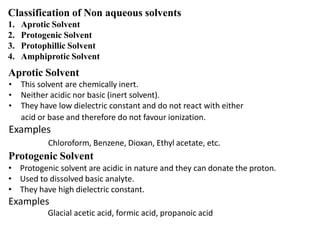
Classification of Non aqueous solvents
1. Aprotic Solvent
2. Protogenic Solvent
3. Protophillic Solvent
4. Amphiprotic Solvent
Aprotic Solvent
• This solvent are chemically inert.
• Neither acidic nor basic (inert solvent).
• They have low dielectric constant and do not react with either
acid or base and therefore do not favour ionization.
Examples
Chloroform, Benzene, Dioxan, Ethyl acetate, etc.
Protogenic Solvent
• Protogenic solvent are acidic in nature and they can donate the proton.
• Used to dissolved basic analyte.
• They have high dielectric constant.
Examples
Glacial acetic acid, formic acid, propanoic acid
Protophilic Solvent
• Protophillic solvent are basic in nature.
• Which possess a high affinity for proton.
• Used to dissolved acidic analytes.
Examples:- Amines and ketone. Pyridine, ethylenediamine, DMF
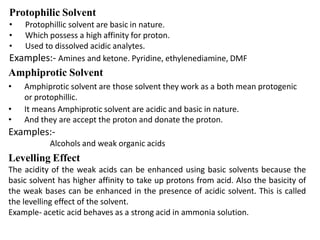
Amphiprotic Solvent
• Amphiprotic solvent are those solvent they work as a both mean protogenic
or protophillic.
• It means Amphiprotic solvent are acidic and basic in nature.
• And they are accept the proton and donate the proton.
Examples:-
Alcohols and weak organic acids
Levelling Effect
The acidity of the weak acids can be enhanced using basic solvents because the
basic solvent has higher affinity to take up protons from acid. Also the basicity of
the weak bases can be enhanced in the presence of acidic solvent. This is called
the levelling effect of the solvent.
Example- acetic acid behaves as a strong acid in ammonia solution.
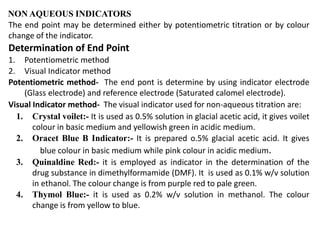
NON AQUEOUS INDICATORS
The end point may be determined either by potentiometric titration or by colour
change of the indicator.
Determination of End Point
1. Potentiometric method
2. Visual Indicator method
Potentiometric method- The end pont is determine by using indicator electrode
(Glass electrode) and reference electrode (Saturated calomel electrode).
Visual Indicator method- The visual indicator used for non-aqueous titration are:
1. Crystal voilet:- It is used as 0.5% solution in glacial acetic acid, it gives voilet
colour in basic medium and yellowish green in acidic medium.
2. Oracet Blue B Indicator:- It is prepared o.5% glacial acetic acid. It gives
blue colour in basic medium while pink colour in acidic medium.
3. Quinaldine Red:- it is employed as indicator in the determination of the
drug substance in dimethylformamide (DMF). It is used as 0.1% w/v solution
in ethanol. The colour change is from purple red to pale green.
4. Thymol Blue:- it is used as 0.2% w/v solution in methanol. The colour
change is from yellow to blue.
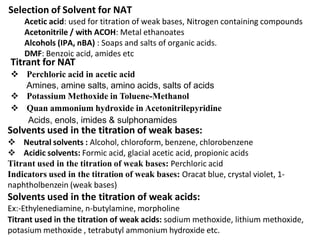
Selection of Solvent for NAT
Acetic acid: used for titration of weak bases, Nitrogen containing compounds
Acetonitrile / with ACOH: Metal ethanoates
Alcohols (IPA, nBA) : Soaps and salts of organic acids.
DMF: Benzoic acid, amides etc
Titrant for NAT
 Perchloric acid in acetic acid
Amines, amine salts, amino acids, salts of acids
 Potassium Methoxide in Toluene-Methanol
 Quan ammonium hydroxide in Acetonitrilepyridine
Acids, enols, imides & sulphonamides
Solvents used in the titration of weak bases:
 Neutral solvents : Alcohol, chloroform, benzene, chlorobenzene
 Acidic solvents: Formic acid, glacial acetic acid, propionic acids
Titrant used in the titration of weak bases: Perchloric acid
Indicators used in the titration of weak bases: Oracat blue, crystal violet, 1-
naphtholbenzein (weak bases)
Solvents used in the titration of weak acids:
Ex:-Ethylenediamine, n-butylamine, morpholine
Titrant used in the titration of weak acids: sodium methoxide, lithium methoxide,
potasium methoxide , tetrabutyl ammonium hydroxide etc.

non-aqueous-titration FOR PHARM ANALYSIS.pptx

  • 1.
  • 2.
    Acid base titrationin non aqueous solvants Non aqueous titration refers to a type of titration in which the analyte substance is dissolved in a solvent which does not contain water. Non Aqueous Titration Theory The need for non aqueous titration arises because water can behave as a weak base and a weak acid as well, and can hence compete in proton acceptance or proton donation with other weak acids and bases dissolved in it. The procedure of non aqueous titration is very useful because:  it satisfies two different requirements, namely – suitable titration of very weak acids or bases  Providing a solvent with an ability to dissolve organic compounds. An example of a reaction in which water is not a suitable solvent is the reaction given by R-NH2 + H+ ⇌ R-NH3+ which is competed with in an aqueous solvent by the reaction given by: H2O + H+ ⇌ H3O+
  • 3.
    This type ofcompetition provided by water towards weak bases or weak acids makes it difficult to detect the end point of the titration. Therefore, these substances which have very sharp end points when titrated in aqueous solutions due to their weakly basic or weakly acidic nature generally need to be titrated in non aqueous solvents. Limitation of aqueous acid-base titrations Titration in water solutions is limited by factors:  It is impossible to titrate for a mix of acids or the bases  It is impossible to titrate for a mix of strong and weak acids (bases)  It is impossible to titrate separately for a mix of acids (bases) with near constants of dissociation.  It is impossible to define substances which are insoluble in water.  Organic acids and bases that are insoluble in water are soluble in non-aqueous solvent.  A non-aqueous solvent may help two are more acids in mixture.  The individual acid can give separate end point in different solvent.  Enlargement of solubility range: many substances that are not soluble in water can be easily titrated in water-free media (e.g. fats and oils).  Enlargement of application range: weak bases and acids can be easily titrated.  Non-aqueous solvents are useful for the titration of very weak acids or bases that cannot be titrated in water. Advantages of Non-aqueous titrations
  • 4.
    Classification of Nonaqueous solvents 1. Aprotic Solvent 2. Protogenic Solvent 3. Protophillic Solvent 4. Amphiprotic Solvent Aprotic Solvent • This solvent are chemically inert. • Neither acidic nor basic (inert solvent). • They have low dielectric constant and do not react with either acid or base and therefore do not favour ionization. Examples Chloroform, Benzene, Dioxan, Ethyl acetate, etc. Protogenic Solvent • Protogenic solvent are acidic in nature and they can donate the proton. • Used to dissolved basic analyte. • They have high dielectric constant. Examples Glacial acetic acid, formic acid, propanoic acid
  • 5.
    Protophilic Solvent • Protophillicsolvent are basic in nature. • Which possess a high affinity for proton. • Used to dissolved acidic analytes. Examples:- Amines and ketone. Pyridine, ethylenediamine, DMF Amphiprotic Solvent • Amphiprotic solvent are those solvent they work as a both mean protogenic or protophillic. • It means Amphiprotic solvent are acidic and basic in nature. • And they are accept the proton and donate the proton. Examples:- Alcohols and weak organic acids Levelling Effect The acidity of the weak acids can be enhanced using basic solvents because the basic solvent has higher affinity to take up protons from acid. Also the basicity of the weak bases can be enhanced in the presence of acidic solvent. This is called the levelling effect of the solvent. Example- acetic acid behaves as a strong acid in ammonia solution.
  • 6.
    NON AQUEOUS INDICATORS Theend point may be determined either by potentiometric titration or by colour change of the indicator. Determination of End Point 1. Potentiometric method 2. Visual Indicator method Potentiometric method- The end pont is determine by using indicator electrode (Glass electrode) and reference electrode (Saturated calomel electrode). Visual Indicator method- The visual indicator used for non-aqueous titration are: 1. Crystal voilet:- It is used as 0.5% solution in glacial acetic acid, it gives voilet colour in basic medium and yellowish green in acidic medium. 2. Oracet Blue B Indicator:- It is prepared o.5% glacial acetic acid. It gives blue colour in basic medium while pink colour in acidic medium. 3. Quinaldine Red:- it is employed as indicator in the determination of the drug substance in dimethylformamide (DMF). It is used as 0.1% w/v solution in ethanol. The colour change is from purple red to pale green. 4. Thymol Blue:- it is used as 0.2% w/v solution in methanol. The colour change is from yellow to blue.
  • 7.
    Selection of Solventfor NAT Acetic acid: used for titration of weak bases, Nitrogen containing compounds Acetonitrile / with ACOH: Metal ethanoates Alcohols (IPA, nBA) : Soaps and salts of organic acids. DMF: Benzoic acid, amides etc Titrant for NAT  Perchloric acid in acetic acid Amines, amine salts, amino acids, salts of acids  Potassium Methoxide in Toluene-Methanol  Quan ammonium hydroxide in Acetonitrilepyridine Acids, enols, imides & sulphonamides Solvents used in the titration of weak bases:  Neutral solvents : Alcohol, chloroform, benzene, chlorobenzene  Acidic solvents: Formic acid, glacial acetic acid, propionic acids Titrant used in the titration of weak bases: Perchloric acid Indicators used in the titration of weak bases: Oracat blue, crystal violet, 1- naphtholbenzein (weak bases) Solvents used in the titration of weak acids: Ex:-Ethylenediamine, n-butylamine, morpholine Titrant used in the titration of weak acids: sodium methoxide, lithium methoxide, potasium methoxide , tetrabutyl ammonium hydroxide etc.