PHARMACEUTICAL ANALYSIS
UNIT-5
TOPIC: CONDUCTOMETRY
B.PHARM 1ST YEAR
PRESENTED BY:
MS. SHWETA SINGH
(Assistant Professor)
RBMI, Bareilly
CONTENTS
• Introduction
• Principle of conductometry
• Important definition and relations
• Factors affecting conductance
• Instrumentation
• Conductometric titration
• Application of conductometry
INTRODUCTION
• Conductometry is used to analyze ionic species and to monitor a
chemical reaction by studying the electrolytic conductivity of the
reacting species or the resultant products.
• It has notable applications in analytical chemistry. Conductivity
measurement can be performed directly using a conductivity meter or
conducting conductometric titration.
• Conductometric analysis of electrolytes is a long-time practice.
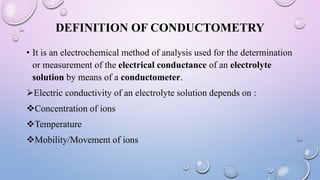
DEFINITION OF CONDUCTOMETRY
• It is an electrochemical method of analysis used for the determination
or measurement of the electrical conductance of an electrolyte
solution by means of a conductometer.
Electric conductivity of an electrolyte solution depends on :
Concentration of ions
Temperature
Mobility/Movement of ions
PRINCIPLE OF CONDUCTOMETRY
• The main principle involved in this method is that the movement of
the ions creates electrical conductivity. The movement of the ions
mainly depends on the concentration of the ions.
• The electric conductance follows Ohms law which states that, the
strength of current (I) passing through the conductor is directly
proportional to potential difference/voltage (V) and inversely to
resistance (R).
I =V/R
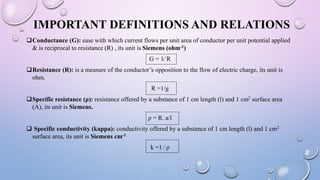
IMPORTANT DEFINITIONS AND RELATIONS
Conductance (G): ease with which current flows per unit area of conductor per unit potential applied
& is reciprocal to resistance (R) , its unit is Siemens (ohm-1)
G = 1⁄ R
Resistance (R): is a measure of the conductor’s opposition to the flow of electric charge, its unit is
ohm.
R =1/g
Specific resistance (ρ): resistance offered by a substance of 1 cm length (l) and 1 cm2 surface area
(A), its unit is Siemens.
ρ = R. a/l
 Specific conductivity (kappa): conductivity offered by a substance of 1 cm length (l) and 1 cm2
surface area, its unit is Siemens cm-1
k =1 ⁄ ρ
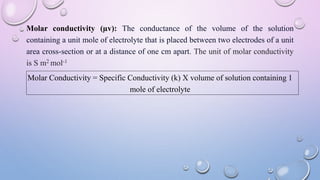
Molar conductivity (µv): The conductance of the volume of the solution
containing a unit mole of electrolyte that is placed between two electrodes of a unit
area cross-section or at a distance of one cm apart. The unit of molar conductivity
is S m2 mol-1
Molar Conductivity = Specific Conductivity (k) X volume of solution containing 1
mole of electrolyte
FACTORS EFFECTING CONDUCTANCE
The conductance of the solution depends on:
• Temperature: Conductance increases by increasing the temperature.
• Nature of ions: Size, molecular weight, number of charges the ion carries.
• The concentration of ions: As the number of ions increases the conductance of
the solution increases. The concentrated electrolyte solution will have high
conductance as compared to the dilute electrolyte solution.
• The size of the electrodes.
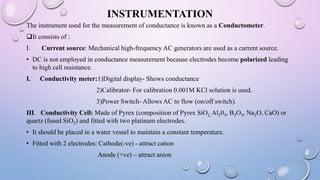
INSTRUMENTATION
The instrument used for the measurement of conductance is known as a Conductometer.
It consists of :
I. Current source: Mechanical high-frequency AC generators are used as a current source.
• DC is not employed in conductance measurement because electrodes become polarized leading
to high cell resistance.
I. Conductivity meter:1)Digital display- Shows conductance
2)Calibrator- For calibration 0.001M KCl solution is used.
3)Power Switch- Allows AC to flow (on/off switch).
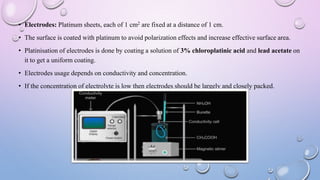
Ⅲ. Conductivity Cell: Made of Pyrex (composition of Pyrex SiO2, Al203, B2O3, Na2O, CaO) or
quartz (fused SiO2) and fitted with two platinum electrodes.
• It should be placed in a water vessel to maintain a constant temperature.
• Fitted with 2 electrodes: Cathode(-ve) - attract cation
Anode (+ve) – attract anion
• Electrodes: Platinum sheets, each of 1 cm2 are fixed at a distance of 1 cm.
• The surface is coated with platinum to avoid polarization effects and increase effective surface area.
• Platinisation of electrodes is done by coating a solution of 3% chloroplatinic acid and lead acetate on
it to get a uniform coating.
• Electrodes usage depends on conductivity and concentration.
• If the concentration of electrolyte is low then electrodes should be largely and closely packed.
CONDUCTOMETRIC TITRATIONS
PRINCIPLE
The determination of the endpoint of a titration by means of conductivity
measurements is known as conductometric titration.
During the course of titration, the conductivity of the solution changes, since
there is a change in the number and the mobility of ions.
At the endpoint of the titration, there is a sharp change in the conductivity of a
solution shown by the intersection of the lines in the graph of conductivity vs
volume of titrant added.
TYPES OF CONDUCTOMETRIC TITRATION
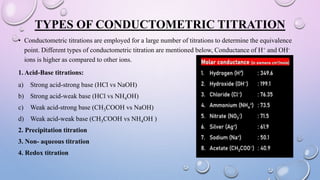
• Conductometric titrations are employed for a large number of titrations to determine the equivalence
point. Different types of conductometric titration are mentioned below, Conductance of H+ and OH-
ions is higher as compared to other ions.
1. Acid-Base titrations:
a) Strong acid-strong base (HCl vs NaOH)
b) Strong acid-weak base (HCl vs NH4OH)
c) Weak acid-strong base (CH3COOH vs NaOH)
d) Weak acid-weak base (CH3COOH vs NH4OH )
2. Precipitation titration
3. Non- aqueous titration
4. Redox titration
TYPES OF CONDUCTOMETRIC TITRATION
A. Acid-Base titration
1. Strong acid vs. Strong Base
• Strong acid (HCl) is taken in a conductometric quartz vessel and strong base (NaOH) is added slowly as a titrant in the
HCl analyte solution.
• Initially, the concentration of hydrogen ions (H+) is higher, and the solution of HCl shows higher conductance. After
the addition of NaOH; hydrogen ions (H+) react with hydroxide ions (OH-) of NaOH and the conductance of the
solution decreases as salt formation occurs.
• At the endpoint, the conductance of the solution is lowest because all hydrogen ions (H+) react with hydroxide ions
(OH-).
• After the end point, addition of NaOH enhances the conductivity of the solution due to presence of hydroxide ions
(OH-).
HCl + NaOH NaCl + H2O
2. Strong acid vs Weak base
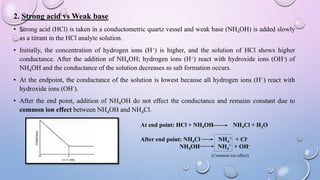
• Strong acid (HCl) is taken in a conductometric quartz vessel and weak base (NH4OH) is added slowly
as a titrant in the HCl analyte solution.
• Initially, the concentration of hydrogen ions (H+) is higher, and the solution of HCl shows higher
conductance. After the addition of NH4OH; hydrogen ions (H+) react with hydroxide ions (OH-) of
NH4OH and the conductance of the solution decreases as salt formation occurs.
• At the endpoint, the conductance of the solution is lowest because all hydrogen ions (H+) react with
hydroxide ions (OH-).
• After the end point, addition of NH4OH do not effect the conductance and remains constant due to
common ion effect between NH4OH and NH4Cl.
At end point: HCl + NH4OH NH4Cl + H2O
After end point: NH4Cl NH4
+ + Cl-
NH4OH NH4
+ + OH-
(Common ion effect)
3. Weak acid vs. Strong base
• Weak acid (CH3COOH) is taken in a conductometric quartz vessel and weak base (NaOH) is added slowly as
a titrant in the analyte CH3COOH solution.
• Initially, the concentration of hydrogen ions (H+) is slightly higher and the solution of CH3COOH shows
slightly higher conductance because it is a weak acid and hence it disassociates partially. After the addition of
NaOH; hydrogen ions (H+) react with hydroxide ions (OH-) of NaOH and the conductance of the solution
decreases slowly as salt formation occurs.
• At the endpoint, the conductance of the solution is lowest because all hydrogen ions react with hydroxide
ions (OH-).
• After the endpoint, if NaOH is added, rapid enhancement in the conductivity of the solution takes place due
to the presence of hydroxide ions (OH-).
At end point: CH3COOH + NaOH CH3COONa + H2O
After end point: CH3COOH CH3COO- + H+
CH3COONa CH3COO- + Na
(Common ion effect)
4. Weak acid vs. Weak base
• A weak acid (CH3COOH) is taken in a conductometric quartz vessel and a weak base (NH4OH) is added slowly
as a titrant in the analyte CH3COOH solution.
• Initially, the concentration of hydrogen ions (H+) is slightly higher and the solution of CH3COOH shows
slightly higher conductance because it is a weak acid and hence it disassociates partially. After the addition of
NH4OH; hydrogen ions (H+) react with hydroxide ions (OH-) of NH4OH and the conductance of the solution
decreases slowly as salt formation occurs.
• At the endpoint, the conductance of the solution is constant because the addition of weak NH4OH does not
give sufficient hydroxide ions (OH-) to further increase in conductance because it is weak base and hence
disassociates partially.
At end point: CH3COOH + NH4OH CH3COONH4 + H2O
After end point: CH3COONH4 CH3COO- + NH4
CH3COOH CH3COO- + H+
(Common ion effect)
B. Precipitation titration
• A strong electrolyte (NaCl) is taken in a conductometric quartz vessel and Silver nitrate (AgNO3) is
added slowly as a titrant in the NaCl analyte solution. Initially, conductance is shown due to the
presence of NaCl. After the addition of AgNO3; chloride ions are replaced by nitrate ions (NO3
-) and
the conductance of the solution is constant because both ions show the same conductance.
• At the end point conductance of the solution starts increasing because nitrate ions are in excess after
the addition of a small amount of AgNO3.
NaCl + AgNO3 AgCl + NaNO3
APPLICATIONS OF CONDUCTOMETRIC TITRATION
• To check water pollution in rivers and lakes.
• Solubility of sparingly soluble salts like AgCl, BaSO4 can be detected
• Determination of atmospheric SO2.
• Alkalinity of fresh water.
• Salinity of seawater (oceanography)
• Used to trace antibiotics.
• Deuterium ion concentration in water- deuterium mixture food microbiology- for tracing
microorganisms
• Tracing antibiotics
• Estimate ash content in sugar juices
• The purity of distilled and de-ionised water can be determined

Conductometry Pharmaceutical Analysis BP

  • 1.
    PHARMACEUTICAL ANALYSIS UNIT-5 TOPIC: CONDUCTOMETRY B.PHARM1ST YEAR PRESENTED BY: MS. SHWETA SINGH (Assistant Professor) RBMI, Bareilly
  • 2.
    CONTENTS • Introduction • Principleof conductometry • Important definition and relations • Factors affecting conductance • Instrumentation • Conductometric titration • Application of conductometry
  • 3.
    INTRODUCTION • Conductometry isused to analyze ionic species and to monitor a chemical reaction by studying the electrolytic conductivity of the reacting species or the resultant products. • It has notable applications in analytical chemistry. Conductivity measurement can be performed directly using a conductivity meter or conducting conductometric titration. • Conductometric analysis of electrolytes is a long-time practice.
  • 4.
    DEFINITION OF CONDUCTOMETRY •It is an electrochemical method of analysis used for the determination or measurement of the electrical conductance of an electrolyte solution by means of a conductometer. Electric conductivity of an electrolyte solution depends on : Concentration of ions Temperature Mobility/Movement of ions
  • 5.
    PRINCIPLE OF CONDUCTOMETRY •The main principle involved in this method is that the movement of the ions creates electrical conductivity. The movement of the ions mainly depends on the concentration of the ions. • The electric conductance follows Ohms law which states that, the strength of current (I) passing through the conductor is directly proportional to potential difference/voltage (V) and inversely to resistance (R). I =V/R
  • 6.
    IMPORTANT DEFINITIONS ANDRELATIONS Conductance (G): ease with which current flows per unit area of conductor per unit potential applied & is reciprocal to resistance (R) , its unit is Siemens (ohm-1) G = 1⁄ R Resistance (R): is a measure of the conductor’s opposition to the flow of electric charge, its unit is ohm. R =1/g Specific resistance (ρ): resistance offered by a substance of 1 cm length (l) and 1 cm2 surface area (A), its unit is Siemens. ρ = R. a/l  Specific conductivity (kappa): conductivity offered by a substance of 1 cm length (l) and 1 cm2 surface area, its unit is Siemens cm-1 k =1 ⁄ ρ
  • 7.
    Molar conductivity (µv):The conductance of the volume of the solution containing a unit mole of electrolyte that is placed between two electrodes of a unit area cross-section or at a distance of one cm apart. The unit of molar conductivity is S m2 mol-1 Molar Conductivity = Specific Conductivity (k) X volume of solution containing 1 mole of electrolyte
  • 8.
    FACTORS EFFECTING CONDUCTANCE Theconductance of the solution depends on: • Temperature: Conductance increases by increasing the temperature. • Nature of ions: Size, molecular weight, number of charges the ion carries. • The concentration of ions: As the number of ions increases the conductance of the solution increases. The concentrated electrolyte solution will have high conductance as compared to the dilute electrolyte solution. • The size of the electrodes.
  • 9.
    INSTRUMENTATION The instrument usedfor the measurement of conductance is known as a Conductometer. It consists of : I. Current source: Mechanical high-frequency AC generators are used as a current source. • DC is not employed in conductance measurement because electrodes become polarized leading to high cell resistance. I. Conductivity meter:1)Digital display- Shows conductance 2)Calibrator- For calibration 0.001M KCl solution is used. 3)Power Switch- Allows AC to flow (on/off switch). Ⅲ. Conductivity Cell: Made of Pyrex (composition of Pyrex SiO2, Al203, B2O3, Na2O, CaO) or quartz (fused SiO2) and fitted with two platinum electrodes. • It should be placed in a water vessel to maintain a constant temperature. • Fitted with 2 electrodes: Cathode(-ve) - attract cation Anode (+ve) – attract anion
  • 10.
    • Electrodes: Platinumsheets, each of 1 cm2 are fixed at a distance of 1 cm. • The surface is coated with platinum to avoid polarization effects and increase effective surface area. • Platinisation of electrodes is done by coating a solution of 3% chloroplatinic acid and lead acetate on it to get a uniform coating. • Electrodes usage depends on conductivity and concentration. • If the concentration of electrolyte is low then electrodes should be largely and closely packed.
  • 11.
    CONDUCTOMETRIC TITRATIONS PRINCIPLE The determinationof the endpoint of a titration by means of conductivity measurements is known as conductometric titration. During the course of titration, the conductivity of the solution changes, since there is a change in the number and the mobility of ions. At the endpoint of the titration, there is a sharp change in the conductivity of a solution shown by the intersection of the lines in the graph of conductivity vs volume of titrant added.
  • 12.
    TYPES OF CONDUCTOMETRICTITRATION • Conductometric titrations are employed for a large number of titrations to determine the equivalence point. Different types of conductometric titration are mentioned below, Conductance of H+ and OH- ions is higher as compared to other ions. 1. Acid-Base titrations: a) Strong acid-strong base (HCl vs NaOH) b) Strong acid-weak base (HCl vs NH4OH) c) Weak acid-strong base (CH3COOH vs NaOH) d) Weak acid-weak base (CH3COOH vs NH4OH ) 2. Precipitation titration 3. Non- aqueous titration 4. Redox titration
  • 13.
    TYPES OF CONDUCTOMETRICTITRATION A. Acid-Base titration 1. Strong acid vs. Strong Base • Strong acid (HCl) is taken in a conductometric quartz vessel and strong base (NaOH) is added slowly as a titrant in the HCl analyte solution. • Initially, the concentration of hydrogen ions (H+) is higher, and the solution of HCl shows higher conductance. After the addition of NaOH; hydrogen ions (H+) react with hydroxide ions (OH-) of NaOH and the conductance of the solution decreases as salt formation occurs. • At the endpoint, the conductance of the solution is lowest because all hydrogen ions (H+) react with hydroxide ions (OH-). • After the end point, addition of NaOH enhances the conductivity of the solution due to presence of hydroxide ions (OH-). HCl + NaOH NaCl + H2O
  • 14.
    2. Strong acidvs Weak base • Strong acid (HCl) is taken in a conductometric quartz vessel and weak base (NH4OH) is added slowly as a titrant in the HCl analyte solution. • Initially, the concentration of hydrogen ions (H+) is higher, and the solution of HCl shows higher conductance. After the addition of NH4OH; hydrogen ions (H+) react with hydroxide ions (OH-) of NH4OH and the conductance of the solution decreases as salt formation occurs. • At the endpoint, the conductance of the solution is lowest because all hydrogen ions (H+) react with hydroxide ions (OH-). • After the end point, addition of NH4OH do not effect the conductance and remains constant due to common ion effect between NH4OH and NH4Cl. At end point: HCl + NH4OH NH4Cl + H2O After end point: NH4Cl NH4 + + Cl- NH4OH NH4 + + OH- (Common ion effect)
  • 15.
    3. Weak acidvs. Strong base • Weak acid (CH3COOH) is taken in a conductometric quartz vessel and weak base (NaOH) is added slowly as a titrant in the analyte CH3COOH solution. • Initially, the concentration of hydrogen ions (H+) is slightly higher and the solution of CH3COOH shows slightly higher conductance because it is a weak acid and hence it disassociates partially. After the addition of NaOH; hydrogen ions (H+) react with hydroxide ions (OH-) of NaOH and the conductance of the solution decreases slowly as salt formation occurs. • At the endpoint, the conductance of the solution is lowest because all hydrogen ions react with hydroxide ions (OH-). • After the endpoint, if NaOH is added, rapid enhancement in the conductivity of the solution takes place due to the presence of hydroxide ions (OH-). At end point: CH3COOH + NaOH CH3COONa + H2O After end point: CH3COOH CH3COO- + H+ CH3COONa CH3COO- + Na (Common ion effect)
  • 16.
    4. Weak acidvs. Weak base • A weak acid (CH3COOH) is taken in a conductometric quartz vessel and a weak base (NH4OH) is added slowly as a titrant in the analyte CH3COOH solution. • Initially, the concentration of hydrogen ions (H+) is slightly higher and the solution of CH3COOH shows slightly higher conductance because it is a weak acid and hence it disassociates partially. After the addition of NH4OH; hydrogen ions (H+) react with hydroxide ions (OH-) of NH4OH and the conductance of the solution decreases slowly as salt formation occurs. • At the endpoint, the conductance of the solution is constant because the addition of weak NH4OH does not give sufficient hydroxide ions (OH-) to further increase in conductance because it is weak base and hence disassociates partially. At end point: CH3COOH + NH4OH CH3COONH4 + H2O After end point: CH3COONH4 CH3COO- + NH4 CH3COOH CH3COO- + H+ (Common ion effect)
  • 17.
    B. Precipitation titration •A strong electrolyte (NaCl) is taken in a conductometric quartz vessel and Silver nitrate (AgNO3) is added slowly as a titrant in the NaCl analyte solution. Initially, conductance is shown due to the presence of NaCl. After the addition of AgNO3; chloride ions are replaced by nitrate ions (NO3 -) and the conductance of the solution is constant because both ions show the same conductance. • At the end point conductance of the solution starts increasing because nitrate ions are in excess after the addition of a small amount of AgNO3. NaCl + AgNO3 AgCl + NaNO3
  • 18.
    APPLICATIONS OF CONDUCTOMETRICTITRATION • To check water pollution in rivers and lakes. • Solubility of sparingly soluble salts like AgCl, BaSO4 can be detected • Determination of atmospheric SO2. • Alkalinity of fresh water. • Salinity of seawater (oceanography) • Used to trace antibiotics. • Deuterium ion concentration in water- deuterium mixture food microbiology- for tracing microorganisms • Tracing antibiotics • Estimate ash content in sugar juices • The purity of distilled and de-ionised water can be determined