


Presented by:
Aditya Sharma
M.S. (Pharm)
Pharmaceutical Analysis
NIPER Guwahati
Content
Introduction
Limit Test For Chlorides
Limit Test For Sulphates
Limit Test For Iron
Limit Test For Lead
Limit Test For Arsenic
Introduction
• Limit means a value or amount that is likely to be present in a substance and test
means to examine or to investigate.
• Limit test is defined as quantitative or semi quantitative test designed to identify
and control small quantities of impurity which is likely to be present in the
substance.
• Limit test is generally carried out to determine the inorganic impurities present in
compound.
• Limit tests are a category of impurity tests in which a solution of an unknown
sample is compared to a standard that contains the impurity at the product limit.
Generally this definition applies to limit tests that are in widespread use in
various pharmacopoeial compendia, such as United States Pharmacopoeia (USP),
European Pharmacopoeia (EP), Japanese Pharmacopoeia (JP) and Food Chemicals
Codex (FCC).
• These tests are used to make a simple pass/fail evaluation of the sample.
Typically this category of test relies on the comparison of an unknown sample to
a standard solution.
• Often these tests rely on a visual evaluation by the technician, though some may
rely on instrumental analysis of the sample.
Limit Test For Chlorides
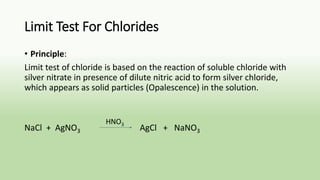
• Principle:
Limit test of chloride is based on the reaction of soluble chloride with
silver nitrate in presence of dilute nitric acid to form silver chloride,
which appears as solid particles (Opalescence) in the solution.
NaCl + AgNO3 AgCl + NaNO3
HNO3
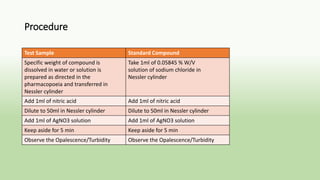
Procedure
Test Sample Standard Compound
Specific weight of compound is
dissolved in water or solution is
prepared as directed in the
pharmacopoeia and transferred in
Nessler cylinder
Take 1ml of 0.05845 % W/V
solution of sodium chloride in
Nessler cylinder
Add 1ml of nitric acid Add 1ml of nitric acid
Dilute to 50ml in Nessler cylinder Dilute to 50ml in Nessler cylinder
Add 1ml of AgNO3 solution Add 1ml of AgNO3 solution
Keep aside for 5 min Keep aside for 5 min
Observe the Opalescence/Turbidity Observe the Opalescence/Turbidity
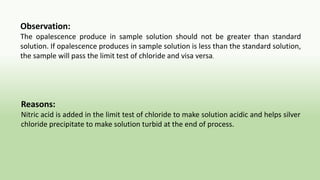
Observation:
The opalescence produce in sample solution should not be greater than standard
solution. If opalescence produces in sample solution is less than the standard solution,
the sample will pass the limit test of chloride and visa versa.
Reasons:
Nitric acid is added in the limit test of chloride to make solution acidic and helps silver
chloride precipitate to make solution turbid at the end of process.
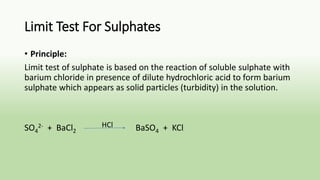
Limit Test For Sulphates
• Principle:
Limit test of sulphate is based on the reaction of soluble sulphate with
barium chloride in presence of dilute hydrochloric acid to form barium
sulphate which appears as solid particles (turbidity) in the solution.
SO4
2- + BaCl2 BaSO4 + KClHCl
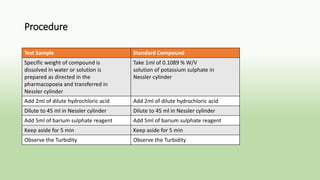
Procedure
Test Sample Standard Compound
Specific weight of compound is
dissolved in water or solution is
prepared as directed in the
pharmacopoeia and transferred in
Nessler cylinder
Take 1ml of 0.1089 % W/V
solution of potassium sulphate in
Nessler cylinder
Add 2ml of dilute hydrochloric acid Add 2ml of dilute hydrochloric acid
Dilute to 45 ml in Nessler cylinder Dilute to 45 ml in Nessler cylinder
Add 5ml of barium sulphate reagent Add 5ml of barium sulphate reagent
Keep aside for 5 min Keep aside for 5 min
Observe the Turbidity Observe the Turbidity
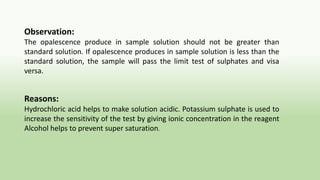
Observation:
The opalescence produce in sample solution should not be greater than
standard solution. If opalescence produces in sample solution is less than the
standard solution, the sample will pass the limit test of sulphates and visa
versa.
Reasons:
Hydrochloric acid helps to make solution acidic. Potassium sulphate is used to
increase the sensitivity of the test by giving ionic concentration in the reagent
Alcohol helps to prevent super saturation.
Limit Test For Iron
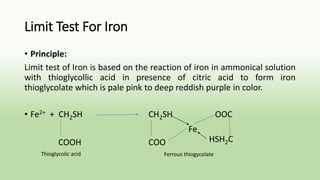
• Principle:
Limit test of Iron is based on the reaction of iron in ammonical solution
with thioglycollic acid in presence of citric acid to form iron
thioglycolate which is pale pink to deep reddish purple in color.
• Fe2+ + CH2SH CH2SH OOC
COOH COO
Fe
HSH2C
Thioglycolic acid Ferrous thiogycolate
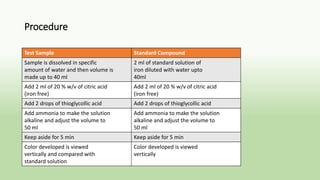
Procedure
Test Sample Standard Compound
Sample is dissolved in specific
amount of water and then volume is
made up to 40 ml
2 ml of standard solution of
iron diluted with water upto
40ml
Add 2 ml of 20 % w/v of citric acid
(iron free)
Add 2 ml of 20 % w/v of citric acid
(iron free)
Add 2 drops of thioglycollic acid Add 2 drops of thioglycollic acid
Add ammonia to make the solution
alkaline and adjust the volume to
50 ml
Add ammonia to make the solution
alkaline and adjust the volume to
50 ml
Keep aside for 5 min Keep aside for 5 min
Color developed is viewed
vertically and compared with
standard solution
Color developed is viewed
vertically
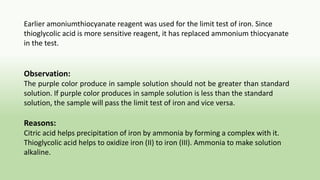
Earlier amoniumthiocyanate reagent was used for the limit test of iron. Since
thioglycolic acid is more sensitive reagent, it has replaced ammonium thiocyanate
in the test.
Observation:
The purple color produce in sample solution should not be greater than standard
solution. If purple color produces in sample solution is less than the standard
solution, the sample will pass the limit test of iron and vice versa.
Reasons:
Citric acid helps precipitation of iron by ammonia by forming a complex with it.
Thioglycolic acid helps to oxidize iron (II) to iron (III). Ammonia to make solution
alkaline.
Limit Test For Lead
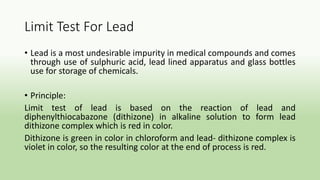
• Lead is a most undesirable impurity in medical compounds and comes
through use of sulphuric acid, lead lined apparatus and glass bottles
use for storage of chemicals.
• Principle:
Limit test of lead is based on the reaction of lead and
diphenylthiocabazone (dithizone) in alkaline solution to form lead
dithizone complex which is red in color.
Dithizone is green in color in chloroform and lead- dithizone complex is
violet in color, so the resulting color at the end of process is red.
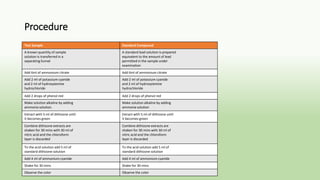
Procedure
Test Sample Standard Compound
A known quantity of sample
solution is transferred in a
separating funnel
A standard lead solution is prepared
equivalent to the amount of lead
permitted in the sample under
examination
Add 6ml of ammonium citrate Add 6ml of ammonium citrate
Add 2 ml of potassium cyanide
and 2 ml of hydroxylamine
hydrochloride
Add 2 ml of potassium cyanide
and 2 ml of hydroxylamine
hydrochloride
Add 2 drops of phenol red Add 2 drops of phenol red
Make solution alkaline by adding
ammonia solution.
Make solution alkaline by adding
ammonia solution
Extract with 5 ml of dithizone until
it becomes green
Extract with 5 ml of dithizone until
it becomes green
Combine dithizone extracts are
shaken for 30 mins with 30 ml of
nitric acid and the chloroform
layer is discarded
Combine dithizone extracts are
shaken for 30 mins with 30 ml of
nitric acid and the chloroform
layer is discarded
To the acid solution add 5 ml of
standard dithizone solution
To the acid solution add 5 ml of
standard dithizone solution
Add 4 ml of ammonium cyanide Add 4 ml of ammonium cyanide
Shake for 30 mins Shake for 30 mins
Observe the color Observe the color
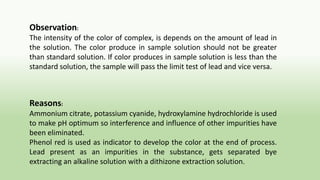
Observation:
The intensity of the color of complex, is depends on the amount of lead in
the solution. The color produce in sample solution should not be greater
than standard solution. If color produces in sample solution is less than the
standard solution, the sample will pass the limit test of lead and vice versa.
Reasons:
Ammonium citrate, potassium cyanide, hydroxylamine hydrochloride is used
to make pH optimum so interference and influence of other impurities have
been eliminated.
Phenol red is used as indicator to develop the color at the end of process.
Lead present as an impurities in the substance, gets separated bye
extracting an alkaline solution with a dithizone extraction solution.
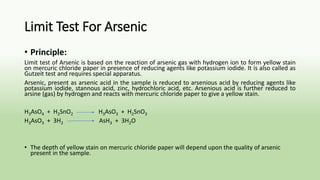
Limit Test For Arsenic
• Principle:
Limit test of Arsenic is based on the reaction of arsenic gas with hydrogen ion to form yellow stain
on mercuric chloride paper in presence of reducing agents like potassium iodide. It is also called as
Gutzeit test and requires special apparatus.
Arsenic, present as arsenic acid in the sample is reduced to arsenious acid by reducing agents like
potassium iodide, stannous acid, zinc, hydrochloric acid, etc. Arsenious acid is further reduced to
arsine (gas) by hydrogen and reacts with mercuric chloride paper to give a yellow stain.
H3AsO4 + H2SnO2 H3AsO3 + H2SnO3
H3AsO3 + 3H2 AsH3 + 3H2O
• The depth of yellow stain on mercuric chloride paper will depend upon the quality of arsenic
present in the sample.
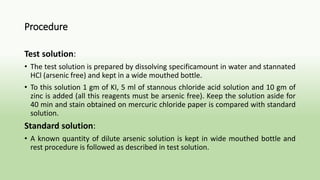
Procedure
Test solution:
• The test solution is prepared by dissolving specificamount in water and stannated
HCl (arsenic free) and kept in a wide mouthed bottle.
• To this solution 1 gm of KI, 5 ml of stannous chloride acid solution and 10 gm of
zinc is added (all this reagents must be arsenic free). Keep the solution aside for
40 min and stain obtained on mercuric chloride paper is compared with standard
solution.
Standard solution:
• A known quantity of dilute arsenic solution is kept in wide mouthed bottle and
rest procedure is followed as described in test solution.
Reasons:
Stannous chloride is used for complete evolution of arsine Zinc, potassium
iodide and stannous chloride is used as a reducing agent Hydrochloric acid is
used to make the solution acidic Lead acetate pledger or papers are used to
trap any hydrogen sulphide which may be evolved along with arsine.
References
• A.H. Beckett and J.B. Stenlake, Practical pharmaceutical chemistry, Part-I. The
Athtone press, University of London, London.
• P. Gundu Rao, Inorganic Pharmaceutical Chemistry; Vallabh Prakashan, Delhi.
• Advanced Inorganic Chemistry by Satya Prakash, G.D. Tuli
• J.H Block, E. Roche, T.O Soine and C.O. Wilson, Inorganic Medical and
Pharmaceutical Chemistry Lea & Febiger Philadelphia PA.
Limit Tests ppt

Limit Tests ppt

  • 1.
    Presented by: Aditya Sharma M.S.(Pharm) Pharmaceutical Analysis NIPER Guwahati
  • 2.
    Content Introduction Limit Test ForChlorides Limit Test For Sulphates Limit Test For Iron Limit Test For Lead Limit Test For Arsenic
  • 3.
    Introduction • Limit meansa value or amount that is likely to be present in a substance and test means to examine or to investigate. • Limit test is defined as quantitative or semi quantitative test designed to identify and control small quantities of impurity which is likely to be present in the substance. • Limit test is generally carried out to determine the inorganic impurities present in compound.
  • 4.
    • Limit testsare a category of impurity tests in which a solution of an unknown sample is compared to a standard that contains the impurity at the product limit. Generally this definition applies to limit tests that are in widespread use in various pharmacopoeial compendia, such as United States Pharmacopoeia (USP), European Pharmacopoeia (EP), Japanese Pharmacopoeia (JP) and Food Chemicals Codex (FCC). • These tests are used to make a simple pass/fail evaluation of the sample. Typically this category of test relies on the comparison of an unknown sample to a standard solution. • Often these tests rely on a visual evaluation by the technician, though some may rely on instrumental analysis of the sample.
  • 5.
    Limit Test ForChlorides • Principle: Limit test of chloride is based on the reaction of soluble chloride with silver nitrate in presence of dilute nitric acid to form silver chloride, which appears as solid particles (Opalescence) in the solution. NaCl + AgNO3 AgCl + NaNO3 HNO3
  • 6.
    Procedure Test Sample StandardCompound Specific weight of compound is dissolved in water or solution is prepared as directed in the pharmacopoeia and transferred in Nessler cylinder Take 1ml of 0.05845 % W/V solution of sodium chloride in Nessler cylinder Add 1ml of nitric acid Add 1ml of nitric acid Dilute to 50ml in Nessler cylinder Dilute to 50ml in Nessler cylinder Add 1ml of AgNO3 solution Add 1ml of AgNO3 solution Keep aside for 5 min Keep aside for 5 min Observe the Opalescence/Turbidity Observe the Opalescence/Turbidity
  • 7.
    Observation: The opalescence producein sample solution should not be greater than standard solution. If opalescence produces in sample solution is less than the standard solution, the sample will pass the limit test of chloride and visa versa. Reasons: Nitric acid is added in the limit test of chloride to make solution acidic and helps silver chloride precipitate to make solution turbid at the end of process.
  • 8.
    Limit Test ForSulphates • Principle: Limit test of sulphate is based on the reaction of soluble sulphate with barium chloride in presence of dilute hydrochloric acid to form barium sulphate which appears as solid particles (turbidity) in the solution. SO4 2- + BaCl2 BaSO4 + KClHCl
  • 9.
    Procedure Test Sample StandardCompound Specific weight of compound is dissolved in water or solution is prepared as directed in the pharmacopoeia and transferred in Nessler cylinder Take 1ml of 0.1089 % W/V solution of potassium sulphate in Nessler cylinder Add 2ml of dilute hydrochloric acid Add 2ml of dilute hydrochloric acid Dilute to 45 ml in Nessler cylinder Dilute to 45 ml in Nessler cylinder Add 5ml of barium sulphate reagent Add 5ml of barium sulphate reagent Keep aside for 5 min Keep aside for 5 min Observe the Turbidity Observe the Turbidity
  • 10.
    Observation: The opalescence producein sample solution should not be greater than standard solution. If opalescence produces in sample solution is less than the standard solution, the sample will pass the limit test of sulphates and visa versa. Reasons: Hydrochloric acid helps to make solution acidic. Potassium sulphate is used to increase the sensitivity of the test by giving ionic concentration in the reagent Alcohol helps to prevent super saturation.
  • 11.
    Limit Test ForIron • Principle: Limit test of Iron is based on the reaction of iron in ammonical solution with thioglycollic acid in presence of citric acid to form iron thioglycolate which is pale pink to deep reddish purple in color. • Fe2+ + CH2SH CH2SH OOC COOH COO Fe HSH2C Thioglycolic acid Ferrous thiogycolate
  • 12.
    Procedure Test Sample StandardCompound Sample is dissolved in specific amount of water and then volume is made up to 40 ml 2 ml of standard solution of iron diluted with water upto 40ml Add 2 ml of 20 % w/v of citric acid (iron free) Add 2 ml of 20 % w/v of citric acid (iron free) Add 2 drops of thioglycollic acid Add 2 drops of thioglycollic acid Add ammonia to make the solution alkaline and adjust the volume to 50 ml Add ammonia to make the solution alkaline and adjust the volume to 50 ml Keep aside for 5 min Keep aside for 5 min Color developed is viewed vertically and compared with standard solution Color developed is viewed vertically
  • 13.
    Earlier amoniumthiocyanate reagentwas used for the limit test of iron. Since thioglycolic acid is more sensitive reagent, it has replaced ammonium thiocyanate in the test. Observation: The purple color produce in sample solution should not be greater than standard solution. If purple color produces in sample solution is less than the standard solution, the sample will pass the limit test of iron and vice versa. Reasons: Citric acid helps precipitation of iron by ammonia by forming a complex with it. Thioglycolic acid helps to oxidize iron (II) to iron (III). Ammonia to make solution alkaline.
  • 14.
    Limit Test ForLead • Lead is a most undesirable impurity in medical compounds and comes through use of sulphuric acid, lead lined apparatus and glass bottles use for storage of chemicals. • Principle: Limit test of lead is based on the reaction of lead and diphenylthiocabazone (dithizone) in alkaline solution to form lead dithizone complex which is red in color. Dithizone is green in color in chloroform and lead- dithizone complex is violet in color, so the resulting color at the end of process is red.
  • 15.
    Procedure Test Sample StandardCompound A known quantity of sample solution is transferred in a separating funnel A standard lead solution is prepared equivalent to the amount of lead permitted in the sample under examination Add 6ml of ammonium citrate Add 6ml of ammonium citrate Add 2 ml of potassium cyanide and 2 ml of hydroxylamine hydrochloride Add 2 ml of potassium cyanide and 2 ml of hydroxylamine hydrochloride Add 2 drops of phenol red Add 2 drops of phenol red Make solution alkaline by adding ammonia solution. Make solution alkaline by adding ammonia solution Extract with 5 ml of dithizone until it becomes green Extract with 5 ml of dithizone until it becomes green Combine dithizone extracts are shaken for 30 mins with 30 ml of nitric acid and the chloroform layer is discarded Combine dithizone extracts are shaken for 30 mins with 30 ml of nitric acid and the chloroform layer is discarded To the acid solution add 5 ml of standard dithizone solution To the acid solution add 5 ml of standard dithizone solution Add 4 ml of ammonium cyanide Add 4 ml of ammonium cyanide Shake for 30 mins Shake for 30 mins Observe the color Observe the color
  • 16.
    Observation: The intensity ofthe color of complex, is depends on the amount of lead in the solution. The color produce in sample solution should not be greater than standard solution. If color produces in sample solution is less than the standard solution, the sample will pass the limit test of lead and vice versa. Reasons: Ammonium citrate, potassium cyanide, hydroxylamine hydrochloride is used to make pH optimum so interference and influence of other impurities have been eliminated. Phenol red is used as indicator to develop the color at the end of process. Lead present as an impurities in the substance, gets separated bye extracting an alkaline solution with a dithizone extraction solution.
  • 17.
    Limit Test ForArsenic • Principle: Limit test of Arsenic is based on the reaction of arsenic gas with hydrogen ion to form yellow stain on mercuric chloride paper in presence of reducing agents like potassium iodide. It is also called as Gutzeit test and requires special apparatus. Arsenic, present as arsenic acid in the sample is reduced to arsenious acid by reducing agents like potassium iodide, stannous acid, zinc, hydrochloric acid, etc. Arsenious acid is further reduced to arsine (gas) by hydrogen and reacts with mercuric chloride paper to give a yellow stain. H3AsO4 + H2SnO2 H3AsO3 + H2SnO3 H3AsO3 + 3H2 AsH3 + 3H2O • The depth of yellow stain on mercuric chloride paper will depend upon the quality of arsenic present in the sample.
  • 18.
    Procedure Test solution: • Thetest solution is prepared by dissolving specificamount in water and stannated HCl (arsenic free) and kept in a wide mouthed bottle. • To this solution 1 gm of KI, 5 ml of stannous chloride acid solution and 10 gm of zinc is added (all this reagents must be arsenic free). Keep the solution aside for 40 min and stain obtained on mercuric chloride paper is compared with standard solution. Standard solution: • A known quantity of dilute arsenic solution is kept in wide mouthed bottle and rest procedure is followed as described in test solution.
  • 19.
    Reasons: Stannous chloride isused for complete evolution of arsine Zinc, potassium iodide and stannous chloride is used as a reducing agent Hydrochloric acid is used to make the solution acidic Lead acetate pledger or papers are used to trap any hydrogen sulphide which may be evolved along with arsine.
  • 20.
    References • A.H. Beckettand J.B. Stenlake, Practical pharmaceutical chemistry, Part-I. The Athtone press, University of London, London. • P. Gundu Rao, Inorganic Pharmaceutical Chemistry; Vallabh Prakashan, Delhi. • Advanced Inorganic Chemistry by Satya Prakash, G.D. Tuli • J.H Block, E. Roche, T.O Soine and C.O. Wilson, Inorganic Medical and Pharmaceutical Chemistry Lea & Febiger Philadelphia PA.