Saline cathartics
Definition
• Drugs that relieve constipation and promote
defecation.
• It is otherwise called as laxatives or purgatives.
• Constipation is delayed passage of faeces
• Presence of hard dehydrated fecal matter in
the rectum.
• Habitual use of purgatives.
• Presence of haemorrhoids and fissures
• Constipation is relieved by non
therapeutic measures like increasing the
fibre content of daily diet intake or
increase daily fluid intake.
• If it fails the laxatives and purgatives are
used.
• The intensity of their action depends on
dose.
• Laxatives eliminates soft semisolid stool
and the purgative lead to watery
evacuation.
The order of effectiveness is described
as follows
• Aperients – to smooth and soft
• Evacuant – to empty
• Purgative – to clean
• Catharatic – to completely
clean
Types of laxative
•Bulk forming laxatives
•Osmotic laxatives
•Lubricants laxatives
•Surfactant laxatives
Bulk forming laxatives
• It acts on intestinal luminal
• Hydrophilic
• Indigestible vegetable fibres which
stimulate peristalsis .
• Peristalsis produce defecation reflexes
by increasing the fecal bulk due to their
water absorbing and retaining capacity.
Bulk forming laxatives
• Eg wheat bran. Isphagula , carboxy
methyl cellulose
• Administered with plenty of water.
• Side effect :
• Bacterial digestion of vegetable
fibres within the colon may leads to
abdominal discomfort.
Osmotic diuretic
• Non absorbable
• Indigestible disaccharide.
• Osmotic action
• Eg Sorbitol and lactulose.
• Dose: 10 g twice daily with plenty of water.
• Side effect:
• Lead to flatulence, nausea and cramps.
Lubricant laxatives
• Pharmacologically inert mineral oils.
• It acts on intestinal lumen.
• It is fecal lubricants and stool softener by
decreasing the water absorption from the
stools.
• Eg liquid paraffin
• 15-30ml / day at bed time
• Leads to deficiency of fat soluble vitamin.
Surfactant laxatives
• Luminally active laxative.
• An anionic surfactant which softens the stools
by decreasing the surface tension of fluids in
the bowel.
• Sometimes it act as wetting agent for the
bowel by emulsifying the colonic contents
which facilitates the mixing of water in to fatty
substance of feces
• Eg docusate sodium
PURGATIVE
• It provides semi fluid stool or leads to watery
evacuation.
• These are used for complete cleaning of bowel
prior to gastrointestinal endoscopic
procedures.
• To flush out the worms of post bed ridden or
post operative patients after the use of
anthelmintic drugs
• Cleaning the bowel before surgery or taking
abdominal x-ray
• Classification
• Osmotic purgatives
• Irritant purgatives
Osmotic purgative
• Electrolyte osmotic purgative
• Saline purgatives
Electrolyte osmotic purgative
• It contains non absorbable PEG
• It retains water due to its high osmotic nature.
• It is given along with a balanced isotonic
solution which contain sodium chloride,
Sodium bi carbonate, sodium sulphate and
potassium chloride.
• It is safer to all patient.
Saline purgatives
• It is soluble inorganic salts which acts by
increasing the fecal bulk by retaining water
due to its osmotic effect thus increases the
peristalsis indirectly.
• Magnesium salts also releases cholecytokinin
which is used to increases the intestinal
secretions and peristalsis
Common side effect
• It is given along with plenty of water because
being irritant it may induce vomiting.
• High osmolar property leads to intravascular
fluid depletion and electrolyte disturbances.
• Long term usage should be avoided for
hypertensive and cardiac failure patient.
• Long term use of magnesium for renal failure
patient leads to risk of hyper magnesemia.
Irritant Purgatives
• Anthraquinone derivatives – senna,
cascara and aloe
• Oils – Castor oil
• Organic irritants- Phenolphthalein,
bisacodyl
• All the above stimulate intestinal
peristalsis due to their irritant action
Common side effect
• Senna glycoside leads to
melanosis coli on long term use.
• Long term of castor oil use leads
to damaging the intestinal
mucosa.
• Bisacodyl leads to hypokalemia.
MAGNESIUM HYDROXIDE
Preparation
• It is an aqueous suspension of hydrated
magnesium oxide.
• Light magnesium oxide is mixed with sodium
hydroxide solution to get a cream.
• It is diluted with water; the suspension is
poured in thin stream into a solution of
magnesium sulphate with constant stirring.
• The precipitate is allowed to settle .
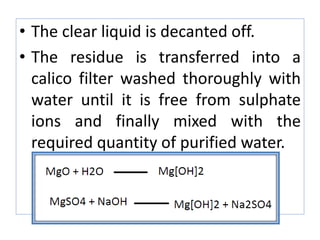
• The clear liquid is decanted off.
• The residue is transferred into a
calico filter washed thoroughly with
water until it is free from sulphate
ions and finally mixed with the
required quantity of purified water.
• In this reaction sodium hydroxide reacts with
magnesium sulphate and gives masnesium
hydroxide.
• In the above formula pharmacopoeia permits
the use of the following pharmaceutical aid.
• 0.1% citric acid which is used to minimize the
reaction between glass containers and milk of
magnesia during storage.
• Otherwise it imparts bitter taste.
• 0.5 ml / 1000 ml of volatile oil as a flavouring
agent.
• 0.2% of sodium benzoate
• 0.125% of methyl paraben as preservative
Assay-complexometric
• Weigh accuratley about 0.1 g
dissolve in 20 ml of 2M HCl and
dilute to 100 ml with water . To 50ml
of this solution add 5 ml of strong
ammonia – ammonium chloride
buffer and titrate with 0.05M
disodium edetate, using 50 mg of
mordant black II mixture as indicator.
uses
• Antacid and laxative.
• Alkaline mouth wash
• It is used to liberate alkaloids from solution.
• Dose
• As Antacid 5-10 ml
• As laxative 15-30 ml
• It should not be refrigerated
• Shake well before use.
MAGNESIUM SULPHATE
EPSOM SALT
Preparation
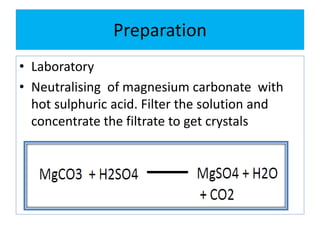
• Laboratory
• Neutralising of magnesium carbonate with
hot sulphuric acid. Filter the solution and
concentrate the filtrate to get crystals
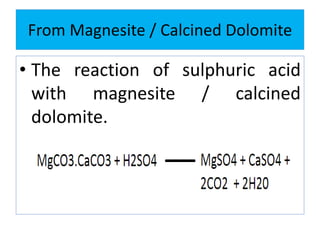
From Magnesite / Calcined Dolomite
• The reaction of sulphuric acid
with magnesite / calcined
dolomite.
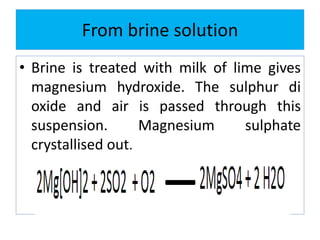
From brine solution
• Brine is treated with milk of lime gives
magnesium hydroxide. The sulphur di
oxide and air is passed through this
suspension. Magnesium sulphate
crystallised out.
Mechanism of action
It does not get absorbed from
intestine, so it retains sufficient
water within the lumen which
leads to increase in the hydrostatic
pressure of the lumen to promote
peristalsis of bowel.
Assay - complexometric
Weigh accurately about 0.3 g dissolve
in 50 ml of water, add 10 ml of strong
ammonia – ammonium chloride
solution and titrate with 0.05 M
disodium edetate using mordant black
II as indicator, untill a blue colour is
obtained.
Use
• Osmotic laxative
• Electrolyte replenishers.
• It is also used in renal impaired
patients as laxative.
MAGNESIUM CARBONATE
Preparation of Heavy magnesium
carbonate
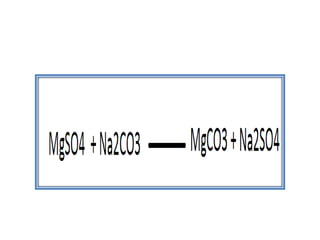
• It is preapared by double decomposition
of magnesium sulphate and sodium
carbonate.
• 125 parts of magnesium sulphate and
150 parts of sodium carbonate.
• Dissolved in boiling water separatley.
• Two solutions are mixed , filtered,
washed, evaporated and dried
Preparation of light magnesium
carbonate
125 parts of magnesium sulphate
solution is mixed with 150 parts of
sodium carbonate in cold water ,
heated for 5 minutes then precipitate
is collected, washed untill gives a slight
reaction for sulphate and dried in an
oven.
uses
• Antacid
• Osmotic laxative
• Pharmaceutical aid
• Slow acting antacid. [ during
pregnancy and lactation]
• Cathartic
Dose
• Antacid
• 300-600 mg
• Laxative
• 2-4 g
Cathartics

Cathartics

  • 1.
  • 2.
    Definition • Drugs thatrelieve constipation and promote defecation. • It is otherwise called as laxatives or purgatives. • Constipation is delayed passage of faeces • Presence of hard dehydrated fecal matter in the rectum. • Habitual use of purgatives. • Presence of haemorrhoids and fissures
  • 3.
    • Constipation isrelieved by non therapeutic measures like increasing the fibre content of daily diet intake or increase daily fluid intake. • If it fails the laxatives and purgatives are used. • The intensity of their action depends on dose. • Laxatives eliminates soft semisolid stool and the purgative lead to watery evacuation.
  • 4.
    The order ofeffectiveness is described as follows • Aperients – to smooth and soft • Evacuant – to empty • Purgative – to clean • Catharatic – to completely clean
  • 5.
    Types of laxative •Bulkforming laxatives •Osmotic laxatives •Lubricants laxatives •Surfactant laxatives
  • 6.
    Bulk forming laxatives •It acts on intestinal luminal • Hydrophilic • Indigestible vegetable fibres which stimulate peristalsis . • Peristalsis produce defecation reflexes by increasing the fecal bulk due to their water absorbing and retaining capacity.
  • 7.
    Bulk forming laxatives •Eg wheat bran. Isphagula , carboxy methyl cellulose • Administered with plenty of water. • Side effect : • Bacterial digestion of vegetable fibres within the colon may leads to abdominal discomfort.
  • 8.
    Osmotic diuretic • Nonabsorbable • Indigestible disaccharide. • Osmotic action • Eg Sorbitol and lactulose. • Dose: 10 g twice daily with plenty of water. • Side effect: • Lead to flatulence, nausea and cramps.
  • 9.
    Lubricant laxatives • Pharmacologicallyinert mineral oils. • It acts on intestinal lumen. • It is fecal lubricants and stool softener by decreasing the water absorption from the stools. • Eg liquid paraffin • 15-30ml / day at bed time • Leads to deficiency of fat soluble vitamin.
  • 10.
    Surfactant laxatives • Luminallyactive laxative. • An anionic surfactant which softens the stools by decreasing the surface tension of fluids in the bowel. • Sometimes it act as wetting agent for the bowel by emulsifying the colonic contents which facilitates the mixing of water in to fatty substance of feces • Eg docusate sodium
  • 11.
  • 12.
    • It providessemi fluid stool or leads to watery evacuation. • These are used for complete cleaning of bowel prior to gastrointestinal endoscopic procedures. • To flush out the worms of post bed ridden or post operative patients after the use of anthelmintic drugs
  • 13.
    • Cleaning thebowel before surgery or taking abdominal x-ray • Classification • Osmotic purgatives • Irritant purgatives
  • 14.
    Osmotic purgative • Electrolyteosmotic purgative • Saline purgatives
  • 15.
    Electrolyte osmotic purgative •It contains non absorbable PEG • It retains water due to its high osmotic nature. • It is given along with a balanced isotonic solution which contain sodium chloride, Sodium bi carbonate, sodium sulphate and potassium chloride. • It is safer to all patient.
  • 16.
    Saline purgatives • Itis soluble inorganic salts which acts by increasing the fecal bulk by retaining water due to its osmotic effect thus increases the peristalsis indirectly. • Magnesium salts also releases cholecytokinin which is used to increases the intestinal secretions and peristalsis
  • 17.
    Common side effect •It is given along with plenty of water because being irritant it may induce vomiting. • High osmolar property leads to intravascular fluid depletion and electrolyte disturbances. • Long term usage should be avoided for hypertensive and cardiac failure patient. • Long term use of magnesium for renal failure patient leads to risk of hyper magnesemia.
  • 18.
    Irritant Purgatives • Anthraquinonederivatives – senna, cascara and aloe • Oils – Castor oil • Organic irritants- Phenolphthalein, bisacodyl • All the above stimulate intestinal peristalsis due to their irritant action
  • 19.
    Common side effect •Senna glycoside leads to melanosis coli on long term use. • Long term of castor oil use leads to damaging the intestinal mucosa. • Bisacodyl leads to hypokalemia.
  • 20.
  • 21.
    Preparation • It isan aqueous suspension of hydrated magnesium oxide. • Light magnesium oxide is mixed with sodium hydroxide solution to get a cream. • It is diluted with water; the suspension is poured in thin stream into a solution of magnesium sulphate with constant stirring. • The precipitate is allowed to settle .
  • 22.
    • The clearliquid is decanted off. • The residue is transferred into a calico filter washed thoroughly with water until it is free from sulphate ions and finally mixed with the required quantity of purified water.
  • 23.
    • In thisreaction sodium hydroxide reacts with magnesium sulphate and gives masnesium hydroxide. • In the above formula pharmacopoeia permits the use of the following pharmaceutical aid. • 0.1% citric acid which is used to minimize the reaction between glass containers and milk of magnesia during storage. • Otherwise it imparts bitter taste.
  • 24.
    • 0.5 ml/ 1000 ml of volatile oil as a flavouring agent. • 0.2% of sodium benzoate • 0.125% of methyl paraben as preservative
  • 25.
    Assay-complexometric • Weigh accuratleyabout 0.1 g dissolve in 20 ml of 2M HCl and dilute to 100 ml with water . To 50ml of this solution add 5 ml of strong ammonia – ammonium chloride buffer and titrate with 0.05M disodium edetate, using 50 mg of mordant black II mixture as indicator.
  • 26.
    uses • Antacid andlaxative. • Alkaline mouth wash • It is used to liberate alkaloids from solution. • Dose • As Antacid 5-10 ml • As laxative 15-30 ml • It should not be refrigerated • Shake well before use.
  • 27.
  • 28.
    Preparation • Laboratory • Neutralisingof magnesium carbonate with hot sulphuric acid. Filter the solution and concentrate the filtrate to get crystals
  • 29.
    From Magnesite /Calcined Dolomite • The reaction of sulphuric acid with magnesite / calcined dolomite.
  • 30.
    From brine solution •Brine is treated with milk of lime gives magnesium hydroxide. The sulphur di oxide and air is passed through this suspension. Magnesium sulphate crystallised out.
  • 31.
    Mechanism of action Itdoes not get absorbed from intestine, so it retains sufficient water within the lumen which leads to increase in the hydrostatic pressure of the lumen to promote peristalsis of bowel.
  • 32.
    Assay - complexometric Weighaccurately about 0.3 g dissolve in 50 ml of water, add 10 ml of strong ammonia – ammonium chloride solution and titrate with 0.05 M disodium edetate using mordant black II as indicator, untill a blue colour is obtained.
  • 33.
    Use • Osmotic laxative •Electrolyte replenishers. • It is also used in renal impaired patients as laxative.
  • 34.
  • 35.
    Preparation of Heavymagnesium carbonate • It is preapared by double decomposition of magnesium sulphate and sodium carbonate. • 125 parts of magnesium sulphate and 150 parts of sodium carbonate. • Dissolved in boiling water separatley. • Two solutions are mixed , filtered, washed, evaporated and dried
  • 37.
    Preparation of lightmagnesium carbonate 125 parts of magnesium sulphate solution is mixed with 150 parts of sodium carbonate in cold water , heated for 5 minutes then precipitate is collected, washed untill gives a slight reaction for sulphate and dried in an oven.
  • 38.
    uses • Antacid • Osmoticlaxative • Pharmaceutical aid • Slow acting antacid. [ during pregnancy and lactation] • Cathartic
  • 39.
    Dose • Antacid • 300-600mg • Laxative • 2-4 g