D. Pharm –I Year
Pharmaceutical Chemistry -1
Unit –II (2) Volumetric Analysis - Non aqueous titration
Mrs Vandana Sharma
Assistant Professor
Previous year questions
1. Write detail note on nonaqueous titration, with principle,
reactions and Suitable examples
2. Give an example of nonaqueous solvents
• Titration, also known as volumetric or titrimetry method, is a
process in which titrant filled in burette (solution of known
concentration) added to a conical flask (solution of unknown
concentration) until the reaction is complete, and usually, an
indicator is used to determine the endpoint of the reaction.
• Acid-base, redox, precipitation, and complexometric titrations are
different types of titrations. However, in the quantitative chemical
analysis most commonly used are redox titrations and acid-base
titrations.
Non Aqueous titration
Definition-Titration which are carried out in the absence of aqueous
medium are called non aqueous titration.
• Non-aqueous titration is a type of titration in which weakly acidic or
basic analytes are carried out in a solvent medium that does not
contain water. The solute is dissolved in a non-aqueous solvent
and titrated with an acid or base titrant.
• The principle of non-aqueous titration is the same as acid-base
titration, which states that a substance that can donate a proton
• The theory behind non-aqueous titrations:
• Water can act as both a weak acid and a weak basic.
Water competes efficiently in proton acceptance and
proton donation when other weak acids or bases are
dissolved in it. However, titrating may not result in the
correct endpoint.
• This is why non-aqueous titration is required. This
approach is advantageous for accurate titration of
weak acids and bases, as well as the ability of the non-
aqueous solvent to dissolve organic molecules.
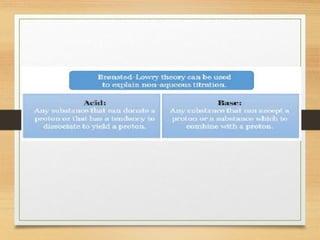
• The Lowry-Bronsted theory's concepts may help to
explain the different reactions that happen
throughout many non-aqueous titrations. Therefore,
Reasons for non aqueous titration
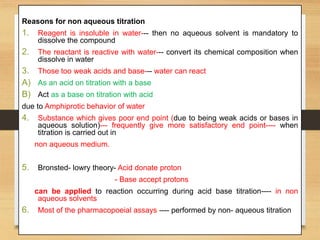
1. Reagent is insoluble in water--- then no aqueous solvent is mandatory to
dissolve the compound
2. The reactant is reactive with water--- convert its chemical composition when
dissolve in water
3. Those too weak acids and base--- water can react
A) As an acid on titration with a base
B) Act as a base on titration with acid
due to Amphiprotic behavior of water
4. Substance which gives poor end point (due to being weak acids or bases in
aqueous solution)--- frequently give more satisfactory end point---- when
titration is carried out in
non aqueous medium.
5. Bronsted- lowry theory- Acid donate proton
- Base accept protons
can be applied to reaction occurring during acid base titration---- in non
aqueous solvents
6. Most of the pharmacopoeial assays ---- performed by non- aqueous titration
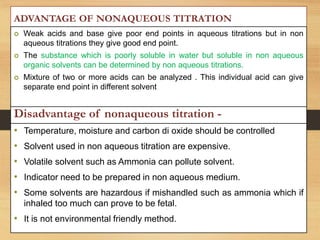
Disadvantage of nonaqueous titration -
• Temperature, moisture and carbon di oxide should be controlled
• Solvent used in non aqueous titration are expensive.
• Volatile solvent such as Ammonia can pollute solvent.
• Indicator need to be prepared in non aqueous medium.
• Some solvents are hazardous if mishandled such as ammonia which if
inhaled too much can prove to be fetal.
• It is not environmental friendly method.
ADVANTAGE OF NONAQUEOUS TITRATION
 Weak acids and base give poor end points in aqueous titrations but in non
aqueous titrations they give good end point.
 The substance which is poorly soluble in water but soluble in non aqueous
organic solvents can be determined by non aqueous titrations.
 Mixture of two or more acids can be analyzed . This individual acid can give
separate end point in different solvent
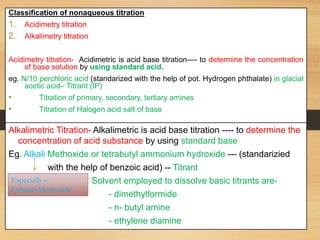
Classification of nonaqueous titration
1. Acidimetry titration
2. Alkalimetry titration
Acidimetry titration- Acidimetric is acid base titration---- to determine the concentration
of base solution by using standard acid.
eg. N/10 perchloric acid (standarized with the help of pot. Hydrogen phthalate) in glacial
acetic acid– Titrant (IP)
• Titration of primary, secondary, tertiary amines
• Titration of Halogen acid salt of base
Alkalimetric Titration- Alkalimetric is acid base titration ---- to determine the
concentration of acid substance by using standard base
Eg. Alkali Methoxide or tetrabutyl ammonium hydroxide --- (standarizied
with the help of benzoic acid) -- Titrant
Solvent employed to dissolve basic titrants are-
- dimethylformide
- n- butyl amine
- ethylene diamine
Especially –
Lithium Methoxide
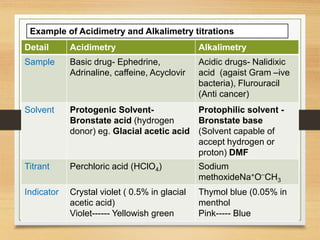
Detail Acidimetry Alkalimetry
Sample Basic drug- Ephedrine,
Adrinaline, caffeine, Acyclovir
Acidic drugs- Nalidixic
acid (agaist Gram –ive
bacteria), Flurouracil
(Anti cancer)
Solvent Protogenic Solvent-
Bronstate acid (hydrogen
donor) eg. Glacial acetic acid
Protophilic solvent -
Bronstate base
(Solvent capable of
accept hydrogen or
proton) DMF
Titrant Perchloric acid (HClO4) Sodium
methoxideNa+O
_
CH3
Indicator Crystal violet ( 0.5% in glacial
acetic acid)
Violet------ Yellowish green
Thymol blue (0.05% in
menthol
Pink----- Blue
Example of Acidimetry and Alkalimetry titrations
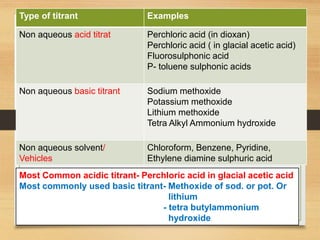
Type of titrant Examples
Non aqueous acid titrat Perchloric acid (in dioxan)
Perchloric acid ( in glacial acetic acid)
Fluorosulphonic acid
P- toluene sulphonic acids
Non aqueous basic titrant Sodium methoxide
Potassium methoxide
Lithium methoxide
Tetra Alkyl Ammonium hydroxide
Non aqueous solvent/
Vehicles
Chloroform, Benzene, Pyridine,
Ethylene diamine sulphuric acid
Most Common acidic titrant- Perchloric acid in glacial acetic acid
Most commonly used basic titrant- Methoxide of sod. or pot. Or
lithium
- tetra butylammonium
hydroxide
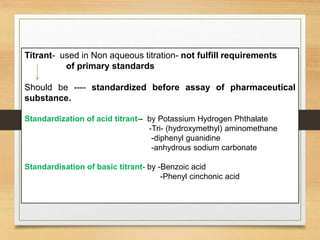
Titrant- used in Non aqueous titration- not fulfill requirements
of primary standards
Should be ---- standardized before assay of pharmaceutical
substance.
Standardization of acid titrant-- by Potassium Hydrogen Phthalate
-Tri- (hydroxymethyl) aminomethane
-diphenyl guanidine
-anhydrous sodium carbonate
Standardisation of basic titrant- by -Benzoic acid
-Phenyl cinchonic acid
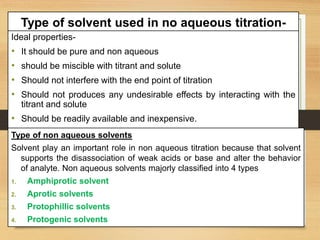
Type of solvent used in no aqueous titration-
Ideal properties-
• It should be pure and non aqueous
• should be miscible with titrant and solute
• Should not interfere with the end point of titration
• Should not produces any undesirable effects by interacting with the
titrant and solute
• Should be readily available and inexpensive.
Type of non aqueous solvents
Solvent play an important role in non aqueous titration because that solvent
supports the disassociation of weak acids or base and alter the behavior
of analyte. Non aqueous solvents majorly classified into 4 types
1. Amphiprotic solvent
2. Aprotic solvents
3. Protophillic solvents
4. Protogenic solvents
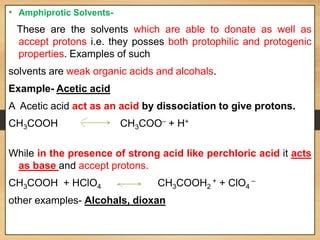
• Amphiprotic Solvents-
These are the solvents which are able to donate as well as
accept protons i.e. they posses both protophilic and protogenic
properties. Examples of such
solvents are weak organic acids and alcohals.
Example- Acetic acid
A Acetic acid act as an acid by dissociation to give protons.
CH3COOH CH3COO
_
+ H+
While in the presence of strong acid like perchloric acid it acts
as base and accept protons.
CH3COOH + HClO4 CH3COOH2
+ + ClO4
_
other examples- Alcohals, dioxan
• Aprotic solvents-
These are the solvents which are chemically inert and
does not donate or accept protons,use for dilution of
reaction mixture.
o Solvent in which a hydrogen atom is bonded to
oxygen or fluorine, or nitrogen.
o These are neutral in charge and are chemically inert.
o Therefore they don't have any acidic or basic nature.
o They don't ionized because they neither react with
acid nor base.
o eg Chloroform, Benzene, Toluene, Carbon tetra
chloride
• Protophilic Solvent- (Proton loving solvent- Bronsted base)
These types of solvents are basic solvents that have a high tendency to
accept protons.
When they react with weak acids, they form solvated Protons When they
react with weak acid (eg Nalidixic acid, Flurouracil), they form solvated
protons from acids.
HB + S SH+ + B
_
Weak Acid Solvent (Bronsted base) Solvated Proton
Conjugates base
Eg Liquid ammonia, n- butyl amine, ethylene diamine, dimethylformide
(DMF)
Experiment-
Conical flask --DMF (protophilic solvent) + thymol blue (Pink to Blue)
In burette --Sodium methoxide
Weak acids are normally used in the presence of strong protophilic
solvents----their acidic strength are then enhanced become comparable
to strong acid--- this is known as leveling effect.
Protogenic solvent (Bronsated Acid)-
Acidic in nature---- they readily donate proton
Generally, they are applied to increase the alkalinity of
weak acids to enhance the strength of weak bases.
Eg. Sulphuric acid, formic, Hydrochloric acid, Hydrogen
fluoride, Glacial Acetic acid/ Anhydrous acetic acid
(free from water )
Effects of Solvents
• Leveling effect
• Differentiating effect
• Leveling effect- Weak acids and bases are normally used in the
presence of strong protophilic (pyridine, Liquid ammonia) and strong
photogenic solvents (HF and Sulphuric acid ) because their
strengths is enhanced by these solvents.
• Weak acid act like strong acid in the presence of strong
protophilic solvents
• As well as weak base act as strong base in the presence of strong
photogenic solvents.
• This effect is called leveling effect and solvents are called
leveling solvent.
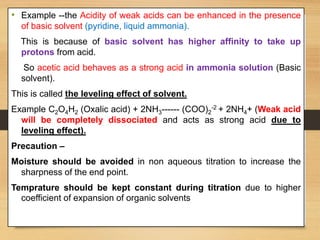
• Example --the Acidity of weak acids can be enhanced in the presence
of basic solvent (pyridine, liquid ammonia).
This is because of basic solvent has higher affinity to take up
protons from acid.
So acetic acid behaves as a strong acid in ammonia solution (Basic
solvent).
This is called the leveling effect of solvent.
Example C2O4H2 (Oxalic acid) + 2NH3------ (COO)2
-2 + 2NH4+ (Weak acid
will be completely dissociated and acts as strong acid due to
leveling effect).
Precaution –
Moisture should be avoided in non aqueous titration to increase the
sharpness of the end point.
Temprature should be kept constant during titration due to higher
coefficient of expansion of organic solvents
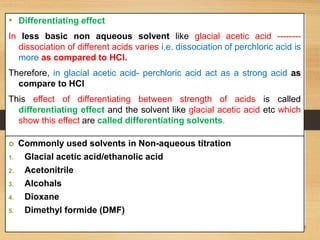
• Differentiating effect
In less basic non aqueous solvent like glacial acetic acid --------
dissociation of different acids varies i.e. dissociation of perchloric acid is
more as compared to HCl.
Therefore, in glacial acetic acid- perchloric acid act as a strong acid as
compare to HCl
This effect of differentiating between strength of acids is called
differentiating effect and the solvent like glacial acetic acid etc which
show this effect are called differentiating solvents.
 Commonly used solvents in Non-aqueous titration
1. Glacial acetic acid/ethanolic acid
2. Acetonitrile
3. Alcohals
4. Dioxane
5. Dimethyl formide (DMF)
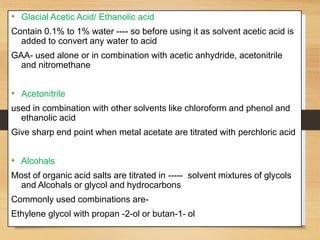
• Glacial Acetic Acid/ Ethanolic acid
Contain 0.1% to 1% water ---- so before using it as solvent acetic acid is
added to convert any water to acid
GAA- used alone or in combination with acetic anhydride, acetonitrile
and nitromethane
• Acetonitrile
used in combination with other solvents like chloroform and phenol and
ethanolic acid
Give sharp end point when metal acetate are titrated with perchloric acid
• Alcohals
Most of organic acid salts are titrated in ----- solvent mixtures of glycols
and Alcohals or glycol and hydrocarbons
Commonly used combinations are-
Ethylene glycol with propan -2-ol or butan-1- ol
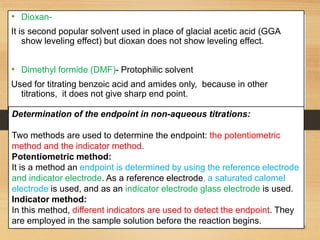
• Dioxan-
It is second popular solvent used in place of glacial acetic acid (GGA
show leveling effect) but dioxan does not show leveling effect.
• Dimethyl formide (DMF)- Protophilic solvent
Used for titrating benzoic acid and amides only, because in other
titrations, it does not give sharp end point.
Determination of the endpoint in non-aqueous titrations:
Two methods are used to determine the endpoint: the potentiometric
method and the indicator method.
Potentiometric method:
It is a method an endpoint is determined by using the reference electrode
and indicator electrode. As a reference electrode, a saturated calomel
electrode is used, and as an indicator electrode glass electrode is used.
Indicator method:
In this method, different indicators are used to detect the endpoint. They
are employed in the sample solution before the reaction begins.
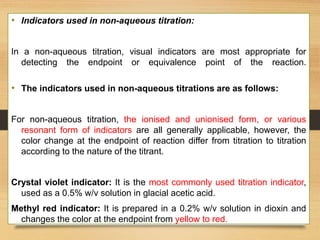
• Indicators used in non-aqueous titration:
In a non-aqueous titration, visual indicators are most appropriate for
detecting the endpoint or equivalence point of the reaction.
• The indicators used in non-aqueous titrations are as follows:
For non-aqueous titration, the ionised and unionised form, or various
resonant form of indicators are all generally applicable, however, the
color change at the endpoint of reaction differ from titration to titration
according to the nature of the titrant.
Crystal violet indicator: It is the most commonly used titration indicator,
used as a 0.5% w/v solution in glacial acetic acid.
Methyl red indicator: It is prepared in a 0.2% w/v solution in dioxin and
changes the color at the endpoint from yellow to red.
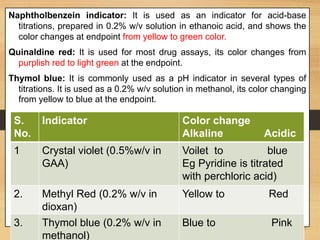
Naphtholbenzein indicator: It is used as an indicator for acid-base
titrations, prepared in 0.2% w/v solution in ethanoic acid, and shows the
color changes at endpoint from yellow to green color.
Quinaldine red: It is used for most drug assays, its color changes from
purplish red to light green at the endpoint.
Thymol blue: It is commonly used as a pH indicator in several types of
titrations. It is used as a 0.2% w/v solution in methanol, its color changing
from yellow to blue at the endpoint.
S.
No.
Indicator Color change
Alkaline Acidic
1 Crystal violet (0.5%w/v in
GAA)
Voilet to blue
Eg Pyridine is titrated
with perchloric acid)
2. Methyl Red (0.2% w/v in
dioxan)
Yellow to Red
3. Thymol blue (0.2% w/v in
methanol)
Blue to Pink
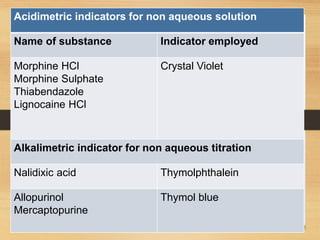
Acidimetric indicators for non aqueous solution
Name of substance Indicator employed
Morphine HCl
Morphine Sulphate
Thiabendazole
Lignocaine HCl
Crystal Violet
Alkalimetric indicator for non aqueous titration
Nalidixic acid Thymolphthalein
Allopurinol
Mercaptopurine
Thymol blue
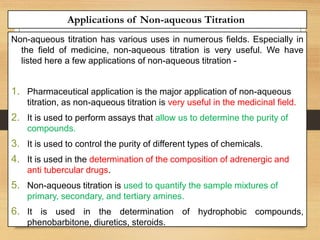
Applications of Non-aqueous Titration
Non-aqueous titration has various uses in numerous fields. Especially in
the field of medicine, non-aqueous titration is very useful. We have
listed here a few applications of non-aqueous titration -
1. Pharmaceutical application is the major application of non-aqueous
titration, as non-aqueous titration is very useful in the medicinal field.
2. It is used to perform assays that allow us to determine the purity of
compounds.
3. It is used to control the purity of different types of chemicals.
4. It is used in the determination of the composition of adrenergic and
anti tubercular drugs.
5. Non-aqueous titration is used to quantify the sample mixtures of
primary, secondary, and tertiary amines.
6. It is used in the determination of hydrophobic compounds,
phenobarbitone, diuretics, steroids.
Commonly asked questions on non-aqueous titration are as follows.
Non-aqueous titration is based on which theory?
Non-aqueous titration is based on the Bronsted-Lowry principle.
Which compound titration is carried out by non-aqueous titration?
Non-aqueous titrations are those in which non-aqueous solvents are used
to titrate weakly acidic or basic analytes to obtain a sharp endpoint.
Why non-aqueous titration is required?
Non-aqueous titration is important and required because water can act as
both a weak acid and, a weak base and therefore can compete with
other weak acids and bases dissolved in it in proton acceptance of
proton donation.
D. pharm nonaqueous titration short notes.pptx

D. pharm nonaqueous titration short notes.pptx

  • 1.
    D. Pharm –IYear Pharmaceutical Chemistry -1 Unit –II (2) Volumetric Analysis - Non aqueous titration Mrs Vandana Sharma Assistant Professor
  • 2.
    Previous year questions 1.Write detail note on nonaqueous titration, with principle, reactions and Suitable examples 2. Give an example of nonaqueous solvents
  • 3.
    • Titration, alsoknown as volumetric or titrimetry method, is a process in which titrant filled in burette (solution of known concentration) added to a conical flask (solution of unknown concentration) until the reaction is complete, and usually, an indicator is used to determine the endpoint of the reaction. • Acid-base, redox, precipitation, and complexometric titrations are different types of titrations. However, in the quantitative chemical analysis most commonly used are redox titrations and acid-base titrations. Non Aqueous titration Definition-Titration which are carried out in the absence of aqueous medium are called non aqueous titration. • Non-aqueous titration is a type of titration in which weakly acidic or basic analytes are carried out in a solvent medium that does not contain water. The solute is dissolved in a non-aqueous solvent and titrated with an acid or base titrant. • The principle of non-aqueous titration is the same as acid-base titration, which states that a substance that can donate a proton
  • 4.
    • The theorybehind non-aqueous titrations: • Water can act as both a weak acid and a weak basic. Water competes efficiently in proton acceptance and proton donation when other weak acids or bases are dissolved in it. However, titrating may not result in the correct endpoint. • This is why non-aqueous titration is required. This approach is advantageous for accurate titration of weak acids and bases, as well as the ability of the non- aqueous solvent to dissolve organic molecules. • The Lowry-Bronsted theory's concepts may help to explain the different reactions that happen throughout many non-aqueous titrations. Therefore,
  • 6.
    Reasons for nonaqueous titration 1. Reagent is insoluble in water--- then no aqueous solvent is mandatory to dissolve the compound 2. The reactant is reactive with water--- convert its chemical composition when dissolve in water 3. Those too weak acids and base--- water can react A) As an acid on titration with a base B) Act as a base on titration with acid due to Amphiprotic behavior of water 4. Substance which gives poor end point (due to being weak acids or bases in aqueous solution)--- frequently give more satisfactory end point---- when titration is carried out in non aqueous medium. 5. Bronsted- lowry theory- Acid donate proton - Base accept protons can be applied to reaction occurring during acid base titration---- in non aqueous solvents 6. Most of the pharmacopoeial assays ---- performed by non- aqueous titration
  • 7.
    Disadvantage of nonaqueoustitration - • Temperature, moisture and carbon di oxide should be controlled • Solvent used in non aqueous titration are expensive. • Volatile solvent such as Ammonia can pollute solvent. • Indicator need to be prepared in non aqueous medium. • Some solvents are hazardous if mishandled such as ammonia which if inhaled too much can prove to be fetal. • It is not environmental friendly method. ADVANTAGE OF NONAQUEOUS TITRATION  Weak acids and base give poor end points in aqueous titrations but in non aqueous titrations they give good end point.  The substance which is poorly soluble in water but soluble in non aqueous organic solvents can be determined by non aqueous titrations.  Mixture of two or more acids can be analyzed . This individual acid can give separate end point in different solvent
  • 8.
    Classification of nonaqueoustitration 1. Acidimetry titration 2. Alkalimetry titration Acidimetry titration- Acidimetric is acid base titration---- to determine the concentration of base solution by using standard acid. eg. N/10 perchloric acid (standarized with the help of pot. Hydrogen phthalate) in glacial acetic acid– Titrant (IP) • Titration of primary, secondary, tertiary amines • Titration of Halogen acid salt of base Alkalimetric Titration- Alkalimetric is acid base titration ---- to determine the concentration of acid substance by using standard base Eg. Alkali Methoxide or tetrabutyl ammonium hydroxide --- (standarizied with the help of benzoic acid) -- Titrant Solvent employed to dissolve basic titrants are- - dimethylformide - n- butyl amine - ethylene diamine Especially – Lithium Methoxide
  • 9.
    Detail Acidimetry Alkalimetry SampleBasic drug- Ephedrine, Adrinaline, caffeine, Acyclovir Acidic drugs- Nalidixic acid (agaist Gram –ive bacteria), Flurouracil (Anti cancer) Solvent Protogenic Solvent- Bronstate acid (hydrogen donor) eg. Glacial acetic acid Protophilic solvent - Bronstate base (Solvent capable of accept hydrogen or proton) DMF Titrant Perchloric acid (HClO4) Sodium methoxideNa+O _ CH3 Indicator Crystal violet ( 0.5% in glacial acetic acid) Violet------ Yellowish green Thymol blue (0.05% in menthol Pink----- Blue Example of Acidimetry and Alkalimetry titrations
  • 10.
    Type of titrantExamples Non aqueous acid titrat Perchloric acid (in dioxan) Perchloric acid ( in glacial acetic acid) Fluorosulphonic acid P- toluene sulphonic acids Non aqueous basic titrant Sodium methoxide Potassium methoxide Lithium methoxide Tetra Alkyl Ammonium hydroxide Non aqueous solvent/ Vehicles Chloroform, Benzene, Pyridine, Ethylene diamine sulphuric acid Most Common acidic titrant- Perchloric acid in glacial acetic acid Most commonly used basic titrant- Methoxide of sod. or pot. Or lithium - tetra butylammonium hydroxide
  • 11.
    Titrant- used inNon aqueous titration- not fulfill requirements of primary standards Should be ---- standardized before assay of pharmaceutical substance. Standardization of acid titrant-- by Potassium Hydrogen Phthalate -Tri- (hydroxymethyl) aminomethane -diphenyl guanidine -anhydrous sodium carbonate Standardisation of basic titrant- by -Benzoic acid -Phenyl cinchonic acid
  • 12.
    Type of solventused in no aqueous titration- Ideal properties- • It should be pure and non aqueous • should be miscible with titrant and solute • Should not interfere with the end point of titration • Should not produces any undesirable effects by interacting with the titrant and solute • Should be readily available and inexpensive. Type of non aqueous solvents Solvent play an important role in non aqueous titration because that solvent supports the disassociation of weak acids or base and alter the behavior of analyte. Non aqueous solvents majorly classified into 4 types 1. Amphiprotic solvent 2. Aprotic solvents 3. Protophillic solvents 4. Protogenic solvents
  • 13.
    • Amphiprotic Solvents- Theseare the solvents which are able to donate as well as accept protons i.e. they posses both protophilic and protogenic properties. Examples of such solvents are weak organic acids and alcohals. Example- Acetic acid A Acetic acid act as an acid by dissociation to give protons. CH3COOH CH3COO _ + H+ While in the presence of strong acid like perchloric acid it acts as base and accept protons. CH3COOH + HClO4 CH3COOH2 + + ClO4 _ other examples- Alcohals, dioxan
  • 14.
    • Aprotic solvents- Theseare the solvents which are chemically inert and does not donate or accept protons,use for dilution of reaction mixture. o Solvent in which a hydrogen atom is bonded to oxygen or fluorine, or nitrogen. o These are neutral in charge and are chemically inert. o Therefore they don't have any acidic or basic nature. o They don't ionized because they neither react with acid nor base. o eg Chloroform, Benzene, Toluene, Carbon tetra chloride
  • 15.
    • Protophilic Solvent-(Proton loving solvent- Bronsted base) These types of solvents are basic solvents that have a high tendency to accept protons. When they react with weak acids, they form solvated Protons When they react with weak acid (eg Nalidixic acid, Flurouracil), they form solvated protons from acids. HB + S SH+ + B _ Weak Acid Solvent (Bronsted base) Solvated Proton Conjugates base Eg Liquid ammonia, n- butyl amine, ethylene diamine, dimethylformide (DMF) Experiment- Conical flask --DMF (protophilic solvent) + thymol blue (Pink to Blue) In burette --Sodium methoxide Weak acids are normally used in the presence of strong protophilic solvents----their acidic strength are then enhanced become comparable to strong acid--- this is known as leveling effect.
  • 16.
    Protogenic solvent (BronsatedAcid)- Acidic in nature---- they readily donate proton Generally, they are applied to increase the alkalinity of weak acids to enhance the strength of weak bases. Eg. Sulphuric acid, formic, Hydrochloric acid, Hydrogen fluoride, Glacial Acetic acid/ Anhydrous acetic acid (free from water )
  • 17.
    Effects of Solvents •Leveling effect • Differentiating effect • Leveling effect- Weak acids and bases are normally used in the presence of strong protophilic (pyridine, Liquid ammonia) and strong photogenic solvents (HF and Sulphuric acid ) because their strengths is enhanced by these solvents. • Weak acid act like strong acid in the presence of strong protophilic solvents • As well as weak base act as strong base in the presence of strong photogenic solvents. • This effect is called leveling effect and solvents are called leveling solvent.
  • 18.
    • Example --theAcidity of weak acids can be enhanced in the presence of basic solvent (pyridine, liquid ammonia). This is because of basic solvent has higher affinity to take up protons from acid. So acetic acid behaves as a strong acid in ammonia solution (Basic solvent). This is called the leveling effect of solvent. Example C2O4H2 (Oxalic acid) + 2NH3------ (COO)2 -2 + 2NH4+ (Weak acid will be completely dissociated and acts as strong acid due to leveling effect). Precaution – Moisture should be avoided in non aqueous titration to increase the sharpness of the end point. Temprature should be kept constant during titration due to higher coefficient of expansion of organic solvents
  • 19.
    • Differentiating effect Inless basic non aqueous solvent like glacial acetic acid -------- dissociation of different acids varies i.e. dissociation of perchloric acid is more as compared to HCl. Therefore, in glacial acetic acid- perchloric acid act as a strong acid as compare to HCl This effect of differentiating between strength of acids is called differentiating effect and the solvent like glacial acetic acid etc which show this effect are called differentiating solvents.  Commonly used solvents in Non-aqueous titration 1. Glacial acetic acid/ethanolic acid 2. Acetonitrile 3. Alcohals 4. Dioxane 5. Dimethyl formide (DMF)
  • 20.
    • Glacial AceticAcid/ Ethanolic acid Contain 0.1% to 1% water ---- so before using it as solvent acetic acid is added to convert any water to acid GAA- used alone or in combination with acetic anhydride, acetonitrile and nitromethane • Acetonitrile used in combination with other solvents like chloroform and phenol and ethanolic acid Give sharp end point when metal acetate are titrated with perchloric acid • Alcohals Most of organic acid salts are titrated in ----- solvent mixtures of glycols and Alcohals or glycol and hydrocarbons Commonly used combinations are- Ethylene glycol with propan -2-ol or butan-1- ol
  • 21.
    • Dioxan- It issecond popular solvent used in place of glacial acetic acid (GGA show leveling effect) but dioxan does not show leveling effect. • Dimethyl formide (DMF)- Protophilic solvent Used for titrating benzoic acid and amides only, because in other titrations, it does not give sharp end point. Determination of the endpoint in non-aqueous titrations: Two methods are used to determine the endpoint: the potentiometric method and the indicator method. Potentiometric method: It is a method an endpoint is determined by using the reference electrode and indicator electrode. As a reference electrode, a saturated calomel electrode is used, and as an indicator electrode glass electrode is used. Indicator method: In this method, different indicators are used to detect the endpoint. They are employed in the sample solution before the reaction begins.
  • 22.
    • Indicators usedin non-aqueous titration: In a non-aqueous titration, visual indicators are most appropriate for detecting the endpoint or equivalence point of the reaction. • The indicators used in non-aqueous titrations are as follows: For non-aqueous titration, the ionised and unionised form, or various resonant form of indicators are all generally applicable, however, the color change at the endpoint of reaction differ from titration to titration according to the nature of the titrant. Crystal violet indicator: It is the most commonly used titration indicator, used as a 0.5% w/v solution in glacial acetic acid. Methyl red indicator: It is prepared in a 0.2% w/v solution in dioxin and changes the color at the endpoint from yellow to red.
  • 23.
    Naphtholbenzein indicator: Itis used as an indicator for acid-base titrations, prepared in 0.2% w/v solution in ethanoic acid, and shows the color changes at endpoint from yellow to green color. Quinaldine red: It is used for most drug assays, its color changes from purplish red to light green at the endpoint. Thymol blue: It is commonly used as a pH indicator in several types of titrations. It is used as a 0.2% w/v solution in methanol, its color changing from yellow to blue at the endpoint. S. No. Indicator Color change Alkaline Acidic 1 Crystal violet (0.5%w/v in GAA) Voilet to blue Eg Pyridine is titrated with perchloric acid) 2. Methyl Red (0.2% w/v in dioxan) Yellow to Red 3. Thymol blue (0.2% w/v in methanol) Blue to Pink
  • 24.
    Acidimetric indicators fornon aqueous solution Name of substance Indicator employed Morphine HCl Morphine Sulphate Thiabendazole Lignocaine HCl Crystal Violet Alkalimetric indicator for non aqueous titration Nalidixic acid Thymolphthalein Allopurinol Mercaptopurine Thymol blue
  • 25.
    Applications of Non-aqueousTitration Non-aqueous titration has various uses in numerous fields. Especially in the field of medicine, non-aqueous titration is very useful. We have listed here a few applications of non-aqueous titration - 1. Pharmaceutical application is the major application of non-aqueous titration, as non-aqueous titration is very useful in the medicinal field. 2. It is used to perform assays that allow us to determine the purity of compounds. 3. It is used to control the purity of different types of chemicals. 4. It is used in the determination of the composition of adrenergic and anti tubercular drugs. 5. Non-aqueous titration is used to quantify the sample mixtures of primary, secondary, and tertiary amines. 6. It is used in the determination of hydrophobic compounds, phenobarbitone, diuretics, steroids.
  • 26.
    Commonly asked questionson non-aqueous titration are as follows. Non-aqueous titration is based on which theory? Non-aqueous titration is based on the Bronsted-Lowry principle. Which compound titration is carried out by non-aqueous titration? Non-aqueous titrations are those in which non-aqueous solvents are used to titrate weakly acidic or basic analytes to obtain a sharp endpoint. Why non-aqueous titration is required? Non-aqueous titration is important and required because water can act as both a weak acid and, a weak base and therefore can compete with other weak acids and bases dissolved in it in proton acceptance of proton donation.