Pabitra Kumar Mani,

Assoc. Prof., ACSS, BCKV

Class 13

Red–ox titrations,
permanganometry, iodometry
etc.
Redox Titrations
•
•
•
•
•

Basics
Potassium Permanganate
Potassium Dichromate
Cerium IV
Iodine
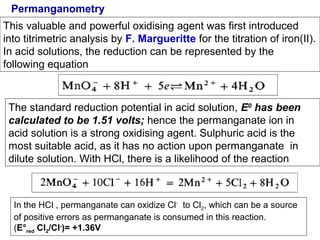
Permanganometry
This valuable and powerful oxidising agent was first introduced
into titrimetric analysis by F. Margueritte for the titration of iron(II).
In acid solutions, the reduction can be represented by the
following equation

The standard reduction potential in acid solution, E0 has been
calculated to be 1.51 volts; hence the permanganate ion in
acid solution is a strong oxidising agent. Sulphuric acid is the
most suitable acid, as it has no action upon permanganate in
dilute solution. With HCl, there is a likelihood of the reaction

In the HCl , permanganate can oxidize Cl- to Cl2, which can be a source
of positive errors as permanganate is consumed in this reaction.
(E°red Cl2/Cl-)= +1.36V
Permanganate titration
KMnO4 Powerful oxidant that the most widely used.
Eq. Wt.(=M/5): In strongly acidic solutions (1M H2SO4 or HCl, pH ≤ 1)
MnO4– + 8H+ + 5e- = Mn2 + + 4H2 O
Eo = 1.51 V
violet color
colorless manganous
KMnO4 is a self-indicator.
In feebly acidic, neutral, or alkaline solutions (E=M/3)
MnO4– + 4H+ + 3e- = MnO2 (s) + 2H2 O
Eo = 0.59 V
brown manganese dioxide solid
In very strongly alkaline solution (2M NaOH or Ba (OH)2) (E=M/1)
MnO4– + e- = MnO42 –
Eo = 0.56 V
green manganate
III
E=M/4 (in HF or NH4HF2 Medium)
MnO4– + 4e- + 6F-+ 8H+ = [MnF6] 3 – + 4H2O
Trivalent Fluoro magnate anion
Estimation of Fe+2
In the analysis of iron ores, (solution is frequently effected in
conc. HCl); the Fe+3 is reduced and the Fe+2 is then determined in
the resultant solution.
If Cl- is present, to prevent its oxidation in acidic medium (1-2
N) by MnO4- about 25 mL of Zimmermann and Reinhardt's
solution (preventive solution) has to be used.
It is prepared by dissolving 50 g of crystallised (MnSO4,4H2O) in
250 mL water, adding a cooled mixture of 100 mL conc.H2SO4
and 300 mL water, followed by 100 mL H3PO4. The manganese
(II) sulphate (presence of Mn+2) lowers the oxidation potential of
the MnO4- - Mn(II) couple (-1.20V) and thereby makes it a weaker
oxidising agent; the tendency of the permanganate ion to oxidise
chloride ion is thus reduced.( Eo of Cl-/Cl2 is much higher)

[

] ]

0.0591
MnO 4 [ H
E = -1.52 log
[ Mn + 2 ]
5
−

+ 8

positive

See Vogels book
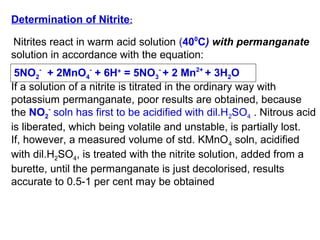
Determination of Nitrite:
Nitrites react in warm acid solution (400C) with permanganate
solution in accordance with the equation:
5NO2- + 2MnO4- + 6H+ = 5NO3- + 2 Mn2+ + 3H2O
If a solution of a nitrite is titrated in the ordinary way with
potassium permanganate, poor results are obtained, because
the NO2- soln has first to be acidified with dil.H2SO4 . Nitrous acid
is liberated, which being volatile and unstable, is partially lost.
If, however, a measured volume of std. KMnO 4 soln, acidified
with dil.H2SO4, is treated with the nitrite solution, added from a
burette, until the permanganate is just decolorised, results
accurate to 0.5-1 per cent may be obtained
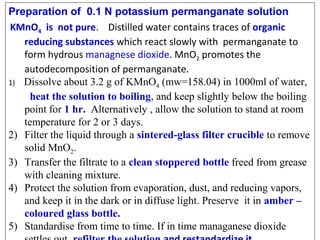
Preparation of 0.1 N potassium permanganate solution
KMnO4 is not pure. Distilled water contains traces of organic
reducing substances which react slowly with permanganate to
form hydrous managnese dioxide. MnO2 promotes the
autodecomposition of permanganate.
1) Dissolve about 3.2 g of KMnO4 (mw=158.04) in 1000ml of water,
heat the solution to boiling, and keep slightly below the boiling
point for 1 hr. Alternatively , allow the solution to stand at room
temperature for 2 or 3 days.
2) Filter the liquid through a sintered-glass filter crucible to remove
solid MnO2.
3) Transfer the filtrate to a clean stoppered bottle freed from grease
with cleaning mixture.
4) Protect the solution from evaporation, dust, and reducing vapors,
and keep it in the dark or in diffuse light. Preserve it in amber –
coloured glass bottle.
5) Standardise from time to time. If in time managanese dioxide
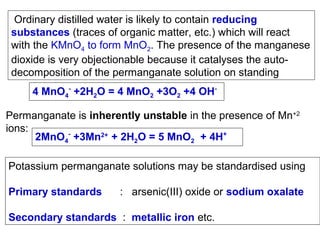
Ordinary distilled water is likely to contain reducing
substances (traces of organic matter, etc.) which will react
with the KMnO4 to form MnO2. The presence of the manganese
dioxide is very objectionable because it catalyses the autodecomposition of the permanganate solution on standing
4 MnO4- +2H2O = 4 MnO2 +3O2 +4 OHPermanganate is inherently unstable in the presence of Mn+2
ions:
2MnO4- +3Mn2+ + 2H2O = 5 MnO2 + 4H+
Potassium permanganate solutions may be standardised using
Primary standards

: arsenic(III) oxide or sodium oxalate

Secondary standards : metallic iron etc.
Standardization of KMnO4 solution

Standardization by titration of sodium oxalate Na2C2O4.2H20 (primary standard)
(Fowler and Bright) :

C2O42- = 2CO2 + 2 e-

E° red = +0.77V

2KMnO4 +5 Na2(COO)2 +8H2SO4 = 2MnSO4 +K2SO4 +5Na2SO4 +10 CO2 + 8H2O

The reaction between oxalic acid and potassium permanganate can be represented
as:

2KMnO4 + 5 H2C2O4 +3H2SO4 = 2MnSO4 +K2SO4 +10 CO2+ 8H2O
In ionic form the reaction can be represented as:

2MnO4- + 5 C2O4 2- +

16H+

= 2Mn2+ + 10 CO2 + 8H2O
This titration is carried out in warm conditions (60 oC). The reaction at room
temperature is slow because of the equilibrium nature of this reaction. CO2 is highly
soluble in water and thus heating removes all dissolved CO2 out of the solution
driving the reaction in forward direction.
Also at low temperature, the reduction of permanganate may not be
complete producing Mn(III) (in the form [Mn(C2O4)3]3-). The formation of this
species introduce errors in titrations as no. of electrons utilized here are different as
compared to production of Mn2+.
Standardization of KMnO4 solution
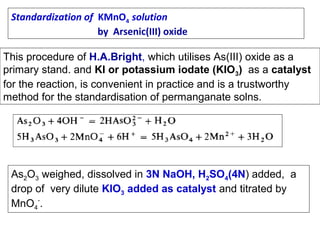
by Arsenic(III) oxide
This procedure of H.A.Bright, which utilises As(III) oxide as a
primary stand. and KI or potassium iodate (KIO3) as a catalyst
for the reaction, is convenient in practice and is a trustworthy
method for the standardisation of permanganate solns.

As2O3 weighed, dissolved in 3N NaOH, H2SO4(4N) added, a
drop of very dilute KIO3 added as catalyst and titrated by
MnO4-.
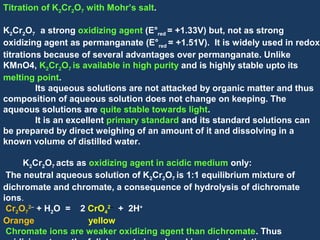
Titration of K2Cr2O7 with Mohr’s salt.
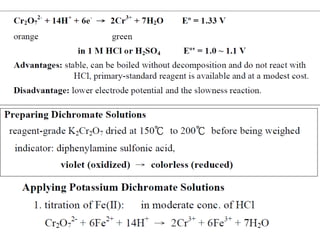
K2Cr2O7 a strong oxidizing agent (E°red = +1.33V) but, not as strong
oxidizing agent as permanganate (E°red = +1.51V). It is widely used in redox
titrations because of several advantages over permanganate. Unlike
KMnO4, K2Cr2O7 is available in high purity and is highly stable upto its
melting point.
Its aqueous solutions are not attacked by organic matter and thus
composition of aqueous solution does not change on keeping. The
aqueous solutions are quite stable towards light.
It is an excellent primary standard and its standard solutions can
be prepared by direct weighing of an amount of it and dissolving in a
known volume of distilled water.
K2Cr2O7 acts as oxidizing agent in acidic medium only:
The neutral aqueous solution of K2Cr2O7 is 1:1 equilibrium mixture of
dichromate and chromate, a consequence of hydrolysis of dichromate
ions.
Cr2O72– + H2O = 2 CrO42– + 2H+
Orange
yellow
Chromate ions are weaker oxidizing agent than dichromate. Thus
[

]

0.0591
Cr2 O 7 [ H
E =E log
[Cr +3 ]
6
0

−2

(10 )(10
0.0591
E = −1.33 log
-2 2
6
[10 ]
−3

0.0591
E = −1.33 log10 - 27
6
 0.0591 
E = −1.33 + 27 x

 6


E = − .06V
1

]

+ 14

−2

)

14
E =E

[ Fe ]
- 0.0591log
[ Fe ]
+3

0

+2

0.003
E = -0.771 - 0.0591log
0.15

E = -0.671V

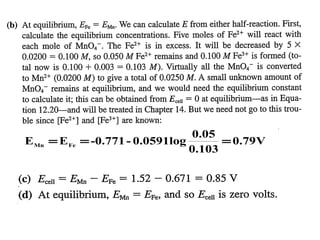
[

]

0.0591
MnO 4 [ H + ]
0
E=E log
[ Mn + 2 ]
5
−

8

( 0.02)( 1.00 )
0.0591
E = -1.51 log
( 0.005)
5

E = -1.52 V

8
E Mn = E Fe

0.05
= -0.771 - 0.0591log
= 0.79V
0.103
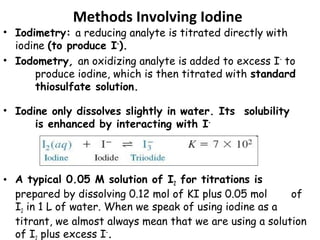
Methods Involving Iodine

• Iodimetry: a reducing analyte is titrated directly with
iodine (to produce I−).
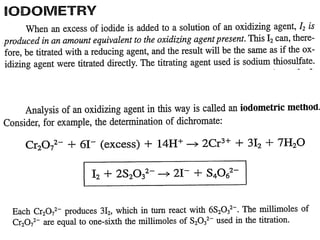
• Iodometry, an oxidizing analyte is added to excess I− to
produce iodine, which is then titrated with standard
thiosulfate solution.
• Iodine only dissolves slightly in water. Its solubility
is enhanced by interacting with I-

• A typical 0.05 M solution of I2 for titrations is
prepared by dissolving 0.12 mol of KI plus 0.05 mol
of
I2 in 1 L of water. When we speak of using iodine as a
titrant, we almost always mean that we are using a solution
of I plus excess I−.
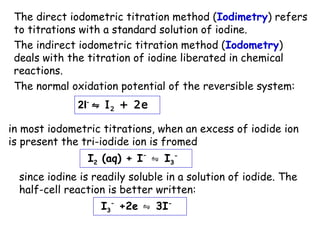
The direct iodometric titration method (Iodimetry) refers
to titrations with a standard solution of iodine.
The indirect iodometric titration method (Iodometry)
deals with the titration of iodine liberated in chemical
reactions.
The normal oxidation potential of the reversible system:
2I- ⇋ I 2 + 2e
in most iodometric titrations, when an excess of iodide ion
is present the tri-iodide ion is fromed
I2 (aq) + I- ⇋ I3since iodine is readily soluble in a solution of iodide. The
half-cell reaction is better written:
I3- +2e ⇋ 3I-
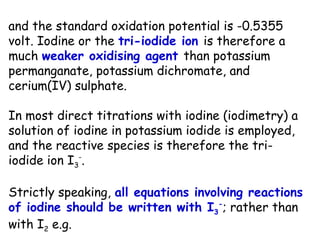
and the standard oxidation potential is -0.5355
volt. Iodine or the tri-iodide ion is therefore a
much weaker oxidising agent than potassium
permanganate, potassium dichromate, and
cerium(IV) sulphate.
In most direct titrations with iodine (iodimetry) a
solution of iodine in potassium iodide is employed,
and the reactive species is therefore the triiodide ion I3-.
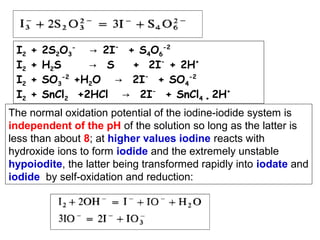
Strictly speaking, all equations involving reactions
of iodine should be written with I3-; rather than
with I2 e.g.
I2
I2
I2
I2

+
+
+
+

2S2O3- → 2I- + S4O6-2
H2S
→ S
+ 2I- + 2H+
SO3-2 +H2O → 2I- + SO4-2
SnCl2 +2HCl → 2I- + SnCl4 + 2H+

The normal oxidation potential of the iodine-iodide system is
independent of the pH of the solution so long as the latter is
less than about 8; at higher values iodine reacts with
hydroxide ions to form iodide and the extremely unstable
hypoiodite, the latter being transformed rapidly into iodate and
iodide by self-oxidation and reduction:
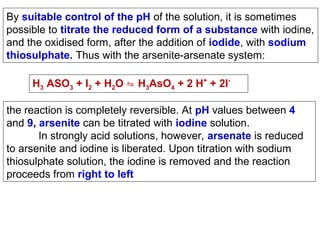
By suitable control of the pH of the solution, it is sometimes
possible to titrate the reduced form of a substance with iodine,
and the oxidised form, after the addition of iodide, with sodium
thiosulphate. Thus with the arsenite-arsenate system:
H3 ASO3 + I2 + H2O ⇋ H3AsO4 + 2 H+ + 2Ithe reaction is completely reversible. At pH values between 4
and 9, arsenite can be titrated with iodine solution.
In strongly acid solutions, however, arsenate is reduced
to arsenite and iodine is liberated. Upon titration with sodium
thiosulphate solution, the iodine is removed and the reaction
proceeds from right to left
Preparation and Standardization of Solutions

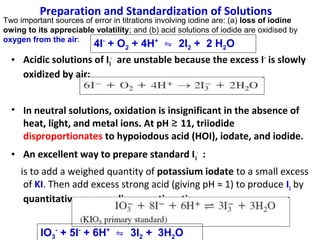
Two important sources of error in titrations involving iodine are: (a) loss of iodine
owing to its appreciable volatility; and (b) acid solutions of iodide are oxidised by
oxygen from the air:
+

4I + O2 + 4H ⇋ 2I2 + 2 H2O
• Acidic solutions of I3- are unstable because the excess I− is slowly
oxidized by air:
• In neutral solutions, oxidation is insignificant in the absence of
heat, light, and metal ions. At pH ≳ 11, triiodide
disproportionates to hypoiodous acid (HOI), iodate, and iodide.
• An excellent way to prepare standard I3- :
is to add a weighed quantity of potassium iodate to a small excess
of KI. Then add excess strong acid (giving pH ≈ 1) to produce I2 by
quantitative reverse disproportionation:
IO3- + 5I- + 6H+ ⇋ 3I2 + 3H2O
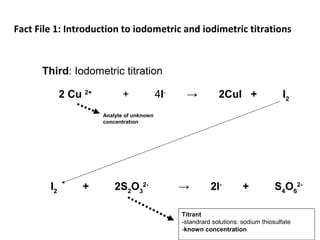
Fact File 1: Introduction to iodometric and iodimetric titrations

Third: Iodometric titration
2 Cu 2+

+

4I-

→

2CuI +

I2

Analyte of unknown
concentration

I2

+

2S2O32-

→

2I-

+

S4O62-

Titrant
-standrard solutions: sodium thiosulfate
-known concentration
Starch-Iodine complex
Starch solution(05~ 1%) is not redox indicator.
The active fraction of starch is amylose, a polymer of the sugar αD-glucose ( 1,4 bond).
The polymer exists as a coiled helix into which small molecules
can fit.

In the presence of starch and I–, iodine molecules form long
chains of I5– ions that occupy the center of the amylose helix.
••••[I I I I I]– ••••[I I I I I]– ••••
Visible absorption by the I5– chain bound within the helix gives
rise to the characteristic starch-iodine color.
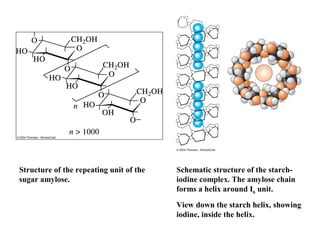
Structure of the repeating unit of the
sugar amylose.

Schematic structure of the starchiodine complex. The amylose chain
forms a helix around I6 unit.
View down the starch helix, showing
iodine, inside the helix.
Starch-Iodine Complex
•

•
•

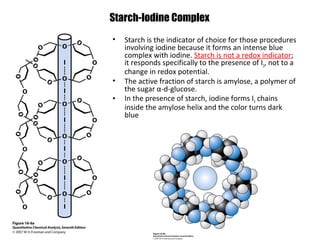
Starch is the indicator of choice for those procedures
involving iodine because it forms an intense blue
complex with iodine. Starch is not a redox indicator;
it responds specifically to the presence of I2, not to a
change in redox potential.
The active fraction of starch is amylose, a polymer of
the sugar α-d-glucose.
In the presence of starch, iodine forms I6 chains
inside the amylose helix and the color turns dark
blue
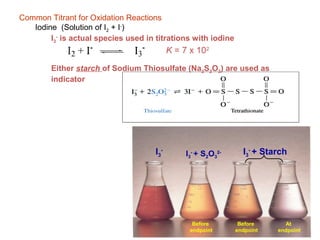
Common Titrant for Oxidation Reactions
Iodine (Solution of I2 + I-)
I3- is actual species used in titrations with iodine

K = 7 x 10²
Either starch of Sodium Thiosulfate (Na2S2O3) are used as
indicator

I3-

I3- + S2O32-

Before
endpoint

I3- + Starch

Before
endpoint

At
endpoint
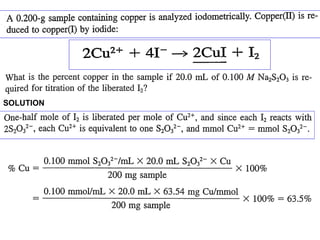
SOLUTION
Determination of Cu+2 :
2Cu+2 + 4I-

→ CuI + I2

Acetic acid buffer pH ~4.5 or better NH4HF2 buffer. In
presence of free mineral acid, at pH<3, dissolved O 2
liberate I2 from I- also.
The elments which interferes with the iodometric
determination are iron, arsenic and antimony, Trivalent
iron is reduced by iodide:
2Fe3+ + 2I- ⇋ 2Fe2+ + I2
but by addition of excess of fluoride, the iron(III) is
converted into the complex [FeF6]3-, which yields so small
a concn of Fe+3 ions that it has no oxidising action upon the
DETERMINATION OF THE AVAILABLE CHLORINE IN Bleaching powder

the hypochlorite solution or suspension is treated with an
excess of a solution of potassium iodide, and strongly
acidified with acetic acid:
Ca(OCl)+ KI +HAc → CaCl2 + I2 + H2O + KAc
The liberated iodine is titrated with standard sodium
thiosulphate solution.
Determination of hypochlorite in bleaches [CaCl(OCl)H2O]:
OCl– + 2I– + 2H+ → Cl– + I2 + H2O
(unmeasured excess KI)
I2 + 2 S2O3 2– → 2I– + S4O6 2–
Indicator: soluble starch (β-amylose)
pabitramani@gmail.com
http://www.bckv.edu.in

Permanganometry, iodometry in analytical technique, P K MANI

  • 1.
    Pabitra Kumar Mani, Assoc.Prof., ACSS, BCKV Class 13 Red–ox titrations, permanganometry, iodometry etc.
  • 2.
  • 3.
    Permanganometry This valuable andpowerful oxidising agent was first introduced into titrimetric analysis by F. Margueritte for the titration of iron(II). In acid solutions, the reduction can be represented by the following equation The standard reduction potential in acid solution, E0 has been calculated to be 1.51 volts; hence the permanganate ion in acid solution is a strong oxidising agent. Sulphuric acid is the most suitable acid, as it has no action upon permanganate in dilute solution. With HCl, there is a likelihood of the reaction In the HCl , permanganate can oxidize Cl- to Cl2, which can be a source of positive errors as permanganate is consumed in this reaction. (E°red Cl2/Cl-)= +1.36V
  • 4.
    Permanganate titration KMnO4 Powerfuloxidant that the most widely used. Eq. Wt.(=M/5): In strongly acidic solutions (1M H2SO4 or HCl, pH ≤ 1) MnO4– + 8H+ + 5e- = Mn2 + + 4H2 O Eo = 1.51 V violet color colorless manganous KMnO4 is a self-indicator. In feebly acidic, neutral, or alkaline solutions (E=M/3) MnO4– + 4H+ + 3e- = MnO2 (s) + 2H2 O Eo = 0.59 V brown manganese dioxide solid In very strongly alkaline solution (2M NaOH or Ba (OH)2) (E=M/1) MnO4– + e- = MnO42 – Eo = 0.56 V green manganate III E=M/4 (in HF or NH4HF2 Medium) MnO4– + 4e- + 6F-+ 8H+ = [MnF6] 3 – + 4H2O Trivalent Fluoro magnate anion
  • 5.
    Estimation of Fe+2 Inthe analysis of iron ores, (solution is frequently effected in conc. HCl); the Fe+3 is reduced and the Fe+2 is then determined in the resultant solution. If Cl- is present, to prevent its oxidation in acidic medium (1-2 N) by MnO4- about 25 mL of Zimmermann and Reinhardt's solution (preventive solution) has to be used. It is prepared by dissolving 50 g of crystallised (MnSO4,4H2O) in 250 mL water, adding a cooled mixture of 100 mL conc.H2SO4 and 300 mL water, followed by 100 mL H3PO4. The manganese (II) sulphate (presence of Mn+2) lowers the oxidation potential of the MnO4- - Mn(II) couple (-1.20V) and thereby makes it a weaker oxidising agent; the tendency of the permanganate ion to oxidise chloride ion is thus reduced.( Eo of Cl-/Cl2 is much higher) [ ] ] 0.0591 MnO 4 [ H E = -1.52 log [ Mn + 2 ] 5 − + 8 positive See Vogels book
  • 6.
    Determination of Nitrite: Nitritesreact in warm acid solution (400C) with permanganate solution in accordance with the equation: 5NO2- + 2MnO4- + 6H+ = 5NO3- + 2 Mn2+ + 3H2O If a solution of a nitrite is titrated in the ordinary way with potassium permanganate, poor results are obtained, because the NO2- soln has first to be acidified with dil.H2SO4 . Nitrous acid is liberated, which being volatile and unstable, is partially lost. If, however, a measured volume of std. KMnO 4 soln, acidified with dil.H2SO4, is treated with the nitrite solution, added from a burette, until the permanganate is just decolorised, results accurate to 0.5-1 per cent may be obtained
  • 7.
    Preparation of 0.1N potassium permanganate solution KMnO4 is not pure. Distilled water contains traces of organic reducing substances which react slowly with permanganate to form hydrous managnese dioxide. MnO2 promotes the autodecomposition of permanganate. 1) Dissolve about 3.2 g of KMnO4 (mw=158.04) in 1000ml of water, heat the solution to boiling, and keep slightly below the boiling point for 1 hr. Alternatively , allow the solution to stand at room temperature for 2 or 3 days. 2) Filter the liquid through a sintered-glass filter crucible to remove solid MnO2. 3) Transfer the filtrate to a clean stoppered bottle freed from grease with cleaning mixture. 4) Protect the solution from evaporation, dust, and reducing vapors, and keep it in the dark or in diffuse light. Preserve it in amber – coloured glass bottle. 5) Standardise from time to time. If in time managanese dioxide
  • 8.
    Ordinary distilled wateris likely to contain reducing substances (traces of organic matter, etc.) which will react with the KMnO4 to form MnO2. The presence of the manganese dioxide is very objectionable because it catalyses the autodecomposition of the permanganate solution on standing 4 MnO4- +2H2O = 4 MnO2 +3O2 +4 OHPermanganate is inherently unstable in the presence of Mn+2 ions: 2MnO4- +3Mn2+ + 2H2O = 5 MnO2 + 4H+ Potassium permanganate solutions may be standardised using Primary standards : arsenic(III) oxide or sodium oxalate Secondary standards : metallic iron etc.
  • 9.
    Standardization of KMnO4solution Standardization by titration of sodium oxalate Na2C2O4.2H20 (primary standard) (Fowler and Bright) : C2O42- = 2CO2 + 2 e- E° red = +0.77V 2KMnO4 +5 Na2(COO)2 +8H2SO4 = 2MnSO4 +K2SO4 +5Na2SO4 +10 CO2 + 8H2O The reaction between oxalic acid and potassium permanganate can be represented as: 2KMnO4 + 5 H2C2O4 +3H2SO4 = 2MnSO4 +K2SO4 +10 CO2+ 8H2O In ionic form the reaction can be represented as: 2MnO4- + 5 C2O4 2- + 16H+ = 2Mn2+ + 10 CO2 + 8H2O This titration is carried out in warm conditions (60 oC). The reaction at room temperature is slow because of the equilibrium nature of this reaction. CO2 is highly soluble in water and thus heating removes all dissolved CO2 out of the solution driving the reaction in forward direction. Also at low temperature, the reduction of permanganate may not be complete producing Mn(III) (in the form [Mn(C2O4)3]3-). The formation of this species introduce errors in titrations as no. of electrons utilized here are different as compared to production of Mn2+.
  • 10.
    Standardization of KMnO4solution by Arsenic(III) oxide This procedure of H.A.Bright, which utilises As(III) oxide as a primary stand. and KI or potassium iodate (KIO3) as a catalyst for the reaction, is convenient in practice and is a trustworthy method for the standardisation of permanganate solns. As2O3 weighed, dissolved in 3N NaOH, H2SO4(4N) added, a drop of very dilute KIO3 added as catalyst and titrated by MnO4-.
  • 11.
    Titration of K2Cr2O7with Mohr’s salt. K2Cr2O7 a strong oxidizing agent (E°red = +1.33V) but, not as strong oxidizing agent as permanganate (E°red = +1.51V). It is widely used in redox titrations because of several advantages over permanganate. Unlike KMnO4, K2Cr2O7 is available in high purity and is highly stable upto its melting point. Its aqueous solutions are not attacked by organic matter and thus composition of aqueous solution does not change on keeping. The aqueous solutions are quite stable towards light. It is an excellent primary standard and its standard solutions can be prepared by direct weighing of an amount of it and dissolving in a known volume of distilled water. K2Cr2O7 acts as oxidizing agent in acidic medium only: The neutral aqueous solution of K2Cr2O7 is 1:1 equilibrium mixture of dichromate and chromate, a consequence of hydrolysis of dichromate ions. Cr2O72– + H2O = 2 CrO42– + 2H+ Orange yellow Chromate ions are weaker oxidizing agent than dichromate. Thus
  • 13.
    [ ] 0.0591 Cr2 O 7[ H E =E log [Cr +3 ] 6 0 −2 (10 )(10 0.0591 E = −1.33 log -2 2 6 [10 ] −3 0.0591 E = −1.33 log10 - 27 6  0.0591  E = −1.33 + 27 x   6  E = − .06V 1 ] + 14 −2 ) 14
  • 14.
    E =E [ Fe] - 0.0591log [ Fe ] +3 0 +2 0.003 E = -0.771 - 0.0591log 0.15 E = -0.671V [ ] 0.0591 MnO 4 [ H + ] 0 E=E log [ Mn + 2 ] 5 − 8 ( 0.02)( 1.00 ) 0.0591 E = -1.51 log ( 0.005) 5 E = -1.52 V 8
  • 15.
    E Mn =E Fe 0.05 = -0.771 - 0.0591log = 0.79V 0.103
  • 16.
    Methods Involving Iodine •Iodimetry: a reducing analyte is titrated directly with iodine (to produce I−). • Iodometry, an oxidizing analyte is added to excess I− to produce iodine, which is then titrated with standard thiosulfate solution. • Iodine only dissolves slightly in water. Its solubility is enhanced by interacting with I- • A typical 0.05 M solution of I2 for titrations is prepared by dissolving 0.12 mol of KI plus 0.05 mol of I2 in 1 L of water. When we speak of using iodine as a titrant, we almost always mean that we are using a solution of I plus excess I−.
  • 17.
    The direct iodometrictitration method (Iodimetry) refers to titrations with a standard solution of iodine. The indirect iodometric titration method (Iodometry) deals with the titration of iodine liberated in chemical reactions. The normal oxidation potential of the reversible system: 2I- ⇋ I 2 + 2e in most iodometric titrations, when an excess of iodide ion is present the tri-iodide ion is fromed I2 (aq) + I- ⇋ I3since iodine is readily soluble in a solution of iodide. The half-cell reaction is better written: I3- +2e ⇋ 3I-
  • 18.
    and the standardoxidation potential is -0.5355 volt. Iodine or the tri-iodide ion is therefore a much weaker oxidising agent than potassium permanganate, potassium dichromate, and cerium(IV) sulphate. In most direct titrations with iodine (iodimetry) a solution of iodine in potassium iodide is employed, and the reactive species is therefore the triiodide ion I3-. Strictly speaking, all equations involving reactions of iodine should be written with I3-; rather than with I2 e.g.
  • 19.
    I2 I2 I2 I2 + + + + 2S2O3- → 2I-+ S4O6-2 H2S → S + 2I- + 2H+ SO3-2 +H2O → 2I- + SO4-2 SnCl2 +2HCl → 2I- + SnCl4 + 2H+ The normal oxidation potential of the iodine-iodide system is independent of the pH of the solution so long as the latter is less than about 8; at higher values iodine reacts with hydroxide ions to form iodide and the extremely unstable hypoiodite, the latter being transformed rapidly into iodate and iodide by self-oxidation and reduction:
  • 20.
    By suitable controlof the pH of the solution, it is sometimes possible to titrate the reduced form of a substance with iodine, and the oxidised form, after the addition of iodide, with sodium thiosulphate. Thus with the arsenite-arsenate system: H3 ASO3 + I2 + H2O ⇋ H3AsO4 + 2 H+ + 2Ithe reaction is completely reversible. At pH values between 4 and 9, arsenite can be titrated with iodine solution. In strongly acid solutions, however, arsenate is reduced to arsenite and iodine is liberated. Upon titration with sodium thiosulphate solution, the iodine is removed and the reaction proceeds from right to left
  • 21.
    Preparation and Standardizationof Solutions Two important sources of error in titrations involving iodine are: (a) loss of iodine owing to its appreciable volatility; and (b) acid solutions of iodide are oxidised by oxygen from the air: + 4I + O2 + 4H ⇋ 2I2 + 2 H2O • Acidic solutions of I3- are unstable because the excess I− is slowly oxidized by air: • In neutral solutions, oxidation is insignificant in the absence of heat, light, and metal ions. At pH ≳ 11, triiodide disproportionates to hypoiodous acid (HOI), iodate, and iodide. • An excellent way to prepare standard I3- : is to add a weighed quantity of potassium iodate to a small excess of KI. Then add excess strong acid (giving pH ≈ 1) to produce I2 by quantitative reverse disproportionation: IO3- + 5I- + 6H+ ⇋ 3I2 + 3H2O
  • 22.
    Fact File 1:Introduction to iodometric and iodimetric titrations Third: Iodometric titration 2 Cu 2+ + 4I- → 2CuI + I2 Analyte of unknown concentration I2 + 2S2O32- → 2I- + S4O62- Titrant -standrard solutions: sodium thiosulfate -known concentration
  • 23.
    Starch-Iodine complex Starch solution(05~1%) is not redox indicator. The active fraction of starch is amylose, a polymer of the sugar αD-glucose ( 1,4 bond). The polymer exists as a coiled helix into which small molecules can fit. In the presence of starch and I–, iodine molecules form long chains of I5– ions that occupy the center of the amylose helix. ••••[I I I I I]– ••••[I I I I I]– •••• Visible absorption by the I5– chain bound within the helix gives rise to the characteristic starch-iodine color.
  • 24.
    Structure of therepeating unit of the sugar amylose. Schematic structure of the starchiodine complex. The amylose chain forms a helix around I6 unit. View down the starch helix, showing iodine, inside the helix.
  • 25.
    Starch-Iodine Complex • • • Starch isthe indicator of choice for those procedures involving iodine because it forms an intense blue complex with iodine. Starch is not a redox indicator; it responds specifically to the presence of I2, not to a change in redox potential. The active fraction of starch is amylose, a polymer of the sugar α-d-glucose. In the presence of starch, iodine forms I6 chains inside the amylose helix and the color turns dark blue
  • 26.
    Common Titrant forOxidation Reactions Iodine (Solution of I2 + I-) I3- is actual species used in titrations with iodine K = 7 x 10² Either starch of Sodium Thiosulfate (Na2S2O3) are used as indicator I3- I3- + S2O32- Before endpoint I3- + Starch Before endpoint At endpoint
  • 28.
  • 29.
    Determination of Cu+2: 2Cu+2 + 4I- → CuI + I2 Acetic acid buffer pH ~4.5 or better NH4HF2 buffer. In presence of free mineral acid, at pH<3, dissolved O 2 liberate I2 from I- also. The elments which interferes with the iodometric determination are iron, arsenic and antimony, Trivalent iron is reduced by iodide: 2Fe3+ + 2I- ⇋ 2Fe2+ + I2 but by addition of excess of fluoride, the iron(III) is converted into the complex [FeF6]3-, which yields so small a concn of Fe+3 ions that it has no oxidising action upon the
  • 30.
    DETERMINATION OF THEAVAILABLE CHLORINE IN Bleaching powder the hypochlorite solution or suspension is treated with an excess of a solution of potassium iodide, and strongly acidified with acetic acid: Ca(OCl)+ KI +HAc → CaCl2 + I2 + H2O + KAc The liberated iodine is titrated with standard sodium thiosulphate solution. Determination of hypochlorite in bleaches [CaCl(OCl)H2O]: OCl– + 2I– + 2H+ → Cl– + I2 + H2O (unmeasured excess KI) I2 + 2 S2O3 2– → 2I– + S4O6 2– Indicator: soluble starch (β-amylose)
  • 32.