Md : Obydulla Al Mamun
Id:131-29-500
9th(B)
Department Of Pharmacy
Daffodil International University
almamundcc94@gmail.com
Complexometric titrationsComplexometric titrations
Complexometry
 • A titration based on the formation of a coordination complex is known
as a complexometric titration. 
   Complex formation titrations are used to titrate cations via complex
formation reagents.
   Most, if not all, metals form coordination complexes with anions or
molecules. For example,
Fe2+
+ 6 CN1-
Fe(CN)6
4-
 Molecules/anions that react with metal ions must donate an unshared
pair of electrons to form a coordinate covalent bond
• Molecules composed of metals and chelates or metals and coordinating
agents are known as coordination complexes.
• Chelating agents form strong 1:1 complexes with metal ions.
• Most common chelating agents belong to a group of compounds called
polyaminocarboxylic acids. 
The complex can form only when…
1. The central atom (a metal ion (or cation) in a complex) accepts an
electron pair from one or more ligands (ligand = electron-pair donating
species).
2. The ligand possesses at least one electron pair to donate.
3. The bonding (coordinate covalent bonding) occurs .
A number of common anionic and molecular ligands can form
complexes:
1. Anionic ligands include halides, SCN1-
, CN1-
, OH1-
, RCOO1-
, S2-
, C2
O4
2-
(oxalate), etc.
2. Molecular ligands include water, ammonia, RNH2
(amines) C5
H5
N
(pyridine) H2
NCH2
CH2
NH2
(ethlenediamine), etc. 
Ligands that have (or share) only one electron pair are called unidentate.
1. "Dentate" = a tooth-like projection.
2. For example, ammonia is unidentate... 
  
Cu2+
+ 4 NH3
Cu(NH3
)4
2+
Bidentate ligands share two electron pairs. Examples:
1. Glycine complexed with copper(II).
2. Ethylenediamine complexed with zinc ion.
Multidentate ligands complexed to metal ions are called chelates. Chelates
always have a "chelate ring." For example, the zinc-8-hydroxyquinolate
complex. 
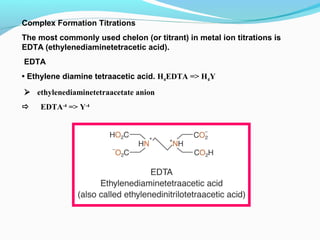
Complex Formation Titrations
The most commonly used chelon (or titrant) in metal ion titrations is
EDTA (ethylenediaminetetracetic acid).
EDTA
• Ethylene diamine tetraacetic acid. H4EDTA => H4Y
 ethylenediaminetetraacetate anion
 EDTA-4
=> Y-4
EDTA is hexadentate, donating one electron pair from each of the two
amine group and one electron pair from each of the four carboxylates
to the bound metal ion.
• Virtually every element in the periodic table can be determined by
titrating with EDTA.
• EDTA forms a "cage" around metal ions, like a spider grasping a fly.
• Note that only the fully ionized, -4-charged anion binds to metal ions.
• Competition of the metal ion with protons dictates that the solution
must be well buffered.
• EDTA is used as a titrant for the determination of water hardness.
•EDTA is a tetraprotic acid,
Standard solutions of EDTA are usually prepared by dissolving the
Na2
H2
Y.
2H2
O in a volumetric flask. (Note: Most Na2
H2
Y.
2H2
O at normal,
atmospheric conditions comes with 0.3% excess water in the crystal.
The excess water must be taken into account when preparing standard
solutions.)
Colorimetric indicators
 • Also known as metallochromic indicators.
 • The color change occurs when the metal ion is bound with
the indicator.
 • This binding is pH dependent.
 • Masking agents are often used for complexometric
titrations, which allow for the removal of interferents.
Metal Ion Indicators
• Over 200 organic compounds form colored chelates with
ions in a pM range that is unique to the cation and the dye
selected.
 • To be useful, the dye-metal chelates usually will be
visible at 10-6
-10-7
M concentration.
 The dye is selected such that the color change corresponds to
the pM at equivalence.
Examples:
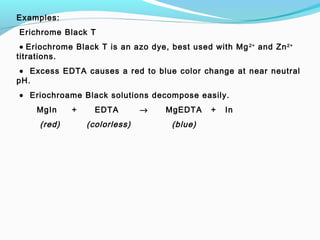
 Erichrome Black T
 • Eriochrome Black T is an azo dye, best used with Mg2+
and Zn2+
titrations.
 • Excess EDTA causes a red to blue color change at near neutral
pH.
 • Eriochroame Black solutions decompose easily.
MgIn + EDTA → MgEDTA + In
(red) (colorless) (blue)
 
N
OH
O2N
SO3H
N
OH
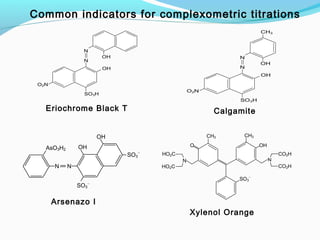
Common indicators for complexometric titrations
Eriochrome Black T
N
OH
O2N
SO3H
N
OH
CH3
Calgamite
N N
SO3
−
AsO3H2 OH
OH
SO3
−
Arsenazo I
N
O
N
SO3
−
CH3
OH
CO2H
CO2H
CH3
HO2C
HO2C
Xylenol Orange
[ ]
[ ] [ ]-4
4)-(n
MY
YM
MY
K
+
=
EDTA Titration
EDTA combined with the metal ion (1 : 1) to form complex.
 
For a +1 cation: Ag+
+ Y4−
→ Ag Y3−
 For a +2 cation: Hg2+
+ Y4−
→ Hg Y2−
 For a +3 cation: Fe3+
+ Y4−
→ Fe Y−
 For a + n ion: Mn+
+ Y4−
→ MY(n – 4)+
 
The Formation Constant,
EDTA Titration Techniques
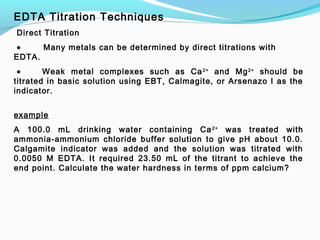
 Direct Titration
 • Many metals can be determined by direct titrations with
EDTA.
 • Weak metal complexes such as Ca2+
and Mg2+
should be
titrated in basic solution using EBT, Calmagite, or Arsenazo I as the
indicator.
 
example
A 100.0 mL drinking water containing Ca2+
was treated with
ammonia-ammonium chloride buffer solution to give pH about 10.0.
Calgamite indicator was added and the solution was titrated with
0.0050 M EDTA. It required 23.50 mL of the titrant to achieve the
end point. Calculate the water hardness in terms of ppm calcium?
EDTA Titration Techniques
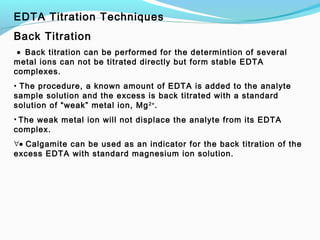
Back Titration
 • Back titration can be performed for the determintion of several
metal ions can not be titrated directly but form stable EDTA
complexes.
• The procedure, a known amount of EDTA is added to the analyte
sample solution and the excess is back titrated with a standard
solution of “weak” metal ion, Mg2+
.
• The weak metal ion will not displace the analyte from its EDTA
complex.
∀• Calgamite can be used as an indicator for the back titration of the
excess EDTA with standard magnesium ion solution.
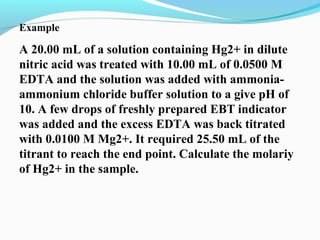
Example
A 20.00 mL of a solution containing Hg2+ in dilute
nitric acid was treated with 10.00 mL of 0.0500 M
EDTA and the solution was added with ammonia-
ammonium chloride buffer solution to a give pH of
10. A few drops of freshly prepared EBT indicator
was added and the excess EDTA was back titrated
with 0.0100 M Mg2+. It required 25.50 mL of the
titrant to reach the end point. Calculate the molariy
of Hg2+ in the sample.
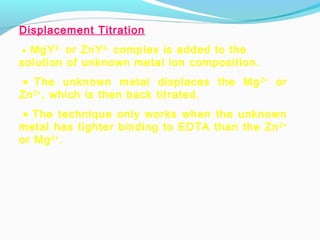
Displacement Titration
 • MgY2-
or ZnY2-
complex is added to the
solution of unknown metal ion composition.
 • The unknown metal displaces the Mg2+
or
Zn2+
, which is then back titrated.
 • The technique only works when the unknown
metal has tighter binding to EDTA than the Zn2+
or Mg2+
.
Thanks all

Complexometric titrations

  • 1.
    Md : ObydullaAl Mamun Id:131-29-500 9th(B) Department Of Pharmacy Daffodil International University almamundcc94@gmail.com
  • 2.
    Complexometric titrationsComplexometric titrations Complexometry  •A titration based on the formation of a coordination complex is known as a complexometric titration.     Complex formation titrations are used to titrate cations via complex formation reagents.    Most, if not all, metals form coordination complexes with anions or molecules. For example, Fe2+ + 6 CN1- Fe(CN)6 4-  Molecules/anions that react with metal ions must donate an unshared pair of electrons to form a coordinate covalent bond • Molecules composed of metals and chelates or metals and coordinating agents are known as coordination complexes. • Chelating agents form strong 1:1 complexes with metal ions. • Most common chelating agents belong to a group of compounds called polyaminocarboxylic acids. 
  • 3.
    The complex canform only when… 1. The central atom (a metal ion (or cation) in a complex) accepts an electron pair from one or more ligands (ligand = electron-pair donating species). 2. The ligand possesses at least one electron pair to donate. 3. The bonding (coordinate covalent bonding) occurs . A number of common anionic and molecular ligands can form complexes: 1. Anionic ligands include halides, SCN1- , CN1- , OH1- , RCOO1- , S2- , C2 O4 2- (oxalate), etc. 2. Molecular ligands include water, ammonia, RNH2 (amines) C5 H5 N (pyridine) H2 NCH2 CH2 NH2 (ethlenediamine), etc. 
  • 4.
    Ligands that have(or share) only one electron pair are called unidentate. 1. "Dentate" = a tooth-like projection. 2. For example, ammonia is unidentate...     Cu2+ + 4 NH3 Cu(NH3 )4 2+ Bidentate ligands share two electron pairs. Examples: 1. Glycine complexed with copper(II). 2. Ethylenediamine complexed with zinc ion. Multidentate ligands complexed to metal ions are called chelates. Chelates always have a "chelate ring." For example, the zinc-8-hydroxyquinolate complex. 
  • 5.
    Complex Formation Titrations Themost commonly used chelon (or titrant) in metal ion titrations is EDTA (ethylenediaminetetracetic acid). EDTA • Ethylene diamine tetraacetic acid. H4EDTA => H4Y  ethylenediaminetetraacetate anion  EDTA-4 => Y-4
  • 6.
    EDTA is hexadentate,donating one electron pair from each of the two amine group and one electron pair from each of the four carboxylates to the bound metal ion. • Virtually every element in the periodic table can be determined by titrating with EDTA. • EDTA forms a "cage" around metal ions, like a spider grasping a fly. • Note that only the fully ionized, -4-charged anion binds to metal ions. • Competition of the metal ion with protons dictates that the solution must be well buffered. • EDTA is used as a titrant for the determination of water hardness. •EDTA is a tetraprotic acid, Standard solutions of EDTA are usually prepared by dissolving the Na2 H2 Y. 2H2 O in a volumetric flask. (Note: Most Na2 H2 Y. 2H2 O at normal, atmospheric conditions comes with 0.3% excess water in the crystal. The excess water must be taken into account when preparing standard solutions.)
  • 7.
    Colorimetric indicators  • Alsoknown as metallochromic indicators.  • The color change occurs when the metal ion is bound with the indicator.  • This binding is pH dependent.  • Masking agents are often used for complexometric titrations, which allow for the removal of interferents. Metal Ion Indicators • Over 200 organic compounds form colored chelates with ions in a pM range that is unique to the cation and the dye selected.  • To be useful, the dye-metal chelates usually will be visible at 10-6 -10-7 M concentration.  The dye is selected such that the color change corresponds to the pM at equivalence.
  • 8.
    Examples:  Erichrome Black T  •Eriochrome Black T is an azo dye, best used with Mg2+ and Zn2+ titrations.  • Excess EDTA causes a red to blue color change at near neutral pH.  • Eriochroame Black solutions decompose easily. MgIn + EDTA → MgEDTA + In (red) (colorless) (blue)  
  • 9.
    N OH O2N SO3H N OH Common indicators forcomplexometric titrations Eriochrome Black T N OH O2N SO3H N OH CH3 Calgamite N N SO3 − AsO3H2 OH OH SO3 − Arsenazo I N O N SO3 − CH3 OH CO2H CO2H CH3 HO2C HO2C Xylenol Orange
  • 10.
    [ ] [ ][ ]-4 4)-(n MY YM MY K + = EDTA Titration EDTA combined with the metal ion (1 : 1) to form complex.   For a +1 cation: Ag+ + Y4− → Ag Y3−  For a +2 cation: Hg2+ + Y4− → Hg Y2−  For a +3 cation: Fe3+ + Y4− → Fe Y−  For a + n ion: Mn+ + Y4− → MY(n – 4)+   The Formation Constant,
  • 11.
    EDTA Titration Techniques  DirectTitration  • Many metals can be determined by direct titrations with EDTA.  • Weak metal complexes such as Ca2+ and Mg2+ should be titrated in basic solution using EBT, Calmagite, or Arsenazo I as the indicator.   example A 100.0 mL drinking water containing Ca2+ was treated with ammonia-ammonium chloride buffer solution to give pH about 10.0. Calgamite indicator was added and the solution was titrated with 0.0050 M EDTA. It required 23.50 mL of the titrant to achieve the end point. Calculate the water hardness in terms of ppm calcium?
  • 12.
    EDTA Titration Techniques BackTitration  • Back titration can be performed for the determintion of several metal ions can not be titrated directly but form stable EDTA complexes. • The procedure, a known amount of EDTA is added to the analyte sample solution and the excess is back titrated with a standard solution of “weak” metal ion, Mg2+ . • The weak metal ion will not displace the analyte from its EDTA complex. ∀• Calgamite can be used as an indicator for the back titration of the excess EDTA with standard magnesium ion solution.
  • 13.
    Example A 20.00 mLof a solution containing Hg2+ in dilute nitric acid was treated with 10.00 mL of 0.0500 M EDTA and the solution was added with ammonia- ammonium chloride buffer solution to a give pH of 10. A few drops of freshly prepared EBT indicator was added and the excess EDTA was back titrated with 0.0100 M Mg2+. It required 25.50 mL of the titrant to reach the end point. Calculate the molariy of Hg2+ in the sample.
  • 14.
    Displacement Titration  • MgY2- orZnY2- complex is added to the solution of unknown metal ion composition.  • The unknown metal displaces the Mg2+ or Zn2+ , which is then back titrated.  • The technique only works when the unknown metal has tighter binding to EDTA than the Zn2+ or Mg2+ .
  • 15.