Non-Aqueous Titration
BY- SANCHIT DHANKHAR
1
Non-aqueous acid base titrimetry
Non- aqueous titrations are those in which the
titrations of too weakly acidic or basic
substances are carried out using non-aqueous
solvents so as to get sharp end point.
Such titrations can also be used for the titration
of the substances not soluble in water.
The speed, precision and accuracy of the non-
aqueous method are close to those of classical
acidimetric and alkalimetric titrations.
Non-aqueous titrimetry
First reported successful quantitative titration
of organic acid and base in non-aqueous
solvent: 1910.
To an understanding of non-aqueous acid
base titrimetry the theories of acid and base is
very important. The theories are:
- Arrhenius acids and bases
- Bronsted-Lowry acids and bases
- Lewis acids and bases
Arrhenius acids and bases
Acids are hydrogen containing compounds
that dissociates to yield hydrogen ions (H+)
when dissolved in water.
Bases are compounds that dissociates to
yield hydroxide/hydroxyl ions (OH-) when
dissolved in water.
Arrhenius acids and bases
It has two major limitations.
First, it was limited to water, or aqueous,
solutions.
Second, it practically limited acids and bases to
ionic compounds that contained the H+ ion or
the OH- ion.
Drawbacks:
- Acids or bases must be dissociated or ionized
- Didn’t explain, why CH4 contains H but not an
acid?
- Na2CO3 is basic but unable to donate OH-
Bronsted-Lowry theory
The Bronsted-Lowry theory of acid and base
can be applied to reactions occurring during
acid base titrations in non-aqueous solvents.
Acid: any substance, charged or uncharged
which can donate proton.
Base: any substance, charged or uncharged
which can accept a proton.
Acid: HA  H+ + A-
Base: B + H+  BH+
An acid ‘HA’ dissociates to give a proton H+ and
its conjugate base A-.
A base ‘B’ unite with a proton to produce its
conjugate acid BH+.
Every base has its conjugate acid, just as an
acid has its conjugate base.
According to this theory, an acid may be an
electrically neutral molecule (HCl), a positively
charged cation (C5H5NH+), or a negatively
charged anion (H2PO4
-).
A base may be an electrically neutral molecule
(C5H5N) or an anion (Cl-).
8
Lewis acids and bases
The third theory of acids and bases was
proposed by Gilbert Lewis.
Lewis focused on the donation or acceptance
of a pair of electrons during a reaction.
This concept is more general than either the
Arrhenius theory or the Bronsted-Lowry theory.
A Lewis acid is a substance that can accept a
pair of electrons to form a covalent bond.
A Lewis base is a substance that can donate
a pair of electrons to form a covalent bond.
A hydrogen ion (Bronsted-Lowry acid) can
accept a pair of electrons in forming a bond. A
hydrogen ion, therefore, is also a Lewis acid.
A Bronsted-Lowry base, or a substance that
accepts a hydrogen ion, must have a pair of
electrons available and is also a Lewis base.
An acid can only exhibit its acidic properties
in the presence of base; conversely a base can
only function as such in the presence of an
acid.
The relative strengths of acids and bases are
measured by the tendencies of these
substances to give up or take on protons.
HCl is strong acid in water because it gives
up its proton readily, where as acetic acid is
weak acid since it relinquishes its proton to a
small extent only.
Strength of acids and bases
Ionization of acids is less in an acidic solvent
than in water. For example, hydrogen chloride
is a weak acid when dissolved in acetic acid.
This is because acetic acid is a much weaker
base than water.
Compare this reaction with what happens
when acetic acid is dissolved in the more acidic
solvent like pure sulfuric acid.
The strength of an acid or base varies with
the solvent or environment.
HCl behaves as a weak acid in glacial acetic
acid whereas acetic acid is a strong acid in
liquid ammonia.
Consequently, the strength of an acid
depends not only on its own ability to release a
proton, but also on the ability of the solvent to
take up proton from acid.
Solvents
The ability of substances to act as acids &
bases will depend very much upon the nature
of the solvent system which is employed.
Non-aqueous solvents are classified into the
4 groups:
- Protophilic solvents
- Protogenic solvents
- Amphiprotic solvents
- Aprotic solvents
Protophilic solvents
Possess high affinity for proton
Weak acids are normally used as solute
Strong protophilic solvents convert weak acid
to strong acid-known as ’leveling effect’
Example: Liquid ammonia, amines, ether
and ketones
HA + S  SH+ + A-
Weak Acid
(appeared as
strong acid)
Basic
solvent
Solvated
proton
Conjugated
base of acid
Weak acids are normally used in the
presence of strongly protophilic solvents as
their acidic strengths are then enhanced and
then become comparable to these of strong
acids; this is known as the leveling effect.
16
Protogenic solvents
Acidic in nature
Readily donates protons
Strong protogenic solvents increase the
strength of weak bases
Such solvents exert a leveling effect on all
bases dissolved in them
Example: Anhydrous acid like hydrogen
fluoride & sulfuric acid
B + H+  BH+
Weak Base
(appeared as strong
base)
From
solvent
Conjugated
acid of base
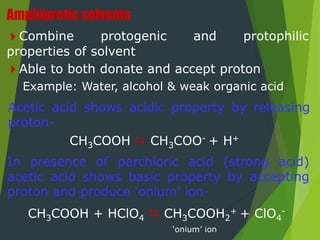
Amphiprotic solvents
Combine protogenic and protophilic
properties of solvent
Able to both donate and accept proton
Example: Water, alcohol & weak organic acid
Acetic acid shows acidic property by releasing
proton-
CH3COOH  CH3COO- + H+
In presence of perchloric acid (strong acid)
acetic acid shows basic property by accepting
proton and produce ‘onium’ ion-
CH3COOH + HClO4  CH3COOH2
+ + ClO4
-
‘onium’ ion
Aprotic solvents
Chemically neutral substances
Virtually un-reactive
Do not cause ionization of solute
No reactions with acids and bases
Used to dilute reaction mixture
Example: Carbon tetrachloride, benzene,
tolune.
In such a solution then, the actual titrating
species is the ion CH3COOH2
+ which readily
donates its proton to a base.
Theory of non-aqueous acid base titration
Water behaves both as a weak acid and a
weak base thus in an aqueous environment it
can compete effectively with very weak acids
and weak bases with regard to proton donation
and acceptance.
H2O + H+  H3O+ Compete with
RNH2 + H+  RNH3
+
H2O + B  OH- + BH+ Compete with
ROH + B  RO- + BH+
Base
Acid
The effect of this is that the inflection in the
titration curves for very weak acids and very
weak bases is small, thus making end-point
detection more difficult.
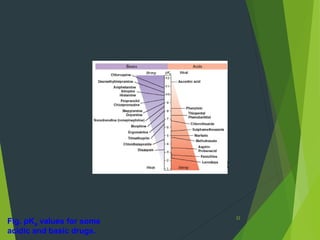
A general rule is that bases with pKa<7
(morphine, diazepam) or acids with pKa>7
(ascorbic acid, phenytoin) cannot be determine
accurately in aqueous solution.
Various organic solvents may be used to
replace the water since they compete less
effectively with the analyte for proton donation
and acceptance.
Fig. pKa values for some
acidic and basic drugs.
22
Phenol (pKa= 9.9, Solubility in water:
8.3g/100ml at 20°C) , for example, cannot be
titrated as an acid in aqueous solution because
water is too acidic and present in too high a
concentration to permit the phenolate ion to be
formed by titration with the hydroxide ion.
Non-aqueous solvents also improve the
solubility of many organic compounds. Many
organic acids will dissolve more readily in
methanol.
 H+
+
Titration in non-aqueous solvents: Advantages
1. Weak acids and weak bases give poor end
point during titration in aqueous solutions. Far
more satisfactory end point found when
titrations are carried out in non-aqueous media.
2. Many compounds are insoluble in water
and soluble in organic solvent, thus permit their
titration in non-aqueous media.
Non-aqueous titration of weak acids:
Titrants:
There are several titrant available for the
titration of acids:
- Methoxides of the alkali metals (CH3ONa)
- Potassium hydroxide in methanol (KOH+CH3OH)
- Tetrabutyl ammonium hydroxide [CH3(CH2)3]4NOH
Methoxides of the alkali metals:
- These are most commonly used.
- They are prepared by dissolving the
appropriate amount of alkali metal (Na, K, Li)
in a mixture of benzene and methanol.
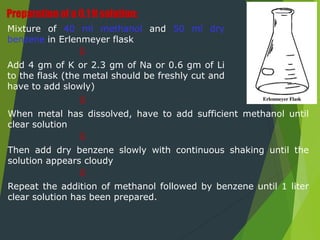
Preparation of a 0.1 N solution:

When metal has dissolved, have to add sufficient methanol until
clear solution

Then add dry benzene slowly with continuous shaking until the
solution appears cloudy

Repeat the addition of methanol followed by benzene until 1 liter
clear solution has been prepared.
Mixture of 40 ml methanol and 50 ml dry
benzene in Erlenmeyer flask

Add 4 gm of K or 2.3 gm of Na or 0.6 gm of Li
to the flask (the metal should be freshly cut and
have to add slowly)
1. Minimum amount of methanol have to use
to ensure clear solution.
2. Have to store in sodium free glass.
3.Have to protect it from atmospheric CO2.
Precaution:
Titrants are usually standardized by using
reference standard- benzoic acid.
0.5% thymol blue in anhydrous methanol
used as indicator.
Dimethylformamide used as solvent for the
titration.
Standardization:
Burettes:
1. Titrant must be protected
from atmosphere to obtain
highest degree of precisions. It
is preferable to store the
titrant in a burette with a
reservoir sufficiently large to
contain 1 liter.
2. The reservoir is flushed
out with nitrogen and a layer
of nitrogen is laid over the
titrant.
3. Teflon stopcocks can be
used.
Apparatus:
Fig: Apparatus for the titration
of weak acids
Burette
28
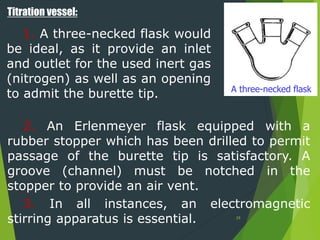
Titration vessel:
1. A three-necked flask would
be ideal, as it provide an inlet
and outlet for the used inert gas
(nitrogen) as well as an opening
to admit the burette tip. A three-necked flask
2. An Erlenmeyer flask equipped with a
rubber stopper which has been drilled to permit
passage of the burette tip is satisfactory. A
groove (channel) must be notched in the
stopper to provide an air vent.
3. In all instances, an electromagnetic
stirring apparatus is essential. 29
Solvents:
The solvents (protophilic solvents) most
commonly employed in the titration of weak
acids are-
Dimethylformamide O=CH-N(CH)3
n-butylamine
Pyridine
Ethylenediamine H2N-CH2-CH2-NH2
Acetone
Morpholine
30
Practical example:
The titration of benzoic acid in n-butylamine by
sodium methoxide.
C6H5COOH + CH3(CH2)3NH2  CH3(CH2)3NH3 + C6H5COO-
+
CH3(CH2)3NH3 + CH3O-  CH3OH + CH3(CH2)3NH2
+
C6H5COOH + CH3O-  CH3OH + C6H5COO-
The titration is performed by the direct
withdrawal of the proton from the benzoic acid
by the methoxide.
31
Non-aqueous titration of weak bases
Titrants:
Solutions of perchloric acid (HClO4) in either
glacial acetic acid (CH3COOH) or dioxane are
used almost exclusively for the titration of
bases in non-aqueous titrimetry.
In glacial acetic acid, the titrating species will
be onium ion.
CH3COOH + HClO4  CH3COOH2
+ + ClO4
-
‘onium’ ion
O
O
HClO4
+
O
O
ClO4
+
-
H
+
Dioxane Mono-protonated dioxane
The usual concentration of titrant used is
0.1N to 0.05N. It may be diluted one (0.001N)
In dioxane, the titrating species will be mono-
or diprotonated dioxane.
33
Apparatus:
Burettes:
Having teflon stopcock are most suitable.
Necessity of lubricating the teflon stopcock is
eliminated.
Capacity of burette may be from 1ml to
10ml.
Titration vessels:
It is not essential to protect the titration
from environment.
So Erlenmeyer flasks or beakers may be
used.
Solvents:
Glacial acetic acid alone, or
Glacial acetic acid combined with aprotic
solvent is commonly used.
Aprotic solvents commonly used are
chloroform, benzene.
Practical example:
 Titration of ephedrine alkaloid in glacial
acetic acid by acetous perchloric acid.
 Titration of ephedrine alkaloid by the
solutions of perchloric acid (HClO4) in dioxane.
Here aprotic solvents are used as solvent.
See reactions and description
Ref: Pharmaceutical chemistry by Chatten, Volume 1, pp 236-237
OH
N
H CH3
Ephedrine pKa = 9.6
36
THANKYOU
37

Non aqueous titration- Pharmaceutical Analysis

  • 1.
  • 2.
    Non-aqueous acid basetitrimetry Non- aqueous titrations are those in which the titrations of too weakly acidic or basic substances are carried out using non-aqueous solvents so as to get sharp end point. Such titrations can also be used for the titration of the substances not soluble in water. The speed, precision and accuracy of the non- aqueous method are close to those of classical acidimetric and alkalimetric titrations.
  • 3.
    Non-aqueous titrimetry First reportedsuccessful quantitative titration of organic acid and base in non-aqueous solvent: 1910. To an understanding of non-aqueous acid base titrimetry the theories of acid and base is very important. The theories are: - Arrhenius acids and bases - Bronsted-Lowry acids and bases - Lewis acids and bases
  • 4.
    Arrhenius acids andbases Acids are hydrogen containing compounds that dissociates to yield hydrogen ions (H+) when dissolved in water. Bases are compounds that dissociates to yield hydroxide/hydroxyl ions (OH-) when dissolved in water.
  • 5.
    Arrhenius acids andbases It has two major limitations. First, it was limited to water, or aqueous, solutions. Second, it practically limited acids and bases to ionic compounds that contained the H+ ion or the OH- ion. Drawbacks: - Acids or bases must be dissociated or ionized - Didn’t explain, why CH4 contains H but not an acid? - Na2CO3 is basic but unable to donate OH-
  • 6.
    Bronsted-Lowry theory The Bronsted-Lowrytheory of acid and base can be applied to reactions occurring during acid base titrations in non-aqueous solvents. Acid: any substance, charged or uncharged which can donate proton. Base: any substance, charged or uncharged which can accept a proton.
  • 7.
    Acid: HA H+ + A- Base: B + H+  BH+ An acid ‘HA’ dissociates to give a proton H+ and its conjugate base A-. A base ‘B’ unite with a proton to produce its conjugate acid BH+. Every base has its conjugate acid, just as an acid has its conjugate base.
  • 8.
    According to thistheory, an acid may be an electrically neutral molecule (HCl), a positively charged cation (C5H5NH+), or a negatively charged anion (H2PO4 -). A base may be an electrically neutral molecule (C5H5N) or an anion (Cl-). 8
  • 9.
    Lewis acids andbases The third theory of acids and bases was proposed by Gilbert Lewis. Lewis focused on the donation or acceptance of a pair of electrons during a reaction. This concept is more general than either the Arrhenius theory or the Bronsted-Lowry theory.
  • 10.
    A Lewis acidis a substance that can accept a pair of electrons to form a covalent bond. A Lewis base is a substance that can donate a pair of electrons to form a covalent bond. A hydrogen ion (Bronsted-Lowry acid) can accept a pair of electrons in forming a bond. A hydrogen ion, therefore, is also a Lewis acid. A Bronsted-Lowry base, or a substance that accepts a hydrogen ion, must have a pair of electrons available and is also a Lewis base.
  • 11.
    An acid canonly exhibit its acidic properties in the presence of base; conversely a base can only function as such in the presence of an acid. The relative strengths of acids and bases are measured by the tendencies of these substances to give up or take on protons. HCl is strong acid in water because it gives up its proton readily, where as acetic acid is weak acid since it relinquishes its proton to a small extent only. Strength of acids and bases
  • 12.
    Ionization of acidsis less in an acidic solvent than in water. For example, hydrogen chloride is a weak acid when dissolved in acetic acid. This is because acetic acid is a much weaker base than water. Compare this reaction with what happens when acetic acid is dissolved in the more acidic solvent like pure sulfuric acid.
  • 13.
    The strength ofan acid or base varies with the solvent or environment. HCl behaves as a weak acid in glacial acetic acid whereas acetic acid is a strong acid in liquid ammonia. Consequently, the strength of an acid depends not only on its own ability to release a proton, but also on the ability of the solvent to take up proton from acid.
  • 14.
    Solvents The ability ofsubstances to act as acids & bases will depend very much upon the nature of the solvent system which is employed. Non-aqueous solvents are classified into the 4 groups: - Protophilic solvents - Protogenic solvents - Amphiprotic solvents - Aprotic solvents
  • 15.
    Protophilic solvents Possess highaffinity for proton Weak acids are normally used as solute Strong protophilic solvents convert weak acid to strong acid-known as ’leveling effect’ Example: Liquid ammonia, amines, ether and ketones HA + S  SH+ + A- Weak Acid (appeared as strong acid) Basic solvent Solvated proton Conjugated base of acid
  • 16.
    Weak acids arenormally used in the presence of strongly protophilic solvents as their acidic strengths are then enhanced and then become comparable to these of strong acids; this is known as the leveling effect. 16
  • 17.
    Protogenic solvents Acidic innature Readily donates protons Strong protogenic solvents increase the strength of weak bases Such solvents exert a leveling effect on all bases dissolved in them Example: Anhydrous acid like hydrogen fluoride & sulfuric acid B + H+  BH+ Weak Base (appeared as strong base) From solvent Conjugated acid of base
  • 18.
    Amphiprotic solvents Combine protogenicand protophilic properties of solvent Able to both donate and accept proton Example: Water, alcohol & weak organic acid Acetic acid shows acidic property by releasing proton- CH3COOH  CH3COO- + H+ In presence of perchloric acid (strong acid) acetic acid shows basic property by accepting proton and produce ‘onium’ ion- CH3COOH + HClO4  CH3COOH2 + + ClO4 - ‘onium’ ion
  • 19.
    Aprotic solvents Chemically neutralsubstances Virtually un-reactive Do not cause ionization of solute No reactions with acids and bases Used to dilute reaction mixture Example: Carbon tetrachloride, benzene, tolune. In such a solution then, the actual titrating species is the ion CH3COOH2 + which readily donates its proton to a base.
  • 20.
    Theory of non-aqueousacid base titration Water behaves both as a weak acid and a weak base thus in an aqueous environment it can compete effectively with very weak acids and weak bases with regard to proton donation and acceptance. H2O + H+  H3O+ Compete with RNH2 + H+  RNH3 + H2O + B  OH- + BH+ Compete with ROH + B  RO- + BH+ Base Acid
  • 21.
    The effect ofthis is that the inflection in the titration curves for very weak acids and very weak bases is small, thus making end-point detection more difficult. A general rule is that bases with pKa<7 (morphine, diazepam) or acids with pKa>7 (ascorbic acid, phenytoin) cannot be determine accurately in aqueous solution. Various organic solvents may be used to replace the water since they compete less effectively with the analyte for proton donation and acceptance.
  • 22.
    Fig. pKa valuesfor some acidic and basic drugs. 22
  • 23.
    Phenol (pKa= 9.9,Solubility in water: 8.3g/100ml at 20°C) , for example, cannot be titrated as an acid in aqueous solution because water is too acidic and present in too high a concentration to permit the phenolate ion to be formed by titration with the hydroxide ion. Non-aqueous solvents also improve the solubility of many organic compounds. Many organic acids will dissolve more readily in methanol.  H+ +
  • 24.
    Titration in non-aqueoussolvents: Advantages 1. Weak acids and weak bases give poor end point during titration in aqueous solutions. Far more satisfactory end point found when titrations are carried out in non-aqueous media. 2. Many compounds are insoluble in water and soluble in organic solvent, thus permit their titration in non-aqueous media.
  • 25.
    Non-aqueous titration ofweak acids: Titrants: There are several titrant available for the titration of acids: - Methoxides of the alkali metals (CH3ONa) - Potassium hydroxide in methanol (KOH+CH3OH) - Tetrabutyl ammonium hydroxide [CH3(CH2)3]4NOH Methoxides of the alkali metals: - These are most commonly used. - They are prepared by dissolving the appropriate amount of alkali metal (Na, K, Li) in a mixture of benzene and methanol.
  • 26.
    Preparation of a0.1 N solution:  When metal has dissolved, have to add sufficient methanol until clear solution  Then add dry benzene slowly with continuous shaking until the solution appears cloudy  Repeat the addition of methanol followed by benzene until 1 liter clear solution has been prepared. Mixture of 40 ml methanol and 50 ml dry benzene in Erlenmeyer flask  Add 4 gm of K or 2.3 gm of Na or 0.6 gm of Li to the flask (the metal should be freshly cut and have to add slowly)
  • 27.
    1. Minimum amountof methanol have to use to ensure clear solution. 2. Have to store in sodium free glass. 3.Have to protect it from atmospheric CO2. Precaution: Titrants are usually standardized by using reference standard- benzoic acid. 0.5% thymol blue in anhydrous methanol used as indicator. Dimethylformamide used as solvent for the titration. Standardization:
  • 28.
    Burettes: 1. Titrant mustbe protected from atmosphere to obtain highest degree of precisions. It is preferable to store the titrant in a burette with a reservoir sufficiently large to contain 1 liter. 2. The reservoir is flushed out with nitrogen and a layer of nitrogen is laid over the titrant. 3. Teflon stopcocks can be used. Apparatus: Fig: Apparatus for the titration of weak acids Burette 28
  • 29.
    Titration vessel: 1. Athree-necked flask would be ideal, as it provide an inlet and outlet for the used inert gas (nitrogen) as well as an opening to admit the burette tip. A three-necked flask 2. An Erlenmeyer flask equipped with a rubber stopper which has been drilled to permit passage of the burette tip is satisfactory. A groove (channel) must be notched in the stopper to provide an air vent. 3. In all instances, an electromagnetic stirring apparatus is essential. 29
  • 30.
    Solvents: The solvents (protophilicsolvents) most commonly employed in the titration of weak acids are- Dimethylformamide O=CH-N(CH)3 n-butylamine Pyridine Ethylenediamine H2N-CH2-CH2-NH2 Acetone Morpholine 30
  • 31.
    Practical example: The titrationof benzoic acid in n-butylamine by sodium methoxide. C6H5COOH + CH3(CH2)3NH2  CH3(CH2)3NH3 + C6H5COO- + CH3(CH2)3NH3 + CH3O-  CH3OH + CH3(CH2)3NH2 + C6H5COOH + CH3O-  CH3OH + C6H5COO- The titration is performed by the direct withdrawal of the proton from the benzoic acid by the methoxide. 31
  • 32.
    Non-aqueous titration ofweak bases Titrants: Solutions of perchloric acid (HClO4) in either glacial acetic acid (CH3COOH) or dioxane are used almost exclusively for the titration of bases in non-aqueous titrimetry. In glacial acetic acid, the titrating species will be onium ion. CH3COOH + HClO4  CH3COOH2 + + ClO4 - ‘onium’ ion
  • 33.
    O O HClO4 + O O ClO4 + - H + Dioxane Mono-protonated dioxane Theusual concentration of titrant used is 0.1N to 0.05N. It may be diluted one (0.001N) In dioxane, the titrating species will be mono- or diprotonated dioxane. 33
  • 34.
    Apparatus: Burettes: Having teflon stopcockare most suitable. Necessity of lubricating the teflon stopcock is eliminated. Capacity of burette may be from 1ml to 10ml. Titration vessels: It is not essential to protect the titration from environment. So Erlenmeyer flasks or beakers may be used.
  • 35.
    Solvents: Glacial acetic acidalone, or Glacial acetic acid combined with aprotic solvent is commonly used. Aprotic solvents commonly used are chloroform, benzene.
  • 36.
    Practical example:  Titrationof ephedrine alkaloid in glacial acetic acid by acetous perchloric acid.  Titration of ephedrine alkaloid by the solutions of perchloric acid (HClO4) in dioxane. Here aprotic solvents are used as solvent. See reactions and description Ref: Pharmaceutical chemistry by Chatten, Volume 1, pp 236-237 OH N H CH3 Ephedrine pKa = 9.6 36
  • 37.

Editor's Notes