
1
NON AQUEOUES TITRATION
BY
Dr. Suman Pattanayak
Associate Professor
Department of Pharma Analysis & QA.
Vijaya Institute of Pharmaceutical Sciences for Women
M. Pharm/ I Sem
Advance Pharmaceutical Analysis
CONTENT
 Introduction
 Types Of Solvents
1. Aprotic solvents
2. Protophilic solvents
3. Protogenic solvents
4. Amphiprotic solvents
 Non Aqueous Titration Of Weak Acids
 Non Aqueous Titration Of Weak Bases
INTRODUCTION
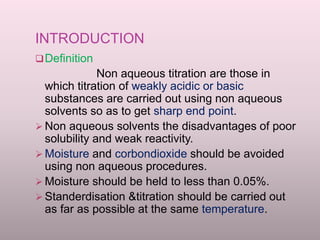
Definition
Non aqueous titration are those in
which titration of weakly acidic or basic
substances are carried out using non aqueous
solvents so as to get sharp end point.
 Non aqueous solvents the disadvantages of poor
solubility and weak reactivity.
 Moisture and corbondioxide should be avoided
using non aqueous procedures.
 Moisture should be held to less than 0.05%.
 Standerdisation &titration should be carried out
as far as possible at the same temperature.
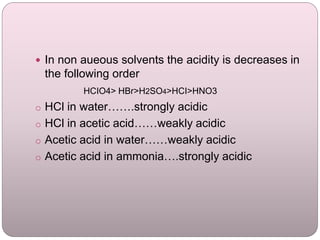
 In non aueous solvents the acidity is decreases in
the following order
HCIO4> HBr>H2SO4>HCI>HNO3
o HCl in water…….strongly acidic
o HCl in acetic acid……weakly acidic
o Acetic acid in water……weakly acidic
o Acetic acid in ammonia….strongly acidic
Types of solvents
The solvents are divided into 4 groups
1. Aprotic solvents
2. Protophilic solvents
3. Protogenic solvents
4. Amphiprotic solvents
Aprotic solvents(inert solvents)
 Aprotic solvents are neutral, chemically inert
substances such as benzene and chloroform.
 They have a low dielectric constant, do not react
with either acids or bases and therefore do not
favor ionization.
 The picric acid gives a colorless solution in
benzene or toluene which becomes yellow on
adding aniline shows that picric acid is not
dissociated in benzene or toluene solution.
 This type of solvents neither accept or donate
protons
Ex:-Benzene , dioxan ,
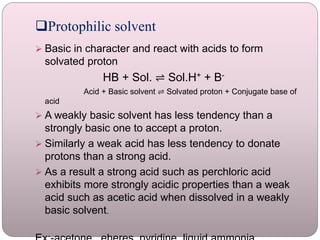
Protophilic solvent
 Basic in character and react with acids to form
solvated proton
HB + Sol. ⇌ Sol.H+ + B-
Acid + Basic solvent ⇌ Solvated proton + Conjugate base of
acid
 A weakly basic solvent has less tendency than a
strongly basic one to accept a proton.
 Similarly a weak acid has less tendency to donate
protons than a strong acid.
 As a result a strong acid such as perchloric acid
exhibits more strongly acidic properties than a weak
acid such as acetic acid when dissolved in a weakly
basic solvent.
Protogenic solvents
 Acidic in nature and donte protons
 Ex:- sulphuric acid , formic acid, propionoic acid
,acetic anhydride etc.
 They have high dielectric constant and ionised
 Because of their strength and ability to donate
protons.
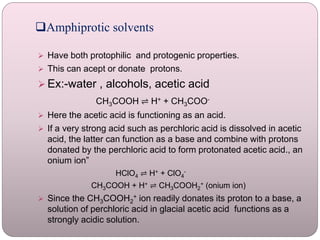
Amphiprotic solvents
 Have both protophilic and protogenic properties.
 This can acept or donate protons.
 Ex:-water , alcohols, acetic acid
CH3COOH ⇌ H+ + CH3COO-
 Here the acetic acid is functioning as an acid.
 If a very strong acid such as perchloric acid is dissolved in acetic
acid, the latter can function as a base and combine with protons
donated by the perchloric acid to form protonated acetic acid., an
onium ion”
HClO4 ⇌ H+ + ClO4
-
CH3COOH + H+ ⇌ CH3COOH2
+ (onium ion)
 Since the CH3COOH2
+ ion readily donates its proton to a base, a
solution of perchloric acid in glacial acetic acid functions as a
strongly acidic solution.
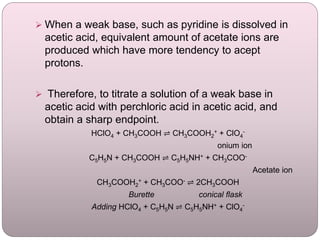
 When a weak base, such as pyridine is dissolved in
acetic acid, equivalent amount of acetate ions are
produced which have more tendency to acept
protons.
 Therefore, to titrate a solution of a weak base in
acetic acid with perchloric acid in acetic acid, and
obtain a sharp endpoint.
HClO4 + CH3COOH ⇌ CH3COOH2
+ + ClO4
-
onium ion
C5H5N + CH3COOH ⇌ C5H5NH+ + CH3COO-
Acetate ion
CH3COOH2
+ + CH3COO- ⇌ 2CH3COOH
Burette conical flask
Adding HClO4 + C5H5N ⇌ C5H5NH+ + ClO4
-
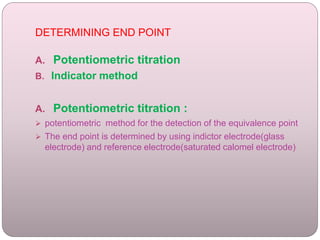
DETERMINING END POINT
A. Potentiometric titration
B. Indicator method
A. Potentiometric titration :
 potentiometric method for the detection of the equivalence point
 The end point is determined by using indictor electrode(glass
electrode) and reference electrode(saturated calomel electrode)
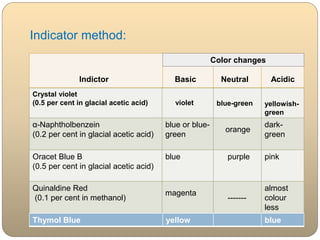
Indicator method:
Crystal violet
(0.5 per cent in glacial acetic acid) violet blue-green yellowish-
green
α-Naphtholbenzein
(0.2 per cent in glacial acetic acid)
blue or blue-
green
orange
dark-
green
Oracet Blue B
(0.5 per cent in glacial acetic acid)
blue purple pink
Quinaldine Red
(0.1 per cent in methanol)
magenta
-------
almost
colour
less
Indictor Basic Neutral Acidic
Color changes
Thymol Blue yellow blue
Non Aqueous Titration of weak Bases
 Solvents used in the titration of weak bases;
Neutral solvents :
Ex: -
alcohol,chloroform,benzene,chlorobenzene
Acidic solvents:
Ex:-formic acid,glacial acetic
acid,propionic acids
 Titrant used in the titration of weak basess:
Ex:-Perchloric acid
 Indicatores used in the titration of weak bases
Ex:-oracat blue ,crystal violet,1-
naphtholbenzein(weak bases)
methyl red,methyl orange & thymol blue(stronger bases)
 Many weakly acidic substances (aicohol or aprotic solvent)can
be titrated in an appropiate non aqueous solvents with a
sharp end point .
Ex:- acidic halides, acids,amino acids,
enols(barbiturates,xanthines), phenols, pyrroles
sulphonamides etc,.
1) Solvents used in the titration of weak acids:
Ex:-Ethylenediamine,n-butylamine,morpholine
2) Titrant used in the titration of weak acids:
Ex:-sodium methoxide, lithium methoxide,
potasium methoxide ,tetrabutyl ammonium hydroxide etc.
3) Indicatores used in the titration of weak acids
Ex:-azo violet.thymol blue,thymolphthalein.,O-
Nitro aniline
Non Aqueous titration Of weak acids
REFERENCES:
Textbook of QUANTITATIVE CHEMICAL
ANALYSIS : VOGEL’S
PHARMACEUTICAL TITRIMETRIC
ANALYSIS:
A.A NAPOLEON
6 non aqueous jntu pharmacy

6 non aqueous jntu pharmacy

  • 1.
    1 NON AQUEOUES TITRATION BY Dr.Suman Pattanayak Associate Professor Department of Pharma Analysis & QA. Vijaya Institute of Pharmaceutical Sciences for Women M. Pharm/ I Sem Advance Pharmaceutical Analysis
  • 2.
    CONTENT  Introduction  TypesOf Solvents 1. Aprotic solvents 2. Protophilic solvents 3. Protogenic solvents 4. Amphiprotic solvents  Non Aqueous Titration Of Weak Acids  Non Aqueous Titration Of Weak Bases
  • 3.
    INTRODUCTION Definition Non aqueous titrationare those in which titration of weakly acidic or basic substances are carried out using non aqueous solvents so as to get sharp end point.  Non aqueous solvents the disadvantages of poor solubility and weak reactivity.  Moisture and corbondioxide should be avoided using non aqueous procedures.  Moisture should be held to less than 0.05%.  Standerdisation &titration should be carried out as far as possible at the same temperature.
  • 4.
     In nonaueous solvents the acidity is decreases in the following order HCIO4> HBr>H2SO4>HCI>HNO3 o HCl in water…….strongly acidic o HCl in acetic acid……weakly acidic o Acetic acid in water……weakly acidic o Acetic acid in ammonia….strongly acidic
  • 5.
    Types of solvents Thesolvents are divided into 4 groups 1. Aprotic solvents 2. Protophilic solvents 3. Protogenic solvents 4. Amphiprotic solvents
  • 6.
    Aprotic solvents(inert solvents) Aprotic solvents are neutral, chemically inert substances such as benzene and chloroform.  They have a low dielectric constant, do not react with either acids or bases and therefore do not favor ionization.  The picric acid gives a colorless solution in benzene or toluene which becomes yellow on adding aniline shows that picric acid is not dissociated in benzene or toluene solution.  This type of solvents neither accept or donate protons Ex:-Benzene , dioxan ,
  • 7.
    Protophilic solvent  Basicin character and react with acids to form solvated proton HB + Sol. ⇌ Sol.H+ + B- Acid + Basic solvent ⇌ Solvated proton + Conjugate base of acid  A weakly basic solvent has less tendency than a strongly basic one to accept a proton.  Similarly a weak acid has less tendency to donate protons than a strong acid.  As a result a strong acid such as perchloric acid exhibits more strongly acidic properties than a weak acid such as acetic acid when dissolved in a weakly basic solvent.
  • 8.
    Protogenic solvents  Acidicin nature and donte protons  Ex:- sulphuric acid , formic acid, propionoic acid ,acetic anhydride etc.  They have high dielectric constant and ionised  Because of their strength and ability to donate protons.
  • 9.
    Amphiprotic solvents  Haveboth protophilic and protogenic properties.  This can acept or donate protons.  Ex:-water , alcohols, acetic acid CH3COOH ⇌ H+ + CH3COO-  Here the acetic acid is functioning as an acid.  If a very strong acid such as perchloric acid is dissolved in acetic acid, the latter can function as a base and combine with protons donated by the perchloric acid to form protonated acetic acid., an onium ion” HClO4 ⇌ H+ + ClO4 - CH3COOH + H+ ⇌ CH3COOH2 + (onium ion)  Since the CH3COOH2 + ion readily donates its proton to a base, a solution of perchloric acid in glacial acetic acid functions as a strongly acidic solution.
  • 10.
     When aweak base, such as pyridine is dissolved in acetic acid, equivalent amount of acetate ions are produced which have more tendency to acept protons.  Therefore, to titrate a solution of a weak base in acetic acid with perchloric acid in acetic acid, and obtain a sharp endpoint. HClO4 + CH3COOH ⇌ CH3COOH2 + + ClO4 - onium ion C5H5N + CH3COOH ⇌ C5H5NH+ + CH3COO- Acetate ion CH3COOH2 + + CH3COO- ⇌ 2CH3COOH Burette conical flask Adding HClO4 + C5H5N ⇌ C5H5NH+ + ClO4 -
  • 11.
    DETERMINING END POINT A.Potentiometric titration B. Indicator method A. Potentiometric titration :  potentiometric method for the detection of the equivalence point  The end point is determined by using indictor electrode(glass electrode) and reference electrode(saturated calomel electrode)
  • 12.
    Indicator method: Crystal violet (0.5per cent in glacial acetic acid) violet blue-green yellowish- green α-Naphtholbenzein (0.2 per cent in glacial acetic acid) blue or blue- green orange dark- green Oracet Blue B (0.5 per cent in glacial acetic acid) blue purple pink Quinaldine Red (0.1 per cent in methanol) magenta ------- almost colour less Indictor Basic Neutral Acidic Color changes Thymol Blue yellow blue
  • 13.
    Non Aqueous Titrationof weak Bases  Solvents used in the titration of weak bases; Neutral solvents : Ex: - alcohol,chloroform,benzene,chlorobenzene Acidic solvents: Ex:-formic acid,glacial acetic acid,propionic acids  Titrant used in the titration of weak basess: Ex:-Perchloric acid  Indicatores used in the titration of weak bases Ex:-oracat blue ,crystal violet,1- naphtholbenzein(weak bases) methyl red,methyl orange & thymol blue(stronger bases)
  • 14.
     Many weaklyacidic substances (aicohol or aprotic solvent)can be titrated in an appropiate non aqueous solvents with a sharp end point . Ex:- acidic halides, acids,amino acids, enols(barbiturates,xanthines), phenols, pyrroles sulphonamides etc,. 1) Solvents used in the titration of weak acids: Ex:-Ethylenediamine,n-butylamine,morpholine 2) Titrant used in the titration of weak acids: Ex:-sodium methoxide, lithium methoxide, potasium methoxide ,tetrabutyl ammonium hydroxide etc. 3) Indicatores used in the titration of weak acids Ex:-azo violet.thymol blue,thymolphthalein.,O- Nitro aniline Non Aqueous titration Of weak acids
  • 15.
    REFERENCES: Textbook of QUANTITATIVECHEMICAL ANALYSIS : VOGEL’S PHARMACEUTICAL TITRIMETRIC ANALYSIS: A.A NAPOLEON