

 CHARACTERISTICS AND ETIOLOGY OF
THE SPEECH AND LANGUAGE DISORDER
 SUBMITTED TO
 Dr MUHIB ULLAH KHAN MARWAT
 PREPARED BY
 ROHEENA TABBASUM MARWAT
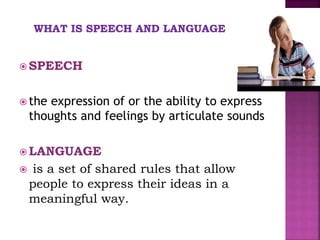
 SPEECH
 the expression of or the ability to express
thoughts and feelings by articulate sounds
 LANGUAGE
 is a set of shared rules that allow
people to express their ideas in a
meaningful way.
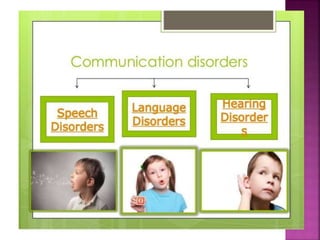
SPEECH AND LANGUAGE DISORDER
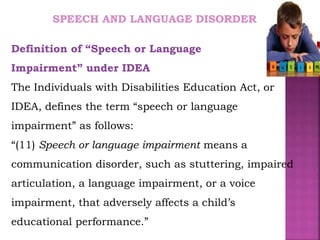
Definition of “Speech or Language
Impairment” under IDEA
The Individuals with Disabilities Education Act, or
IDEA, defines the term “speech or language
impairment” as follows:
“(11) Speech or language impairment means a
communication disorder, such as stuttering, impaired
articulation, a language impairment, or a voice
impairment, that adversely affects a child’s
educational performance.”
SPEECH DISORDER
Speech disorders refer to difficulties producing
speech sounds or problems with voice quality.
Speech disorders may be problems with the way
sounds are formed, called articulation or
phonological disorders, or they may be difficulties
with the pitch, volume or quality of the voice.
They may say "see" when they mean "ski“
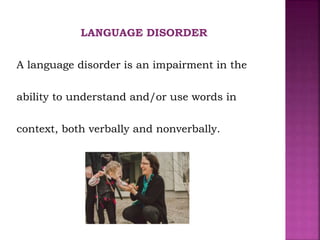
LANGUAGE DISORDER
A language disorder is an impairment in the
ability to understand and/or use words in
context, both verbally and nonverbally.
TYPES OF LANGUAGE DISORDERS
There are three kinds of language disorders.
Receptive language issues involve difficulty
understanding what others are saying.
Expressive language issues involve difficulty
expressing thoughts and ideas.
Mixed receptive-expressive language issues
involve difficulty understanding and using spoken
language.
 There are many kinds of speech disorders
that can affect children.
 In this fact sheet, we’ll talk about three major
areas in which these impairments occur. These
are the areas of:
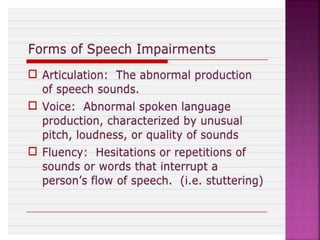
 Articulation
 speech impairments where the child produces
sounds incorrectly (e.g., lisp, difficulty articulating
certain sounds, such as “wabbit” instead of “rabbit”
Fluency The rhythm of speech
speech impairments where a child’s flow of speech
is disrupted by sounds, syllables, and words that
are repeated, prolonged, or avoided and where
there may be silent blocks or inappropriate
inhalation, exhalation, or phonation patterns;
Voice
speech impairments where the child’s voice has an
abnormal quality to its pitch, resonance, or loudness;
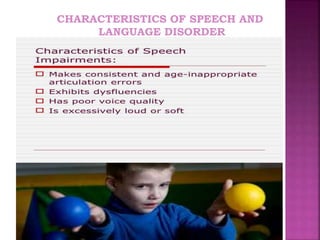
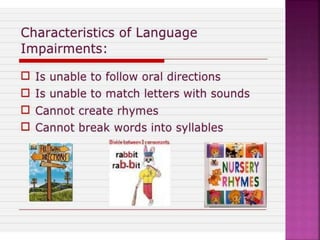
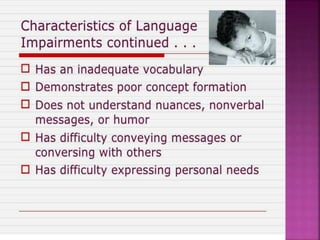
CHARACTERISTICS OF SPEECH AND
LANGUAGE DISORDER
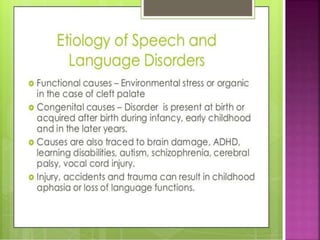
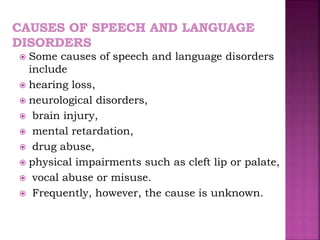
 Some causes of speech and language disorders
include
 hearing loss,
 neurological disorders,
 brain injury,
 mental retardation,
 drug abuse,
 physical impairments such as cleft lip or palate,
 vocal abuse or misuse.
 Frequently, however, the cause is unknown.
 —LEARN as much as you can about the student’s
specific disability. Speech-language impairments
differ considerably from one another, so it’s
important to know the specific impairment and how
it affects the student’s communication abilities.
 —RECOGNIZE that you can make an enormous
difference in this student’s life! Find out what the
student’s strengths and interests are, and
emphasize them. Create opportunities for success.
If you are not part of the student’s IEP team, ask for a
copy of his or her IEP. The student’s educational goals
will be listed there, as well as the services and classroom
accommodations he or she is to receive.
NEEDED ACCOMMODATIONS ARE PROVIDED
make sure that needed accommodations are provided for
classwork, homework, and testing. These will help the
student learn successfully.
CONSULT
Consult with others (e.g., special educators, the
SLP) who can help you identify strategies for
teaching and supporting this student, ways to
adapt the curriculum, and how to address the
student’s IEP goals in your classroom.
MATERIALS OR RESOURCES
find out if your state or school district has materials or
resources available to help educators address the
learning needs of children with speech or language
impairments. It’s amazing how many do!
COMMUNICATE WITH THE STUDENT’S PARENTS.
Regularly share information about how the student is
doing at school and at home.
Any Question
Presentation 2 special education language disorders

Presentation 2 special education language disorders

  • 2.
     CHARACTERISTICS ANDETIOLOGY OF THE SPEECH AND LANGUAGE DISORDER  SUBMITTED TO  Dr MUHIB ULLAH KHAN MARWAT  PREPARED BY  ROHEENA TABBASUM MARWAT
  • 5.
     SPEECH  theexpression of or the ability to express thoughts and feelings by articulate sounds  LANGUAGE  is a set of shared rules that allow people to express their ideas in a meaningful way.
  • 6.
    SPEECH AND LANGUAGEDISORDER Definition of “Speech or Language Impairment” under IDEA The Individuals with Disabilities Education Act, or IDEA, defines the term “speech or language impairment” as follows: “(11) Speech or language impairment means a communication disorder, such as stuttering, impaired articulation, a language impairment, or a voice impairment, that adversely affects a child’s educational performance.”
  • 7.
    SPEECH DISORDER Speech disordersrefer to difficulties producing speech sounds or problems with voice quality. Speech disorders may be problems with the way sounds are formed, called articulation or phonological disorders, or they may be difficulties with the pitch, volume or quality of the voice. They may say "see" when they mean "ski“
  • 9.
    LANGUAGE DISORDER A languagedisorder is an impairment in the ability to understand and/or use words in context, both verbally and nonverbally.
  • 10.
    TYPES OF LANGUAGEDISORDERS There are three kinds of language disorders. Receptive language issues involve difficulty understanding what others are saying. Expressive language issues involve difficulty expressing thoughts and ideas. Mixed receptive-expressive language issues involve difficulty understanding and using spoken language.
  • 11.
     There aremany kinds of speech disorders that can affect children.  In this fact sheet, we’ll talk about three major areas in which these impairments occur. These are the areas of:  Articulation  speech impairments where the child produces sounds incorrectly (e.g., lisp, difficulty articulating certain sounds, such as “wabbit” instead of “rabbit”
  • 12.
    Fluency The rhythmof speech speech impairments where a child’s flow of speech is disrupted by sounds, syllables, and words that are repeated, prolonged, or avoided and where there may be silent blocks or inappropriate inhalation, exhalation, or phonation patterns; Voice speech impairments where the child’s voice has an abnormal quality to its pitch, resonance, or loudness;
  • 13.
    CHARACTERISTICS OF SPEECHAND LANGUAGE DISORDER
  • 17.
     Some causesof speech and language disorders include  hearing loss,  neurological disorders,  brain injury,  mental retardation,  drug abuse,  physical impairments such as cleft lip or palate,  vocal abuse or misuse.  Frequently, however, the cause is unknown.
  • 18.
     —LEARN asmuch as you can about the student’s specific disability. Speech-language impairments differ considerably from one another, so it’s important to know the specific impairment and how it affects the student’s communication abilities.  —RECOGNIZE that you can make an enormous difference in this student’s life! Find out what the student’s strengths and interests are, and emphasize them. Create opportunities for success.
  • 19.
    If you arenot part of the student’s IEP team, ask for a copy of his or her IEP. The student’s educational goals will be listed there, as well as the services and classroom accommodations he or she is to receive. NEEDED ACCOMMODATIONS ARE PROVIDED make sure that needed accommodations are provided for classwork, homework, and testing. These will help the student learn successfully.
  • 20.
    CONSULT Consult with others(e.g., special educators, the SLP) who can help you identify strategies for teaching and supporting this student, ways to adapt the curriculum, and how to address the student’s IEP goals in your classroom.
  • 21.
    MATERIALS OR RESOURCES findout if your state or school district has materials or resources available to help educators address the learning needs of children with speech or language impairments. It’s amazing how many do! COMMUNICATE WITH THE STUDENT’S PARENTS. Regularly share information about how the student is doing at school and at home.
  • 22.