PRESENTED TO:
Mam Nazia Qayum
Mam Noor Amna
Mam Rehana
PRESENTED BY:
Maria Qibtia
Shazia Anjum
Definition:
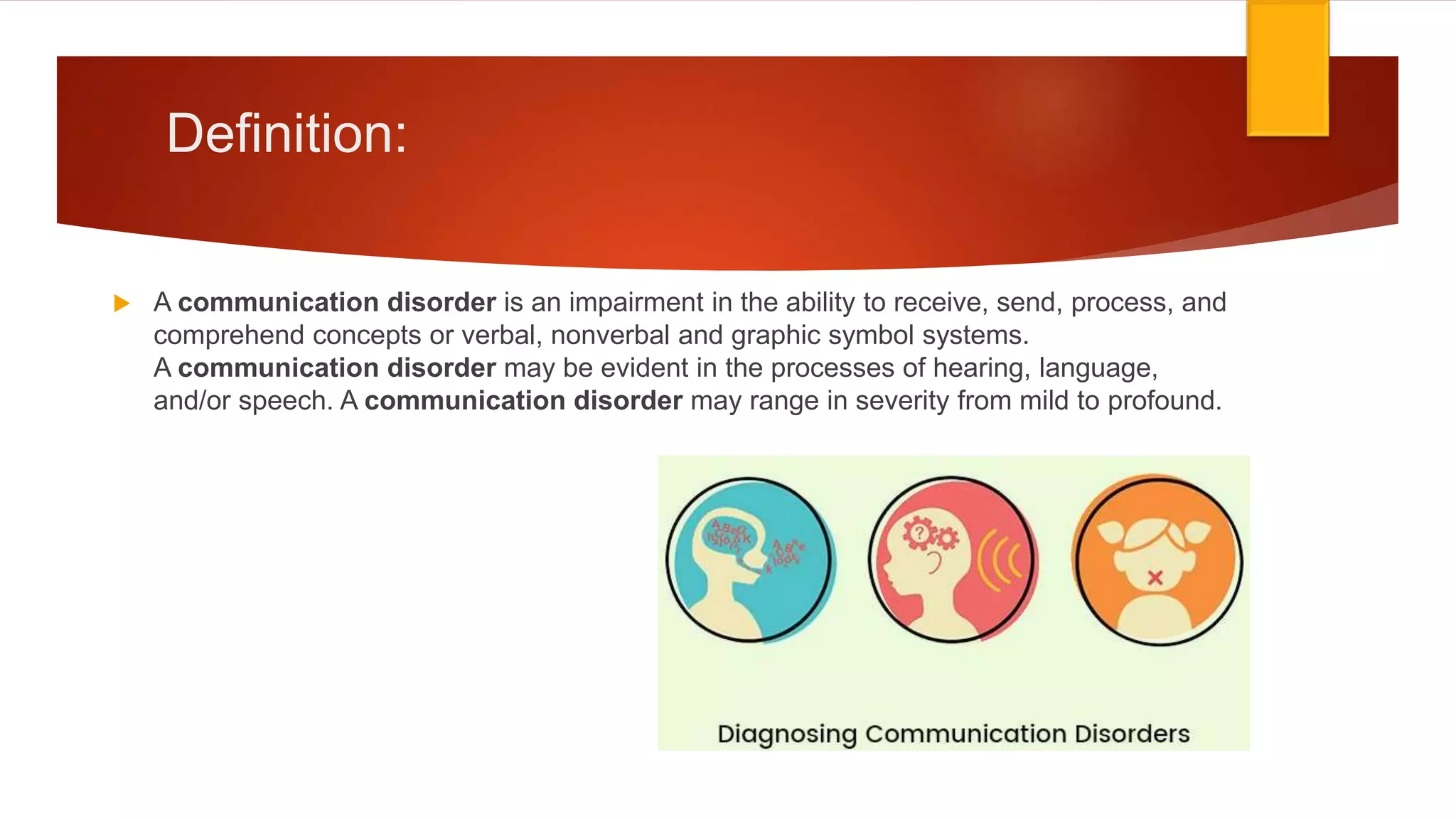
 A communication disorder is an impairment in the ability to receive, send, process, and
comprehend concepts or verbal, nonverbal and graphic symbol systems.
A communication disorder may be evident in the processes of hearing, language,
and/or speech. A communication disorder may range in severity from mild to profound.
Frequency of Communication Disorders
 1 in 6 (16%) people in the U.S. has a communication disorder. That is approx. 42
million people.
 10% of our population has a functional speech disorder, of which 8% to 9% of
those require treatment.
Identification
 Review developmental, educational and medical history
 Interview parents, teachers, etc.
 Questionnaires
 Systematic observation
 Language sampling
 Formal tests
Service Delivery
 Service Delivery Models
 Monitoring
 Collaborative consultation
 Classroom-Based
 Pullout
 Issues
 Shortage of SLPs
 Heavy caseloads
Collaboration
 Discuss concerns about students
 Know what student is working on
 Ask how you can help students achieve and generalize skills
 Communicate progress
 Discuss behavioral challenges
 Ask how to improve the communication skills of the whole class.
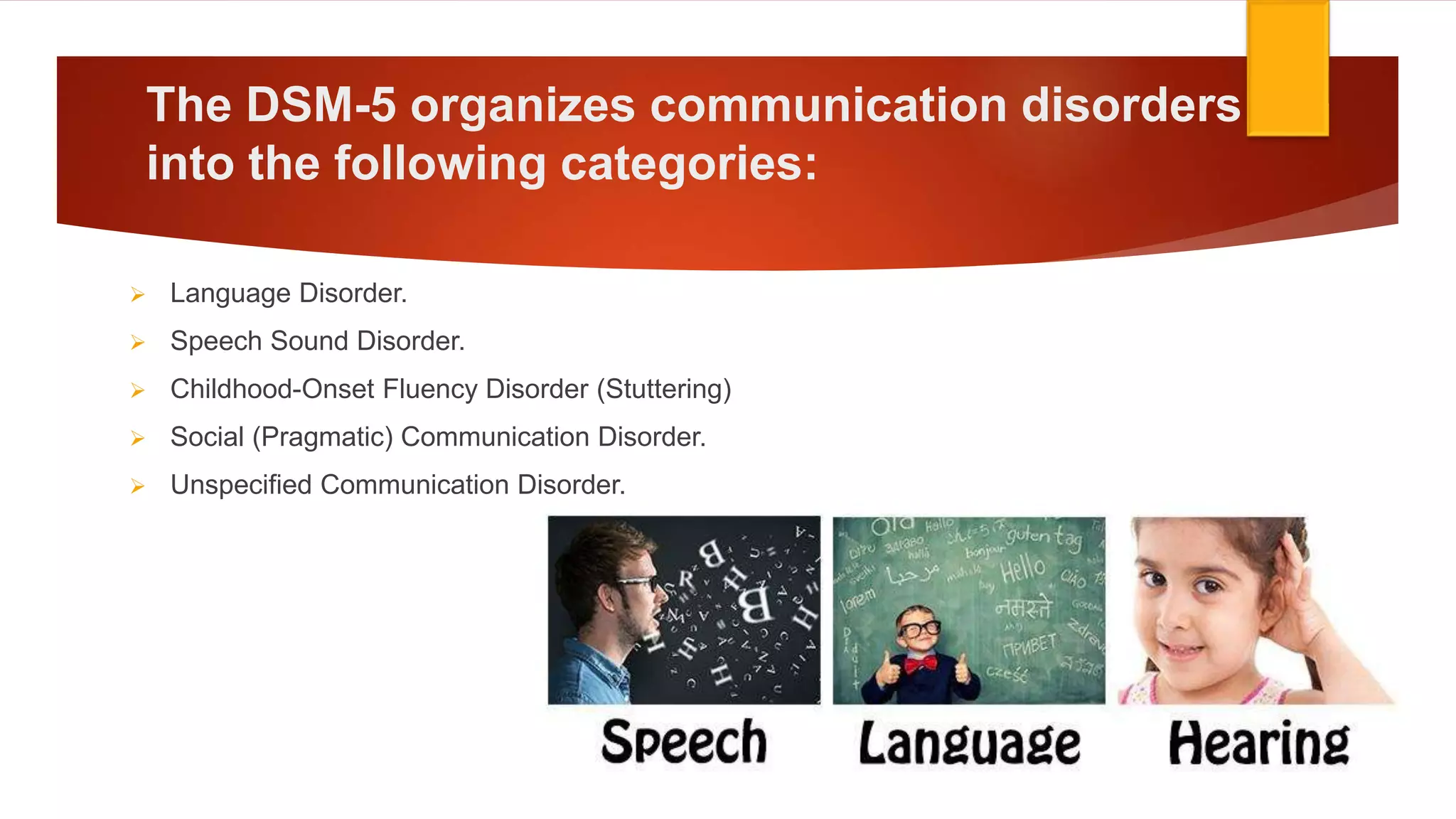
The DSM-5 organizes communication disorders
into the following categories:
 Language Disorder.
 Speech Sound Disorder.
 Childhood-Onset Fluency Disorder (Stuttering)
 Social (Pragmatic) Communication Disorder.
 Unspecified Communication Disorder.
Language Disorder
 language disorder there are difficulties in the attainment and use
of language due to comprehension or discourse shortfalls.
Diagnostic Criteria
A. Persistent difficulties in the acquisition and use of language across modalities (i.e., spoken, written,
sign language, or other)
1. Reduced vocabulary (word knowledge and use).
2. Limited sentence structure (based on the rules of grammar and morphology).
3. Impairments in discourse (ability to use vocabulary and connect sentences to explain).
B. Language abilities are substantially and quantifiably below those expected for age, resulting in
functional limitations in effective communication, social participation, academic achievement, or
occupational performance, individually or in any combination.
C. Onset of symptoms is in the early developmental period.
D. The difficulties are not attributable to hearing or other sensory impairment, motor dysfunction, or another
medical or neurological condition and are not better explained by intellectual disability (intellectual
developmental disorder) or global developmental delay.
Diagnostic Features
Differential Diagnosis
 Normal variations in language.
 Hearing or other sensory impairment.
 Intellectual disability (intellectual developmental disorder).
 Language regression.
Comorbidity
 Neurodevelopmental Disorders
 Specific Learning Disorder (Literacy And Numeracy)
 Attention-deficit/Hyperactivity Disorder
 Autism Spectrum Disorder
 Developmental Coordination Disorder.
 Social (Pragmatic) Communication Disorder.
Treatment:
The disorder is often treated through the collective efforts of parents, teachers, speech-language
pathologists, and other health professionals.
Medical exam
 The first course of action is to visit your doctor for a full physical. This will help rule out or
diagnose other conditions, such as a hearing problem or other sensory impairment.
Language therapy
 The common treatment for language disorder is speech and language therapy. Treatment will
depend on the age of your child and the cause and extent of the condition. For example, your
child may participate in one-on-one treatment sessions with a speech-language therapist or
attend group sessions. The speech-language therapist will diagnose and treat your child
according to their deficits.
 Early intervention often plays an important role in a successful outcome.
Treatment:
Home care options
 Working with your child at home can help. Here are some tips:
 Speak clearly, slowly, and concisely when asking your child a question.
 Wait patiently as your child forms a response.
 Keep the atmosphere relaxed to reduce anxiety.
 Ask your child to put your instructions in their own words after giving an explanation or
command.
 Frequent contact with teachers is also important. Your child may be reserved in class and may
not want to participate in activities that involve talking and sharing. Ask the teacher about class
activities in advance to help prepare your child for upcoming discussions.
Psychological therapy
 Having difficulty understanding and communicating with others can be frustrating and may
trigger episodes of acting out. Counseling may be needed to address emotional or behavioral
issues
Teaching techniques
 Focus on interactive communication.
 Use active listening.
 Incorporate the student’s interests into speech.
 Ensure that the student has a way to appropriately express their wants and needs.
 Reinforce communication attempts (e.g. their gestures, partial verbalizations) when the
student is non-verbal or emerging verbal.
 Paraphrase back what the student has said or indicated.
 Use storybook sharing in which a story is read to student and responses are elicited
(praise is given for appropriate comments about the content).
 Ask open-ended appropriate questions.
 Use linguistic scaffolding techniques that involve a series of questions.
 Use language for social interaction and to resolve conflicts.
 Emphasize goals and tasks that are easy for the student to accomplish.
 Work at the student's pace.
 Present only one concept at a time.
 Have speech therapist present language units to the entire class.
 Use computers in the classroom for language enhancement.
 Encourage reading and writing daily.
 Use tactile and visual cues (e.g., pictures, 3-D objects).
 Incorporate vocabulary with unit being taught.
 Provide fun activities that are functional and practical.
 Be aware of the student's functioning level in auditory skills, semantics, word recall, syntax,
phonology, and pragmatics (and how they affect academic performance).
Speech Sound Disorder
Speech sound disorder is a communication disorder in which children have
persistent difficulty saying words or sounds correctly. Speech sound production
describes the clear articulation of the phonemes (individual sounds) that make up
spoken words.
Diagnostic Criteria
A. Persistent difficulty with speech sound production that interferes with speech
intelligibility or prevents verbal communication of messages.
B. The disturbance causes limitations in effective communication that interfere with
social participation, academic achievement, or occupational performance,
individually or in any combination.
C. Onset of symptoms is in the early developmental period.
D. The difficulties are not attributable to congenital or acquired conditions, such as
cerebral palsy, cleft palate, deafness or hearing loss, traumatic brain injury, or other
medical or neurological conditions.
Diagnostic Features
Differential Diagnosis
 Normal variations in speech.
 Hearing or other sensory impairment.
 Structural deficits.
 Dysarthria.
 Selective mutism.
Treatment
The type of treatment will typically depend on the severity of the speech disorder and its underlying cause.
Treatment options can include:
 speech therapy exercises that focus on building familiarity with certain words or sounds
 physical exercises that focus on strengthening the muscles that produce speech sounds
 We discuss some of the treatment options for speech disorders below:
Target selection
 Target selection involves a person practicing specific sounds or words to familiarize themselves with
particular speech patterns. Examples of therapy targets may include difficult words or sounds that trigger
speech disruptions.
Contextual utilization
 For this approach, SLPs teach people to recognize speech sounds in different syllable-based contexts.
Treatment
 Contrast therapy
 Contrast therapy involves saying word pairs that contain one or more different speech sounds. An example word pair might be “beat” and “feet”
or “dough” and “show.”
 Oral-motor therapy
 The oral-motor therapy approach focuses on improving muscle strength, motor control, and breath control. These exercises can help people
develop fluency, which produces smoother speech that sounds more natural.
 Ear device
 Ear devices are small electronic aids that fit inside the ear canal. These devices can help improve fluency in people who have a stutter.
 Some ear devices replay altered versions of the wearer’s voice to make it seem as though someone else is speaking with them. Other ear devices
produce a noise that helps control stuttering.
 Medication
 Some speech disorders can cause people to develop anxiety disorders. Stressful situations can trigger anxiety, resulting in more pronounced
speech disorder symptoms. Anxiety medications may help reduce symptoms of speech disorders in some people.
Teaching techniques
 Develop a procedure for the student to ask for help.
 Speak directly to the student.
 Be a good speech model.
 Have easy and good interactive communication in classroom.
 Consult a speech language pathologist concerning your assignments and activities.Be aware that students may require another form of
communication.
 Encourage participation in classroom activities and discussions.
 Model acceptance and understanding in classroom.
 Anticipate areas of difficulty and involve the student in problem-solving.
 Provide assistance and provide positive reinforcement when the student shows the ability to do something unaided.
 Use a peer-buddy system when appropriate.
 Devise alternate procedures for an activity with student.
 Use gestures that support understanding.
 Model correct speech patterns and avoid correcting speech difficulties.
 Be patient when student is speaking, since rushing may result in frustration.
Assessment and Evaluation of Speech-
Language Disorders in Schools
 Case history, including medical status, education, socioeconomic, cultural, and linguistic backgrounds and
information from teachers and other related service providers
 Patient/client/student and family interview
 Review of auditory, visual, motor, and cognitive status
 Standardized and/or non-standardized measures of specific aspects of speech, spoken and non-spoken
language, cognitive-communication, and swallowing function, including observations and analysis of work
samples
 Identification of potential for effective intervention strategies and compensations
 Selection of standardized measures for speech, language, cognitive-communication, and/or swallowing
assessment with consideration for documented ecological validity and cultural sensitivity
 Follow-up services to monitor communication and swallowing status and ensure appropriate intervention
and support for individuals with identified speech, language, cognitive-communication, and/or swallowing
disorders
Childhood-Onset Fluency Disorder (Stuttering)
A disturbance in the normal fluency and time patterning of speech that is inappropriate for an
individual's age.
The disorder is characterized by frequent repetitions or prolongations of sounds or syllables.
Stuttering is not a language disorder
 Stuttering reflects an underlying problem with speech production rather than a
language problem. Weis stated that “children who stutter know what they want to
say, but they have a problem saying it”
 Stuttering is not affected by personality. Hundreds of studies found that there
are no differences in personality or temperament between people who stutter and
who do not stutter. People who stutter are not more nervous, tense, or anxious
than people who do not stutter (Guntupalli,at al., 2006).
 Students who stutter have the same cognitive and language abilities as
other students. As Yairi and his colleagues (1996) found, at the ages 7 to 11
school performance was not affected with respect to whether the child stutter or
not.( Yairi at al. 1996).
 Stuttering is associated with social anxiety(fear of speech).
 Researches suggests that stuttering is not caused by anxiety. Fear of speaking is
rather a consequence of repeated episodes of speech disfluency in
uncomfortable speaking environments (Haynes, Moran, Pindzola, 2006).
Interestingly, “nearly all children report a dramatic reduction in stuttering when
they sing, speak to an infant or a pet, or read aloud the passage with a large
group of students” (Weis, 2013)
Diagnostic Criteria
Criterion A
Disturbances in the normal fluency (i.e. - dysfluencies) and time patterning of
speech that are inappropriate for the individual’s age and language skills, persist
over time, and occurrences of at least 1 of the following:
• Sound and syllable repetitions
• Sound prolongations of consonants as well as vowels
• Broken words (e.g. - pauses within a word)
• Audible or silent blocking (filled or unfilled pauses in speech)
• Circumlocutions (word substitutions to avoid problematic words)
• Words produced with an excess of physical tension
• Monosyllabic whole-word repetitions (e.g. - “I-I-I am fine”)
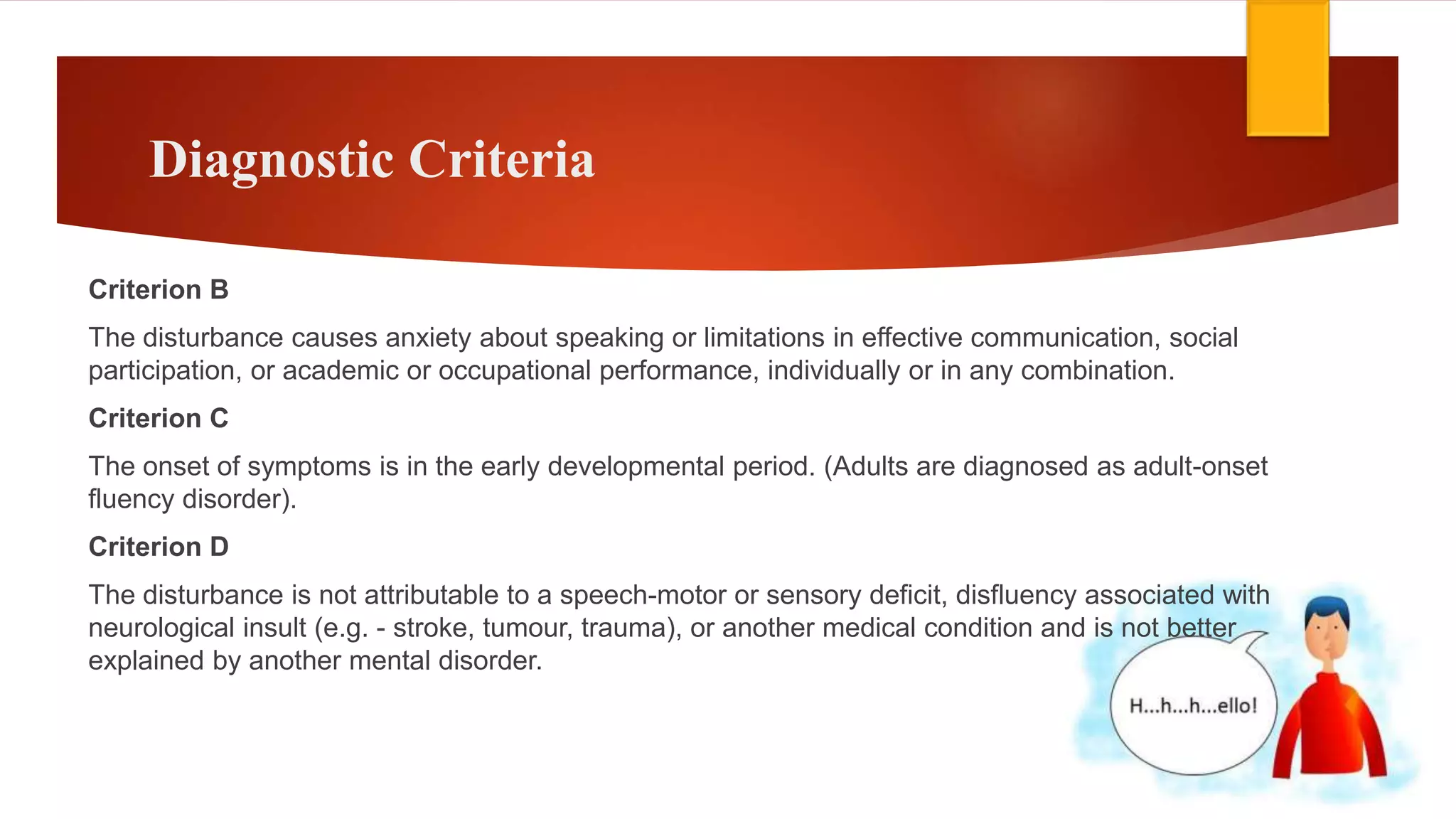
Criterion B
The disturbance causes anxiety about speaking or limitations in effective communication, social
participation, or academic or occupational performance, individually or in any combination.
Criterion C
The onset of symptoms is in the early developmental period. (Adults are diagnosed as adult-onset
fluency disorder).
Criterion D
The disturbance is not attributable to a speech-motor or sensory deficit, disfluency associated with
neurological insult (e.g. - stroke, tumour, trauma), or another medical condition and is not better
explained by another mental disorder.
Diagnostic Criteria
Diagnostic Features
The dysfluencies from stuttering are usually absent during oral reading, singing, or
talking to inanimate objects or to pets. The deficits are most severe when is a special
pressure to communicate or stressful environment.
Differential diagnosis:
 Sensory deficits
 Dysfluencies of speech can be caused by hearing impairment, sensory
deficit, or a speech-motor deficit. Only when the speech dysfluencies are
in excess of what is expected, should a diagnosis of childhood-onset
fluency disorder be made.
 Normal speech dysfluencies
 Normal dysfluencies occur frequently in young children. This includes
whole-word or phrase repetitions (e.g. - “I want, I want that toy!”),
incomplete phrases, unfilled pauses. If these difficulties continue to
increase in frequency or complexity with age, then childhood-onset
fluency disorder is more likely.
Medication side effect:
 Stuttering can occur as a side effect from medications.
 Adult onset dysfluencies:
 If dysfluency begins during or after adolescence, it is an diagnosed as adult-onset
dysfluency rather than neurodevelopment disorder.
 Tourette’s Disorder:
 The vocal tics and repetitive vocalizations of Tourette's disorder should be
distinguished from the repetitive sounds of childhood-onset fluency disorder by their
nature and timing.
ASSESSMENT OF SCHOOL- AGE
CHILDREN
 Behavioral Style Questionnaire (BSQ) for school age children.
 Behavior Assessment Battery (BAB)
 CALMS Rating Scale for School- Age Children who stutter.
 Communication Attitude Test (CAT).
 A- 19 Scale for Children who stutter.
 Stuttering Prediction Instrument for Young Children (SPI) ,age 3-8
 The Speech Situation Checklists for school age.
Treatment:
 Treatment is focuses on decreasing or eliminating fluency problems as well as developing
effective communication skills and promoting participation in school, work, and social
environments.
 Speech therapy
 may be used to teach the individual to speak slowly and effectively. Some small electronic
devices can also help improve speech fluency, such as a delayed auditory feedback tool that
requires the user to slow their speech.
 Cognitive behavioral therapy
 may be used to identify thoughts patterns that make stuttering worse and to help cope with or
resolve stress or anxiety related to stuttering.
 To improve the communication style between children with the condition and their parents, in
order to facilitate treatment strategies and help the child cope with their stuttering.
Prevalence:
 About 5% of all children go through a period of stuttering that lasts six months or
more. Three quarters of those who begin to stutter will recover by late childhood,
leaving about 1% of the population with a long -term problem (Barry & Edward,
2007).
Teaching techniques:
 How a Teacher Can help a Student Who Stutters
 Talk Slower. Students with bumpy speech may benefit from hearing slower speech in
the classroom
 Use More Wait Time
 Look and Listen.
 Repeat or Paraphrase
 Encourage Turn-Taking
 Adjust Talking Demands When a Student's Speech is Bumpy
 Do Not have a Hurried and Rushed Classroom
 Acknowledge a Student's Trouble with Stuttering
SOCIAL (PRAGMATIC) COMMUNICATION
DISORDER
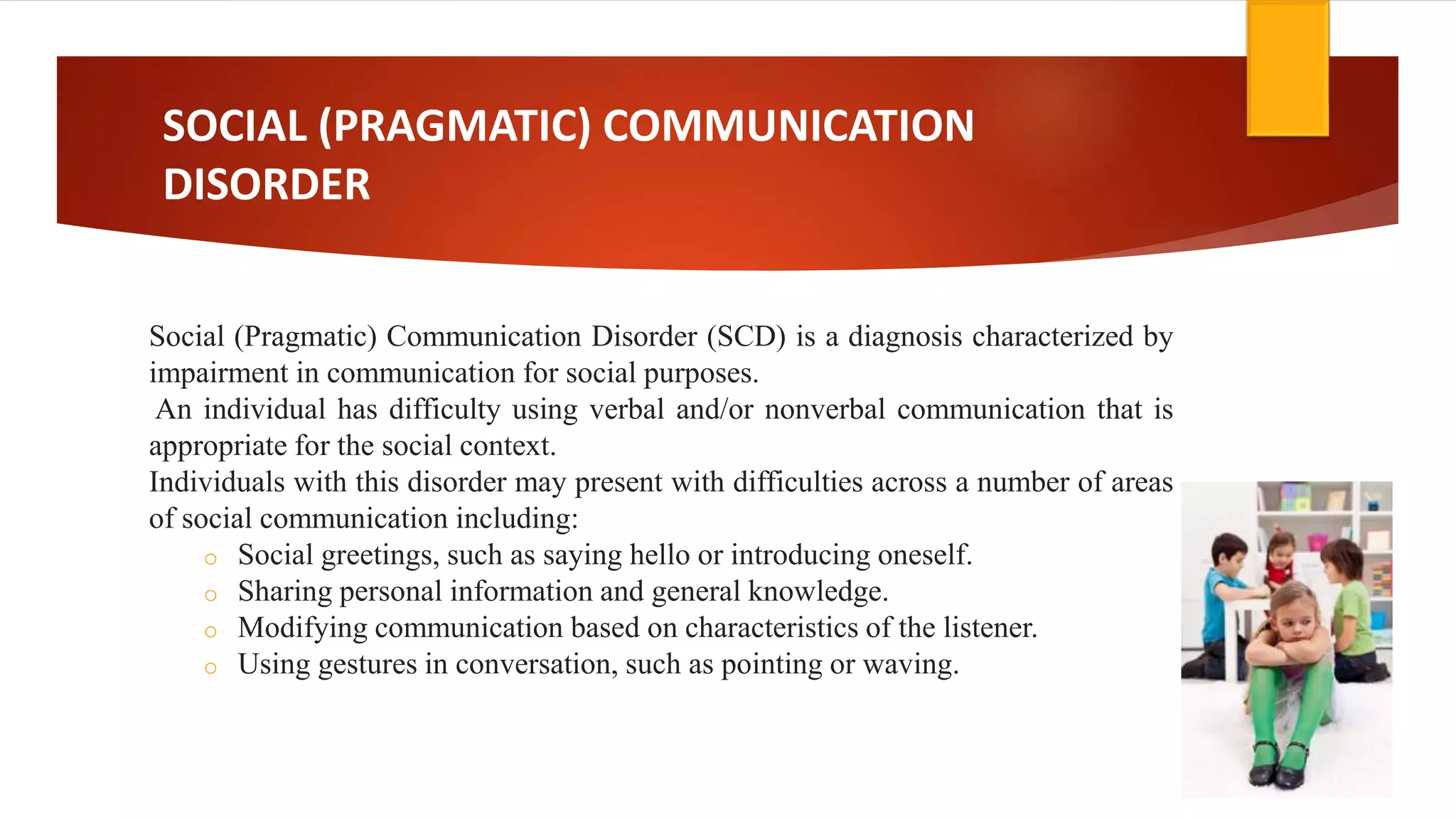
Social (Pragmatic) Communication Disorder (SCD) is a diagnosis characterized by
impairment in communication for social purposes.
An individual has difficulty using verbal and/or nonverbal communication that is
appropriate for the social context.
Individuals with this disorder may present with difficulties across a number of areas
of social communication including:
o Social greetings, such as saying hello or introducing oneself.
o Sharing personal information and general knowledge.
o Modifying communication based on characteristics of the listener.
o Using gestures in conversation, such as pointing or waving.
Diagnostic Criteria :
A. Persistent difficulties in the social use of verbal and nonverbal communication as manifested by all
of the following
1. Deficits in using communication for social purposes, such as greeting and sharing information, in a
manner that is appropriate for social context.
2. Impairment in the ability to change communication to match context or the needs of the listener,
such as speaking differently in a classroom than on a playground, talking differently to a child than to
an adult.
3. Difficulties following rules for conversation and storytelling, such as taking turns in conversation,
rephrasing when misunderstood, and knowing how to use verbal and nonverbal signals to regulate
interaction.
4. Difficulties understanding what is not explicitly stated (e.g., making inferences) and non literal or
ambiguous meaning of language (e.g., idioms, humor, metaphors, multiple meanings that depend on
the context for interpretation.)
Diagnostic Criteria :
B. The deficits result in functional limitations in effective communication, social
participation, social relationships, academic achievement, or occupational
performance, individually or in combination.
C. The onset of the symptoms is in the early developmental period .
D. The symptoms are not attributable to another medical or neurological condition or
to low abilities in the domains of word structure and grammar, and are not better
explained by autism spectrum disorder, intellectual disability , global developmental
delay, or another mental disorder.
Assessment:
 • Social Language Development Test: Elementary – ages 6.0–11.
 • Test of Pragmatic Language-2 (TOPL-2) – ages 6.0–18.0
 • Clinical Evaluation of Language Fundamentals Metal linguistics – ages 9.0–
21.11
 • Social Emotional Evaluation – ages 6.0–12.11
Differential diagnosis:
 Autism spectrum disorder:
 The two disorders can be differentiated by the presence in autism spectrum disorder
of restricted/ repetitive patterns of behavior, interests, or activities and their absence
in social (pragmatic) communication disorder. Individuals with autism spectrum
disorder may only display the restricted/repetitive patterns of behavior, interests, and
activities during the early developmental period, so a comprehensive history should
be obtained.
 Attention-deficit/hyperactivity disorder:
 Primary deficits of ADHD may cause impairments in social communication and
functional limitations of effective communication, social participation, or academic
achievement.

 Social anxiety disorder (social phobia).
 The symptoms of social communication disorder overlap with those of social anxiety
disorder. In social (pragmatic) communication disorder, the individual has never had
effective social communication skills; in social anxiety disorder, the social
communication skills developed appropriately but are not utilized because of anxiety,
fear, or distress about social interactions.
 Intellectual disability and global developmental delay.
 Social communication skills may be deficient among individuals with global
developmental delay or intellectual disability, but a separate diagnosis is not given
unless the social communication deficits are clearly in excess of the intellectual
limitations.

Treatment of SCD:
 Social communication disorder as a new disorder some argue that SCD never
occurs by itself, that SCD is just a symptom of other conditions such as ADHD,
Autism Spectrum Disorder, language disorder, other communication disorders.
 Treatment should include
 opportunities for generalization of social communication skills in various settings
with various communication partners.
 A therapist may use Applied Behavioral Analysis, social skills groups, and
cognitive behavioral therapy in the treatment of SCD.
Learning techniques:
 A teacher may work with child to practice turn-taking, introduce and end topics,
and other conversational skills.
 Maintain contact with students.
 Role playing games and visuals can also aid in learning strategies to manage
social situations.
 Encourage and assist in facilitation or participation in activities and discussion.
Prevalence:
 Boys (9.6 percent) are more likely than girls (5.7 percent) to have
a communication disorder. The highest prevalence of communication
disorders is among children ages 3–6 (11 percent), compared to 9.3 percent of
children ages 7–10, and 4.9 percent of children ages 11–17.
Unspecified Communication Disorder:
This category applies to presentations in which symptoms characteristic of communication disorder that
cause clinically significant distress or impairment in social, occupational, or other important areas of
functioning predominate but do not meet the full criteria for communication disorder or for any of the
disorders in the neurodevelopmental disorders diagnostic class. The unspecified communication disorder
category is used in situations in which the clinician chooses not to specify the reason that the criteria are
not met for communication disorder or for a specific neurodevelopmental disorder, and includes
presentations in which there is insufficient information to make a more specific diagnosis.
References
 American Psychiatric Association. "Diagnostic and Statistical Manual of Mental
Disorders Fifth Edition".
 Arlington, VA, American Psychiatric Association, 2013.
 Katrin, Neumann, Harald, A. Euler, Hans-Georg, Bosshardt, Susanne, Cook, Patricia,
Sandrieser, & Martin ,Sommer" The Pathogenesis, Assessment and Treatment of
Speech Fluency Disorders", Dtsch Arztebl Int. ,2017 , 114(22-23): 383–390.
 Kraft, Shelly, Jo, Lowther Emily &Beilby ,Janet" The Role of Effortful Control in
Stuttering Severity in Children: Replication Study". Am J Speech Lang Pathol. 2019
28(1): 14–28.
 American Speech-Language-Hearing Association: www.asha.org
 Weis, R. (2013). Introduction to abnormal child and adolescent psychology. Sage
Publications. Yairi, E., Ambrose, N. G., Paden, E. P., & Throneburg, R. N. (1996).
Predictive factors of persistence and recovery: Pathways of childhood stuttering.
Journal of Communication Disorders, 29, 51-77.
 .https://manhattanpsychologygroup.com/social-issues-
children/https://www.psychdb.com/child/communication/childhood-onset-fluency-
disorder
 https://www.psychdb.com/child/communication/childhood-onset-fluency-disorder
Communication disorders (1)

Communication disorders (1)

  • 2.
    PRESENTED TO: Mam NaziaQayum Mam Noor Amna Mam Rehana PRESENTED BY: Maria Qibtia Shazia Anjum
  • 3.
    Definition:  A communicationdisorder is an impairment in the ability to receive, send, process, and comprehend concepts or verbal, nonverbal and graphic symbol systems. A communication disorder may be evident in the processes of hearing, language, and/or speech. A communication disorder may range in severity from mild to profound.
  • 4.
    Frequency of CommunicationDisorders  1 in 6 (16%) people in the U.S. has a communication disorder. That is approx. 42 million people.  10% of our population has a functional speech disorder, of which 8% to 9% of those require treatment.
  • 5.
    Identification  Review developmental,educational and medical history  Interview parents, teachers, etc.  Questionnaires  Systematic observation  Language sampling  Formal tests
  • 6.
    Service Delivery  ServiceDelivery Models  Monitoring  Collaborative consultation  Classroom-Based  Pullout  Issues  Shortage of SLPs  Heavy caseloads
  • 7.
    Collaboration  Discuss concernsabout students  Know what student is working on  Ask how you can help students achieve and generalize skills  Communicate progress  Discuss behavioral challenges  Ask how to improve the communication skills of the whole class.
  • 10.
    The DSM-5 organizescommunication disorders into the following categories:  Language Disorder.  Speech Sound Disorder.  Childhood-Onset Fluency Disorder (Stuttering)  Social (Pragmatic) Communication Disorder.  Unspecified Communication Disorder.
  • 11.
    Language Disorder  languagedisorder there are difficulties in the attainment and use of language due to comprehension or discourse shortfalls.
  • 14.
    Diagnostic Criteria A. Persistentdifficulties in the acquisition and use of language across modalities (i.e., spoken, written, sign language, or other) 1. Reduced vocabulary (word knowledge and use). 2. Limited sentence structure (based on the rules of grammar and morphology). 3. Impairments in discourse (ability to use vocabulary and connect sentences to explain). B. Language abilities are substantially and quantifiably below those expected for age, resulting in functional limitations in effective communication, social participation, academic achievement, or occupational performance, individually or in any combination. C. Onset of symptoms is in the early developmental period. D. The difficulties are not attributable to hearing or other sensory impairment, motor dysfunction, or another medical or neurological condition and are not better explained by intellectual disability (intellectual developmental disorder) or global developmental delay.
  • 15.
  • 16.
    Differential Diagnosis  Normalvariations in language.  Hearing or other sensory impairment.  Intellectual disability (intellectual developmental disorder).  Language regression.
  • 17.
    Comorbidity  Neurodevelopmental Disorders Specific Learning Disorder (Literacy And Numeracy)  Attention-deficit/Hyperactivity Disorder  Autism Spectrum Disorder  Developmental Coordination Disorder.  Social (Pragmatic) Communication Disorder.
  • 18.
    Treatment: The disorder isoften treated through the collective efforts of parents, teachers, speech-language pathologists, and other health professionals. Medical exam  The first course of action is to visit your doctor for a full physical. This will help rule out or diagnose other conditions, such as a hearing problem or other sensory impairment. Language therapy  The common treatment for language disorder is speech and language therapy. Treatment will depend on the age of your child and the cause and extent of the condition. For example, your child may participate in one-on-one treatment sessions with a speech-language therapist or attend group sessions. The speech-language therapist will diagnose and treat your child according to their deficits.  Early intervention often plays an important role in a successful outcome.
  • 19.
    Treatment: Home care options Working with your child at home can help. Here are some tips:  Speak clearly, slowly, and concisely when asking your child a question.  Wait patiently as your child forms a response.  Keep the atmosphere relaxed to reduce anxiety.  Ask your child to put your instructions in their own words after giving an explanation or command.  Frequent contact with teachers is also important. Your child may be reserved in class and may not want to participate in activities that involve talking and sharing. Ask the teacher about class activities in advance to help prepare your child for upcoming discussions. Psychological therapy  Having difficulty understanding and communicating with others can be frustrating and may trigger episodes of acting out. Counseling may be needed to address emotional or behavioral issues
  • 20.
    Teaching techniques  Focuson interactive communication.  Use active listening.  Incorporate the student’s interests into speech.  Ensure that the student has a way to appropriately express their wants and needs.  Reinforce communication attempts (e.g. their gestures, partial verbalizations) when the student is non-verbal or emerging verbal.  Paraphrase back what the student has said or indicated.  Use storybook sharing in which a story is read to student and responses are elicited (praise is given for appropriate comments about the content).  Ask open-ended appropriate questions.  Use linguistic scaffolding techniques that involve a series of questions.
  • 21.
     Use languagefor social interaction and to resolve conflicts.  Emphasize goals and tasks that are easy for the student to accomplish.  Work at the student's pace.  Present only one concept at a time.  Have speech therapist present language units to the entire class.  Use computers in the classroom for language enhancement.  Encourage reading and writing daily.  Use tactile and visual cues (e.g., pictures, 3-D objects).  Incorporate vocabulary with unit being taught.  Provide fun activities that are functional and practical.  Be aware of the student's functioning level in auditory skills, semantics, word recall, syntax, phonology, and pragmatics (and how they affect academic performance).
  • 22.
    Speech Sound Disorder Speechsound disorder is a communication disorder in which children have persistent difficulty saying words or sounds correctly. Speech sound production describes the clear articulation of the phonemes (individual sounds) that make up spoken words.
  • 23.
    Diagnostic Criteria A. Persistentdifficulty with speech sound production that interferes with speech intelligibility or prevents verbal communication of messages. B. The disturbance causes limitations in effective communication that interfere with social participation, academic achievement, or occupational performance, individually or in any combination. C. Onset of symptoms is in the early developmental period. D. The difficulties are not attributable to congenital or acquired conditions, such as cerebral palsy, cleft palate, deafness or hearing loss, traumatic brain injury, or other medical or neurological conditions.
  • 24.
  • 25.
    Differential Diagnosis  Normalvariations in speech.  Hearing or other sensory impairment.  Structural deficits.  Dysarthria.  Selective mutism.
  • 26.
    Treatment The type oftreatment will typically depend on the severity of the speech disorder and its underlying cause. Treatment options can include:  speech therapy exercises that focus on building familiarity with certain words or sounds  physical exercises that focus on strengthening the muscles that produce speech sounds  We discuss some of the treatment options for speech disorders below: Target selection  Target selection involves a person practicing specific sounds or words to familiarize themselves with particular speech patterns. Examples of therapy targets may include difficult words or sounds that trigger speech disruptions. Contextual utilization  For this approach, SLPs teach people to recognize speech sounds in different syllable-based contexts.
  • 27.
    Treatment  Contrast therapy Contrast therapy involves saying word pairs that contain one or more different speech sounds. An example word pair might be “beat” and “feet” or “dough” and “show.”  Oral-motor therapy  The oral-motor therapy approach focuses on improving muscle strength, motor control, and breath control. These exercises can help people develop fluency, which produces smoother speech that sounds more natural.  Ear device  Ear devices are small electronic aids that fit inside the ear canal. These devices can help improve fluency in people who have a stutter.  Some ear devices replay altered versions of the wearer’s voice to make it seem as though someone else is speaking with them. Other ear devices produce a noise that helps control stuttering.  Medication  Some speech disorders can cause people to develop anxiety disorders. Stressful situations can trigger anxiety, resulting in more pronounced speech disorder symptoms. Anxiety medications may help reduce symptoms of speech disorders in some people.
  • 28.
    Teaching techniques  Developa procedure for the student to ask for help.  Speak directly to the student.  Be a good speech model.  Have easy and good interactive communication in classroom.  Consult a speech language pathologist concerning your assignments and activities.Be aware that students may require another form of communication.  Encourage participation in classroom activities and discussions.  Model acceptance and understanding in classroom.  Anticipate areas of difficulty and involve the student in problem-solving.  Provide assistance and provide positive reinforcement when the student shows the ability to do something unaided.  Use a peer-buddy system when appropriate.  Devise alternate procedures for an activity with student.  Use gestures that support understanding.  Model correct speech patterns and avoid correcting speech difficulties.  Be patient when student is speaking, since rushing may result in frustration.
  • 29.
    Assessment and Evaluationof Speech- Language Disorders in Schools  Case history, including medical status, education, socioeconomic, cultural, and linguistic backgrounds and information from teachers and other related service providers  Patient/client/student and family interview  Review of auditory, visual, motor, and cognitive status  Standardized and/or non-standardized measures of specific aspects of speech, spoken and non-spoken language, cognitive-communication, and swallowing function, including observations and analysis of work samples  Identification of potential for effective intervention strategies and compensations  Selection of standardized measures for speech, language, cognitive-communication, and/or swallowing assessment with consideration for documented ecological validity and cultural sensitivity  Follow-up services to monitor communication and swallowing status and ensure appropriate intervention and support for individuals with identified speech, language, cognitive-communication, and/or swallowing disorders
  • 30.
    Childhood-Onset Fluency Disorder(Stuttering) A disturbance in the normal fluency and time patterning of speech that is inappropriate for an individual's age. The disorder is characterized by frequent repetitions or prolongations of sounds or syllables.
  • 31.
    Stuttering is nota language disorder  Stuttering reflects an underlying problem with speech production rather than a language problem. Weis stated that “children who stutter know what they want to say, but they have a problem saying it”  Stuttering is not affected by personality. Hundreds of studies found that there are no differences in personality or temperament between people who stutter and who do not stutter. People who stutter are not more nervous, tense, or anxious than people who do not stutter (Guntupalli,at al., 2006).  Students who stutter have the same cognitive and language abilities as other students. As Yairi and his colleagues (1996) found, at the ages 7 to 11 school performance was not affected with respect to whether the child stutter or not.( Yairi at al. 1996).
  • 32.
     Stuttering isassociated with social anxiety(fear of speech).  Researches suggests that stuttering is not caused by anxiety. Fear of speaking is rather a consequence of repeated episodes of speech disfluency in uncomfortable speaking environments (Haynes, Moran, Pindzola, 2006). Interestingly, “nearly all children report a dramatic reduction in stuttering when they sing, speak to an infant or a pet, or read aloud the passage with a large group of students” (Weis, 2013)
  • 33.
    Diagnostic Criteria Criterion A Disturbancesin the normal fluency (i.e. - dysfluencies) and time patterning of speech that are inappropriate for the individual’s age and language skills, persist over time, and occurrences of at least 1 of the following: • Sound and syllable repetitions • Sound prolongations of consonants as well as vowels • Broken words (e.g. - pauses within a word) • Audible or silent blocking (filled or unfilled pauses in speech) • Circumlocutions (word substitutions to avoid problematic words) • Words produced with an excess of physical tension • Monosyllabic whole-word repetitions (e.g. - “I-I-I am fine”)
  • 34.
    Criterion B The disturbancecauses anxiety about speaking or limitations in effective communication, social participation, or academic or occupational performance, individually or in any combination. Criterion C The onset of symptoms is in the early developmental period. (Adults are diagnosed as adult-onset fluency disorder). Criterion D The disturbance is not attributable to a speech-motor or sensory deficit, disfluency associated with neurological insult (e.g. - stroke, tumour, trauma), or another medical condition and is not better explained by another mental disorder. Diagnostic Criteria
  • 35.
    Diagnostic Features The dysfluenciesfrom stuttering are usually absent during oral reading, singing, or talking to inanimate objects or to pets. The deficits are most severe when is a special pressure to communicate or stressful environment.
  • 36.
    Differential diagnosis:  Sensorydeficits  Dysfluencies of speech can be caused by hearing impairment, sensory deficit, or a speech-motor deficit. Only when the speech dysfluencies are in excess of what is expected, should a diagnosis of childhood-onset fluency disorder be made.  Normal speech dysfluencies  Normal dysfluencies occur frequently in young children. This includes whole-word or phrase repetitions (e.g. - “I want, I want that toy!”), incomplete phrases, unfilled pauses. If these difficulties continue to increase in frequency or complexity with age, then childhood-onset fluency disorder is more likely.
  • 37.
    Medication side effect: Stuttering can occur as a side effect from medications.  Adult onset dysfluencies:  If dysfluency begins during or after adolescence, it is an diagnosed as adult-onset dysfluency rather than neurodevelopment disorder.  Tourette’s Disorder:  The vocal tics and repetitive vocalizations of Tourette's disorder should be distinguished from the repetitive sounds of childhood-onset fluency disorder by their nature and timing.
  • 38.
    ASSESSMENT OF SCHOOL-AGE CHILDREN  Behavioral Style Questionnaire (BSQ) for school age children.  Behavior Assessment Battery (BAB)  CALMS Rating Scale for School- Age Children who stutter.  Communication Attitude Test (CAT).  A- 19 Scale for Children who stutter.  Stuttering Prediction Instrument for Young Children (SPI) ,age 3-8  The Speech Situation Checklists for school age.
  • 39.
    Treatment:  Treatment isfocuses on decreasing or eliminating fluency problems as well as developing effective communication skills and promoting participation in school, work, and social environments.  Speech therapy  may be used to teach the individual to speak slowly and effectively. Some small electronic devices can also help improve speech fluency, such as a delayed auditory feedback tool that requires the user to slow their speech.  Cognitive behavioral therapy  may be used to identify thoughts patterns that make stuttering worse and to help cope with or resolve stress or anxiety related to stuttering.  To improve the communication style between children with the condition and their parents, in order to facilitate treatment strategies and help the child cope with their stuttering.
  • 40.
    Prevalence:  About 5%of all children go through a period of stuttering that lasts six months or more. Three quarters of those who begin to stutter will recover by late childhood, leaving about 1% of the population with a long -term problem (Barry & Edward, 2007).
  • 41.
    Teaching techniques:  Howa Teacher Can help a Student Who Stutters  Talk Slower. Students with bumpy speech may benefit from hearing slower speech in the classroom  Use More Wait Time  Look and Listen.  Repeat or Paraphrase  Encourage Turn-Taking  Adjust Talking Demands When a Student's Speech is Bumpy  Do Not have a Hurried and Rushed Classroom  Acknowledge a Student's Trouble with Stuttering
  • 42.
    SOCIAL (PRAGMATIC) COMMUNICATION DISORDER Social(Pragmatic) Communication Disorder (SCD) is a diagnosis characterized by impairment in communication for social purposes. An individual has difficulty using verbal and/or nonverbal communication that is appropriate for the social context. Individuals with this disorder may present with difficulties across a number of areas of social communication including: o Social greetings, such as saying hello or introducing oneself. o Sharing personal information and general knowledge. o Modifying communication based on characteristics of the listener. o Using gestures in conversation, such as pointing or waving.
  • 43.
    Diagnostic Criteria : A.Persistent difficulties in the social use of verbal and nonverbal communication as manifested by all of the following 1. Deficits in using communication for social purposes, such as greeting and sharing information, in a manner that is appropriate for social context. 2. Impairment in the ability to change communication to match context or the needs of the listener, such as speaking differently in a classroom than on a playground, talking differently to a child than to an adult. 3. Difficulties following rules for conversation and storytelling, such as taking turns in conversation, rephrasing when misunderstood, and knowing how to use verbal and nonverbal signals to regulate interaction. 4. Difficulties understanding what is not explicitly stated (e.g., making inferences) and non literal or ambiguous meaning of language (e.g., idioms, humor, metaphors, multiple meanings that depend on the context for interpretation.)
  • 44.
    Diagnostic Criteria : B.The deficits result in functional limitations in effective communication, social participation, social relationships, academic achievement, or occupational performance, individually or in combination. C. The onset of the symptoms is in the early developmental period . D. The symptoms are not attributable to another medical or neurological condition or to low abilities in the domains of word structure and grammar, and are not better explained by autism spectrum disorder, intellectual disability , global developmental delay, or another mental disorder.
  • 45.
    Assessment:  • SocialLanguage Development Test: Elementary – ages 6.0–11.  • Test of Pragmatic Language-2 (TOPL-2) – ages 6.0–18.0  • Clinical Evaluation of Language Fundamentals Metal linguistics – ages 9.0– 21.11  • Social Emotional Evaluation – ages 6.0–12.11
  • 46.
    Differential diagnosis:  Autismspectrum disorder:  The two disorders can be differentiated by the presence in autism spectrum disorder of restricted/ repetitive patterns of behavior, interests, or activities and their absence in social (pragmatic) communication disorder. Individuals with autism spectrum disorder may only display the restricted/repetitive patterns of behavior, interests, and activities during the early developmental period, so a comprehensive history should be obtained.  Attention-deficit/hyperactivity disorder:  Primary deficits of ADHD may cause impairments in social communication and functional limitations of effective communication, social participation, or academic achievement. 
  • 47.
     Social anxietydisorder (social phobia).  The symptoms of social communication disorder overlap with those of social anxiety disorder. In social (pragmatic) communication disorder, the individual has never had effective social communication skills; in social anxiety disorder, the social communication skills developed appropriately but are not utilized because of anxiety, fear, or distress about social interactions.  Intellectual disability and global developmental delay.  Social communication skills may be deficient among individuals with global developmental delay or intellectual disability, but a separate diagnosis is not given unless the social communication deficits are clearly in excess of the intellectual limitations. 
  • 48.
    Treatment of SCD: Social communication disorder as a new disorder some argue that SCD never occurs by itself, that SCD is just a symptom of other conditions such as ADHD, Autism Spectrum Disorder, language disorder, other communication disorders.  Treatment should include  opportunities for generalization of social communication skills in various settings with various communication partners.  A therapist may use Applied Behavioral Analysis, social skills groups, and cognitive behavioral therapy in the treatment of SCD.
  • 49.
    Learning techniques:  Ateacher may work with child to practice turn-taking, introduce and end topics, and other conversational skills.  Maintain contact with students.  Role playing games and visuals can also aid in learning strategies to manage social situations.  Encourage and assist in facilitation or participation in activities and discussion.
  • 50.
    Prevalence:  Boys (9.6percent) are more likely than girls (5.7 percent) to have a communication disorder. The highest prevalence of communication disorders is among children ages 3–6 (11 percent), compared to 9.3 percent of children ages 7–10, and 4.9 percent of children ages 11–17.
  • 51.
    Unspecified Communication Disorder: Thiscategory applies to presentations in which symptoms characteristic of communication disorder that cause clinically significant distress or impairment in social, occupational, or other important areas of functioning predominate but do not meet the full criteria for communication disorder or for any of the disorders in the neurodevelopmental disorders diagnostic class. The unspecified communication disorder category is used in situations in which the clinician chooses not to specify the reason that the criteria are not met for communication disorder or for a specific neurodevelopmental disorder, and includes presentations in which there is insufficient information to make a more specific diagnosis.
  • 52.
    References  American PsychiatricAssociation. "Diagnostic and Statistical Manual of Mental Disorders Fifth Edition".  Arlington, VA, American Psychiatric Association, 2013.  Katrin, Neumann, Harald, A. Euler, Hans-Georg, Bosshardt, Susanne, Cook, Patricia, Sandrieser, & Martin ,Sommer" The Pathogenesis, Assessment and Treatment of Speech Fluency Disorders", Dtsch Arztebl Int. ,2017 , 114(22-23): 383–390.  Kraft, Shelly, Jo, Lowther Emily &Beilby ,Janet" The Role of Effortful Control in Stuttering Severity in Children: Replication Study". Am J Speech Lang Pathol. 2019 28(1): 14–28.  American Speech-Language-Hearing Association: www.asha.org
  • 53.
     Weis, R.(2013). Introduction to abnormal child and adolescent psychology. Sage Publications. Yairi, E., Ambrose, N. G., Paden, E. P., & Throneburg, R. N. (1996). Predictive factors of persistence and recovery: Pathways of childhood stuttering. Journal of Communication Disorders, 29, 51-77.  .https://manhattanpsychologygroup.com/social-issues- children/https://www.psychdb.com/child/communication/childhood-onset-fluency- disorder  https://www.psychdb.com/child/communication/childhood-onset-fluency-disorder