
1
Carbohydrate and Fat
Utilization During Exercise
Developed by: AQ Khan
2
Key Terms
       CARBOHYDRATES they contain carbon
and water, and are the perfered fuel source during
intense exercise.
       ATP supplies the enegy for all forms of
biologic work.
       TCA CYCLE fats and carbohydrates are
burned in the mitochondria.
3
Terms Continued
    FAT a molecule that has the same structural
elements as a carbohydrate except that it differs in
its linkage of atoms. fats are commonly known as
lipids.
   CLYCOGEN stored in active muscle supplies
almost all of the energy in the translation from rest
to moderate, submaximal exercise, just as it does
in intense exercise.
4
Terms Continued
       GLYCOGEN PHOSPHORYLASE augments
glycogen breakdown in the liver and active muscle.
       GLUCOSE can also be called dextrose, or blood
sugar, occurs naturally in food. the digestion of complex
carbohydrates can produce glucose.
      TRIGLYCERIDES the simple lipids, or neutral fats.
they are the most plentiful fats of the body. they constitute
the major storage form of fat in the adipose (fat) cells.
5
Energy Substrate Comes in Two
Varieties
 Carbohydrates
 Fats
In Two Sources
Intramuscular
Blood
6
Exercise Intensity and Duration
 For all energy substrates, carbs and fats,
ultimately ATP is generated in the muscle cell as
the high energy substrate for moving muscle.
 Energy can be generated aerobically or
anaerobically
 Fats and carbs get burned in mitochondria by the
TCA cycle
 Carbs can also be broken down in the absence of
oxygen for limited energy production
7
FAT SOURCES
 Fat for fuel is in the form of free fatty acids
 Two sources of these fats are
 Peripheral fat stores
• Rolls of fat on the belly
 Intramuscular fat
• Triglyceride stored in the actual muscle
8
CARBOHYDRATE SOURCES
 Carbohydrates come in two sources
 Simple sugar glucose
 Storage form of glucose –glycogen
 Glycogen is stored in
• Muscles
• Liver
• Blood (smallest percent in blood)
 The liver is the only tissue that can release stored
glycogen in the form of glucose
 A function of the liver is to maintain blood sugar levels
by releasing glucose through gluconeogenesis and
glycogenolysis
9
Fuel Utilization is Determined by
Energy Output or Intensity Level
 Primarily first thing in the morning before you eat
breakfast your energy demands are very low and
can be met mainly by fat derived from blood free
fatty acids
 Free fatty acids are released at a low rate by
peripheral fat stores
 This allows the muscles to preserve both
intramuscular fat and glycogen stores
10
Fuel Utilization - Intensity
low-medium-high-very high
 Low intensity
 Walking – energy output can be generated entirely
by peripheral fat stores releasing free fatty acids
The removal rate of free fatty acids by muscle cells
is faster than at rest and after 20-30 minutes, there
will be a stimulus to increase free fatty acid
release to maintain sufficient blood concentrations
of free fatty acids for efficient removal by the
working muscles
11
Medium Intensity
 At medium intensity levels, you exceed the
capacity of peripheral fat stores to supply
enough free fatty acids to meet energy output
rates
 Intramuscular triglyceride is broken down to
provide more fat
 Peripheral fat release and uptake does not stop –
it plateaus and another source is provided to
makeup the needed generation rate
12
Medium Intensity
 A medium intensity pace can be maintained until either
your instramuscular fat stores are depleted or you run out
of glycogen
 When the glycogen is depleted then protein is
degraded for three reasons
 Amino acids can be burned for energy much like
carbs
 Some amino acids (branched chain ones) can
supply TCA cycle intermediates to maintain aerobic
energy production derived from fat burning
 Some amino acids (like alanine) are secreted into
the bloodstream, picked up by the liver and
converted into glucose
13
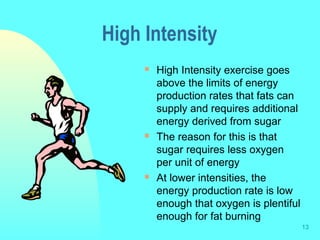
High Intensity
 High Intensity exercise goes
above the limits of energy
production rates that fats can
supply and requires additional
energy derived from sugar
 The reason for this is that
sugar requires less oxygen
per unit of energy
 At lower intensities, the
energy production rate is low
enough that oxygen is plentiful
enough for fat burning
14
Very High Intensity
 At very high intensities the aerobic system
reaches its limitations for energy generation
(fat or sugar)
 The anaerobic system takes over
 Only a little of the potential energy of glucose
is released but it is done so in a very rapid
manner to meet short duration and very high
energy production rates
15
The Benefits of Exercise At Any
Intensity
 Low intensity exercise is
not the best form for
weight loss
 Intramuscular stores (fat or
glycogen) are depleted
 During the recovery
phase (post exercise)
fats and carbs from the
diet will go to restoring
those levels
 High intensity exercise can
lead to fat loss because
with depletion of glycogen
those glycogen stores must
be replenished with dietary
carbs that would otherwise
be burned for energy
 While that storage process
is occurring, the body will
burn extra fat to supply
current energy needs
16
To Sum It All Up
 High intensity exercise
has its limitations
because that pace
cannot be maintained for
a long period of time
 Total calories burned will
be limited
 Consuming some form
of glucose during the
exercise to maintain
energy may be
necessary for
performance
consideration only
 It is unnecessary to consume
any form of glucose during an
exercise workout with a
duration of two hours at a
moderate intensity if weight
loss is your goal
 Aerobic exercise improves
the body’s ability to burn fats
for energy
 Therefore no additional
supply of fuel is needed at
the time
Liver
Glycogen
Blood
Glucose
Muscle
Glycogen
Carbohydrate Stores after an Overnight Fast
Sedentary
4 grams
100
grams
400
grams
Liver
Glycogen
Blood
Glucose
Muscle
Glycogen
Carbohydrate Stores after an Overnight Fast
1 hr of Exercise
4 grams
100
grams
400
grams
Liver
Glycogen
Blood
Glucose
Muscle
Glycogen
Carbohydrate Stores after an Overnight Fast
2 hr of Exercise
4 grams
100
grams
400
grams
Liver
Glycogen
Blood
Glucose
Muscle
Glycogen
Carbohydrate Stores after an Overnight Fast
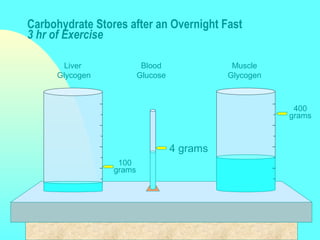
3 hr of Exercise
4 grams
100
grams
400
grams
Liver
Glycogen
Blood
Glucose
Muscle
Glycogen
Carbohydrate Stores after an Overnight Fast
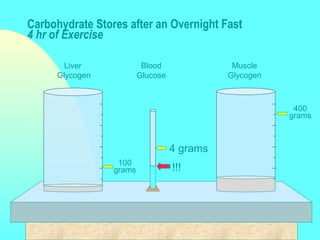
4 hr of Exercise
4 grams
100
grams
400
grams
!!!
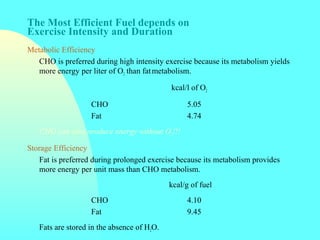
The Most Efficient Fuel depends on
Exercise Intensity and Duration
Metabolic Efficiency
CHO is preferred during high intensity exercise because its metabolism yields
more energy per liter of O2 than fatmetabolism.
kcal/l of O2
CHO 5.05
Fat 4.74
CHO can also produce energy without O2!!!
Storage Efficiency
Fat is preferred during prolonged exercise because its metabolism provides
more energy per unit mass than CHO metabolism.
kcal/g of fuel
CHO 4.10
Fat 9.45
Fats are stored in the absence of H2O.
23
THE END

Carbohydrate and fat utilization during exercise 24 july 16

  • 1.
    1 Carbohydrate and Fat UtilizationDuring Exercise Developed by: AQ Khan
  • 2.
    2 Key Terms        CARBOHYDRATESthey contain carbon and water, and are the perfered fuel source during intense exercise.        ATP supplies the enegy for all forms of biologic work.        TCA CYCLE fats and carbohydrates are burned in the mitochondria.
  • 3.
    3 Terms Continued     FATa molecule that has the same structural elements as a carbohydrate except that it differs in its linkage of atoms. fats are commonly known as lipids.    CLYCOGEN stored in active muscle supplies almost all of the energy in the translation from rest to moderate, submaximal exercise, just as it does in intense exercise.
  • 4.
    4 Terms Continued        GLYCOGENPHOSPHORYLASE augments glycogen breakdown in the liver and active muscle.        GLUCOSE can also be called dextrose, or blood sugar, occurs naturally in food. the digestion of complex carbohydrates can produce glucose.       TRIGLYCERIDES the simple lipids, or neutral fats. they are the most plentiful fats of the body. they constitute the major storage form of fat in the adipose (fat) cells.
  • 5.
    5 Energy Substrate Comesin Two Varieties  Carbohydrates  Fats In Two Sources Intramuscular Blood
  • 6.
    6 Exercise Intensity andDuration  For all energy substrates, carbs and fats, ultimately ATP is generated in the muscle cell as the high energy substrate for moving muscle.  Energy can be generated aerobically or anaerobically  Fats and carbs get burned in mitochondria by the TCA cycle  Carbs can also be broken down in the absence of oxygen for limited energy production
  • 7.
    7 FAT SOURCES  Fatfor fuel is in the form of free fatty acids  Two sources of these fats are  Peripheral fat stores • Rolls of fat on the belly  Intramuscular fat • Triglyceride stored in the actual muscle
  • 8.
    8 CARBOHYDRATE SOURCES  Carbohydratescome in two sources  Simple sugar glucose  Storage form of glucose –glycogen  Glycogen is stored in • Muscles • Liver • Blood (smallest percent in blood)  The liver is the only tissue that can release stored glycogen in the form of glucose  A function of the liver is to maintain blood sugar levels by releasing glucose through gluconeogenesis and glycogenolysis
  • 9.
    9 Fuel Utilization isDetermined by Energy Output or Intensity Level  Primarily first thing in the morning before you eat breakfast your energy demands are very low and can be met mainly by fat derived from blood free fatty acids  Free fatty acids are released at a low rate by peripheral fat stores  This allows the muscles to preserve both intramuscular fat and glycogen stores
  • 10.
    10 Fuel Utilization -Intensity low-medium-high-very high  Low intensity  Walking – energy output can be generated entirely by peripheral fat stores releasing free fatty acids The removal rate of free fatty acids by muscle cells is faster than at rest and after 20-30 minutes, there will be a stimulus to increase free fatty acid release to maintain sufficient blood concentrations of free fatty acids for efficient removal by the working muscles
  • 11.
    11 Medium Intensity  Atmedium intensity levels, you exceed the capacity of peripheral fat stores to supply enough free fatty acids to meet energy output rates  Intramuscular triglyceride is broken down to provide more fat  Peripheral fat release and uptake does not stop – it plateaus and another source is provided to makeup the needed generation rate
  • 12.
    12 Medium Intensity  Amedium intensity pace can be maintained until either your instramuscular fat stores are depleted or you run out of glycogen  When the glycogen is depleted then protein is degraded for three reasons  Amino acids can be burned for energy much like carbs  Some amino acids (branched chain ones) can supply TCA cycle intermediates to maintain aerobic energy production derived from fat burning  Some amino acids (like alanine) are secreted into the bloodstream, picked up by the liver and converted into glucose
  • 13.
    13 High Intensity  HighIntensity exercise goes above the limits of energy production rates that fats can supply and requires additional energy derived from sugar  The reason for this is that sugar requires less oxygen per unit of energy  At lower intensities, the energy production rate is low enough that oxygen is plentiful enough for fat burning
  • 14.
    14 Very High Intensity At very high intensities the aerobic system reaches its limitations for energy generation (fat or sugar)  The anaerobic system takes over  Only a little of the potential energy of glucose is released but it is done so in a very rapid manner to meet short duration and very high energy production rates
  • 15.
    15 The Benefits ofExercise At Any Intensity  Low intensity exercise is not the best form for weight loss  Intramuscular stores (fat or glycogen) are depleted  During the recovery phase (post exercise) fats and carbs from the diet will go to restoring those levels  High intensity exercise can lead to fat loss because with depletion of glycogen those glycogen stores must be replenished with dietary carbs that would otherwise be burned for energy  While that storage process is occurring, the body will burn extra fat to supply current energy needs
  • 16.
    16 To Sum ItAll Up  High intensity exercise has its limitations because that pace cannot be maintained for a long period of time  Total calories burned will be limited  Consuming some form of glucose during the exercise to maintain energy may be necessary for performance consideration only  It is unnecessary to consume any form of glucose during an exercise workout with a duration of two hours at a moderate intensity if weight loss is your goal  Aerobic exercise improves the body’s ability to burn fats for energy  Therefore no additional supply of fuel is needed at the time
  • 17.
    Liver Glycogen Blood Glucose Muscle Glycogen Carbohydrate Stores afteran Overnight Fast Sedentary 4 grams 100 grams 400 grams
  • 18.
    Liver Glycogen Blood Glucose Muscle Glycogen Carbohydrate Stores afteran Overnight Fast 1 hr of Exercise 4 grams 100 grams 400 grams
  • 19.
    Liver Glycogen Blood Glucose Muscle Glycogen Carbohydrate Stores afteran Overnight Fast 2 hr of Exercise 4 grams 100 grams 400 grams
  • 20.
    Liver Glycogen Blood Glucose Muscle Glycogen Carbohydrate Stores afteran Overnight Fast 3 hr of Exercise 4 grams 100 grams 400 grams
  • 21.
    Liver Glycogen Blood Glucose Muscle Glycogen Carbohydrate Stores afteran Overnight Fast 4 hr of Exercise 4 grams 100 grams 400 grams !!!
  • 22.
    The Most EfficientFuel depends on Exercise Intensity and Duration Metabolic Efficiency CHO is preferred during high intensity exercise because its metabolism yields more energy per liter of O2 than fatmetabolism. kcal/l of O2 CHO 5.05 Fat 4.74 CHO can also produce energy without O2!!! Storage Efficiency Fat is preferred during prolonged exercise because its metabolism provides more energy per unit mass than CHO metabolism. kcal/g of fuel CHO 4.10 Fat 9.45 Fats are stored in the absence of H2O.
  • 23.

Editor's Notes

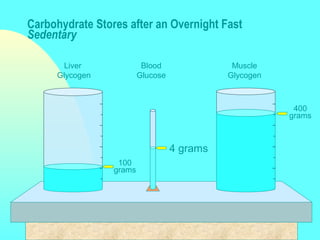
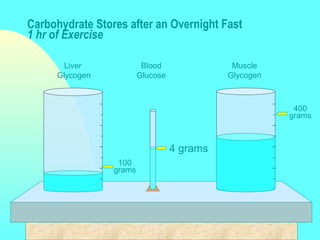
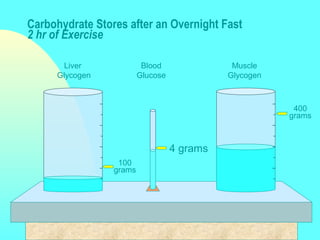
  • #18 Blood glucose is preserved at the expense of glycogen reservoirs. This is illustrated by the response to exercise. In the normal postabsorptive state. There are about 100 g of glycogen in the liver and 400 g of glycogen in muscle. With exercise CHO oxidation by the working muscle can go up by tenfold and yet after 1 h, 4 grams of glucose is maintained in the blood at the expense of liver and muscle glycogen stores. Even after 2 h the amount of glucose in the blood is constant. Even after glycogen stores get criticallly low liver gng willl kick in and limit the fall in glucose. Only after extremely long duration exercise will the blood glucose levels fall to critically low levels.
  • #19 Blood glucose is preserved at the expense of glycogen reservoirs. This is illustrated by the response to exercise. In the normal postabsorptive state. There are about 100 g of glycogen in the liver and 400 g of glycogen in muscle. With exercise CHO oxidation by the working muscle can go up by tenfold and yet after 1 h, 4 grams of glucose is maintained in the blood at the expense of liver and muscle glycogen stores. Even after 2 h the amount of glucose in the blood is constant. Even after glycogen stores get criticallly low liver gng willl kick in and limit the fall in glucose. Only after extremely long duration exercise will the blood glucose levels fall to critically low levels.
  • #20 Blood glucose is preserved at the expense of glycogen reservoirs. This is illustrated by the response to exercise. In the normal postabsorptive state. There are about 100 g of glycogen in the liver and 400 g of glycogen in muscle. With exercise CHO oxidation by the working muscle can go up by tenfold and yet after 1 h, 4 grams of glucose is maintained in the blood at the expense of liver and muscle glycogen stores. Even after 2 h the amount of glucose in the blood is constant. Even after glycogen stores get criticallly low liver gng willl kick in and limit the fall in glucose. Only after extremely long duration exercise will the blood glucose levels fall to critically low levels.
  • #21 Blood glucose is preserved at the expense of glycogen reservoirs. This is illustrated by the response to exercise. In the normal postabsorptive state. There are about 100 g of glycogen in the liver and 400 g of glycogen in muscle. With exercise CHO oxidation by the working muscle can go up by tenfold and yet after 1 h, 4 grams of glucose is maintained in the blood at the expense of liver and muscle glycogen stores. Even after 2 h the amount of glucose in the blood is constant. Even after glycogen stores get criticallly low liver gng willl kick in and limit the fall in glucose. Only after extremely long duration exercise will the blood glucose levels fall to critically low levels.
  • #22 Blood glucose is preserved at the expense of glycogen reservoirs. This is illustrated by the response to exercise. In the normal postabsorptive state. There are about 100 g of glycogen in the liver and 400 g of glycogen in muscle. With exercise CHO oxidation by the working muscle can go up by tenfold and yet after 1 h, 4 grams of glucose is maintained in the blood at the expense of liver and muscle glycogen stores. Even after 2 h the amount of glucose in the blood is constant. Even after glycogen stores get criticallly low liver gng willl kick in and limit the fall in glucose. Only after extremely long duration exercise will the blood glucose levels fall to critically low levels.