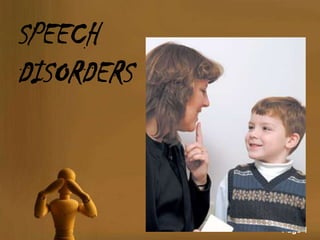
SPEECH
DISORDERS


            Page 1
TYPES OF SPEECH
          DISORDERS
APHASIA
DYSPHONIA
DYSARTHRIA
FUNCTIONAL/PSYCHOGENIC
MISCELLANEOUS


                          Page 2
PROCESS OF        ABNORMALITIES
   SPEECH

    HEARING
                      DEAFNESS


 UNDERSTANDING
                      APHASIA


  THOUGHT &
                      APHASIA
WORD PROCESSING

                     DYSPHONIA
VOICE PRODUCTION

                     DYSARTHRIA
  ARTICULATION


                                   Page 3
APHASIA

• Aphasia is defined as an acquired impairment
  in the use of language due to damage to
  certain parts of the brain
• This damage could be caused by injury,
  stroke, or seizures
• The language deficits include difficulties in
  language comprehension and execution


                                           Page 4
Page 5
MAJOR DIVISIONS OF
             APHASIA
• Fluent aphasias/Receptive aphasia
  – The inability to understand the language of others and the
    production of less meaningful speech then normal. eg; wernicke”s,
    transcortical sensory,conduction,anomic
• Non-fluent aphasias/expressive aphasia
  – Difficulty producing fluent, articulated, or self-initiated speech.eg;
    Broca”s, transcortical motor,global

• Pure aphasia
  – are selective impairments in reading, writing, or the recognition of
    words. These disorders may be quite selective. For example, a
    person is able to read but not write, or is able to write but not read.
    Examples of pure aphasias are
  – : Pure Alexia, Agraphia,Pure word deafness
                                                                      Page 6
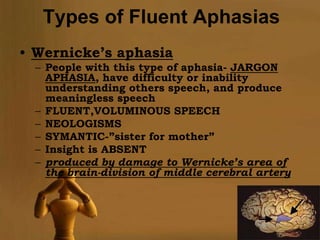
Types of Fluent Aphasias
• Wernicke’s aphasia
  – People with this type of aphasia- JARGON
    APHASIA, have difficulty or inability
    understanding others speech, and produce
    meaningless speech
  – FLUENT,VOLUMINOUS SPEECH
  – NEOLOGISMS
  – SYMANTIC-”sister for mother”
  – Insight is ABSENT
  – produced by damage to Wernicke’s area of
    the brain-division of middle cerebral artery


                                              Page 7
WERNICKE”S APHASIA


                     Page 8
More Types of Fluent Aphasia
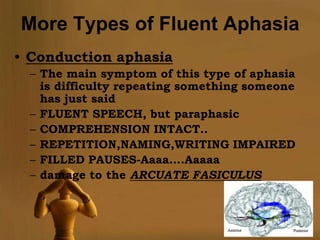
• Conduction aphasia
  – The main symptom of this type of aphasia
    is difficulty repeating something someone
    has just said
  – FLUENT SPEECH, but paraphasic
  – COMPREHENSION INTACT..
  – REPETITION,NAMING,WRITING IMPAIRED
  – FILLED PAUSES-Aaaa….Aaaaa
  – damage to the ARCUATE FASICULUS


                                          Page 9
More Types of Fluent Aphasia
• Anomic aphasia/minimal
  dysfunction syndrome/nominal
  aphasia
 – This aphasia is characterized by difficulty
   finding names and difficulty substituting
   indefinite nouns and pronouns with
   substantive words. For instance, people
   with this affliction will use words like,
   thing, stuff, or it instead of automobiles,
   groceries, or furniture.
 – Primary deficit is WORD FINDING AND
   NAMING
 – SINGLE MOST COMMON LANGUAGE
   DISTURBANCE IN HEAD TRAUMA AND
   ALZHEIMER”S D/S                           Page 10
FLUENT TRANSCORTICAL/
  TRANSCORTICAL SENSORY
          APHASIA
• Similar to WERNICKE”S APHASIA but
  REPETITION IS INTACT
• They can repeat but cant understand it


                                     Page 11
Non-Fluent Aphasias

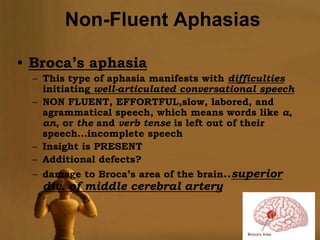
• Broca’s aphasia
  – This type of aphasia manifests with difficulties
    initiating well-articulated conversational speech
  – NON FLUENT, EFFORTFUL,slow, labored, and
    agrammatical speech, which means words like a,
    an, or the and verb tense is left out of their
    speech…incomplete speech
  – Insight is PRESENT
  – Additional defects?
  – damage to Broca’s area of the brain..superior
   div. of middle cerebral artery


                                                  Page 12
BROCA”S APHASIA


                  Page 13
More Types of Non-Fluent
         Aphasia’s
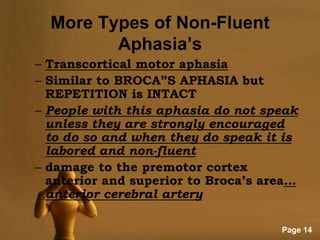
– Transcortical motor aphasia
– Similar to BROCA”S APHASIA but
  REPETITION is INTACT
– People with this aphasia do not speak
  unless they are strongly encouraged
  to do so and when they do speak it is
  labored and non-fluent
– damage to the premotor cortex
  anterior and superior to Broca’s area…
  anterior cerebral artery

                                     Page 14
More Types of Non-Fluent
          Aphasia’s
• Global aphasia
 – As the name suggests, this type of aphasia is
   characterized by a severe depression of all
   language functioning
 – NON FLUENT, naming, repetition,
   comprehension all impaired
 – damage around and to Broca’s and Wernicke’s
   areas of the brain …entire middle cerebral
   artery

                                             Page 15
Other Interesting Facts About Aphasia
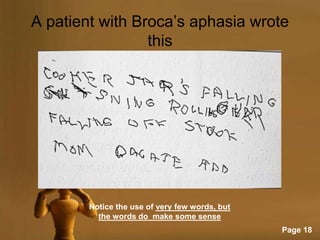
The handwriting of a person with an aphasia
      reflects their speech impediment.

There was an experiment done where people
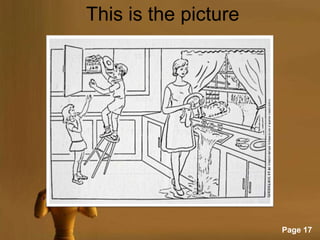
 with Broca’s and Wernicke’s aphasias were
  presented with a picture and then asked to
 write down a description of what they say in
                 the picture.


                                          Page 16
This is the picture


                      Page 17
A patient with Broca’s aphasia wrote
                 this


        Notice the use of very few words, but
          the words do make some sense
                                                Page 18
A patient with Wernicke’s aphasia
             wrote this


      Notice here that there are many, less
      forced, words, but they don’t make
      much sense. Also because they’re not
      struggling to find their words, the
      handwriting is better                   Page 19
Type of aphasia Repetition Naming       Auditory         Fluency
                                      comprehension
 Wernicke’s                  mild–                        fluent
                 mild–mod               defective
  aphaia                     severe                     paraphasic

 Conduction        poor      poor     relatively good     fluent
  aphasia
 Nominal or                  mod–
                   mild                    mild           fluent
Anomic aphasia               severe
                                                        non-fluent,
                             mod–
Broca’s aphasia mod–severe            mild difficulty    effortful,
                             severe
                                                           slow
Global aphasia     poor      poor          poor         non-fluent
                                                             Page 20
DYSARTHRIA

• Is due to defect IN ARTICULATION.
• LANGUAGE CONTENT IS NORMAL
• TYPES- 4


                                      Page 21
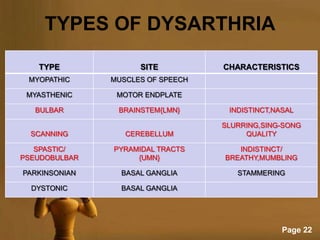
TYPES OF DYSARTHRIA

   TYPE              SITE          CHARACTERISTICS
 MYOPATHIC     MUSCLES OF SPEECH

 MYASTHENIC     MOTOR ENDPLATE

   BULBAR       BRAINSTEM{LMN}      INDISTINCT,NASAL

                                   SLURRING,SING-SONG
  SCANNING        CEREBELLUM            QUALITY

   SPASTIC/    PYRAMIDAL TRACTS       INDISTINCT/
PSEUDOBULBAR        {UMN}          BREATHY,MUMBLING

PARKINSONIAN     BASAL GANGLIA        STAMMERING

  DYSTONIC       BASAL GANGLIA


                                                 Page 22
DYSPHONIA

• Is due to defect in the production of
  sound
CAUSES
1) Laryngeal diseases-eg;laryngitis
2) Vocal cord lesions
3) Xth cranial nerve palsy
4) hysterical


                                          Page 23
OTHERS

1)   Cluttering
2)   Stammering
3)   Dysprosody-in parkinsonian disease
4)   Scanning
5)   Staccato-each syllable is uttered
     seperately


                                      Page 24
THANK YOU!!!!


                Page 25

Speech disorders

  • 1.
  • 2.
    TYPES OF SPEECH DISORDERS APHASIA DYSPHONIA DYSARTHRIA FUNCTIONAL/PSYCHOGENIC MISCELLANEOUS Page 2
  • 3.
    PROCESS OF ABNORMALITIES SPEECH HEARING DEAFNESS UNDERSTANDING APHASIA THOUGHT & APHASIA WORD PROCESSING DYSPHONIA VOICE PRODUCTION DYSARTHRIA ARTICULATION Page 3
  • 4.
    APHASIA • Aphasia isdefined as an acquired impairment in the use of language due to damage to certain parts of the brain • This damage could be caused by injury, stroke, or seizures • The language deficits include difficulties in language comprehension and execution Page 4
  • 5.
  • 6.
    MAJOR DIVISIONS OF APHASIA • Fluent aphasias/Receptive aphasia – The inability to understand the language of others and the production of less meaningful speech then normal. eg; wernicke”s, transcortical sensory,conduction,anomic • Non-fluent aphasias/expressive aphasia – Difficulty producing fluent, articulated, or self-initiated speech.eg; Broca”s, transcortical motor,global • Pure aphasia – are selective impairments in reading, writing, or the recognition of words. These disorders may be quite selective. For example, a person is able to read but not write, or is able to write but not read. Examples of pure aphasias are – : Pure Alexia, Agraphia,Pure word deafness Page 6
  • 7.
    Types of FluentAphasias • Wernicke’s aphasia – People with this type of aphasia- JARGON APHASIA, have difficulty or inability understanding others speech, and produce meaningless speech – FLUENT,VOLUMINOUS SPEECH – NEOLOGISMS – SYMANTIC-”sister for mother” – Insight is ABSENT – produced by damage to Wernicke’s area of the brain-division of middle cerebral artery Page 7
  • 8.
  • 9.
    More Types ofFluent Aphasia • Conduction aphasia – The main symptom of this type of aphasia is difficulty repeating something someone has just said – FLUENT SPEECH, but paraphasic – COMPREHENSION INTACT.. – REPETITION,NAMING,WRITING IMPAIRED – FILLED PAUSES-Aaaa….Aaaaa – damage to the ARCUATE FASICULUS Page 9
  • 10.
    More Types ofFluent Aphasia • Anomic aphasia/minimal dysfunction syndrome/nominal aphasia – This aphasia is characterized by difficulty finding names and difficulty substituting indefinite nouns and pronouns with substantive words. For instance, people with this affliction will use words like, thing, stuff, or it instead of automobiles, groceries, or furniture. – Primary deficit is WORD FINDING AND NAMING – SINGLE MOST COMMON LANGUAGE DISTURBANCE IN HEAD TRAUMA AND ALZHEIMER”S D/S Page 10
  • 11.
    FLUENT TRANSCORTICAL/ TRANSCORTICAL SENSORY APHASIA • Similar to WERNICKE”S APHASIA but REPETITION IS INTACT • They can repeat but cant understand it Page 11
  • 12.
    Non-Fluent Aphasias • Broca’saphasia – This type of aphasia manifests with difficulties initiating well-articulated conversational speech – NON FLUENT, EFFORTFUL,slow, labored, and agrammatical speech, which means words like a, an, or the and verb tense is left out of their speech…incomplete speech – Insight is PRESENT – Additional defects? – damage to Broca’s area of the brain..superior div. of middle cerebral artery Page 12
  • 13.
  • 14.
    More Types ofNon-Fluent Aphasia’s – Transcortical motor aphasia – Similar to BROCA”S APHASIA but REPETITION is INTACT – People with this aphasia do not speak unless they are strongly encouraged to do so and when they do speak it is labored and non-fluent – damage to the premotor cortex anterior and superior to Broca’s area… anterior cerebral artery Page 14
  • 15.
    More Types ofNon-Fluent Aphasia’s • Global aphasia – As the name suggests, this type of aphasia is characterized by a severe depression of all language functioning – NON FLUENT, naming, repetition, comprehension all impaired – damage around and to Broca’s and Wernicke’s areas of the brain …entire middle cerebral artery Page 15
  • 16.
    Other Interesting FactsAbout Aphasia The handwriting of a person with an aphasia reflects their speech impediment. There was an experiment done where people with Broca’s and Wernicke’s aphasias were presented with a picture and then asked to write down a description of what they say in the picture. Page 16
  • 17.
    This is thepicture Page 17
  • 18.
    A patient withBroca’s aphasia wrote this Notice the use of very few words, but the words do make some sense Page 18
  • 19.
    A patient withWernicke’s aphasia wrote this Notice here that there are many, less forced, words, but they don’t make much sense. Also because they’re not struggling to find their words, the handwriting is better Page 19
  • 20.
    Type of aphasiaRepetition Naming Auditory Fluency comprehension Wernicke’s mild– fluent mild–mod defective aphaia severe paraphasic Conduction poor poor relatively good fluent aphasia Nominal or mod– mild mild fluent Anomic aphasia severe non-fluent, mod– Broca’s aphasia mod–severe mild difficulty effortful, severe slow Global aphasia poor poor poor non-fluent Page 20
  • 21.
    DYSARTHRIA • Is dueto defect IN ARTICULATION. • LANGUAGE CONTENT IS NORMAL • TYPES- 4 Page 21
  • 22.
    TYPES OF DYSARTHRIA TYPE SITE CHARACTERISTICS MYOPATHIC MUSCLES OF SPEECH MYASTHENIC MOTOR ENDPLATE BULBAR BRAINSTEM{LMN} INDISTINCT,NASAL SLURRING,SING-SONG SCANNING CEREBELLUM QUALITY SPASTIC/ PYRAMIDAL TRACTS INDISTINCT/ PSEUDOBULBAR {UMN} BREATHY,MUMBLING PARKINSONIAN BASAL GANGLIA STAMMERING DYSTONIC BASAL GANGLIA Page 22
  • 23.
    DYSPHONIA • Is dueto defect in the production of sound CAUSES 1) Laryngeal diseases-eg;laryngitis 2) Vocal cord lesions 3) Xth cranial nerve palsy 4) hysterical Page 23
  • 24.
    OTHERS 1) Cluttering 2) Stammering 3) Dysprosody-in parkinsonian disease 4) Scanning 5) Staccato-each syllable is uttered seperately Page 24
  • 25.