Communication Disorders04:254 Adolescent with ExceptionalitiesMicheal Stanger & Josh Braaksma
What is a Communication Disorder The term “Communication Disorders" incorporates a wide assortment of struggles in language, speech, and hearing. With communication disorders covering a wide variety of different disorders; a student with a communication disorder may present a variety of characteristics including the inability to follow directions, slow and incomprehensible speech, and pronounced difficulties in syntax and articulationCommunication disorder- cannot be defined as one disorder and is broken up with the two major streams being Speech and Language
Possible Causes of Communication Disabilities Many believe that communication disorders are genetically based.  However other environmental factors have also been attributed to causes including: Drugs being taken during pregnancySTI’s such as syphilisBirthing traumaMost common conditions affecting communication include:Language-based learning disabilities, ADD, ADHD, cerebral palsy, mental disabilities, cleft lip or palate, and autism spectrum disorders
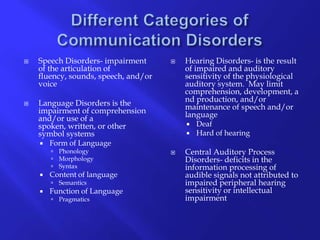
Different Categories of Communication DisordersSpeech Disorders- impairment of the articulation of fluency, sounds, speech, and/or voiceLanguage Disorders is the impairment of comprehension and/or use of a spoken, written, or other symbol systems Form of LanguagePhonologyMorphologySyntaxContent of languageSemanticsFunction of LanguagePragmaticsHearing Disorders- is the result of impaired and auditory sensitivity of the physiological auditory system.  May limit comprehension, development, and production, and/or maintenance of speech and/or languageDeaf Hard of hearingCentral Auditory Process Disorders- deficits in the information processing of audible signals not attributed to impaired peripheral hearing sensitivity or intellectual impairment
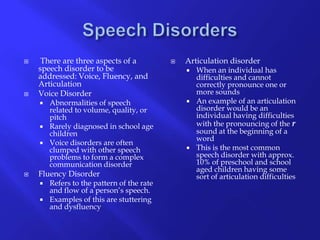
Speech Disorders There are three aspects of a speech disorder to be addressed: Voice, Fluency, and ArticulationVoice DisorderAbnormalities of speech related to volume, quality, or pitchRarely diagnosed in school age children Voice disorders are often clumped with other speech problems to form a complex communication disorder  Fluency DisorderRefers to the pattern of the rate and flow of a person’s speech.Examples of this are stuttering and dysfluencyArticulation disorderWhen an individual has difficulties and cannot correctly pronounce one or more soundsAn example of an articulation disorder would be an individual having difficulties with the pronouncing of the rsound at the beginning of a wordThis is the most common speech disorder with approx. 10% of preschool and school aged children having some sort of articulation difficulties
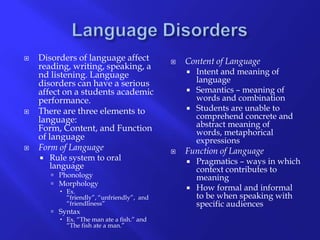
Language DisordersDisorders of language affect reading, writing, speaking, and listening. Language disorders can have a serious affect on a students academic performance. There are three elements to language: Form, Content, and Function of languageForm of LanguageRule system to oral languagePhonologyMorphologyEx. “friendly”, “unfriendly”,  and “friendliness”SyntaxEx. “The man ate a fish.” and “The fish ate a man.”Content of LanguageIntent and meaning of languageSemantics – meaning of words and combinationStudents are unable to comprehend concrete and abstract meaning of words, metaphorical expressionsFunction of Language Pragmatics – ways in which context contributes to meaningHow formal and informal to be when speaking with specific audiences
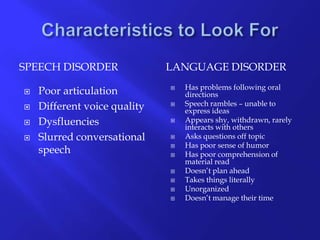
Characteristics to Look ForSpeech disorderLanguage disorderPoor articulation Different voice qualityDysfluenciesSlurred conversational speechHas problems following oral directionsSpeech rambles – unable to express ideasAppears shy, withdrawn, rarely interacts with othersAsks questions off topicHas poor sense of humorHas poor comprehension of material readDoesn’t plan aheadTakes things literallyUnorganizedDoesn’t manage their time
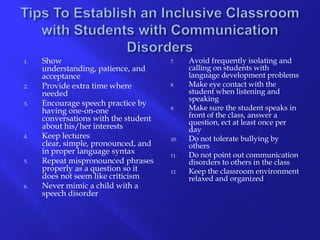
Tips To Establish an Inclusive Classroom with Students with Communication Disorders Show understanding, patience, and acceptanceProvide extra time where neededEncourage speech practice by having one-on-one conversations with the student about his/her interestsKeep lectures clear, simple, pronounced, and in proper language syntaxRepeat mispronounced phrases properly as a question so it does not seem like criticism Never mimic a child with a speech disorder Avoid frequently isolating and calling on students with language development problemsMake eye contact with the student when listening and speakingMake sure the student speaks in front of the class, answer a question, ect at least once per dayDo not tolerate bullying by othersDo not point out communication disorders to others in the classKeep the classroom environment relaxed and organized
Teaching StrategiesMany of the speech problems that are demonstrated by students while they are young can be modified and corrected with therapyThere are a number of communication disorders meaning there are many strategies for them, but most can be used for any type of communication disorders.While therapy is taking place strategies for educators can also aid:Encourage students to participate in groupsTeach students to reinforce themselves and recognize and appreciate when they are doing wellLet students practice skills with peers so when asked to do it in a different situation student is more comfortableLet students record themselves and you to distinguish between right and wrong speechDevelop strategies with the student to address those situations which make them most nervousUse real life activities in classroom (have a newscast, make a movie, etc.)Storytelling and class/group reading followed with writingUse music and play games
More StrategiesArrangement of classroom and studentsSitting student near front of roomBudding up studentsAllowing student to read a graphic novel Use of audio booksGiving practice and build up assignmentsExtra time maybe needed for these studentsExtra instruction after oral class instruction will most likely be neededWrite directions/instruction for things in class around the room with picturesEmphasize what is being said with nonverbal cues, gestures, and facial expressions
Technology Assistive Speech Devices and Methods for communication disordersSign LanguageCommunication BoardsPicture Exchange Hand-Held or computer electronic speech devicesBooks for them to read that help with specific soundsAssistive Hearing DevicesHearing Aids Cochlear Implants FM Devices
ReferencesDowdy, Francis, McIntyre, Patton, Polloway, Smith. (2010). Teaching Students with Special Needs in Inclusive Settings: Third Canadian Edition. Pearson Education Canada, Toronto. Keller, E. (2005, April 22). Strategies For Teaching Students With Communication Disorders. Retrieved February 9, 2011, from Google. Kuder, S. Jay (2008) Teaching Students with Language and Communication Disabilities: Third Edition. Pearson Education Canada, Toronto. Plumley, K. (2009, August 27). Communication Disorders in the Classroom. In Suite 101. Retrieved February 9, 2011, from Google.

Communication disorders

  • 1.
    Communication Disorders04:254 Adolescentwith ExceptionalitiesMicheal Stanger & Josh Braaksma
  • 2.
    What is aCommunication Disorder The term “Communication Disorders" incorporates a wide assortment of struggles in language, speech, and hearing. With communication disorders covering a wide variety of different disorders; a student with a communication disorder may present a variety of characteristics including the inability to follow directions, slow and incomprehensible speech, and pronounced difficulties in syntax and articulationCommunication disorder- cannot be defined as one disorder and is broken up with the two major streams being Speech and Language
  • 3.
    Possible Causes ofCommunication Disabilities Many believe that communication disorders are genetically based. However other environmental factors have also been attributed to causes including: Drugs being taken during pregnancySTI’s such as syphilisBirthing traumaMost common conditions affecting communication include:Language-based learning disabilities, ADD, ADHD, cerebral palsy, mental disabilities, cleft lip or palate, and autism spectrum disorders
  • 4.
    Different Categories ofCommunication DisordersSpeech Disorders- impairment of the articulation of fluency, sounds, speech, and/or voiceLanguage Disorders is the impairment of comprehension and/or use of a spoken, written, or other symbol systems Form of LanguagePhonologyMorphologySyntaxContent of languageSemanticsFunction of LanguagePragmaticsHearing Disorders- is the result of impaired and auditory sensitivity of the physiological auditory system. May limit comprehension, development, and production, and/or maintenance of speech and/or languageDeaf Hard of hearingCentral Auditory Process Disorders- deficits in the information processing of audible signals not attributed to impaired peripheral hearing sensitivity or intellectual impairment
  • 5.
    Speech Disorders Thereare three aspects of a speech disorder to be addressed: Voice, Fluency, and ArticulationVoice DisorderAbnormalities of speech related to volume, quality, or pitchRarely diagnosed in school age children Voice disorders are often clumped with other speech problems to form a complex communication disorder  Fluency DisorderRefers to the pattern of the rate and flow of a person’s speech.Examples of this are stuttering and dysfluencyArticulation disorderWhen an individual has difficulties and cannot correctly pronounce one or more soundsAn example of an articulation disorder would be an individual having difficulties with the pronouncing of the rsound at the beginning of a wordThis is the most common speech disorder with approx. 10% of preschool and school aged children having some sort of articulation difficulties
  • 6.
    Language DisordersDisorders oflanguage affect reading, writing, speaking, and listening. Language disorders can have a serious affect on a students academic performance. There are three elements to language: Form, Content, and Function of languageForm of LanguageRule system to oral languagePhonologyMorphologyEx. “friendly”, “unfriendly”, and “friendliness”SyntaxEx. “The man ate a fish.” and “The fish ate a man.”Content of LanguageIntent and meaning of languageSemantics – meaning of words and combinationStudents are unable to comprehend concrete and abstract meaning of words, metaphorical expressionsFunction of Language Pragmatics – ways in which context contributes to meaningHow formal and informal to be when speaking with specific audiences
  • 7.
    Characteristics to LookForSpeech disorderLanguage disorderPoor articulation Different voice qualityDysfluenciesSlurred conversational speechHas problems following oral directionsSpeech rambles – unable to express ideasAppears shy, withdrawn, rarely interacts with othersAsks questions off topicHas poor sense of humorHas poor comprehension of material readDoesn’t plan aheadTakes things literallyUnorganizedDoesn’t manage their time
  • 8.
    Tips To Establishan Inclusive Classroom with Students with Communication Disorders Show understanding, patience, and acceptanceProvide extra time where neededEncourage speech practice by having one-on-one conversations with the student about his/her interestsKeep lectures clear, simple, pronounced, and in proper language syntaxRepeat mispronounced phrases properly as a question so it does not seem like criticism Never mimic a child with a speech disorder Avoid frequently isolating and calling on students with language development problemsMake eye contact with the student when listening and speakingMake sure the student speaks in front of the class, answer a question, ect at least once per dayDo not tolerate bullying by othersDo not point out communication disorders to others in the classKeep the classroom environment relaxed and organized
  • 9.
    Teaching StrategiesMany ofthe speech problems that are demonstrated by students while they are young can be modified and corrected with therapyThere are a number of communication disorders meaning there are many strategies for them, but most can be used for any type of communication disorders.While therapy is taking place strategies for educators can also aid:Encourage students to participate in groupsTeach students to reinforce themselves and recognize and appreciate when they are doing wellLet students practice skills with peers so when asked to do it in a different situation student is more comfortableLet students record themselves and you to distinguish between right and wrong speechDevelop strategies with the student to address those situations which make them most nervousUse real life activities in classroom (have a newscast, make a movie, etc.)Storytelling and class/group reading followed with writingUse music and play games
  • 10.
    More StrategiesArrangement ofclassroom and studentsSitting student near front of roomBudding up studentsAllowing student to read a graphic novel Use of audio booksGiving practice and build up assignmentsExtra time maybe needed for these studentsExtra instruction after oral class instruction will most likely be neededWrite directions/instruction for things in class around the room with picturesEmphasize what is being said with nonverbal cues, gestures, and facial expressions
  • 11.
    Technology Assistive SpeechDevices and Methods for communication disordersSign LanguageCommunication BoardsPicture Exchange Hand-Held or computer electronic speech devicesBooks for them to read that help with specific soundsAssistive Hearing DevicesHearing Aids Cochlear Implants FM Devices
  • 12.
    ReferencesDowdy, Francis, McIntyre,Patton, Polloway, Smith. (2010). Teaching Students with Special Needs in Inclusive Settings: Third Canadian Edition. Pearson Education Canada, Toronto. Keller, E. (2005, April 22). Strategies For Teaching Students With Communication Disorders. Retrieved February 9, 2011, from Google. Kuder, S. Jay (2008) Teaching Students with Language and Communication Disabilities: Third Edition. Pearson Education Canada, Toronto. Plumley, K. (2009, August 27). Communication Disorders in the Classroom. In Suite 101. Retrieved February 9, 2011, from Google.