Language development
Language development is a process
starting early in human life, when a
person begins to acquire language by
learning it as it is spoken and by
mimicry.
Children's language development moves from simple to
complex. Infants start without language. Yet by four months
of age, babies can read lips and discriminate speech
sounds.
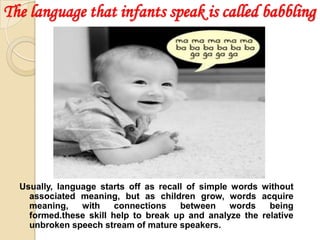
The language that infants speak is called babbling
Usually, language starts off as recall of simple words without
associated meaning, but as children grow, words acquire
meaning, with connections between words being
formed.these skill help to break up and analyze the relative
unbroken speech stream of mature speakers.
 By 5 months infants can discriminate thier own language
even among others with the same prosodic pattern .
 By 8 months children began to store the sound patterns for
words although meaning---beyond this sound pattern goes
with this entity----- is attached
 By 9 months,children are using both the prosodic and
phonotactic clues,to discern individual speech sounds.
 Most words spoken to the infant by caregivers occur in
context in the presence of entities and people to whom the
caregivers refers.As a result,the infants hear the word while
experiencing the entity or person.Up through age
2,comprehension is highly contex-dependant.
 In short,infants may use
semantic,syntactic,phonological,stress-pattern and
contextual cues in combination to break the speech stream
and intrpretation.
TODDLER’S
LANGUAGE
DEVELOPMENT
A toddler is a young child, usually defined as
being between the ages of one and four.
 Toddler development refers to
the change that occur in children aged
between 1 and 4 years
Change may occur as a result of
genetic processes known as maturation,
or may be due to environmental
factors and learning. Usually it involves
an interaction between the two.
 Early language development is
characterized by single-word utterances
and by early multiword combination
.Learning strategies may differ from
children who produce individual
words,mostly nouns,to those who
produce unanalyzed phrases,such as i
don't know.these phrases are called
formulas represent a whole-to-part
strategy of learning that seems to be less
efficient than learning words and building
to longer utterances.
 First words fill the intentions previously served
by gestures or vocalization.
 A toddler's first word most often occurs around
12 months, but again this is only an average.
The child will then continue to steadily add to his
or her vocabulary until around the age of 18
months when language increases rapidly. He or
she may learn as many as 7-9 new words a day.
Around this time, toddlers generally know about
50 words. At 21 months is when toddlers begin
to incorporate two word phrases into their
vocabulary, such as "I go", "mama give", and
"baby play". Before going to sleep they often
engage in a monologue called crib talk in which
they practice conversational skills. At this age,
children are becoming very proficient at
conveying their wants and needs to their parents
 It is important to note
that toddlers not only
imitate others or name
objects.They use their
language to influence
others,to obtain
information,to give
information,and to
engage in
conversational give and
take.
Toddler seem to make 6 assumptions
about the words they hear
 Words refer to entities
 Words are extendable to similar
appearing entities
 Words refer to the whole entity not to the
parts
 Words can be grouped categorically
 Novel words go with previously unamed
entities
 Words are used consistently
 In toddlers most words are learned receptively and
then produced expressively.
 Word learning can be influenced by many
variabels .In general girls seem to begin to aquire
words earlier and have faster initial learning than
boys.
 The childs's first words are simple.Most contain
one or two syllables;syllabic constructions usually
consist of VC (vowel-consonent) (EAT) .CV
(key),CVCV(mama) or CVCV (baby) .
 Frequently used words would be recognized by the
child more quickly and accurately and produced
more rapidly than infrquent ones.On the other
hand high density or lots of neighbours can resut
in more confusion and slower less accurate
recognition and production
Wo r d s a r e
n o t b u i l t
p h e n o me b y
p h e n o me b u t
a r e
p e r c i e v e d ,l e
a r n e d ,a n d
p r o d u c e d a s
 The toddler operate with several
constraints of attentions ,memory, and
knowledge.
 The child's meaning encompasses a
small portion of adults' full defination.
FoR Example :
The child might hear an adult say Won't
fit,when the child tries to pull her wagon
through the door.She may later uses
the word fit to mean too big,i can't do
it.or as a general negation of an action.
overextentions/underextention
s
 In the proces of refining meanings the
child forms hypothesis and underlying
concepts and extends his current
meaning to include new examples.Some
of his concepts are restricted,while
others are extended widely.
overly restricted meanings are called
underextentios,in
contrast,overextentions are meanings
that are too broad.
Two word combination
 Children organize their early words by semantic or
meaning,categories.At the two-word stage,children
follow simple linear word-order patterns of
constructionthat indicates these semantic categories.
 Within early two word combination,meaning ia
signaled by word order.Relationship are expressed
by simple word order rules rather than through
syntactic relationship.The childs' initial words reflect
her rules for each individual word involved.
 With the increasing memory and processing skills,the
child is able to produce longer utterances by
recombining the semantic patterns.When
approximately half of the child's utterances contain
two words he began to use three words
recombinations.
 The typical child produce some four-word utterance
Several learning stretgies
The toddler's language knowledge is
incresed through the use of several
learning strategeies:
 Selective imitation
 evocative uterance
 hypotheses testing
 interogative uterance
Toddlers do immitate the all that the
hears,and imitation is not random.In
general imitaion serves to stablilize
forms being learned and thus is
highly selective.
New information is gained by :
 attempting new words or forms
 awaiting feed back
 testing possible names
 askin question
 Example:
By seing a hourse , the toddler might say any of the
following
 horsie .
(evocative uterance,awaites are response )
 horsie ?
(hypothesis testing ' awaites confirmation)
 what ? that ? wassat ?
( introgative uterance , awaits answer )
KNOWLDGE IS GAINED
IN THIS WAY NOT AS A
RESULT OF DIRECT
PARENTAL INSTRUCTION
“Preschool
language
development”
“The principle is that the shape of
a building or object should be
primarily based upon its
intended function or purpose”
In the same way the communication
function or use is established first and
the child learns the language form to
convey this function more effectively
 Example:
Children ask question very early,and the
function is well etablished.
Hypothesis testing---a word stated with rising
intonation ,as in horsie?----becomes yes no
interogative.
Interogative utternaces -----wassat----becomes
wh--introgatives(what--where---who?)
In general introgatives becomes longer
more complex and more specific.
 Negative statement :
Negative statement offer 2nd example
of Form Following function.Infants
will protest over actions they do not like
and may make a stronger statement by
tantrumming(stuborness).
IT IS NOT SURPRISING THEN
THAT NEGETIVE WORDS
SUCH AS "NO" ARE OFTEN
PRESENT IN THE FIRST 50
WORDS OF TODDLER.
At first ,the negetive word is placed at the
begining of the utternace.Around the age
of 2 the child begans placing the negetive
element between the subject and
predicate as in daddy dont ride bike . By
the next few year other negetive forms
such as isn't aren't doesn't couldn't wasn't
shouldn't are added gradually.
Bootstrapping:
Bootstrapping or booting refers
to a group of metaphors that
share a common meaning: a
self-sustaining process that
proceeds by itself.
Bootstrapping refers to the
question of how language
acquisition "gets started”
 " A child gradually acquires a great deal
of interlocking knowledge about the
structure and vocabulary of his or her
language. It has sometimes been
proposed that some specific type of
linguistic knowledge can be acquired
early, and that this enables the child to
analyze words or sentences well enough
to acquire further knowledge from them.
Metaphorically, this early knowledge
would serve as bootstraps by which
the child pulls himself or herself up.
 Before their 2nd birthday,toddlers use
form such as action+agent(daddy eat)
and action+object (eat cookei)this
information is used to interpret dominant
english sentance form of
subject+verb+object(SVO)
The child assume that the first noun in
the sentence is causing some action and
so on.This strategy will aid in the
interpretation some but not all english
sentences.
In the sentence i am healthy , there is no
action and therefore, no agent.
Semantic bootstrapping:
Semantic bootstrapping in linguistics
refers to the hypothesis that children
utilize innately-known conceptual
knowledge to create grammatical
categories when acquiring their first
language.
Active involvement:
 Preschoolers are actively analyzing
incoming information,searching for
patterns,hypothesizing language
rules,and synthesizing there own
sentences based on these rules. As a
restult,preschoolers often use the full
form of structure first, even thought
the adult model may be contracted.
 Example:
Most childern will use the doggiee is
running before the doggiee’s
running .
 Fast mapping :
Word are added rapidly by a process
called fast mapping in which the child
assume the meaning from context and
then produce the word in a similar
context gradually the meaning is
refined
 Words may be fast mapped using one or more stratgies
1. the range of possible meaning may be constraint by
the situation and also by the meaning already possed
by the child. The child may assume that the new
word’s definition cannot be the same as one already
possesed.
2. possibility is that the child uses an association
startegies in which the regularity in the language,
such as word order and bound morphemes, give the
child clues as to the meaning.
3. the child may use phonetectic probablity or the
likelyhood of accurance of different sound seqences
to aid rapid re-call of newly learned words.
4. hypothesized meanings come from both the linguistic
and non lingustic context
Contrast and Conventionality :
These two strategies can be used to
determine word meaning.
Using a contrast stragetity child asume
that each word is differerent from or
contrast with every other , this strategy
occur concurruntly with the conventially
stratgegy.
In conventially strategy child assume that
certain forms will be used to convey
certain meanings.
 Using both,the child assume that speaker
will use conventional forms that clearly
contrast with eachother.
Complexity And Utterance
Length Relation :
 Childerens begin to speak in single word
utterance whice expand at 18 months of
age into two words. In quick succession two
word utterances are combined to form three
and four words utterances. By the age of
two the pre-schooler is begning to add
more morphological endings,articels and
auxilary verbs.
Embedding and Conjoining :
 Conjoining and embedding also
demonstrate the length complexity
relationship.
 Embedding is a placement of a phrase
or a clause with another clause.(kuch
nahi )
 In conjoining two independent clauses
are joind.(i went to school but my
sister stayed at home with flu.)
Obviously the two processes of
embedding and joining will
lengthen the indiviual
sentence and increase
complexity.
Avoid Exceptions :
 Anyone who has taken a foreign language
knows that rules are easier to learn then
exceptions this is also true for preschoolers.
Preschoolers seem to follow a rule that
when you find a form that works , use it .
It takes time for preschoolers to learn to
invert the verb in interogative.
Example:
 i know what are you doing.
 i remember where we went.
overgeneralizing from interrogatives,the
child may produce the following.
 I know what are you doing.
 I remember where did we go.
Finally around age five the
child learn severals
indefinate negitive forms
such as nobdy, no one ,
nothing .
Word Order is A Guide
 In english the predominat SVO word
order is very important and severs as
a guide for sentence comprehension
and formation.
The order of mention is order of accurance
in other words those things mentioned first ,
occured first.
Avoid deviation from intruption
of standard word order
Rearrangement of the word as in
interrogatives or additions that may
interrupt the sequence as in negetives and
embedding are restricted.
 Caregivers modify conversations to
maximize child participation:
 Caregivers facilitate participation in
conversation for the child in general
care giver discuss topics of interest to
the child and encourage the to
participate .
 There is a corresponding increase in
talkativeness of childern at around 36
months.
 A turnabout is usually a comment
or reply to the child’s utterance ,
followed by a question that serves
as a cue.
Example:
Child: I got a bike for my birthday
Adult: Oh,how special . can u ride all by urselgf ?
Child: No , dady helps me.
Adult: That’s probablly good until you get use to it ,
does he let go every onece in a while?
The adult provide an opertunity
for the child and gives the
signal that it is the child’s
turn. In this way the child
learn to develop a topic in
conversation.
All aspects of language are
intertwined indevelopment
Language features are
not learned in a
context that include all
elements of
language.narratives or
stories also illustrate
this interrelationship.

Language development in children

  • 1.
    Language development Language developmentis a process starting early in human life, when a person begins to acquire language by learning it as it is spoken and by mimicry. Children's language development moves from simple to complex. Infants start without language. Yet by four months of age, babies can read lips and discriminate speech sounds.
  • 2.
    The language thatinfants speak is called babbling Usually, language starts off as recall of simple words without associated meaning, but as children grow, words acquire meaning, with connections between words being formed.these skill help to break up and analyze the relative unbroken speech stream of mature speakers.
  • 3.
     By 5months infants can discriminate thier own language even among others with the same prosodic pattern .  By 8 months children began to store the sound patterns for words although meaning---beyond this sound pattern goes with this entity----- is attached  By 9 months,children are using both the prosodic and phonotactic clues,to discern individual speech sounds.  Most words spoken to the infant by caregivers occur in context in the presence of entities and people to whom the caregivers refers.As a result,the infants hear the word while experiencing the entity or person.Up through age 2,comprehension is highly contex-dependant.  In short,infants may use semantic,syntactic,phonological,stress-pattern and contextual cues in combination to break the speech stream and intrpretation.
  • 4.
  • 5.
    A toddler isa young child, usually defined as being between the ages of one and four.  Toddler development refers to the change that occur in children aged between 1 and 4 years Change may occur as a result of genetic processes known as maturation, or may be due to environmental factors and learning. Usually it involves an interaction between the two.
  • 6.
     Early languagedevelopment is characterized by single-word utterances and by early multiword combination .Learning strategies may differ from children who produce individual words,mostly nouns,to those who produce unanalyzed phrases,such as i don't know.these phrases are called formulas represent a whole-to-part strategy of learning that seems to be less efficient than learning words and building to longer utterances.
  • 7.
     First wordsfill the intentions previously served by gestures or vocalization.  A toddler's first word most often occurs around 12 months, but again this is only an average. The child will then continue to steadily add to his or her vocabulary until around the age of 18 months when language increases rapidly. He or she may learn as many as 7-9 new words a day. Around this time, toddlers generally know about 50 words. At 21 months is when toddlers begin to incorporate two word phrases into their vocabulary, such as "I go", "mama give", and "baby play". Before going to sleep they often engage in a monologue called crib talk in which they practice conversational skills. At this age, children are becoming very proficient at conveying their wants and needs to their parents
  • 8.
     It isimportant to note that toddlers not only imitate others or name objects.They use their language to influence others,to obtain information,to give information,and to engage in conversational give and take.
  • 9.
    Toddler seem tomake 6 assumptions about the words they hear  Words refer to entities  Words are extendable to similar appearing entities  Words refer to the whole entity not to the parts  Words can be grouped categorically  Novel words go with previously unamed entities  Words are used consistently
  • 10.
     In toddlersmost words are learned receptively and then produced expressively.  Word learning can be influenced by many variabels .In general girls seem to begin to aquire words earlier and have faster initial learning than boys.  The childs's first words are simple.Most contain one or two syllables;syllabic constructions usually consist of VC (vowel-consonent) (EAT) .CV (key),CVCV(mama) or CVCV (baby) .  Frequently used words would be recognized by the child more quickly and accurately and produced more rapidly than infrquent ones.On the other hand high density or lots of neighbours can resut in more confusion and slower less accurate recognition and production
  • 11.
    Wo r ds a r e n o t b u i l t p h e n o me b y p h e n o me b u t a r e p e r c i e v e d ,l e a r n e d ,a n d p r o d u c e d a s
  • 12.
     The toddleroperate with several constraints of attentions ,memory, and knowledge.  The child's meaning encompasses a small portion of adults' full defination. FoR Example : The child might hear an adult say Won't fit,when the child tries to pull her wagon through the door.She may later uses the word fit to mean too big,i can't do it.or as a general negation of an action.
  • 13.
    overextentions/underextention s  In theproces of refining meanings the child forms hypothesis and underlying concepts and extends his current meaning to include new examples.Some of his concepts are restricted,while others are extended widely. overly restricted meanings are called underextentios,in contrast,overextentions are meanings that are too broad.
  • 14.
    Two word combination Children organize their early words by semantic or meaning,categories.At the two-word stage,children follow simple linear word-order patterns of constructionthat indicates these semantic categories.  Within early two word combination,meaning ia signaled by word order.Relationship are expressed by simple word order rules rather than through syntactic relationship.The childs' initial words reflect her rules for each individual word involved.  With the increasing memory and processing skills,the child is able to produce longer utterances by recombining the semantic patterns.When approximately half of the child's utterances contain two words he began to use three words recombinations.  The typical child produce some four-word utterance
  • 15.
    Several learning stretgies Thetoddler's language knowledge is incresed through the use of several learning strategeies:  Selective imitation  evocative uterance  hypotheses testing  interogative uterance
  • 16.
    Toddlers do immitatethe all that the hears,and imitation is not random.In general imitaion serves to stablilize forms being learned and thus is highly selective. New information is gained by :  attempting new words or forms  awaiting feed back  testing possible names  askin question
  • 17.
     Example: By seinga hourse , the toddler might say any of the following  horsie . (evocative uterance,awaites are response )  horsie ? (hypothesis testing ' awaites confirmation)  what ? that ? wassat ? ( introgative uterance , awaits answer )
  • 18.
    KNOWLDGE IS GAINED INTHIS WAY NOT AS A RESULT OF DIRECT PARENTAL INSTRUCTION
  • 19.
  • 21.
    “The principle isthat the shape of a building or object should be primarily based upon its intended function or purpose” In the same way the communication function or use is established first and the child learns the language form to convey this function more effectively
  • 22.
     Example: Children askquestion very early,and the function is well etablished. Hypothesis testing---a word stated with rising intonation ,as in horsie?----becomes yes no interogative. Interogative utternaces -----wassat----becomes wh--introgatives(what--where---who?) In general introgatives becomes longer more complex and more specific.
  • 23.
     Negative statement: Negative statement offer 2nd example of Form Following function.Infants will protest over actions they do not like and may make a stronger statement by tantrumming(stuborness).
  • 24.
    IT IS NOTSURPRISING THEN THAT NEGETIVE WORDS SUCH AS "NO" ARE OFTEN PRESENT IN THE FIRST 50 WORDS OF TODDLER.
  • 25.
    At first ,thenegetive word is placed at the begining of the utternace.Around the age of 2 the child begans placing the negetive element between the subject and predicate as in daddy dont ride bike . By the next few year other negetive forms such as isn't aren't doesn't couldn't wasn't shouldn't are added gradually.
  • 26.
    Bootstrapping: Bootstrapping or bootingrefers to a group of metaphors that share a common meaning: a self-sustaining process that proceeds by itself. Bootstrapping refers to the question of how language acquisition "gets started”
  • 27.
     " Achild gradually acquires a great deal of interlocking knowledge about the structure and vocabulary of his or her language. It has sometimes been proposed that some specific type of linguistic knowledge can be acquired early, and that this enables the child to analyze words or sentences well enough to acquire further knowledge from them. Metaphorically, this early knowledge would serve as bootstraps by which the child pulls himself or herself up.
  • 28.
     Before their2nd birthday,toddlers use form such as action+agent(daddy eat) and action+object (eat cookei)this information is used to interpret dominant english sentance form of subject+verb+object(SVO) The child assume that the first noun in the sentence is causing some action and so on.This strategy will aid in the interpretation some but not all english sentences. In the sentence i am healthy , there is no action and therefore, no agent.
  • 29.
    Semantic bootstrapping: Semantic bootstrappingin linguistics refers to the hypothesis that children utilize innately-known conceptual knowledge to create grammatical categories when acquiring their first language.
  • 30.
    Active involvement:  Preschoolersare actively analyzing incoming information,searching for patterns,hypothesizing language rules,and synthesizing there own sentences based on these rules. As a restult,preschoolers often use the full form of structure first, even thought the adult model may be contracted.
  • 31.
     Example: Most childernwill use the doggiee is running before the doggiee’s running .
  • 32.
     Fast mapping: Word are added rapidly by a process called fast mapping in which the child assume the meaning from context and then produce the word in a similar context gradually the meaning is refined
  • 33.
     Words maybe fast mapped using one or more stratgies 1. the range of possible meaning may be constraint by the situation and also by the meaning already possed by the child. The child may assume that the new word’s definition cannot be the same as one already possesed. 2. possibility is that the child uses an association startegies in which the regularity in the language, such as word order and bound morphemes, give the child clues as to the meaning. 3. the child may use phonetectic probablity or the likelyhood of accurance of different sound seqences to aid rapid re-call of newly learned words. 4. hypothesized meanings come from both the linguistic and non lingustic context
  • 34.
    Contrast and Conventionality: These two strategies can be used to determine word meaning. Using a contrast stragetity child asume that each word is differerent from or contrast with every other , this strategy occur concurruntly with the conventially stratgegy. In conventially strategy child assume that certain forms will be used to convey certain meanings.  Using both,the child assume that speaker will use conventional forms that clearly contrast with eachother.
  • 35.
    Complexity And Utterance LengthRelation :  Childerens begin to speak in single word utterance whice expand at 18 months of age into two words. In quick succession two word utterances are combined to form three and four words utterances. By the age of two the pre-schooler is begning to add more morphological endings,articels and auxilary verbs.
  • 36.
    Embedding and Conjoining:  Conjoining and embedding also demonstrate the length complexity relationship.  Embedding is a placement of a phrase or a clause with another clause.(kuch nahi )  In conjoining two independent clauses are joind.(i went to school but my sister stayed at home with flu.)
  • 37.
    Obviously the twoprocesses of embedding and joining will lengthen the indiviual sentence and increase complexity.
  • 38.
    Avoid Exceptions : Anyone who has taken a foreign language knows that rules are easier to learn then exceptions this is also true for preschoolers. Preschoolers seem to follow a rule that when you find a form that works , use it . It takes time for preschoolers to learn to invert the verb in interogative.
  • 39.
    Example:  i knowwhat are you doing.  i remember where we went. overgeneralizing from interrogatives,the child may produce the following.  I know what are you doing.  I remember where did we go.
  • 40.
    Finally around agefive the child learn severals indefinate negitive forms such as nobdy, no one , nothing .
  • 41.
    Word Order isA Guide  In english the predominat SVO word order is very important and severs as a guide for sentence comprehension and formation. The order of mention is order of accurance in other words those things mentioned first , occured first.
  • 42.
    Avoid deviation fromintruption of standard word order Rearrangement of the word as in interrogatives or additions that may interrupt the sequence as in negetives and embedding are restricted.
  • 43.
     Caregivers modifyconversations to maximize child participation:  Caregivers facilitate participation in conversation for the child in general care giver discuss topics of interest to the child and encourage the to participate .  There is a corresponding increase in talkativeness of childern at around 36 months.
  • 44.
     A turnaboutis usually a comment or reply to the child’s utterance , followed by a question that serves as a cue. Example: Child: I got a bike for my birthday Adult: Oh,how special . can u ride all by urselgf ? Child: No , dady helps me. Adult: That’s probablly good until you get use to it , does he let go every onece in a while?
  • 45.
    The adult providean opertunity for the child and gives the signal that it is the child’s turn. In this way the child learn to develop a topic in conversation.
  • 46.
    All aspects oflanguage are intertwined indevelopment Language features are not learned in a context that include all elements of language.narratives or stories also illustrate this interrelationship.