Language and
                                              Speech
                                              development


Presented by: Maie Hilmy
Specialist of Psychiatry - Cairo University
Definitions:

 Language:  Communication of thoughts
 and feelings through a system of signals,
 such as voice sounds, gestures, or
 written symbols.

 Speech:
  Speech  The act of expressing or
 describing thoughts, feelings, or
 perceptions by the articulation of words
Almost every human child succeeds in
          learning language

           We tend to take the
process of language learning for granted,
 language seems like a basic instinct as
                simple as
           breathing or blinking

          In fact, it is the most
       complex ability that a human
         being will ever master.
Linguists in the Chomskyan tradition


                  Universal
                    core


A particular configuration of optional features
                ‘parameters’
Language is an
           Instinct
Driven by specifically human
  Evolutionary adaptations.
Many psychologists disagree
Language does not emerge from a unique instinct
                     But
      Operation of general processes of
                 Evolution,
                Cognition,
             Social processes,
       Facts about the human body


  Language development is a window on the
       operation of the human mind.
Developmental course of language acquisition

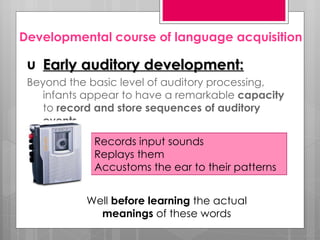
 u Early auditory development:
 Beyond the basic level of auditory processing,
    infants appear to have a remarkable capacity
    to record and store sequences of auditory
    events.
             Records input sounds
             Replays them
             Accustoms the ear to their patterns


           Well before learning the actual
             meanings of these words
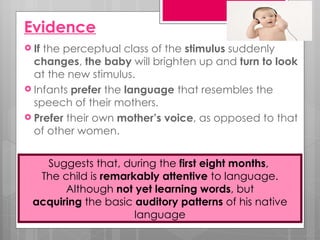
Evidence
 Ifthe perceptual class of the stimulus suddenly
  changes, the baby will brighten up and turn to look
  at the new stimulus.
 Infants prefer the language that resembles the
  speech of their mothers.
 Prefer their own mother’s voice, as opposed to that
  of other women.


    Suggests that, during the first eight months,
   The child is remarkably attentive to language.
        Although not yet learning words, but
  acquiring the basic auditory patterns of his native
                      language
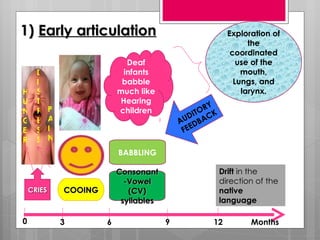
1) Early articulation                                        Exploration of
                                                                   the
                                                              coordinated
                               Deaf                             use of the
  D                           infants                            mouth,
  I                           babble                           Lungs, and
H S                          much like                           larynx.
U T                           Hearing
                                                      Y
N R         P                children               OR K
            A                                    DIT AC
G E                                           AU DB
E S         I                                  FEE
R S         N
                             BABBLING

                             Consonant                     Drift in the
                               -Vowel                      direction of the
    CRIES       COOING          (CV)                       native
                              syllables                    language

0               3        6                9            12          Months
1) The first words

   Based on three earlier developments:

 • Infant’s growing ability to record the sounds of
   words.
 • Ability to control vocal productions that occur
   in the late stages of babbling.
 • General growth of the symbolic function, as
   represented in play and imitation.
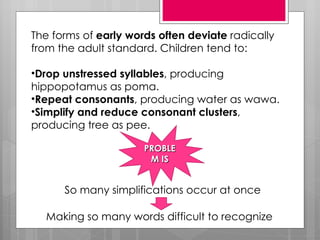
The forms of early words often deviate radically
from the adult standard. Children tend to:

•Drop unstressed syllables, producing
hippopotamus as poma.
•Repeat consonants, producing water as wawa.
•Simplify and reduce consonant clusters,
producing tree as pee.

                      PROBLE
                       M IS


      So many simplifications occur at once

  Making so many words difficult to recognize
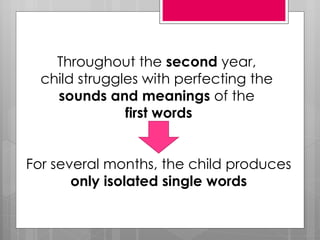
Throughout the second year,
  child struggles with perfecting the
    sounds and meanings of the
               first words


For several months, the child produces
       only isolated single words
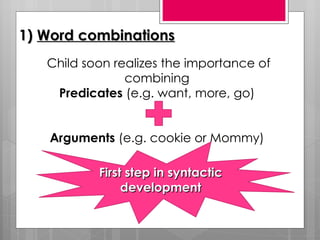
1) Word combinations
   Child soon realizes the importance of
                combining
    Predicates (e.g. want, more, go)


   Arguments (e.g. cookie or Mommy)

           First step in syntactic
                development
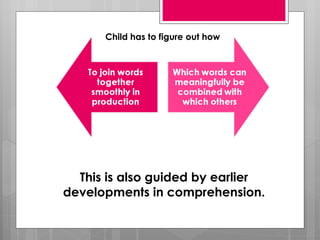
Child has to figure out how


  This is also guided by earlier
developments in comprehension.
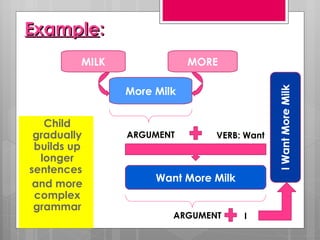
Example:
         MILK               MORE

                More Milk


   Child
 gradually      ARGUMENT       VERB: Want
 builds up
  longer
sentences
                     Want More Milk
 and more
 complex
 grammar
                        ARGUMENT      I
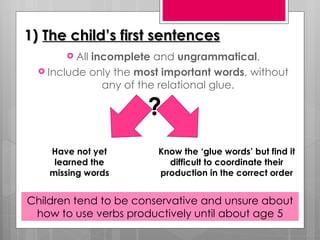
1) The child’s first sentences
        Allincomplete and ungrammatical.
   Include only the most important words, without
              any of the relational glue.

                       ?
    Have not yet         Know the ‘glue words’ but find it
     learned the           difficult to coordinate their
    missing words        production in the correct order


Children tend to be conservative and unsure about
 how to use verbs productively until about age 5
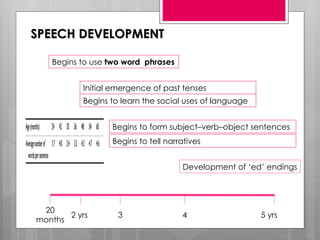
SPEECH DEVELOPMENT

   Begins to use two word phrases


          Initial emergence of past tenses
          Begins to learn the social uses of language


                 Begins to form subject–verb–object sentences
                 Begins to tell narratives


                                    Development of ‘ed’ endings


 20
       2 yrs       3                4                   5 yrs
months
TO SUM UP
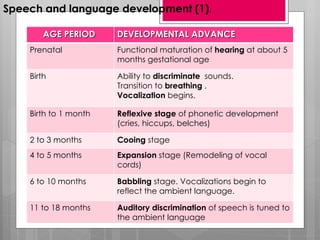
Speech and language development (1).

        AGE PERIOD     DEVELOPMENTAL ADVANCE
    Prenatal           Functional maturation of hearing at about 5
                       months gestational age

    Birth              Ability to discriminate sounds.
                       Transition to breathing .
                       Vocalization begins.

    Birth to 1 month   Reflexive stage of phonetic development
                       (cries, hiccups, belches)

    2 to 3 months      Cooing stage
    4 to 5 months      Expansion stage (Remodeling of vocal
                       cords)

    6 to 10 months     Babbling stage. Vocalizations begin to
                       reflect the ambient language.

    11 to 18 months    Auditory discrimination of speech is tuned to
                       the ambient language
Speech and language development (2).
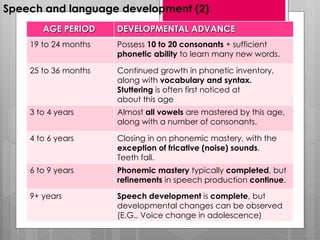
       AGE PERIOD     DEVELOPMENTAL ADVANCE
    19 to 24 months   Possess 10 to 20 consonants + sufficient
                      phonetic ability to learn many new words.

    25 to 36 months   Continued growth in phonetic inventory,
                      along with vocabulary and syntax.
                      Stuttering is often first noticed at
                      about this age
    3 to 4 years      Almost all vowels are mastered by this age,
                      along with a number of consonants.

    4 to 6 years      Closing in on phonemic mastery, with the
                      exception of fricative (noise) sounds.
                      Teeth fall.
    6 to 9 years      Phonemic mastery typically completed, but
                      refinements in speech production continue.

    9+ years          Speech development is complete, but
                      developmental changes can be observed
                      (E.G., Voice change in adolescence)
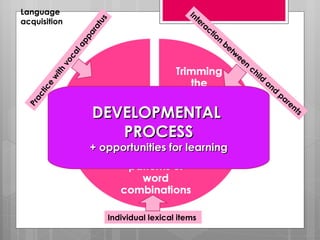
Language                                           In
                                                     te
acquisition


                       us
                                                       ra
                                                         ct


                         t
                      ra
                                                              io


                  pa
                                                                n
                                                                    be


                 ap
                                                                      tw


                  l
                                                                           ee
               ca
            vo                                                               n
                                                                                 ch
           ith

                                                                                   ild
       w


                                                                                         an
      e


                                                                                           d
     tic


                                                                                               pa
   ac


                                                                                                    re
                                                                                                      nt
 Pr


                       DEVELOPMENTAL                                                                       s

                          PROCESS
                      + opportunities for learning


                             Individual lexical items
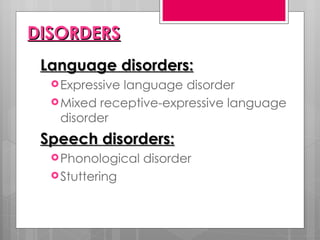
DISORDERS
 Language disorders:
   Expressive
             language disorder
   Mixed receptive-expressive language
    disorder
 Speech disorders:
   Phonological   disorder
   Stuttering
Language and speech development

Language and speech development

  • 1.
    Language and Speech development Presented by: Maie Hilmy Specialist of Psychiatry - Cairo University
  • 2.
    Definitions:  Language: Communication of thoughts and feelings through a system of signals, such as voice sounds, gestures, or written symbols.  Speech: Speech The act of expressing or describing thoughts, feelings, or perceptions by the articulation of words
  • 3.
    Almost every humanchild succeeds in learning language We tend to take the process of language learning for granted, language seems like a basic instinct as simple as breathing or blinking In fact, it is the most complex ability that a human being will ever master.
  • 4.
    Linguists in theChomskyan tradition Universal core A particular configuration of optional features ‘parameters’
  • 5.
    Language is an Instinct Driven by specifically human Evolutionary adaptations.
  • 6.
    Many psychologists disagree Languagedoes not emerge from a unique instinct But Operation of general processes of Evolution, Cognition, Social processes, Facts about the human body Language development is a window on the operation of the human mind.
  • 7.
    Developmental course oflanguage acquisition u Early auditory development: Beyond the basic level of auditory processing, infants appear to have a remarkable capacity to record and store sequences of auditory events. Records input sounds Replays them Accustoms the ear to their patterns Well before learning the actual meanings of these words
  • 8.
    Evidence  Ifthe perceptualclass of the stimulus suddenly changes, the baby will brighten up and turn to look at the new stimulus.  Infants prefer the language that resembles the speech of their mothers.  Prefer their own mother’s voice, as opposed to that of other women. Suggests that, during the first eight months, The child is remarkably attentive to language. Although not yet learning words, but acquiring the basic auditory patterns of his native language
  • 9.
    1) Early articulation Exploration of the coordinated Deaf use of the D infants mouth, I babble Lungs, and H S much like larynx. U T Hearing Y N R P children OR K A DIT AC G E AU DB E S I FEE R S N BABBLING Consonant Drift in the -Vowel direction of the CRIES COOING (CV) native syllables language 0 3 6 9 12 Months
  • 10.
    1) The firstwords Based on three earlier developments: • Infant’s growing ability to record the sounds of words. • Ability to control vocal productions that occur in the late stages of babbling. • General growth of the symbolic function, as represented in play and imitation.
  • 11.
    The forms ofearly words often deviate radically from the adult standard. Children tend to: •Drop unstressed syllables, producing hippopotamus as poma. •Repeat consonants, producing water as wawa. •Simplify and reduce consonant clusters, producing tree as pee. PROBLE M IS So many simplifications occur at once Making so many words difficult to recognize
  • 12.
    Throughout the secondyear, child struggles with perfecting the sounds and meanings of the first words For several months, the child produces only isolated single words
  • 13.
    1) Word combinations Child soon realizes the importance of combining Predicates (e.g. want, more, go) Arguments (e.g. cookie or Mommy) First step in syntactic development
  • 14.
    Child has tofigure out how This is also guided by earlier developments in comprehension.
  • 15.
    Example: MILK MORE More Milk Child gradually ARGUMENT VERB: Want builds up longer sentences Want More Milk and more complex grammar ARGUMENT I
  • 16.
    1) The child’sfirst sentences  Allincomplete and ungrammatical.  Include only the most important words, without any of the relational glue. ? Have not yet Know the ‘glue words’ but find it learned the difficult to coordinate their missing words production in the correct order Children tend to be conservative and unsure about how to use verbs productively until about age 5
  • 17.
    SPEECH DEVELOPMENT Begins to use two word phrases Initial emergence of past tenses Begins to learn the social uses of language Begins to form subject–verb–object sentences Begins to tell narratives Development of ‘ed’ endings 20 2 yrs 3 4 5 yrs months
  • 18.
  • 19.
    Speech and languagedevelopment (1). AGE PERIOD DEVELOPMENTAL ADVANCE Prenatal Functional maturation of hearing at about 5 months gestational age Birth Ability to discriminate sounds. Transition to breathing . Vocalization begins. Birth to 1 month Reflexive stage of phonetic development (cries, hiccups, belches) 2 to 3 months Cooing stage 4 to 5 months Expansion stage (Remodeling of vocal cords) 6 to 10 months Babbling stage. Vocalizations begin to reflect the ambient language. 11 to 18 months Auditory discrimination of speech is tuned to the ambient language
  • 20.
    Speech and languagedevelopment (2). AGE PERIOD DEVELOPMENTAL ADVANCE 19 to 24 months Possess 10 to 20 consonants + sufficient phonetic ability to learn many new words. 25 to 36 months Continued growth in phonetic inventory, along with vocabulary and syntax. Stuttering is often first noticed at about this age 3 to 4 years Almost all vowels are mastered by this age, along with a number of consonants. 4 to 6 years Closing in on phonemic mastery, with the exception of fricative (noise) sounds. Teeth fall. 6 to 9 years Phonemic mastery typically completed, but refinements in speech production continue. 9+ years Speech development is complete, but developmental changes can be observed (E.G., Voice change in adolescence)
  • 21.
    Language In te acquisition us ra ct t ra io pa n be ap tw l ee ca vo n ch ith ild w an e d tic pa ac re nt Pr DEVELOPMENTAL s PROCESS + opportunities for learning Individual lexical items
  • 22.
    DISORDERS Language disorders:  Expressive language disorder  Mixed receptive-expressive language disorder Speech disorders:  Phonological disorder  Stuttering