HEARING IMPAIRMENT
BY - Anant Arun
-Student of B.ASLP From SAIMS
-Date – 12/04/2018
INDEX
 Hearing Impairment
 Deafness
 Hearing impairment
 Four subcategories of hearing loss
 General signs of hearing loss Early signs of hearing
loss can include
 Educational Challenges
 Tips for Teachers and Parents
 Speech Impairment/ Language Disorder
 Speech and language subcategory
 Two General Category
 Sources:
Hearing Impairment
“an impairment in hearing, whether permanent or
fluctuating, that adversely affects a child’s
educational performance but is not included
under the definition of ‘deafness.'”
--- Individuals with Disabilities Education Act (IDEA)
Deafness
A hearing loss above 90 decibels
Hearing impairment
Hearing loss below 90 decibels.
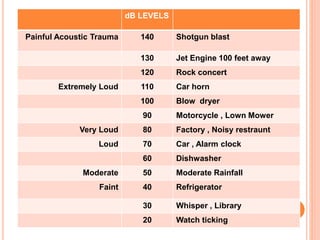
dB LEVELS
Painful Acoustic Trauma 140 Shotgun blast
130 Jet Engine 100 feet away
120 Rock concert
Extremely Loud 110 Car horn
100 Blow dryer
90 Motorcycle , Lown Mower
Very Loud 80 Factory , Noisy restraunt
Loud 70 Car , Alarm clock
60 Dishwasher
Moderate 50 Moderate Rainfall
Faint 40 Refrigerator
30 Whisper , Library
20 Watch ticking
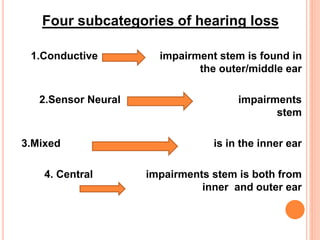
Four subcategories of hearing loss
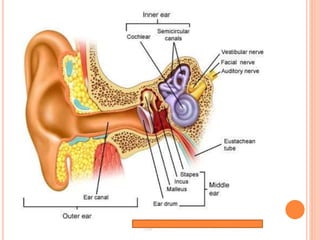
1.Conductive impairment stem is found in
the outer/middle ear
2.Sensor Neural impairments
stem
3.Mixed is in the inner ear
4. Central impairments stem is both from
inner and outer ear
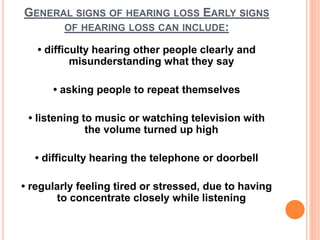
GENERAL SIGNS OF HEARING LOSS EARLY SIGNS
OF HEARING LOSS CAN INCLUDE:
• difficulty hearing other people clearly and
misunderstanding what they say
• asking people to repeat themselves
• listening to music or watching television with
the volume turned up high
• difficulty hearing the telephone or doorbell
• regularly feeling tired or stressed, due to having
to concentrate closely while listening
EDUCATIONAL CHALLENGES
• The subjects of grammar,
spelling and vocabulary
•taking notes while listening to lectures
•participating in classroom discussions
•watching educational videos
•presenting oral reports
TIPS FOR TEACHERS AND PARENTS
• Designating a note taker can allow a student
with a hearing impairment to concentrate
fully on listening to a lecture.
• A combination of traditional communication,
lip reading, sign language and assistive
technology can compensate for issues
which make listening to lectures and
participating in class discussions
challenging.
• Children who read lips often need to sit
close to the teacher, while those who use
sign language may use an interpreter
• Turning on captions during a video can
reiterate what a student may pick up from
his or her amplifying device.
•Finally, it’s important that parents and
teachers don’t underestimate a child’s
intelligence based on a hearing impairment.
•, “For most children with hearing
impairments, language acquisition and
language development are significantly
delayed. As a result, some may incorrectly
estimate the child’s intelligence as low.”
SPEECH IMPAIRMENT/ LANGUAGE DISORDER
“A communication disorder such as stuttering,
impaired articulation, a language impairment, or a
voice impairment that adversely affects a child’s
educational performance.”
“A person is unable to produce speech sounds
correctly or fluently, or has problems with his or her
voice”
SPEECH AND LANGUAGE SUBCATEGORY
1. Communication disorder such as stuttering --
fluency disorder; unusual word repetition and hesitant
speech
2. Impaired articulation -- impairments in which a child
experiences challenges in pronouncing specific sounds
3. A language impairment -- can entail difficulty
comprehending words properly, expressing oneself and
listening to others
4. A voice impairment -- involves difficulty voicing words; for
instance, throat issues may cause an abnormally soft voice
TWO GENERAL CATEGORY
1. Receptive language –
When a person has trouble understanding
others
2. Expressive Language –
When a person has trouble sharing thoughts,
ideas, and feelings completely
SOURCES:
•http://www.specialeducationguide.com/disabil
ityprofiles/hearing-impairments/
•http://www.nhs.uk/conditions/hearingimpairm
ent/Pages/Symptoms.aspx
•http://www.asha.org/public/speech/disorders/
THE END
THANK YOU
FOR SUGGESTION
@ = anantarun27@gmail.com
Instagram = anant_arun

Hearing impairment

  • 1.
    HEARING IMPAIRMENT BY -Anant Arun -Student of B.ASLP From SAIMS -Date – 12/04/2018
  • 2.
    INDEX  Hearing Impairment Deafness  Hearing impairment  Four subcategories of hearing loss  General signs of hearing loss Early signs of hearing loss can include  Educational Challenges  Tips for Teachers and Parents  Speech Impairment/ Language Disorder  Speech and language subcategory  Two General Category  Sources:
  • 3.
    Hearing Impairment “an impairmentin hearing, whether permanent or fluctuating, that adversely affects a child’s educational performance but is not included under the definition of ‘deafness.'” --- Individuals with Disabilities Education Act (IDEA) Deafness A hearing loss above 90 decibels Hearing impairment Hearing loss below 90 decibels.
  • 4.
    dB LEVELS Painful AcousticTrauma 140 Shotgun blast 130 Jet Engine 100 feet away 120 Rock concert Extremely Loud 110 Car horn 100 Blow dryer 90 Motorcycle , Lown Mower Very Loud 80 Factory , Noisy restraunt Loud 70 Car , Alarm clock 60 Dishwasher Moderate 50 Moderate Rainfall Faint 40 Refrigerator 30 Whisper , Library 20 Watch ticking
  • 5.
    Four subcategories ofhearing loss 1.Conductive impairment stem is found in the outer/middle ear 2.Sensor Neural impairments stem 3.Mixed is in the inner ear 4. Central impairments stem is both from inner and outer ear
  • 7.
    GENERAL SIGNS OFHEARING LOSS EARLY SIGNS OF HEARING LOSS CAN INCLUDE: • difficulty hearing other people clearly and misunderstanding what they say • asking people to repeat themselves • listening to music or watching television with the volume turned up high • difficulty hearing the telephone or doorbell • regularly feeling tired or stressed, due to having to concentrate closely while listening
  • 8.
    EDUCATIONAL CHALLENGES • Thesubjects of grammar, spelling and vocabulary •taking notes while listening to lectures •participating in classroom discussions •watching educational videos •presenting oral reports
  • 9.
    TIPS FOR TEACHERSAND PARENTS • Designating a note taker can allow a student with a hearing impairment to concentrate fully on listening to a lecture. • A combination of traditional communication, lip reading, sign language and assistive technology can compensate for issues which make listening to lectures and participating in class discussions challenging. • Children who read lips often need to sit close to the teacher, while those who use sign language may use an interpreter
  • 10.
    • Turning oncaptions during a video can reiterate what a student may pick up from his or her amplifying device. •Finally, it’s important that parents and teachers don’t underestimate a child’s intelligence based on a hearing impairment. •, “For most children with hearing impairments, language acquisition and language development are significantly delayed. As a result, some may incorrectly estimate the child’s intelligence as low.”
  • 11.
    SPEECH IMPAIRMENT/ LANGUAGEDISORDER “A communication disorder such as stuttering, impaired articulation, a language impairment, or a voice impairment that adversely affects a child’s educational performance.” “A person is unable to produce speech sounds correctly or fluently, or has problems with his or her voice”
  • 12.
    SPEECH AND LANGUAGESUBCATEGORY 1. Communication disorder such as stuttering -- fluency disorder; unusual word repetition and hesitant speech 2. Impaired articulation -- impairments in which a child experiences challenges in pronouncing specific sounds 3. A language impairment -- can entail difficulty comprehending words properly, expressing oneself and listening to others 4. A voice impairment -- involves difficulty voicing words; for instance, throat issues may cause an abnormally soft voice
  • 13.
    TWO GENERAL CATEGORY 1.Receptive language – When a person has trouble understanding others 2. Expressive Language – When a person has trouble sharing thoughts, ideas, and feelings completely
  • 14.
  • 15.
  • 16.
  • 17.
    FOR SUGGESTION @ =anantarun27@gmail.com Instagram = anant_arun