Chapter 10: Learners
With Communication
Disorders
Lauren Rivet & Brooke Burley
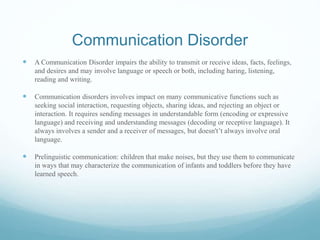
Communication Disorder
 A Communication Disorder impairs the ability to transmit or receive ideas, facts, feelings,
and desires and may involve language or speech or both, including haring, listening,
reading and writing.
 Communication disorders involves impact on many communicative functions such as
seeking social interaction, requesting objects, sharing ideas, and rejecting an object or
interaction. It requires sending messages in understandable form (encoding or expressive
language) and receiving and understanding messages (decoding or receptive language). It
always involves a sender and a receiver of messages, but doesn't’t always involve oral
language.
 Prelinguistic communication: children that make noises, but they use them to communicate
in ways that may characterize the communication of infants and toddlers before they have
learned speech.
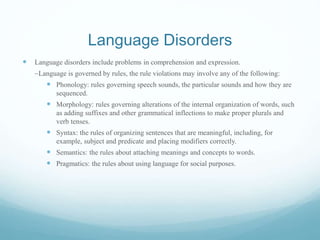
Language Disorders
 Language disorders include problems in comprehension and expression.
~Language is governed by rules, the rule violations may involve any of the following:
 Phonology: rules governing speech sounds, the particular sounds and how they are
sequenced.
 Morphology: rules governing alterations of the internal organization of words, such
as adding suffixes and other grammatical inflections to make proper plurals and
verb tenses.
 Syntax: the rules of organizing sentences that are meaningful, including, for
example, subject and predicate and placing modifiers correctly.
 Semantics: the rules about attaching meanings and concepts to words.
 Pragmatics: the rules about using language for social purposes.
Classification of Language Disorders
 Primary Language Disorder: no known cause
-Specific Language Impairment (SLI): has no identifiable cause, it is an unexpected
and unexplained variation in the acquisition of language involving multiple aspects of language.
Academic problems particularly in reading and writing are common.
-Early Expressive Language Delay (EELD): refers to a significant lag in expressive
language that the child won’t outgrow.
Language- based reading impairment: involves reading problems (example:
dyslexia) based on a language disorder.
Classification of Language Disorders
Cont.
 Secondary Language Disorders: caused by another condition, such as intellectual
disabilities, hearing impairment, autistic spectrum disorder, cerebral palsy, or traumatic
brain injury.
 Social reticence or withdrawal, severe acting out and even aggression
 Young children who have language disorders may have challenges in developing the skills
that go along with social interaction since they do not interpret social circumstances
correctly and have difficulty expressing themselves.
Speech Disorders
 Phonological Disorders:
 Don’t understand the rules for producing the sounds of their language and how to
differentiate and to put sounds of language together to make intelligible words.
 EX: children without internal representation of consonants at the end of a word produce
“hat” as “ha” and “dog” as “do”
 Articulation Disorders: involves errors in producing sounds
 Lisping- involves a substitution or distortion of the /s/ sound
 EX: “thunthine” or “shunshine” for sunshine
 The lack of ability to articulate speech sounds correctly can be caused by biological
factors, brain damage to the nerves controlling the muscles that are used in speech may
make it difficult or impossible to articulate sounds.
Voice Disorders
A voice disorder is characteristics of pitch, loudness, and/or quality that are abusive of the
larynx; hamper communication; or are perceived as markedly difficult from what is customary
for someone of a given age, gender, and cultural back ground.
 EX: cheerleaders develop a temporary disorder due to the formation of calluses on their
vocal cords.
Voice Disorders that have to do with:
 Resonance: impacting voice quality, may be caused by physical abnormalities of the oral
cavity (cleft palate) or damage to the brain or nerves controlling that area.
Fluency Disorders
 Dysfluencies: these are hesitations, repetitions, and other interruptions of normal speech
flow that are entirely normal parts of learning to use language.
 Stuttering: problem with the rate of speech flow.
EX: “It is at my hhhhhhouse…” or “I wa-wa-want…”
To avoid chronic stuttering early diagnosis is important.
Motor-Speech Disorders
 There are two types that affect the production of speech;
 Dysarthria: controlling speech sounds
 Apraxia: planning and coordinating speech
Developmental VS Acquired apraxia
 Developmental apraxia: disorder of motor planning that emerges as the child develops
speech and language skills
 Acquired apraxia: occurs because of a stroke or other type of brain damage after learning
speech
What Can the Teacher Do?
 All teachers must be aware of how they are addressing language problems in the classroom.
 Teachers primary role of the classroom is to facilitate the social use of language
 Teachers need to listen attentively and empathetically when children speak, providing appropriate
models of speech and language for children to imitate, and encouraging children to use their
communication skills appropriately, the classroom teacher can help improve speech, language, and
prevent disorders from developing.
 Teachers need to be conscious of how they ask questions to a child with this type of disorder because
teachers might not know how to modify their questions to teach concepts effectively, so their questions
just add to the child's confusion.
 A teacher that notes possible problems should ask a speech- language pathologist to conduct an
evaluation.
 Teachers shouldn’t merely instruct students about language but also teach them how to use it. The
teacher must help students learn how to use language in the context of a classroom.
 Teachers use of language is a key factor in helping student's learn effectively, especially if they have
language disorders.
 Teachers can use Milieu teaching which is a strategy to teach functional language skills in the natural
environment.
 Place emphasis on facilitating the social uses of language, question asking, and teaching literacy: reading
and writing language.
Technology Help
 Augmentative and alternative communication (AAC): people with disabilities involving the
physical movements of speech may consist of alternatives to the speech sounds of oral
language (e.g. picture boards, ASL, gestures, and electronic devices that produce speech).
Statistics/Misconceptions
 A dialect may lead to a misdiagnosis of a language disorder.
 Language disorders can change with a child’s development.
 About 8% to 9% of preschool children and about 5% of students in elementary and
secondary grades have speech disorders, about 2% to 3% of preschoolers and about 1% of
the school age population have language disorders.
 Phonological disorders tend to occur in children younger than 9 years old and occurs in
about 4 or 5 in 100 children, somewhat more often in boys than in girls.
 Many children don’t learn to produce all the speech sounds correctly until they are 8 or 9
years old.
 Stuttering isn’t a common disorder, about 1% of children and adults are considered
stutterers.

Communication disorders

  • 1.
    Chapter 10: Learners WithCommunication Disorders Lauren Rivet & Brooke Burley
  • 2.
    Communication Disorder  ACommunication Disorder impairs the ability to transmit or receive ideas, facts, feelings, and desires and may involve language or speech or both, including haring, listening, reading and writing.  Communication disorders involves impact on many communicative functions such as seeking social interaction, requesting objects, sharing ideas, and rejecting an object or interaction. It requires sending messages in understandable form (encoding or expressive language) and receiving and understanding messages (decoding or receptive language). It always involves a sender and a receiver of messages, but doesn't’t always involve oral language.  Prelinguistic communication: children that make noises, but they use them to communicate in ways that may characterize the communication of infants and toddlers before they have learned speech.
  • 3.
    Language Disorders  Languagedisorders include problems in comprehension and expression. ~Language is governed by rules, the rule violations may involve any of the following:  Phonology: rules governing speech sounds, the particular sounds and how they are sequenced.  Morphology: rules governing alterations of the internal organization of words, such as adding suffixes and other grammatical inflections to make proper plurals and verb tenses.  Syntax: the rules of organizing sentences that are meaningful, including, for example, subject and predicate and placing modifiers correctly.  Semantics: the rules about attaching meanings and concepts to words.  Pragmatics: the rules about using language for social purposes.
  • 4.
    Classification of LanguageDisorders  Primary Language Disorder: no known cause -Specific Language Impairment (SLI): has no identifiable cause, it is an unexpected and unexplained variation in the acquisition of language involving multiple aspects of language. Academic problems particularly in reading and writing are common. -Early Expressive Language Delay (EELD): refers to a significant lag in expressive language that the child won’t outgrow. Language- based reading impairment: involves reading problems (example: dyslexia) based on a language disorder.
  • 5.
    Classification of LanguageDisorders Cont.  Secondary Language Disorders: caused by another condition, such as intellectual disabilities, hearing impairment, autistic spectrum disorder, cerebral palsy, or traumatic brain injury.  Social reticence or withdrawal, severe acting out and even aggression  Young children who have language disorders may have challenges in developing the skills that go along with social interaction since they do not interpret social circumstances correctly and have difficulty expressing themselves.
  • 6.
    Speech Disorders  PhonologicalDisorders:  Don’t understand the rules for producing the sounds of their language and how to differentiate and to put sounds of language together to make intelligible words.  EX: children without internal representation of consonants at the end of a word produce “hat” as “ha” and “dog” as “do”  Articulation Disorders: involves errors in producing sounds  Lisping- involves a substitution or distortion of the /s/ sound  EX: “thunthine” or “shunshine” for sunshine  The lack of ability to articulate speech sounds correctly can be caused by biological factors, brain damage to the nerves controlling the muscles that are used in speech may make it difficult or impossible to articulate sounds.
  • 7.
    Voice Disorders A voicedisorder is characteristics of pitch, loudness, and/or quality that are abusive of the larynx; hamper communication; or are perceived as markedly difficult from what is customary for someone of a given age, gender, and cultural back ground.  EX: cheerleaders develop a temporary disorder due to the formation of calluses on their vocal cords. Voice Disorders that have to do with:  Resonance: impacting voice quality, may be caused by physical abnormalities of the oral cavity (cleft palate) or damage to the brain or nerves controlling that area.
  • 8.
    Fluency Disorders  Dysfluencies:these are hesitations, repetitions, and other interruptions of normal speech flow that are entirely normal parts of learning to use language.  Stuttering: problem with the rate of speech flow. EX: “It is at my hhhhhhouse…” or “I wa-wa-want…” To avoid chronic stuttering early diagnosis is important.
  • 9.
    Motor-Speech Disorders  Thereare two types that affect the production of speech;  Dysarthria: controlling speech sounds  Apraxia: planning and coordinating speech Developmental VS Acquired apraxia  Developmental apraxia: disorder of motor planning that emerges as the child develops speech and language skills  Acquired apraxia: occurs because of a stroke or other type of brain damage after learning speech
  • 10.
    What Can theTeacher Do?  All teachers must be aware of how they are addressing language problems in the classroom.  Teachers primary role of the classroom is to facilitate the social use of language  Teachers need to listen attentively and empathetically when children speak, providing appropriate models of speech and language for children to imitate, and encouraging children to use their communication skills appropriately, the classroom teacher can help improve speech, language, and prevent disorders from developing.  Teachers need to be conscious of how they ask questions to a child with this type of disorder because teachers might not know how to modify their questions to teach concepts effectively, so their questions just add to the child's confusion.  A teacher that notes possible problems should ask a speech- language pathologist to conduct an evaluation.  Teachers shouldn’t merely instruct students about language but also teach them how to use it. The teacher must help students learn how to use language in the context of a classroom.  Teachers use of language is a key factor in helping student's learn effectively, especially if they have language disorders.  Teachers can use Milieu teaching which is a strategy to teach functional language skills in the natural environment.  Place emphasis on facilitating the social uses of language, question asking, and teaching literacy: reading and writing language.
  • 11.
    Technology Help  Augmentativeand alternative communication (AAC): people with disabilities involving the physical movements of speech may consist of alternatives to the speech sounds of oral language (e.g. picture boards, ASL, gestures, and electronic devices that produce speech).
  • 12.
    Statistics/Misconceptions  A dialectmay lead to a misdiagnosis of a language disorder.  Language disorders can change with a child’s development.  About 8% to 9% of preschool children and about 5% of students in elementary and secondary grades have speech disorders, about 2% to 3% of preschoolers and about 1% of the school age population have language disorders.  Phonological disorders tend to occur in children younger than 9 years old and occurs in about 4 or 5 in 100 children, somewhat more often in boys than in girls.  Many children don’t learn to produce all the speech sounds correctly until they are 8 or 9 years old.  Stuttering isn’t a common disorder, about 1% of children and adults are considered stutterers.