

Language is the tool humans use to communi-
cate and share thoughts, ideas, and emotions.
Language may also be expressed through
writing or things like signing.
The most intensive period of speech and
language development for humans is during the
first three years of life, a period when the brain is
developing and maturing.
An infant's first ability to express his needs
begins with crying during the first days of life.
Concept of Language Development

Six months :
 Vocalise with intonation.
 Respond to her name.
 Responds to human voices without visual cues by
turning her head and eyes.
12 months :
 Uses one or more words with meaning - often mama
or dada.
 Understands simple instructions, such as bye-bye or
bed.
 Is aware of the social value of speech.
Language Skills in
Childhood development
18 months
 May have a vocabulary of between five to 20 words
 May repeat a word over and over again, often called echolalia
 Is able to follow simple commands
24 months
 Can name familiar objects.
 Combines words into a short sentence.
 The majority of what they say will be intelligible and the vocabulary
might be 150-300 words.
 Rhythm and fluency of speech won't be great - neither will their volume
and pitch.
 Can use pronouns correctly - I, me, you, although me and I are often
confused.
language skills in
childhood development

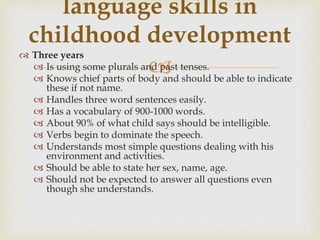
 Three years
 Is using some plurals and past tenses.
 Knows chief parts of body and should be able to indicate
these if not name.
 Handles three word sentences easily.
 Has a vocabulary of 900-1000 words.
 About 90% of what child says should be intelligible.
 Verbs begin to dominate the speech.
 Understands most simple questions dealing with his
environment and activities.
 Should be able to state her sex, name, age.
 Should not be expected to answer all questions even
though she understands.
language skills in
childhood development

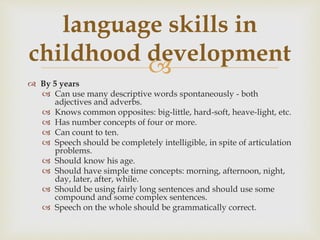
 By 5 years
 Can use many descriptive words spontaneously - both
adjectives and adverbs.
 Knows common opposites: big-little, hard-soft, heave-light, etc.
 Has number concepts of four or more.
 Can count to ten.
 Speech should be completely intelligible, in spite of articulation
problems.
 Should know his age.
 Should have simple time concepts: morning, afternoon, night,
day, later, after, while.
 Should be using fairly long sentences and should use some
compound and some complex sentences.
 Speech on the whole should be grammatically correct.
language skills in
childhood development
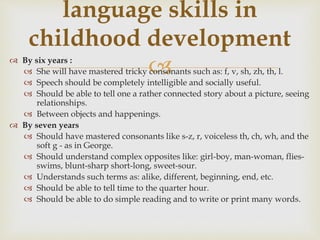
 By six years :
 She will have mastered tricky consonants such as: f, v, sh, zh, th, l.
 Speech should be completely intelligible and socially useful.
 Should be able to tell one a rather connected story about a picture, seeing
relationships.
 Between objects and happenings.
 By seven years
 Should have mastered consonants like s-z, r, voiceless th, ch, wh, and the
soft g - as in George.
 Should understand complex opposites like: girl-boy, man-woman, flies-
swims, blunt-sharp short-long, sweet-sour.
 Understands such terms as: alike, different, beginning, end, etc.
 Should be able to tell time to the quarter hour.
 Should be able to do simple reading and to write or print many words.
language skills in
childhood development

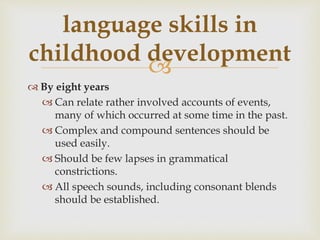
 By eight years
 Can relate rather involved accounts of events,
many of which occurred at some time in the past.
 Complex and compound sentences should be
used easily.
 Should be few lapses in grammatical
constrictions.
 All speech sounds, including consonant blends
should be established.
language skills in
childhood development

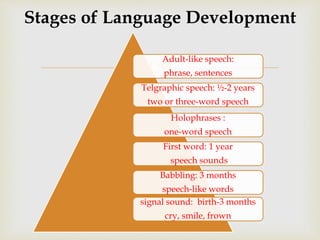
Stages of Language Development
Adult-like speech:
phrase, sentences
Telgraphic speech: ½-2 years
two or three-word speech
Holophrases :
one-word speech
First word: 1 year
speech sounds
Babbling: 3 months
speech-like words
signal sound: birth-3 months
cry, smile, frown
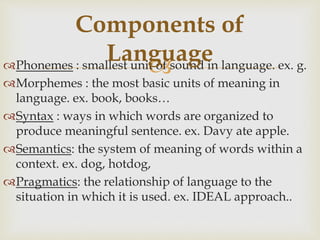
Phonemes : smallest unit of sound in language. ex. g.
Morphemes : the most basic units of meaning in
language. ex. book, books…
Syntax : ways in which words are organized to
produce meaningful sentence. ex. Davy ate apple.
Semantics: the system of meaning of words within a
context. ex. dog, hotdog,
Pragmatics: the relationship of language to the
situation in which it is used. ex. IDEAL approach..
Components of
Language
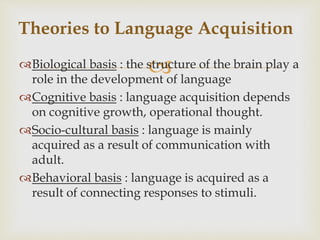
Biological basis : the structure of the brain play a
role in the development of language
Cognitive basis : language acquisition depends
on cognitive growth, operational thought.
Socio-cultural basis : language is mainly
acquired as a result of communication with
adult.
Behavioral basis : language is acquired as a
result of connecting responses to stimuli.
Theories to Language Acquisition
 Thought precedes language, and language is a by-
product of cognitive development. Jean Piaget
 Language is a social bridge to connect a mentor’s
advanced development with a novice’s immature
development, and language creates cognitive
development. Lev Vygotsky
Some ideas on
Linguistic Dev
Language development

Language development

  • 2.
     Language is thetool humans use to communi- cate and share thoughts, ideas, and emotions. Language may also be expressed through writing or things like signing. The most intensive period of speech and language development for humans is during the first three years of life, a period when the brain is developing and maturing. An infant's first ability to express his needs begins with crying during the first days of life. Concept of Language Development
  • 3.
     Six months : Vocalise with intonation.  Respond to her name.  Responds to human voices without visual cues by turning her head and eyes. 12 months :  Uses one or more words with meaning - often mama or dada.  Understands simple instructions, such as bye-bye or bed.  Is aware of the social value of speech. Language Skills in Childhood development
  • 4.
    18 months  Mayhave a vocabulary of between five to 20 words  May repeat a word over and over again, often called echolalia  Is able to follow simple commands 24 months  Can name familiar objects.  Combines words into a short sentence.  The majority of what they say will be intelligible and the vocabulary might be 150-300 words.  Rhythm and fluency of speech won't be great - neither will their volume and pitch.  Can use pronouns correctly - I, me, you, although me and I are often confused. language skills in childhood development
  • 5.
      Three years Is using some plurals and past tenses.  Knows chief parts of body and should be able to indicate these if not name.  Handles three word sentences easily.  Has a vocabulary of 900-1000 words.  About 90% of what child says should be intelligible.  Verbs begin to dominate the speech.  Understands most simple questions dealing with his environment and activities.  Should be able to state her sex, name, age.  Should not be expected to answer all questions even though she understands. language skills in childhood development
  • 6.
      By 5years  Can use many descriptive words spontaneously - both adjectives and adverbs.  Knows common opposites: big-little, hard-soft, heave-light, etc.  Has number concepts of four or more.  Can count to ten.  Speech should be completely intelligible, in spite of articulation problems.  Should know his age.  Should have simple time concepts: morning, afternoon, night, day, later, after, while.  Should be using fairly long sentences and should use some compound and some complex sentences.  Speech on the whole should be grammatically correct. language skills in childhood development
  • 7.
     By sixyears :  She will have mastered tricky consonants such as: f, v, sh, zh, th, l.  Speech should be completely intelligible and socially useful.  Should be able to tell one a rather connected story about a picture, seeing relationships.  Between objects and happenings.  By seven years  Should have mastered consonants like s-z, r, voiceless th, ch, wh, and the soft g - as in George.  Should understand complex opposites like: girl-boy, man-woman, flies- swims, blunt-sharp short-long, sweet-sour.  Understands such terms as: alike, different, beginning, end, etc.  Should be able to tell time to the quarter hour.  Should be able to do simple reading and to write or print many words. language skills in childhood development
  • 8.
      By eightyears  Can relate rather involved accounts of events, many of which occurred at some time in the past.  Complex and compound sentences should be used easily.  Should be few lapses in grammatical constrictions.  All speech sounds, including consonant blends should be established. language skills in childhood development
  • 9.
     Stages of LanguageDevelopment Adult-like speech: phrase, sentences Telgraphic speech: ½-2 years two or three-word speech Holophrases : one-word speech First word: 1 year speech sounds Babbling: 3 months speech-like words signal sound: birth-3 months cry, smile, frown
  • 10.
    Phonemes : smallestunit of sound in language. ex. g. Morphemes : the most basic units of meaning in language. ex. book, books… Syntax : ways in which words are organized to produce meaningful sentence. ex. Davy ate apple. Semantics: the system of meaning of words within a context. ex. dog, hotdog, Pragmatics: the relationship of language to the situation in which it is used. ex. IDEAL approach.. Components of Language
  • 11.
    Biological basis :the structure of the brain play a role in the development of language Cognitive basis : language acquisition depends on cognitive growth, operational thought. Socio-cultural basis : language is mainly acquired as a result of communication with adult. Behavioral basis : language is acquired as a result of connecting responses to stimuli. Theories to Language Acquisition
  • 12.
     Thought precedeslanguage, and language is a by- product of cognitive development. Jean Piaget  Language is a social bridge to connect a mentor’s advanced development with a novice’s immature development, and language creates cognitive development. Lev Vygotsky Some ideas on Linguistic Dev