The Nature and
Meaning of Culture
Learning Objectives:
 State operational definition of culture
 Discuss the characteristics
 Enumerate the components of culture and give
examples of each components
 Explain the different views on culture;
 Identify the categories of culture in the
Philippines society
 Give the causes of culture change
 Show the similarities and differences in culture
 Identify the factors or causes that bring about
similarities and difference in culture.
The Culture
 It shapes as well as guides people’s
perception of reality since it provides rules of
proper conduct for living in society.
 It includes the values, norms, language,
tools, and other shared products of society
that provide a plan for social life and are
passed on from generation to generation.
 The complex whole which includes
knowledge, beliefs, arts, laws, morals,
customs and other capabilities and habits
acquired by people as members of society.
 It prescribes what one can and cannot do and
how one should do things in various
situations.
 Culture is a way of life.
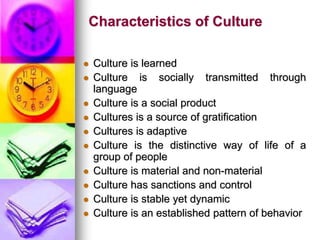
Characteristics of Culture
 Culture is learned
 Culture is socially transmitted through
language
 Culture is a social product
 Cultures is a source of gratification
 Cultures is adaptive
 Culture is the distinctive way of life of a
group of people
 Culture is material and non-material
 Culture has sanctions and control
 Culture is stable yet dynamic
 Culture is an established pattern of behavior
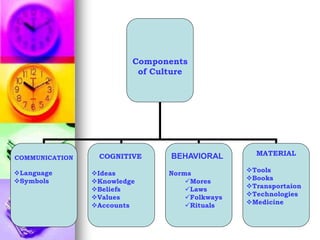
Components
of Culture
COMMUNICATION
Language
Symbols
Ideas
Knowledge
Beliefs
Values
Accounts
Norms
Mores
Laws
Folkways
Rituals
MATERIAL
Tools
Books
Transportaion
Technologies
Medicine
COGNITIVE BEHAVIORAL
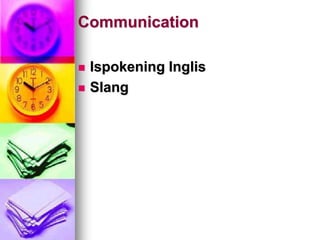
Communication
 Ispokening Inglis
 Slang
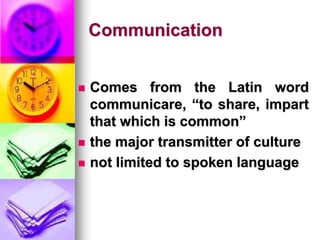
Communication
 Comes from the Latin word
communicare, “to share, impart
that which is common”
 the major transmitter of culture
 not limited to spoken language
Language
 Ano ang punto mo
 Epic Fail
 Attack of the Jejemon
 Language
 systematize usage of speech and
hearing to convey, communicate or
express feelings.
 written and spoken words that represent
objects or ideas
 the core of all culture
Symbols
 anything that carries a particular meaning
recognized by people who share culture.
 represent something concrete or
something abstract (a concept or idea)
 that which represents something else
Cognitive
 Knowledge
 The total range of what has been
learned or perceived as true.
 The storehouse where we accumulate
representations, information, facts,
assumptions, etc.
 Body of information accumulated
through experiences, study or
investigation.
Types of Knowledge
 Natural knowledge – accumulated facts
about the natural worlds.
 Supernatural knowledge – perception
about actions of gods, goddesses,
demons angels or spirit.
 Technological knowledge – knowledge
which in nature is useful in dealing with
practical problems.
 Magical knowledge – perceptions
about methods influencing supernatural
events.
 Ideas
 Mental representations (concepts,
categories, metaphors) used to
organize stimulus.
 Basic units out of which knowledge is
constructed and a world emerges.
 Beliefs.
 Ideas that people hold about the
universe or any part of the total reality
surrounding them.
 Convictions as to what “is” or “is not”.
Superstitious Beliefs
 Mga Pamahiing Pinoy
Values
 Person’s ideas about worth and
desirability.
 Values are concerned with
standards of worthiness of what
is good” or bad, what “should be”
or “should not be”.
 Serve as broad guidelines for
social living
FILIPINO VALUES
 Magalang na Filipino
 Utang na Loob
 Hate Late
Accounts
 Are how people use the common
language to explain, justify,
rationalize, excuse, or legitimize our
behavior to themselves and others.
Behavioral Components
 Norms.
 Standards or rules of behavior
expected to follow.
 Societal prescription on how one
is to act on a given situation.
 Specific guidelines for action
NORMS
 Social Networking Etiquette
Types of norms:
 Mores.
 Standards of conduct that are highly respected and
valued by the group and their fulfillment is felt to be
necessary and vital to group welfare.
 Special type of folkways and represent obligatory
behavior
 Folkways.
The customary rules of conduct that are seen as
appropriate for given situations.
 Laws
Body of rules, made by the government,
interpreted by the courts and backed by the power of
the state.
The function is social engineering
 Rituals
Highly scripted ceremonies or strips of
interaction that follow a specific sequence of actions.
Occur at predetermined times or triggered by
specific cues.
2 Kinds of Mores:
1. Positive Mores or Duty
 “Thou shall behavior”
- Refers to the behavior, which
must and ought to be done
because the are ethically and
morally good.
Negative Mores “Taboo”
 “Thou shall not behavior”
 Taboo refers to societal
prohibitions on certain acts
which must not be done.
 Example: Cannabalism
Material Component
 Physical objects of culture
 The nature of the material culture
produced by a given society is a
function of the society’s level of
technology, available and needs
of the people.
The Organization of Culture
 Cultural Traits.
- Represents a single element or
a combination of elements related to
a specific situation.
- Either a material or non-
material
 Culture complexes
- Clusters of culture traits
 Culture patterns
- Group of clusters of culture
traits
Transmission of Culture
 Enculturation
 Process of learning culture of one’s
own group.
 Acculturation
Process of learning some new traits from
another culture.
 Assimilation
Process in which an individual entirely
loses any awareness of his/her previous
identity and takes on the culture and
attitudes of another group.
Importance and Functions of
Culture
 Culture helps people adapt to the
demands of the surrounding
physical environment.
 Culture compensate for many
human physical limitations.
 Culture provides ways and means
to regulate human collective
existence.
 Culture increased understanding,
prediction, and appreciation of the
varieties of human behavior found
within societies both past and
present.
Sub-Concepts related to
Culture
Cultural Relativism
 States that cultures, differ, so
that a cultural traits, act, or idea
has no meaning of function by
itself bus has a meaning only
within its cultural setting (Horton
and Hunt 1985)
 Notion that each culture should be evaluated from
the standpoint of its own setting rather than from the
standpoint of a different culture
Culture Shock
 Refers to a feeling of disbelief
 Disorganization
 Frustrations one experiences
when he encounters cultural
patterns
Enthnocentrism
 It refers to the tendency to see
behaviors, belief, values, and
norms of own group as the only
right way of living.
 Judging others standards
 Superiority of one’s culture
 Others cultures as inferior
Xenocentrism
 Referring to the idea that what is
foreign is best and that one’s
lifestyle, products, ideas are
inferior to the others.
 Westren culture
 Imported products are superior
Noble Savage Mentality
 Refers to the evaluation of one’s
culture and that of others based
on the romantic notion that the
culture:
 Primitive
 Simple is better
 More Acceptable
 More Orderly
Subculture
 This refers to a social group
which develop norms, values,
belief, and special languages
which can make the distinct
from broader society
 Examples: Tagalogs, Ilokanos, Teen-
agers, Senior citizens, exclusive villages
Counterculture or
Contra Culture
 Refers to a subgroups whose
standards come conflict with
and oppose the conventional
standards of the dominant
culture.
 Examples: Criminals, Drug Addicts,
Deviant, Prostitutes, and terrorist
Culture Lag
 Refers to a gap between the
material and non-material
culture.
 Examples: New inventions is introduced
before the skills to utilize it.
Universal Pattern of Culture
 Refers to a broad areas of social
living found in all societies.
 Refers to features and elements
common to all culture rather
than to the special culture traits
 Examples: Courtship, Dancing, Food,
Taboos, Games, Gestures, Languages,
Hair stylefs
Variations of Man’s Behavior
a. Crazes
b. Fads
c. Fashion
 Social Experiment
Factors that accounts for diversities
or differences in Culture
Factors that account for the
development of Culture
Factors account for the
development of culture:
 Human biological needs and
drives
 Psychological Processes
 Man’s highly developed nervous
system
 Man’s highly developed vocal
apparatus
 Man’s Upright posture
 Physical and Social environment
Factors that accounts for
diversities or differences in
Culture
 Cultural Variability
 Cultural Relativity
 Environmental Differences
 Human ingenuity and ability to
absorb and expand new culture
Are you born into a
Culture or with a
Culture?

Culture

  • 1.
  • 3.
    Learning Objectives:  Stateoperational definition of culture  Discuss the characteristics  Enumerate the components of culture and give examples of each components  Explain the different views on culture;  Identify the categories of culture in the Philippines society  Give the causes of culture change  Show the similarities and differences in culture  Identify the factors or causes that bring about similarities and difference in culture.
  • 4.
    The Culture  Itshapes as well as guides people’s perception of reality since it provides rules of proper conduct for living in society.  It includes the values, norms, language, tools, and other shared products of society that provide a plan for social life and are passed on from generation to generation.  The complex whole which includes knowledge, beliefs, arts, laws, morals, customs and other capabilities and habits acquired by people as members of society.  It prescribes what one can and cannot do and how one should do things in various situations.  Culture is a way of life.
  • 5.
    Characteristics of Culture Culture is learned  Culture is socially transmitted through language  Culture is a social product  Cultures is a source of gratification  Cultures is adaptive  Culture is the distinctive way of life of a group of people  Culture is material and non-material  Culture has sanctions and control  Culture is stable yet dynamic  Culture is an established pattern of behavior
  • 6.
  • 7.
  • 8.
    Communication  Comes fromthe Latin word communicare, “to share, impart that which is common”  the major transmitter of culture  not limited to spoken language
  • 9.
    Language  Ano angpunto mo  Epic Fail  Attack of the Jejemon
  • 10.
     Language  systematizeusage of speech and hearing to convey, communicate or express feelings.  written and spoken words that represent objects or ideas  the core of all culture
  • 11.
    Symbols  anything thatcarries a particular meaning recognized by people who share culture.  represent something concrete or something abstract (a concept or idea)  that which represents something else
  • 12.
    Cognitive  Knowledge  Thetotal range of what has been learned or perceived as true.  The storehouse where we accumulate representations, information, facts, assumptions, etc.  Body of information accumulated through experiences, study or investigation.
  • 13.
    Types of Knowledge Natural knowledge – accumulated facts about the natural worlds.  Supernatural knowledge – perception about actions of gods, goddesses, demons angels or spirit.  Technological knowledge – knowledge which in nature is useful in dealing with practical problems.  Magical knowledge – perceptions about methods influencing supernatural events.
  • 14.
     Ideas  Mentalrepresentations (concepts, categories, metaphors) used to organize stimulus.  Basic units out of which knowledge is constructed and a world emerges.  Beliefs.  Ideas that people hold about the universe or any part of the total reality surrounding them.  Convictions as to what “is” or “is not”.
  • 15.
  • 16.
    Values  Person’s ideasabout worth and desirability.  Values are concerned with standards of worthiness of what is good” or bad, what “should be” or “should not be”.  Serve as broad guidelines for social living
  • 17.
    FILIPINO VALUES  Magalangna Filipino  Utang na Loob  Hate Late
  • 18.
    Accounts  Are howpeople use the common language to explain, justify, rationalize, excuse, or legitimize our behavior to themselves and others.
  • 19.
    Behavioral Components  Norms. Standards or rules of behavior expected to follow.  Societal prescription on how one is to act on a given situation.  Specific guidelines for action
  • 20.
  • 21.
    Types of norms: Mores.  Standards of conduct that are highly respected and valued by the group and their fulfillment is felt to be necessary and vital to group welfare.  Special type of folkways and represent obligatory behavior  Folkways. The customary rules of conduct that are seen as appropriate for given situations.  Laws Body of rules, made by the government, interpreted by the courts and backed by the power of the state. The function is social engineering  Rituals Highly scripted ceremonies or strips of interaction that follow a specific sequence of actions. Occur at predetermined times or triggered by specific cues.
  • 22.
    2 Kinds ofMores: 1. Positive Mores or Duty  “Thou shall behavior” - Refers to the behavior, which must and ought to be done because the are ethically and morally good.
  • 23.
    Negative Mores “Taboo” “Thou shall not behavior”  Taboo refers to societal prohibitions on certain acts which must not be done.  Example: Cannabalism
  • 24.
    Material Component  Physicalobjects of culture  The nature of the material culture produced by a given society is a function of the society’s level of technology, available and needs of the people.
  • 25.
    The Organization ofCulture  Cultural Traits. - Represents a single element or a combination of elements related to a specific situation. - Either a material or non- material  Culture complexes - Clusters of culture traits  Culture patterns - Group of clusters of culture traits
  • 26.
    Transmission of Culture Enculturation  Process of learning culture of one’s own group.  Acculturation Process of learning some new traits from another culture.  Assimilation Process in which an individual entirely loses any awareness of his/her previous identity and takes on the culture and attitudes of another group.
  • 27.
    Importance and Functionsof Culture  Culture helps people adapt to the demands of the surrounding physical environment.  Culture compensate for many human physical limitations.  Culture provides ways and means to regulate human collective existence.  Culture increased understanding, prediction, and appreciation of the varieties of human behavior found within societies both past and present.
  • 28.
  • 29.
    Cultural Relativism  Statesthat cultures, differ, so that a cultural traits, act, or idea has no meaning of function by itself bus has a meaning only within its cultural setting (Horton and Hunt 1985)  Notion that each culture should be evaluated from the standpoint of its own setting rather than from the standpoint of a different culture
  • 30.
    Culture Shock  Refersto a feeling of disbelief  Disorganization  Frustrations one experiences when he encounters cultural patterns
  • 31.
    Enthnocentrism  It refersto the tendency to see behaviors, belief, values, and norms of own group as the only right way of living.  Judging others standards  Superiority of one’s culture  Others cultures as inferior
  • 32.
    Xenocentrism  Referring tothe idea that what is foreign is best and that one’s lifestyle, products, ideas are inferior to the others.  Westren culture  Imported products are superior
  • 33.
    Noble Savage Mentality Refers to the evaluation of one’s culture and that of others based on the romantic notion that the culture:  Primitive  Simple is better  More Acceptable  More Orderly
  • 34.
    Subculture  This refersto a social group which develop norms, values, belief, and special languages which can make the distinct from broader society  Examples: Tagalogs, Ilokanos, Teen- agers, Senior citizens, exclusive villages
  • 35.
    Counterculture or Contra Culture Refers to a subgroups whose standards come conflict with and oppose the conventional standards of the dominant culture.  Examples: Criminals, Drug Addicts, Deviant, Prostitutes, and terrorist
  • 36.
    Culture Lag  Refersto a gap between the material and non-material culture.  Examples: New inventions is introduced before the skills to utilize it.
  • 37.
    Universal Pattern ofCulture  Refers to a broad areas of social living found in all societies.  Refers to features and elements common to all culture rather than to the special culture traits  Examples: Courtship, Dancing, Food, Taboos, Games, Gestures, Languages, Hair stylefs
  • 38.
    Variations of Man’sBehavior a. Crazes b. Fads c. Fashion
  • 39.
  • 40.
    Factors that accountsfor diversities or differences in Culture Factors that account for the development of Culture
  • 41.
    Factors account forthe development of culture:  Human biological needs and drives  Psychological Processes  Man’s highly developed nervous system  Man’s highly developed vocal apparatus  Man’s Upright posture  Physical and Social environment
  • 42.
    Factors that accountsfor diversities or differences in Culture  Cultural Variability  Cultural Relativity  Environmental Differences  Human ingenuity and ability to absorb and expand new culture
  • 43.
    Are you borninto a Culture or with a Culture?