SPEECH ACT THEORY
By: Ernie Chris Lamug
BEE2
WHAT IS A SPEECH ACT?
Speech Act - is a minimal functional unit in
human communication.
- basic unit of communication.
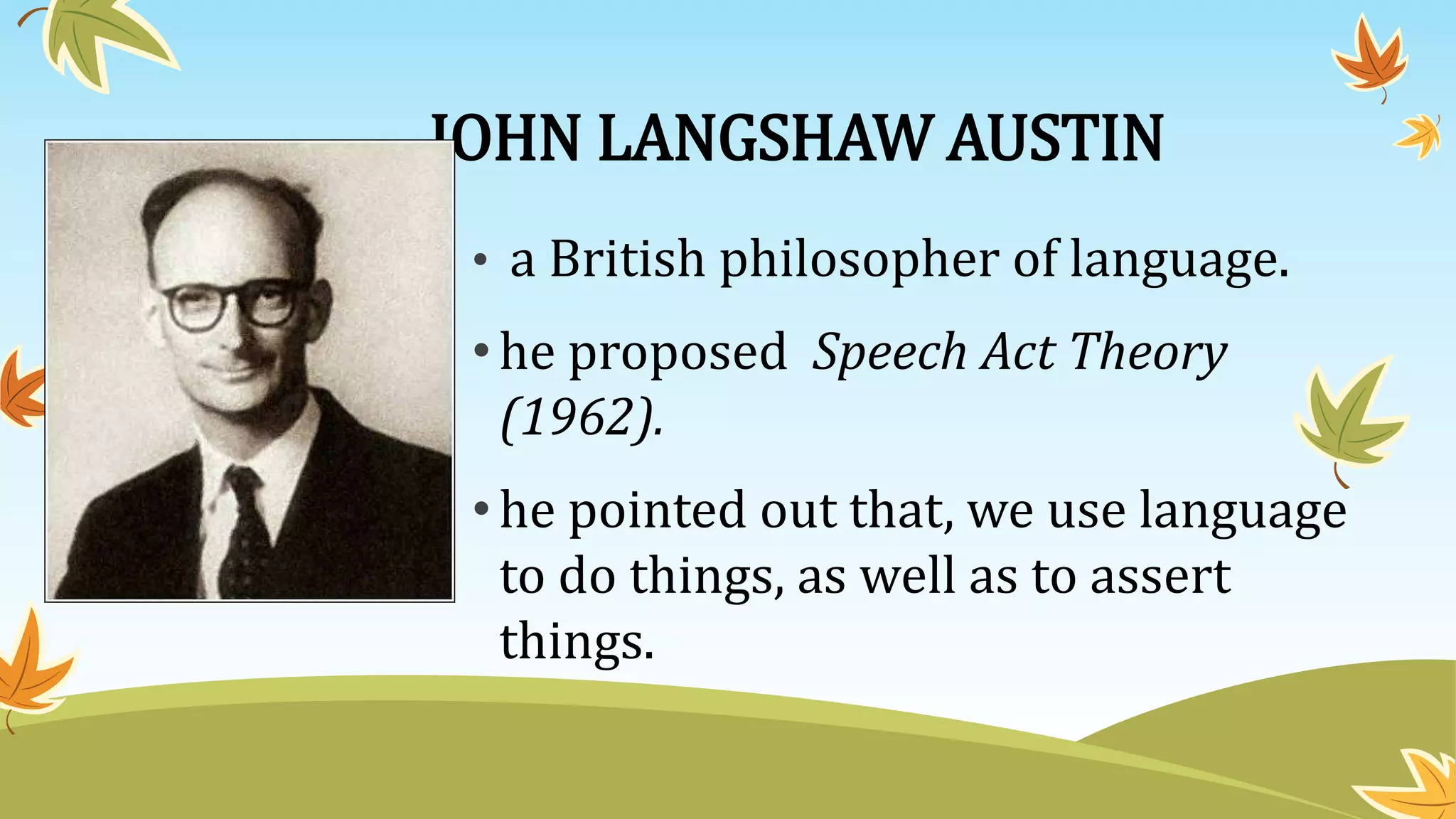
JOHN LANGSHAW AUSTIN
• a British philosopher of language.
•he proposed Speech Act Theory
(1962).
•he pointed out that, we use language
to do things, as well as to assert
things.
THE MEANING OF SPEECH ACTS
• Propositional meaning - the literal meaning of what is
said.
example: It’s hot in here.
• Illocutionary meaning - the social function of what is said.
example: “It’s hot in here” could be:
- an indirect request for someone to open the
window.
- an indirect refusal to close the window
because someone is cold.
- a complaint implying that someone should
know better than to keep the windows closed.
• Perlocutionary meaning – the effect of what is
said.
example: “It’s hot in here” could result in someone
open the windows.
CLASSIFICATION OF SPEECH ACTS
(COHEN (1996))
CLASSIFICATION OF SPEECH
ACTS (COHEN (1996))
- Assertive or Representative
It’s function is to tell what the speaker
knows or believe.
- Directive
Make the addressee perform an action.
- Comissive
Commits the speaker to do something in the
future.
- Expressive
Expresses how the speaker feels about the
situation.
- Declaration
Changes the state of the world in an
immediate way.
SPEECH ACT THEORY
 attempts to explain how speakers use language to
accomplish intended actions and how listeners determine
and intended meaning from what is said.
 is a subfield of pragmatics concerned with the ways in which
words can be used not only to present information but also to
carry out actions.
 this was proposed by “J.L. Austin”.
 from the book of “How To Do Things With Words” and it was
supplemented by “John Searle”.
SPEECH ACT THEORY
Examples:
- performing a wedding
- blessing
• Philosophers like Austin(1962), Grice(1957),
and Searle(1965, 1969, 1975) offered basic
insight into this new theory of linguistic
communication based on the assumption that the
minimal pair of human communication are not
linguistic expressions, but rather the performance
of certain kinds of acts, such as making
statements, asking questions, giving directions,
apologizing, thanking, and so on.
SCARCELLA (1990)
Provides second language instructors with a
number of guidelines intended to reduce negative
consequences of communication difficulties and increase
the learners’ conversational competence through
improving their motivation:
 Stress the advantages of conversing like a native
speaker.
 Stress that it is not necessary to converse perfectly to
communicate in the second language.
 Impress upon learners that they should not be overly
concerned with communication difficulties.
 Help students accept communication difficulties as normal.
 Provide students with information about communication
difficulties.
 Do not expect students to develop the conversational
skills needed to overcome all communication difficulties.
 Provide communicative feedback regarding student
success in conveying meaning and accomplishing
communicative objects.
 Teach students strategies to help them overcome
communication difficulties in the real world.

Speech act theory

  • 1.
    SPEECH ACT THEORY By:Ernie Chris Lamug BEE2
  • 2.
    WHAT IS ASPEECH ACT? Speech Act - is a minimal functional unit in human communication. - basic unit of communication.
  • 3.
    JOHN LANGSHAW AUSTIN •a British philosopher of language. •he proposed Speech Act Theory (1962). •he pointed out that, we use language to do things, as well as to assert things.
  • 4.
    THE MEANING OFSPEECH ACTS • Propositional meaning - the literal meaning of what is said. example: It’s hot in here. • Illocutionary meaning - the social function of what is said. example: “It’s hot in here” could be: - an indirect request for someone to open the window.
  • 5.
    - an indirectrefusal to close the window because someone is cold. - a complaint implying that someone should know better than to keep the windows closed.
  • 6.
    • Perlocutionary meaning– the effect of what is said. example: “It’s hot in here” could result in someone open the windows.
  • 7.
    CLASSIFICATION OF SPEECHACTS (COHEN (1996))
  • 8.
    CLASSIFICATION OF SPEECH ACTS(COHEN (1996)) - Assertive or Representative It’s function is to tell what the speaker knows or believe.
  • 9.
    - Directive Make theaddressee perform an action. - Comissive Commits the speaker to do something in the future.
  • 10.
    - Expressive Expresses howthe speaker feels about the situation. - Declaration Changes the state of the world in an immediate way.
  • 11.
    SPEECH ACT THEORY attempts to explain how speakers use language to accomplish intended actions and how listeners determine and intended meaning from what is said.  is a subfield of pragmatics concerned with the ways in which words can be used not only to present information but also to carry out actions.  this was proposed by “J.L. Austin”.  from the book of “How To Do Things With Words” and it was supplemented by “John Searle”.
  • 12.
    SPEECH ACT THEORY Examples: -performing a wedding - blessing
  • 13.
    • Philosophers likeAustin(1962), Grice(1957), and Searle(1965, 1969, 1975) offered basic insight into this new theory of linguistic communication based on the assumption that the minimal pair of human communication are not linguistic expressions, but rather the performance of certain kinds of acts, such as making statements, asking questions, giving directions, apologizing, thanking, and so on.
  • 14.
    SCARCELLA (1990) Provides secondlanguage instructors with a number of guidelines intended to reduce negative consequences of communication difficulties and increase the learners’ conversational competence through improving their motivation:  Stress the advantages of conversing like a native speaker.
  • 15.
     Stress thatit is not necessary to converse perfectly to communicate in the second language.  Impress upon learners that they should not be overly concerned with communication difficulties.  Help students accept communication difficulties as normal.  Provide students with information about communication difficulties.
  • 16.
     Do notexpect students to develop the conversational skills needed to overcome all communication difficulties.  Provide communicative feedback regarding student success in conveying meaning and accomplishing communicative objects.  Teach students strategies to help them overcome communication difficulties in the real world.