Speech or Language Impairments Chapter 5 Introduction to Special Education
The Significance of Language Language is the foundation for: Cognition (Understanding and Learning) Reading Abilities Social Competence Basically every aspect of life. Page 179, 4 th  ed.
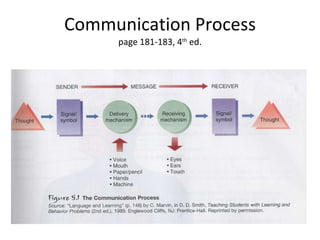
Communication Process page 181-183, 4 th  ed.
Communication is unsuccessful when… The sender or the receiver cannot use the signals and symbols adequately. Either person has a defective mechanism for sending or receiving info. Page 181-182, 4 th  ed.
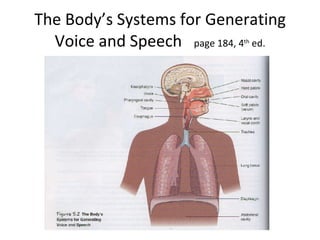
Important Terms Communication – the transfer of knowledge, ideas, opinions and feelings. Language – The formalized method of communication by which ideas are transmitted to others. Speech – The vocal production of language, usually the fastest and most efficient way to communicate. Vocal System – System made up of (1) vibrating system (larynx & vocal folds – the makers of sound) and (2) Resonating Systems (oral & nasal cavities – forms the sounds into words).
The Body’s Systems for Generating Voice and Speech  page 184, 4 th  ed.
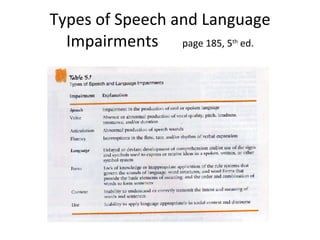
Types of Speech and Language Impairments  page 185, 5 th  ed.
Speech Impairments Speech is abnormal when it is unintelligible, is unpleasant, or interferes with communication. Voice – Pitch and Loudness. Part of ones identity. Articulation – ex. “thinger” instead of “finger”. Considered “cute” at younger ages. Fluency – hesitations or repetitions that interrupt the flow of speech that are not age appropriate. For example: speaking very quickly or hesitation in the middle of a sentence that is covered by using fillers such as “like”, “you know” or “umm”. This can occur with adults during times of stress, excitement or unfamiliar situations. Pages 183-186, 5 th  Ed.
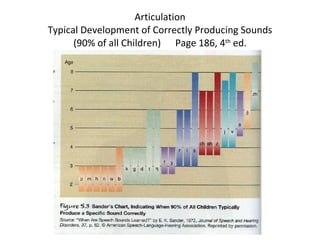
Articulation Typical Development of Correctly Producing Sounds (90% of all Children)  Page 186, 4 th  ed.
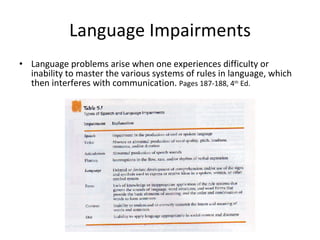
Language Impairments Language problems arise when one experiences difficulty or inability to master the various systems of rules in language, which then interferes with communication.  Pages 187-188, 4 th  Ed.
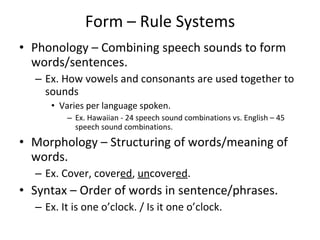
Form – Rule Systems Phonology – Combining speech sounds to form words/sentences. Ex. How vowels and consonants are used together to sounds Varies per language spoken. Ex. Hawaiian - 24 speech sound combinations vs. English – 45 speech sound combinations. Morphology – Structuring of words/meaning of words. Ex. Cover, cover ed ,  un cover ed .  Syntax – Order of words in sentence/phrases. Ex. It is one o’clock. / Is it one o’clock.
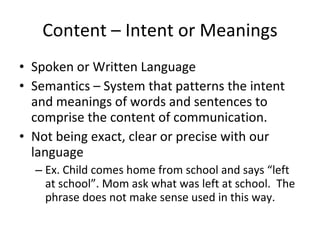
Content – Intent or Meanings Spoken or Written Language Semantics – System that patterns the intent and meanings of words and sentences to comprise the content of communication. Not being exact, clear or precise with our language Ex. Child comes home from school and says “left at school”. Mom ask what was left at school.  The phrase does not make sense used in this way.
Use – Application of Language Concerns application of language in various communications according to the social context of the situation. Pragmatics – Study of language in context & focuses of the intention of the communication. Ex. Child must know what a cup is and what it is used for before he/she can properly use the word cup in communication. Pages 187-188, 4 th  ed.
Identification Who?  Speech / Language Pathologist (SLP’s) Formal assessment of a person to determine if they have a speech or language impairment is made by an SLP. How?  (1) Formal Assessment (2) Informal Assessment Formal assessments such as standardized test are used by SLP’s.  Ex. Test of Language Development (TOLD) Informal assessments such as observations during free play time. This is the primary source of assessment of child’s spontaneous speech.  Page 189, 4 th  Ed.
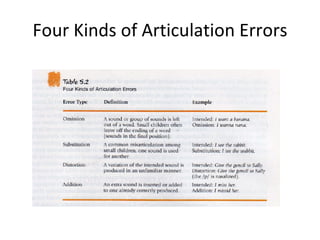
What are SLP’s Looking For? Speech Impairments Articulation Errors Repeated omission of groups of sounds or substitution of one sound for another or extra sounds added. Voice Problems Chronic Hoarseness Fluency Problems Ex. Stuttering
Four Kinds of Articulation Errors
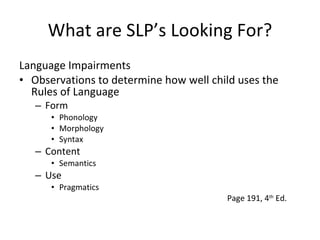
What are SLP’s Looking For? Language Impairments Observations to determine how well child uses the Rules of Language Form Phonology Morphology Syntax Content Semantics Use Pragmatics Page 191, 4 th  Ed.
Significance The ability or inability to use speech and language well influences a person’s academics, social world and employment. Services should be provided to individuals with speech or language difficulties to enable them to learn how best to communicate successfully with others. Page 192, 4 th  Ed.
History of the Field S/L problems have been a part of the human condition as long as there have been humans. In the past people with S/L Impairments were considered fools or buffoons only good for cruel entertainment. In the U.S. speech correction was not available until 20 th  Century.
History of the Field 1910 – Chicago Public Schools – Speech training program for children who “stammered” 1914 – First Speech Clinic by Smiley Blanton at the University of Wisconsin 1925 – American Academy for Speech Correction was formed spearheaded by Robert West. Later became American Speech & hearing Association (ASHA)  Page 193, 5 th  Ed.
History of the Field Speech clinicians in public schools and military research programs demonstrated that speech therapy can be effective and after the war (WWII) more universities began to train SLP’s.  1970s were a period of transition and further improvements in the field as more research resulted in new information about S/L Impairments. Pages 193-194, 5 th  Ed.
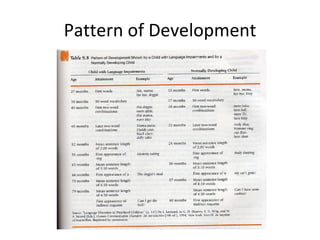
Pattern of Development
Prevention and Early Identification Preventative Measures Proper pre-natal care Proper immunizations from diseases such as rubella and polio Good childhood nutrition Early ID  and Intervention can GREATLY reduce the impact of S/L Impairments on the individual.
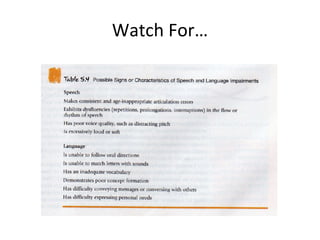
Watch For…
Educational Interventions Almost every school in U.S. has access to SLP’s General Ed teachers play a crucial role in children’s language development. Teachers can utilize Instructional Enhancements that encourage expressive and receptive language such as language based games. Collaborative work with teachers and SLP’s are crucial and the shared responsibility for problem definition, planning, provision of services and evaluating outcomes.
Technology Alternative and Augmentative Communication Low Tech Communication Boards High Tech Speech Synthesizers * Video from EDUC 6100 of Autistic Woman in College who used the communication device. AMAZING what she already knew that no one expected.

Chapter 5 Tmg

  • 1.
    Speech or LanguageImpairments Chapter 5 Introduction to Special Education
  • 2.
    The Significance ofLanguage Language is the foundation for: Cognition (Understanding and Learning) Reading Abilities Social Competence Basically every aspect of life. Page 179, 4 th ed.
  • 3.
    Communication Process page181-183, 4 th ed.
  • 4.
    Communication is unsuccessfulwhen… The sender or the receiver cannot use the signals and symbols adequately. Either person has a defective mechanism for sending or receiving info. Page 181-182, 4 th ed.
  • 5.
    Important Terms Communication– the transfer of knowledge, ideas, opinions and feelings. Language – The formalized method of communication by which ideas are transmitted to others. Speech – The vocal production of language, usually the fastest and most efficient way to communicate. Vocal System – System made up of (1) vibrating system (larynx & vocal folds – the makers of sound) and (2) Resonating Systems (oral & nasal cavities – forms the sounds into words).
  • 6.
    The Body’s Systemsfor Generating Voice and Speech page 184, 4 th ed.
  • 7.
    Types of Speechand Language Impairments page 185, 5 th ed.
  • 8.
    Speech Impairments Speechis abnormal when it is unintelligible, is unpleasant, or interferes with communication. Voice – Pitch and Loudness. Part of ones identity. Articulation – ex. “thinger” instead of “finger”. Considered “cute” at younger ages. Fluency – hesitations or repetitions that interrupt the flow of speech that are not age appropriate. For example: speaking very quickly or hesitation in the middle of a sentence that is covered by using fillers such as “like”, “you know” or “umm”. This can occur with adults during times of stress, excitement or unfamiliar situations. Pages 183-186, 5 th Ed.
  • 9.
    Articulation Typical Developmentof Correctly Producing Sounds (90% of all Children) Page 186, 4 th ed.
  • 10.
    Language Impairments Languageproblems arise when one experiences difficulty or inability to master the various systems of rules in language, which then interferes with communication. Pages 187-188, 4 th Ed.
  • 11.
    Form – RuleSystems Phonology – Combining speech sounds to form words/sentences. Ex. How vowels and consonants are used together to sounds Varies per language spoken. Ex. Hawaiian - 24 speech sound combinations vs. English – 45 speech sound combinations. Morphology – Structuring of words/meaning of words. Ex. Cover, cover ed , un cover ed . Syntax – Order of words in sentence/phrases. Ex. It is one o’clock. / Is it one o’clock.
  • 12.
    Content – Intentor Meanings Spoken or Written Language Semantics – System that patterns the intent and meanings of words and sentences to comprise the content of communication. Not being exact, clear or precise with our language Ex. Child comes home from school and says “left at school”. Mom ask what was left at school. The phrase does not make sense used in this way.
  • 13.
    Use – Applicationof Language Concerns application of language in various communications according to the social context of the situation. Pragmatics – Study of language in context & focuses of the intention of the communication. Ex. Child must know what a cup is and what it is used for before he/she can properly use the word cup in communication. Pages 187-188, 4 th ed.
  • 14.
    Identification Who? Speech / Language Pathologist (SLP’s) Formal assessment of a person to determine if they have a speech or language impairment is made by an SLP. How? (1) Formal Assessment (2) Informal Assessment Formal assessments such as standardized test are used by SLP’s. Ex. Test of Language Development (TOLD) Informal assessments such as observations during free play time. This is the primary source of assessment of child’s spontaneous speech. Page 189, 4 th Ed.
  • 15.
    What are SLP’sLooking For? Speech Impairments Articulation Errors Repeated omission of groups of sounds or substitution of one sound for another or extra sounds added. Voice Problems Chronic Hoarseness Fluency Problems Ex. Stuttering
  • 16.
    Four Kinds ofArticulation Errors
  • 17.
    What are SLP’sLooking For? Language Impairments Observations to determine how well child uses the Rules of Language Form Phonology Morphology Syntax Content Semantics Use Pragmatics Page 191, 4 th Ed.
  • 18.
    Significance The abilityor inability to use speech and language well influences a person’s academics, social world and employment. Services should be provided to individuals with speech or language difficulties to enable them to learn how best to communicate successfully with others. Page 192, 4 th Ed.
  • 19.
    History of theField S/L problems have been a part of the human condition as long as there have been humans. In the past people with S/L Impairments were considered fools or buffoons only good for cruel entertainment. In the U.S. speech correction was not available until 20 th Century.
  • 20.
    History of theField 1910 – Chicago Public Schools – Speech training program for children who “stammered” 1914 – First Speech Clinic by Smiley Blanton at the University of Wisconsin 1925 – American Academy for Speech Correction was formed spearheaded by Robert West. Later became American Speech & hearing Association (ASHA) Page 193, 5 th Ed.
  • 21.
    History of theField Speech clinicians in public schools and military research programs demonstrated that speech therapy can be effective and after the war (WWII) more universities began to train SLP’s. 1970s were a period of transition and further improvements in the field as more research resulted in new information about S/L Impairments. Pages 193-194, 5 th Ed.
  • 22.
  • 23.
    Prevention and EarlyIdentification Preventative Measures Proper pre-natal care Proper immunizations from diseases such as rubella and polio Good childhood nutrition Early ID and Intervention can GREATLY reduce the impact of S/L Impairments on the individual.
  • 24.
  • 25.
    Educational Interventions Almostevery school in U.S. has access to SLP’s General Ed teachers play a crucial role in children’s language development. Teachers can utilize Instructional Enhancements that encourage expressive and receptive language such as language based games. Collaborative work with teachers and SLP’s are crucial and the shared responsibility for problem definition, planning, provision of services and evaluating outcomes.
  • 26.
    Technology Alternative andAugmentative Communication Low Tech Communication Boards High Tech Speech Synthesizers * Video from EDUC 6100 of Autistic Woman in College who used the communication device. AMAZING what she already knew that no one expected.