Mrs.R.Kohila Devi
Asst. Prof. in Education
Thiagarajar College of Preceptors
Madurai -9
 Definition
 Speech and language impairment is defined as a
communication disorder that adversely affects the
child's ability to talk, understand, read, and write. This
disability category can be divided into two groups:
speech impairments and language impairments.
Characteristics
 Speech Impairments
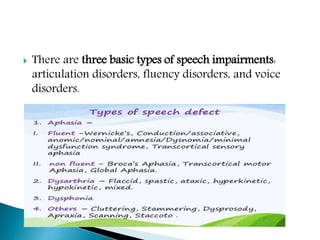
 There are three basic types of speech impairments:
articulation disorders, fluency disorders, and voice
disorders.
 Articulation disorders are errors in the production of
speech sounds that may be related to anatomical or
physiological limitations in the skeletal, muscular, or
neuromuscular support for speech production. These
disorders include:
 Omissions: (bo for boat)
 Substitutions: (wabbit for rabbit)
 Distortions: (shlip for sip)
 Fluency disorders are difficulties with the rhythm and
timing of speech characterized by hesitations, repetitions,
or prolongations of sounds, syllables, words, or phrases.
Common fluency disorders include:
 Stuttering: rapid-fire repetitions of consonant or vowel
sounds especially at the beginning of words, prolongations,
hesitations, interjections, and complete verbal blocks
 Cluttering: excessively fast and jerky speech
 Voice disorders are problems with the quality or use of
one's voice resulting from disorders in the larynx. Voice
disorders are characterized by abnormal production
and/or absences of vocal quality, pitch, loudness,
resonance, and/or duration.
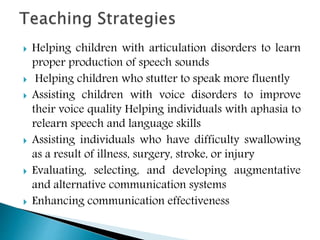
 Helping children with articulation disorders to learn
proper production of speech sounds
 Helping children who stutter to speak more fluently
 Assisting children with voice disorders to improve
their voice quality Helping individuals with aphasia to
relearn speech and language skills
 Assisting individuals who have difficulty swallowing
as a result of illness, surgery, stroke, or injury
 Evaluating, selecting, and developing augmentative
and alternative communication systems
 Enhancing communication effectiveness
 There are three basic types of speech impairments:
articulation disorders, fluency disorders, and voice
disorders.
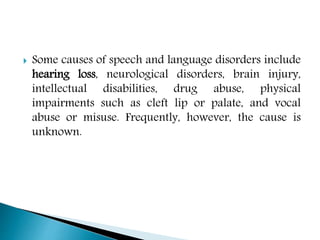
 Some causes of speech and language disorders include
hearing loss, neurological disorders, brain injury,
intellectual disabilities, drug abuse, physical
impairments such as cleft lip or palate, and vocal
abuse or misuse. Frequently, however, the cause is
unknown.
 Other speech disorders include apraxia and
dysarthria. Apraxia is a motor speech disorder caused
by damage to the parts of the brain related to
speaking. Dysarthria is a motor speech disorder in
which the muscles of the mouth, face, or respiratory
system may become weak or have difficulty moving.
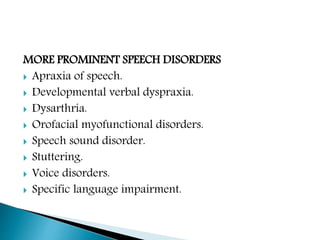
MORE PROMINENT SPEECH DISORDERS
 Apraxia of speech.
 Developmental verbal dyspraxia.
 Dysarthria.
 Orofacial myofunctional disorders.
 Speech sound disorder.
 Stuttering.
 Voice disorders.
 Specific language impairment.
 Stuttering: Stuttering is when a person repeats the first
half of the word. ...
 Apraxia of Speech: Apraxia involves the inconsistent
producing and rearranging of speech sounds. ...
 Speech Sound Disorder: A speech sound disorder
involves difficulty producing certain sounds.
 Apraxia of Speech: Apraxia involves the inconsistent
producing and rearranging of speech sounds. For
instance potato may become totapo. This disorder may
be developmental, where the symptoms have been
evident from birth, or acquired. Acquired apraxia of
speech generally results from a physical impairment
such as injury or stroke.
 Speech Sound Disorder: A speech sound disorder
involves difficulty producing certain sounds. The
sounds could include /r/, /s/, /l/,/th/, /g/, /ch/ and /sh/.
Speech sound disorders are divided into two
categories of speech disorders. The first is a Phonetic
disorder or articulation disorder which involves the
child having difficulty in learning to produce certain
sounds physically. The second speech sound disorder
is a Phonemic disorder. This type of speech
impediment involves the child having difficulty
learning the sound distinctions of a language.
 Cluttering: Cluttering is a speech disorder
characterized by a rapid rate making speech difficult
to understand, which in turn affects the person’s
fluency. This can happen if the person has a tendency
to speak really fast. This can also result when an
individual continues to repeat themselves in order to
try to make them understood. Cluttering is also
referred to as fluency disorder.
 Lisp: A lisp is a speech impediment in children who
are struggling to produce the /s/ sound clearly. A
frontal lisp is when a child pushes his tongue too far
forward in the mouth. A lateral lisp produces a
“slushy” sound because too much air is escaping out
the sides of a child’s mouth.
 Speech disorders affect the vocal cords, muscles,
nerves, and other structures within the throat.
 Causes may include:
 vocal cord damage
 brain damage
 muscle weakness
 respiratory weakness
 strokes
 polyps or nodules on the vocal cords
 vocal cord paralysis
 repeating sounds, which is most often seen in people who
stutter
 adding extra sounds and words
 elongating words
 making jerky movements while talking, usually involving
the head
 blinking several times while talking
 visible frustration when trying to communicate
 taking frequent pauses when talking
 distorting sounds when talking
 hoarseness, or speaking with a raspy or gravelly sounding
voice
 Many tests are available to diagnose speech disorders.
 Denver articulation screening exam
 The Denver articulation screening examination
(DASE) is a commonly used testing system to diagnose
articulation disorders. This test evaluates the clarity in
pronunciation in children between the ages of 2 and
7. This five-minute test uses various exercises to assess
the child’s speech.
 Early language milestones scale 2
 This test, created by neurodevelopmental pediatrician
James Coplan, determines a child’s language development.
This test can quickly identify delayed speech or language
disorders.
 Peabody picture vocabulary test, revised
 This test measures a person’s vocabulary and ability to
speak. The person will listen to various words and choose
pictures that describe the words. People who have severe
intellectual disabilities and those who are blind won’t able
to take this assessment. The Peabody picture vocabulary
test has been revised many times since its first version was
administered in 1959.
 Mild speech disorders may not require any treatment. Some
speech disorders may simply go away. Others can improve with
speech therapy.
 Treatment varies and depends on the type of disorder. In speech
therapy, a professional therapist will guide you through
exercises that work to strengthen the muscles in your face and
throat. You’ll learn to control your breathing while speaking.
Muscle-strengthening exercises and controlled breathing help
improve the way your words sound. You’ll also learn ways to
practice smoother, more fluent speech.
 Some people with speech disorders experience nervousness,
embarrassment, or depression. Talk therapy may be helpful in
these situations. A therapist will discuss ways to cope with the
condition and ways to improve the outlook of your condition. If
your depression is severe, antidepressant medications can help.

SPEECH IMPAIRMENT

  • 1.
    Mrs.R.Kohila Devi Asst. Prof.in Education Thiagarajar College of Preceptors Madurai -9
  • 2.
     Definition  Speechand language impairment is defined as a communication disorder that adversely affects the child's ability to talk, understand, read, and write. This disability category can be divided into two groups: speech impairments and language impairments.
  • 3.
    Characteristics  Speech Impairments There are three basic types of speech impairments: articulation disorders, fluency disorders, and voice disorders.  Articulation disorders are errors in the production of speech sounds that may be related to anatomical or physiological limitations in the skeletal, muscular, or neuromuscular support for speech production. These disorders include:  Omissions: (bo for boat)  Substitutions: (wabbit for rabbit)  Distortions: (shlip for sip)
  • 4.
     Fluency disordersare difficulties with the rhythm and timing of speech characterized by hesitations, repetitions, or prolongations of sounds, syllables, words, or phrases. Common fluency disorders include:  Stuttering: rapid-fire repetitions of consonant or vowel sounds especially at the beginning of words, prolongations, hesitations, interjections, and complete verbal blocks  Cluttering: excessively fast and jerky speech  Voice disorders are problems with the quality or use of one's voice resulting from disorders in the larynx. Voice disorders are characterized by abnormal production and/or absences of vocal quality, pitch, loudness, resonance, and/or duration.
  • 5.
     Helping childrenwith articulation disorders to learn proper production of speech sounds  Helping children who stutter to speak more fluently  Assisting children with voice disorders to improve their voice quality Helping individuals with aphasia to relearn speech and language skills  Assisting individuals who have difficulty swallowing as a result of illness, surgery, stroke, or injury  Evaluating, selecting, and developing augmentative and alternative communication systems  Enhancing communication effectiveness
  • 6.
     There arethree basic types of speech impairments: articulation disorders, fluency disorders, and voice disorders.
  • 7.
     Some causesof speech and language disorders include hearing loss, neurological disorders, brain injury, intellectual disabilities, drug abuse, physical impairments such as cleft lip or palate, and vocal abuse or misuse. Frequently, however, the cause is unknown.
  • 8.
     Other speechdisorders include apraxia and dysarthria. Apraxia is a motor speech disorder caused by damage to the parts of the brain related to speaking. Dysarthria is a motor speech disorder in which the muscles of the mouth, face, or respiratory system may become weak or have difficulty moving.
  • 9.
    MORE PROMINENT SPEECHDISORDERS  Apraxia of speech.  Developmental verbal dyspraxia.  Dysarthria.  Orofacial myofunctional disorders.  Speech sound disorder.  Stuttering.  Voice disorders.  Specific language impairment.
  • 10.
     Stuttering: Stutteringis when a person repeats the first half of the word. ...  Apraxia of Speech: Apraxia involves the inconsistent producing and rearranging of speech sounds. ...  Speech Sound Disorder: A speech sound disorder involves difficulty producing certain sounds.
  • 11.
     Apraxia ofSpeech: Apraxia involves the inconsistent producing and rearranging of speech sounds. For instance potato may become totapo. This disorder may be developmental, where the symptoms have been evident from birth, or acquired. Acquired apraxia of speech generally results from a physical impairment such as injury or stroke.
  • 12.
     Speech SoundDisorder: A speech sound disorder involves difficulty producing certain sounds. The sounds could include /r/, /s/, /l/,/th/, /g/, /ch/ and /sh/. Speech sound disorders are divided into two categories of speech disorders. The first is a Phonetic disorder or articulation disorder which involves the child having difficulty in learning to produce certain sounds physically. The second speech sound disorder is a Phonemic disorder. This type of speech impediment involves the child having difficulty learning the sound distinctions of a language.
  • 13.
     Cluttering: Clutteringis a speech disorder characterized by a rapid rate making speech difficult to understand, which in turn affects the person’s fluency. This can happen if the person has a tendency to speak really fast. This can also result when an individual continues to repeat themselves in order to try to make them understood. Cluttering is also referred to as fluency disorder.
  • 14.
     Lisp: Alisp is a speech impediment in children who are struggling to produce the /s/ sound clearly. A frontal lisp is when a child pushes his tongue too far forward in the mouth. A lateral lisp produces a “slushy” sound because too much air is escaping out the sides of a child’s mouth.
  • 15.
     Speech disordersaffect the vocal cords, muscles, nerves, and other structures within the throat.  Causes may include:  vocal cord damage  brain damage  muscle weakness  respiratory weakness  strokes  polyps or nodules on the vocal cords  vocal cord paralysis
  • 16.
     repeating sounds,which is most often seen in people who stutter  adding extra sounds and words  elongating words  making jerky movements while talking, usually involving the head  blinking several times while talking  visible frustration when trying to communicate  taking frequent pauses when talking  distorting sounds when talking  hoarseness, or speaking with a raspy or gravelly sounding voice
  • 17.
     Many testsare available to diagnose speech disorders.  Denver articulation screening exam  The Denver articulation screening examination (DASE) is a commonly used testing system to diagnose articulation disorders. This test evaluates the clarity in pronunciation in children between the ages of 2 and 7. This five-minute test uses various exercises to assess the child’s speech.
  • 18.
     Early languagemilestones scale 2  This test, created by neurodevelopmental pediatrician James Coplan, determines a child’s language development. This test can quickly identify delayed speech or language disorders.  Peabody picture vocabulary test, revised  This test measures a person’s vocabulary and ability to speak. The person will listen to various words and choose pictures that describe the words. People who have severe intellectual disabilities and those who are blind won’t able to take this assessment. The Peabody picture vocabulary test has been revised many times since its first version was administered in 1959.
  • 19.
     Mild speechdisorders may not require any treatment. Some speech disorders may simply go away. Others can improve with speech therapy.  Treatment varies and depends on the type of disorder. In speech therapy, a professional therapist will guide you through exercises that work to strengthen the muscles in your face and throat. You’ll learn to control your breathing while speaking. Muscle-strengthening exercises and controlled breathing help improve the way your words sound. You’ll also learn ways to practice smoother, more fluent speech.  Some people with speech disorders experience nervousness, embarrassment, or depression. Talk therapy may be helpful in these situations. A therapist will discuss ways to cope with the condition and ways to improve the outlook of your condition. If your depression is severe, antidepressant medications can help.