Communication Disorders: Speech and Language Impairments Presented By: Liwanag Dominguez Lois T. Gumataotao ED443:  Assistive and Adaptive Technology Dr. J. Cyrus October 16, 2008
Ice Breaker ! ! ! Pre-Test
By the end of this presentation the student will be able to . .  . Understand the Communication Process Describe Speech and Language Impairments Discuss the prevalence List some causes of Communication Disorders Know the benefits of AAC and Graphic Organizers  Help in the development of children’s language
Communication Disorder according to ASHA   (American Speech Language and Hearing Association) A communication disorder is an impairment in the ability to receive, send, process and comprehend concepts of verbal, nonverbal and graphic symbol systems.  A communication disorder maybe evident in the process of hearing, language, and or speech.
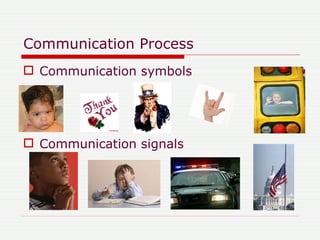
Communication Process Communication symbols Communication signals
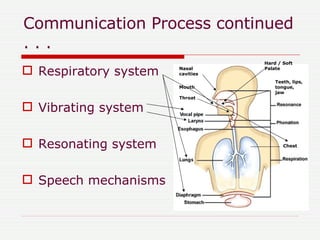
Communication Process continued . . . Respiratory system Vibrating system Resonating system Speech mechanisms Chest Nasal cavities Mouth Throat Hard / Soft Palate Teeth, lips, tongue, jaw
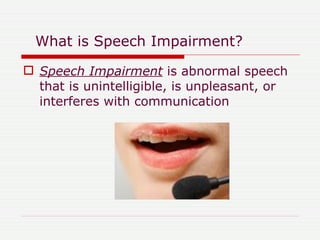
What is Speech Impairment? Speech Impairment  is abnormal speech that is unintelligible, is unpleasant, or interferes with communication
Forms of Speech Impairments Articulation:  The abnormal production of speech sounds. Voice:  Abnormal spoken language production, characterized by unusual pitch, loudness, or quality of sounds Fluency:  Hesitations or repetitions of sounds or words that interrupt a person’s flow of speech.  (i.e. stuttering)
Characteristics of Speech Impairments: Makes consistent and age-inappropriate articulation errors Exhibits dysfluencies Has poor voice quality Is excessively loud or soft
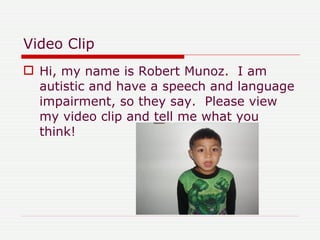
Video Clip Hi, my name is Robert Munoz.  I am autistic and have a speech and language impairment, so they say.  Please view my video clip and tell me what you think!
Some causes of Speech Impairments: Brain damage Autism Malfunction of the respiratory or speech mechanisms Malformation of the articulators Physical or organic problem (cleft palate, cleft lip) Stuttering Voice problems (abuse, arthritis)
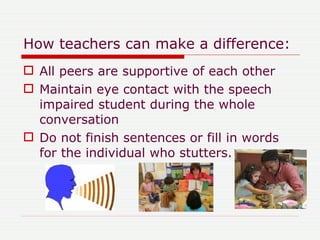
How teachers can make a difference: All peers are supportive of each other Maintain eye contact with the speech impaired student during the whole conversation Do not finish sentences or fill in words for the individual who stutters.
Communication Activity Say what you hear!
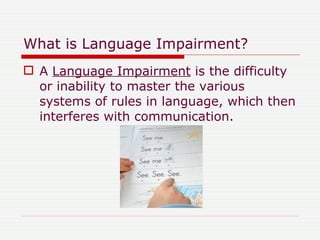
What is Language Impairment? A  Language Impairment  is the difficulty or inability to master the various systems of rules in language, which then interferes with communication.
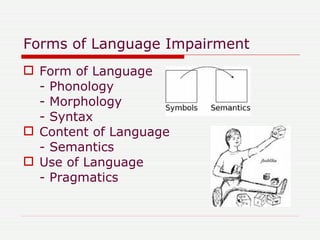
Forms of Language Impairment Form of Language - Phonology - Morphology - Syntax Content of Language - Semantics Use of Language - Pragmatics
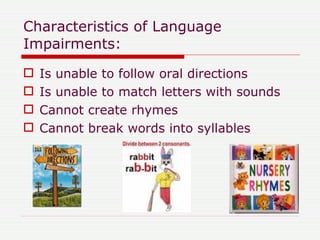
Characteristics of Language Impairments: Is unable to follow oral directions Is unable to match letters with sounds Cannot create rhymes Cannot break words into syllables
Characteristics of Language Impairments continued . . . Has an inadequate vocabulary Demonstrates poor concept formation Does not understand nuances, nonverbal messages, or humor Has difficulty conveying messages or conversing with others Has difficulty expressing personal needs
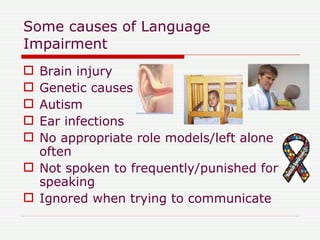
Some causes of Language Impairment Brain injury Genetic causes Autism Ear infections No appropriate role models/left alone often Not spoken to frequently/punished for speaking Ignored when trying to communicate
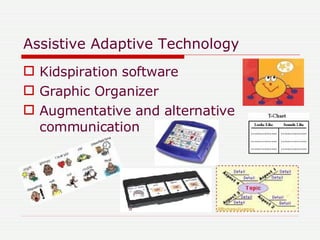
Assistive Adaptive Technology Kidspiration software Graphic Organizer Augmentative and alternative communication
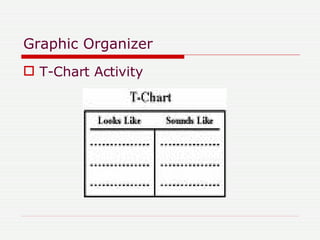
Graphic Organizer T-Chart Activity
Tips for Teachers: Best Practices Be near the student when giving instructions.  Speak slowly and deliberately.  Provide step by step directions.  Use gestures that support understanding.  Model correct speech patterns.  Touch base with the speech/language. Be patient when the child is speaking.
Prevalence 2 nd  largest category (19% of all students with Speech and Language impairments with learning disabilities, nationally. Locally:  2008 (288 out of 2,301 Total number of students)
Summary Many of these disorders are diagnosed during childhood. Patients may struggle in academic settings and may have problems with social interaction. Many children with these disorders show dramatic improvement by adolescence. However, people with severe communication disorders may experience ongoing challenges to their ability to function as independent adults.
Questions? What kind of strategies can parents use at home to improve their child’s language skills at home? Think about how you react to people with severe speech impairment. Do you look away from them? Do you try to avoid the person? What can you do to help your students develop language?
Reference Define Communication Disorder Name of Website:  Child Development Institute http://www.childdevelopmentinfo.com/disorders/children_with_communication_disorders.shtml Children With Communication Disorder Name of Website:  KidSource online http://www.kidsource.com/kidsource/content2/language_disorders.html#Additional%20Reading How to Help the Child with Communication Disorder Develop Language Name of Website:  University of Michigan Health System http://www.med.umich.edu/1libr/yourchild/speech.htm  Assistive Device Products Name of Website:  ABLEDATA http://www.abledata.com/abledata.cfm?pageid=27512 Kidspiration Name of Website:  Inspiration Software, Inc. www.inspiration.com
Thank you for listening! .