Chapter 11

              Communication
                  Disorders


Based on: Special Education for Today’s Teachers: An Introduction,
      by Rosenberg, Westling, and McLeskey (second edition)
Chapter 10 Questions
   What are language and speech disorders?
   What are the main types of language and speech
    disorders?
   How are communication disorders identified?
   What kinds of service delivery options are used?
   What are some ways that teachers can
    collaborate with speech therapists?
Communication Disorders
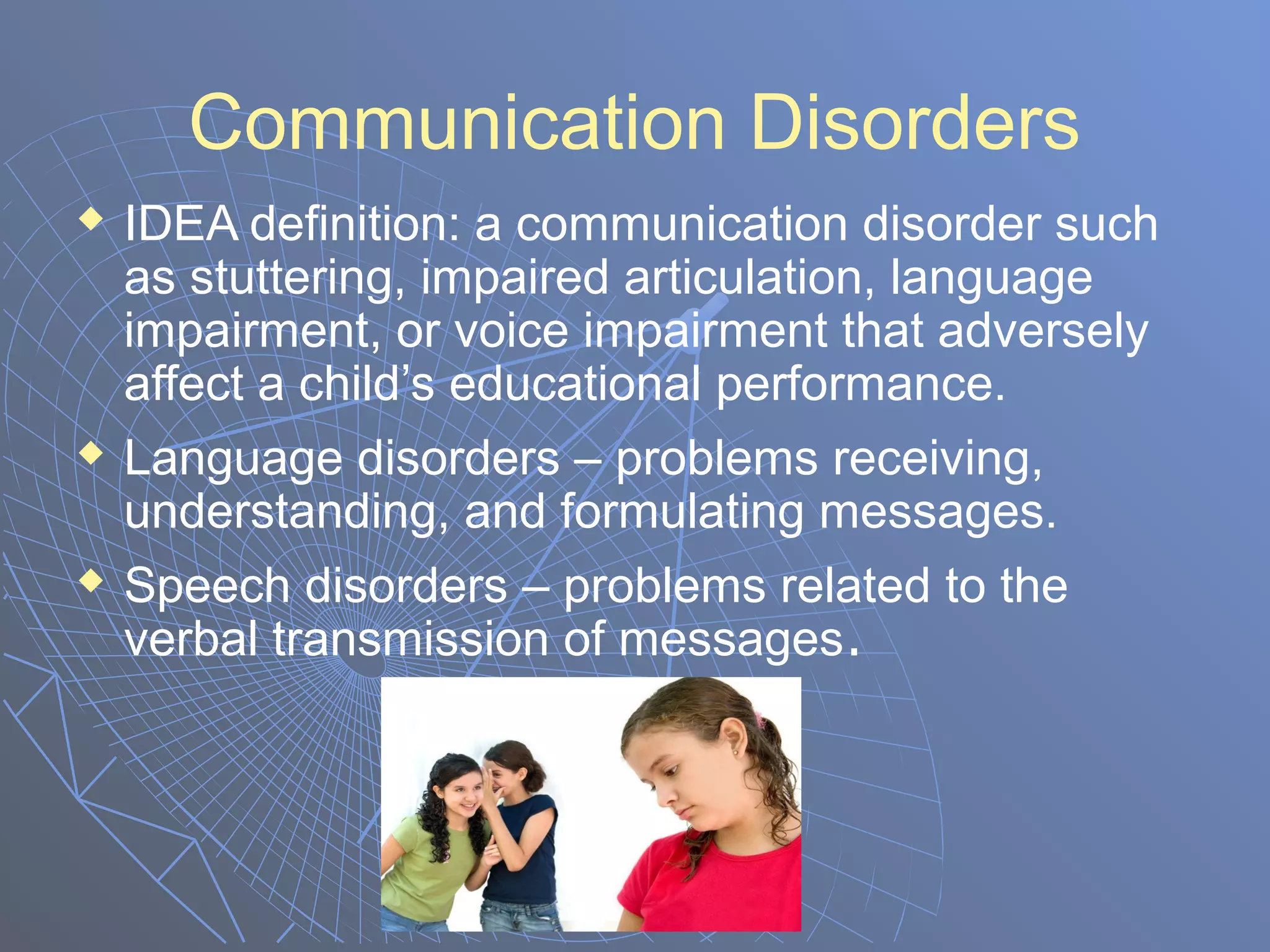
   IDEA definition: a communication disorder such
    as stuttering, impaired articulation, language
    impairment, or voice impairment that adversely
    affect a child’s educational performance.
   Language disorders – problems receiving,
    understanding, and formulating messages.
   Speech disorders – problems related to the
    verbal transmission of messages.
Language Disorders
   Form Disorders
     • Phonology - sounds used to make word parts (e.g., 40
       phonemes in English language)
     • Morphology - rules for constructing words (e.g., plurals,
       suffixes)
     • Syntax - rules for connecting words together (e.g., word
       order, organization)
   Content Disorders
     • Semantics - rules that dictate meaning (e.g., vocabulary)
   Use Disorders
     • Pragmatics – application of language in social contexts
       (e.g., conversation)
Speech Disorders
   Articulation Disorders (common)
     • Phonological – mental representation problem (can
       make sound, but doesn’t)
     • Articulation – structural problem (can’t make sound)
     • Substitutions, omissions, additions, distortions
   Fluency Disorders – interruptions in the flow of speaking
    (e.g., stuttering)
   Voice Disorders - pitch, duration, intensity, resonance,
    vocal quality
   Motor Speech Disorders
     • Apraxia - lack of coordinated muscle movement
     • Disarthria – weak, slow, or paralyzed muscles
Should I Talk to the SLP?
   How is the student’s intelligibility? (By age 4,
    should be 100%.)
   How easy is it to communicate with the student?
    (Can you have a normal conversation?)
   How does the student interact with others?
    (Does s/he avoid talking?)
   Does the student have unusual speech
    characteristics (e.g., substitution, omission,
    stuttering, hoarseness, etc.)?
Identification
   Review developmental, educational and medical
    history
   Interview parents, teachers, etc.
   Questionnaires
   Systematic observation
   Language sampling
   Formal tests
Service Delivery
   Service Delivery Models
    • Monitoring
    • Collaborative consultation
    • Classroom-Based
    • Pullout
   Issues
    • Shortage of SLPs
    • Heavy caseloads
Collaboration
   Discuss concerns about students
   Know what student is working on
   Ask how you can help students
    achieve and generalize skills
   Communicate progress
   Discuss behavioral challenges
   Ask how to improve the
    communication skills of the whole class.

Chapter 11: Communication Disorders

  • 1.
    Chapter 11 Communication Disorders Based on: Special Education for Today’s Teachers: An Introduction, by Rosenberg, Westling, and McLeskey (second edition)
  • 2.
    Chapter 10 Questions  What are language and speech disorders?  What are the main types of language and speech disorders?  How are communication disorders identified?  What kinds of service delivery options are used?  What are some ways that teachers can collaborate with speech therapists?
  • 3.
    Communication Disorders  IDEA definition: a communication disorder such as stuttering, impaired articulation, language impairment, or voice impairment that adversely affect a child’s educational performance.  Language disorders – problems receiving, understanding, and formulating messages.  Speech disorders – problems related to the verbal transmission of messages.
  • 4.
    Language Disorders  Form Disorders • Phonology - sounds used to make word parts (e.g., 40 phonemes in English language) • Morphology - rules for constructing words (e.g., plurals, suffixes) • Syntax - rules for connecting words together (e.g., word order, organization)  Content Disorders • Semantics - rules that dictate meaning (e.g., vocabulary)  Use Disorders • Pragmatics – application of language in social contexts (e.g., conversation)
  • 5.
    Speech Disorders  Articulation Disorders (common) • Phonological – mental representation problem (can make sound, but doesn’t) • Articulation – structural problem (can’t make sound) • Substitutions, omissions, additions, distortions  Fluency Disorders – interruptions in the flow of speaking (e.g., stuttering)  Voice Disorders - pitch, duration, intensity, resonance, vocal quality  Motor Speech Disorders • Apraxia - lack of coordinated muscle movement • Disarthria – weak, slow, or paralyzed muscles
  • 6.
    Should I Talkto the SLP?  How is the student’s intelligibility? (By age 4, should be 100%.)  How easy is it to communicate with the student? (Can you have a normal conversation?)  How does the student interact with others? (Does s/he avoid talking?)  Does the student have unusual speech characteristics (e.g., substitution, omission, stuttering, hoarseness, etc.)?
  • 7.
    Identification  Review developmental, educational and medical history  Interview parents, teachers, etc.  Questionnaires  Systematic observation  Language sampling  Formal tests
  • 8.
    Service Delivery  Service Delivery Models • Monitoring • Collaborative consultation • Classroom-Based • Pullout  Issues • Shortage of SLPs • Heavy caseloads
  • 9.
    Collaboration  Discuss concerns about students  Know what student is working on  Ask how you can help students achieve and generalize skills  Communicate progress  Discuss behavioral challenges  Ask how to improve the communication skills of the whole class.