Learning Disabilities
WHAT IS LEARNING
DISABILITY ?
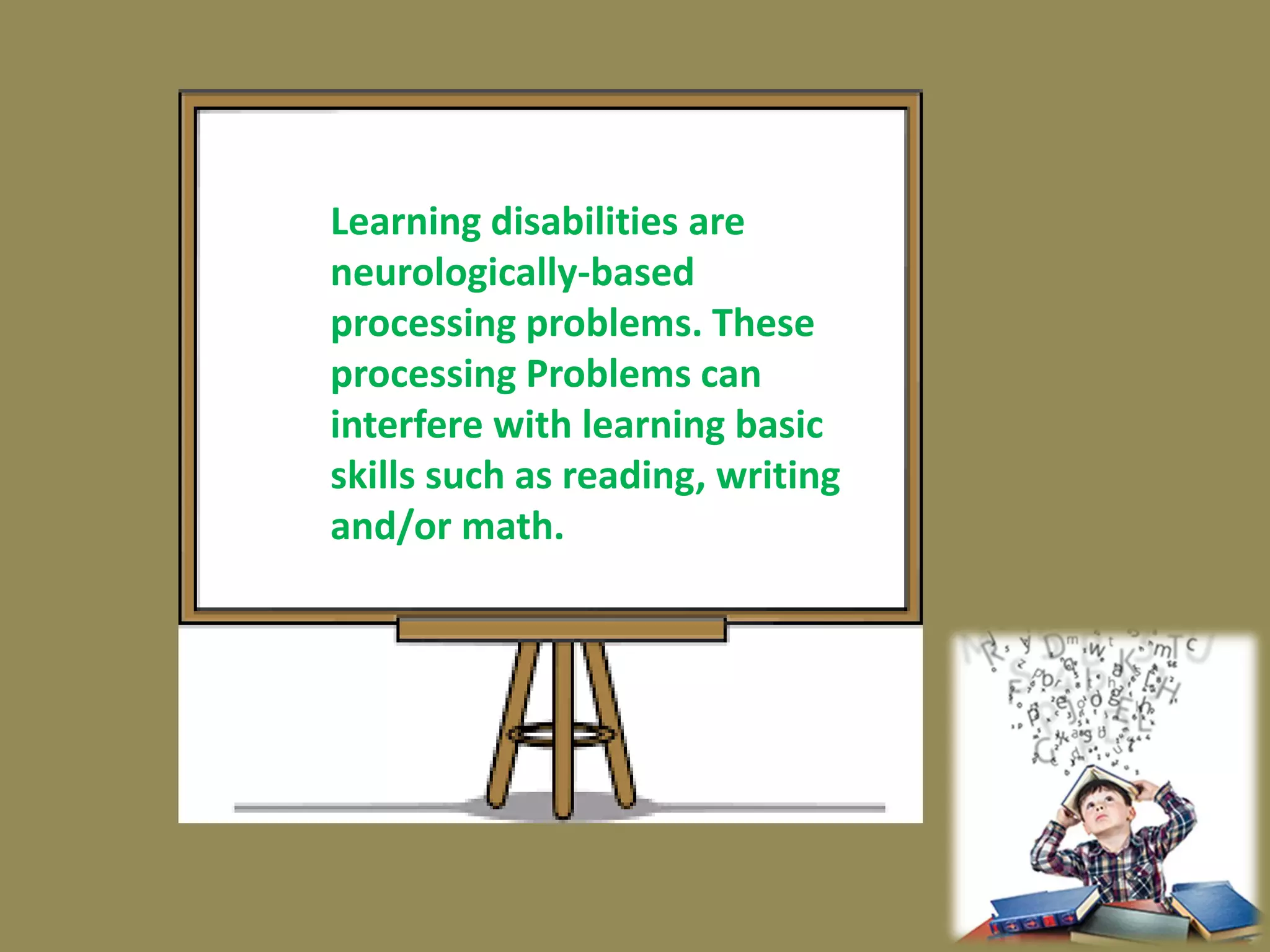
Learning disabilities are
neurologically-based
processing problems. These
processing Problems can
interfere with learning basic
skills such as reading, writing
and/or math.
TYPES OF LEARNING DISABILITY
1. Auditory Processing Disorder (APD)
2. Dyscalculia
3. Dysgraphia
4. Dyslexia
5. Language Processing Disorder
6. Non-Verbal Learning Disabilities
7. Visual Perceptual/Visual Motor Deficit
8. Attention deficit hyperactivity disorder (ADHD)
9. Dyspraxia
1. Auditory Processing Disorder (APD)
This is also known as Central Auditory
Processing Disorder, this is a condition
that adversely affects how sound that
travels unimpeded through the ear is
processed or interpreted by the brain.
2. Dyscalculia
This is difficulty in
learning or
comprehending arit
hmetic, such as
difficulty in
understanding
numbers, learning
how to manipulate
numbers, and
learning facts in
mathematics
3.Dysgraphia
Dysgraphia is a specific
learning disability in
which the ability to
express oneself through
written language is
impaired. Simply put,
dysgraphia describes
difficulty with writing.
4. Dyslexia
A specific learning disability that affects reading
and related language-based processing skills.
The severity can differ in each individual but can
affect reading fluency, decoding, reading
comprehension, recall, writing, spelling, and
sometimes speech and can exist along with
other related disorders.
A specific type of
Auditory Processing
Disorder (APD) in
which there is difficulty
attaching meaning to
sound groups that
form words, sentences
and stories
5. Language Processing Disorder
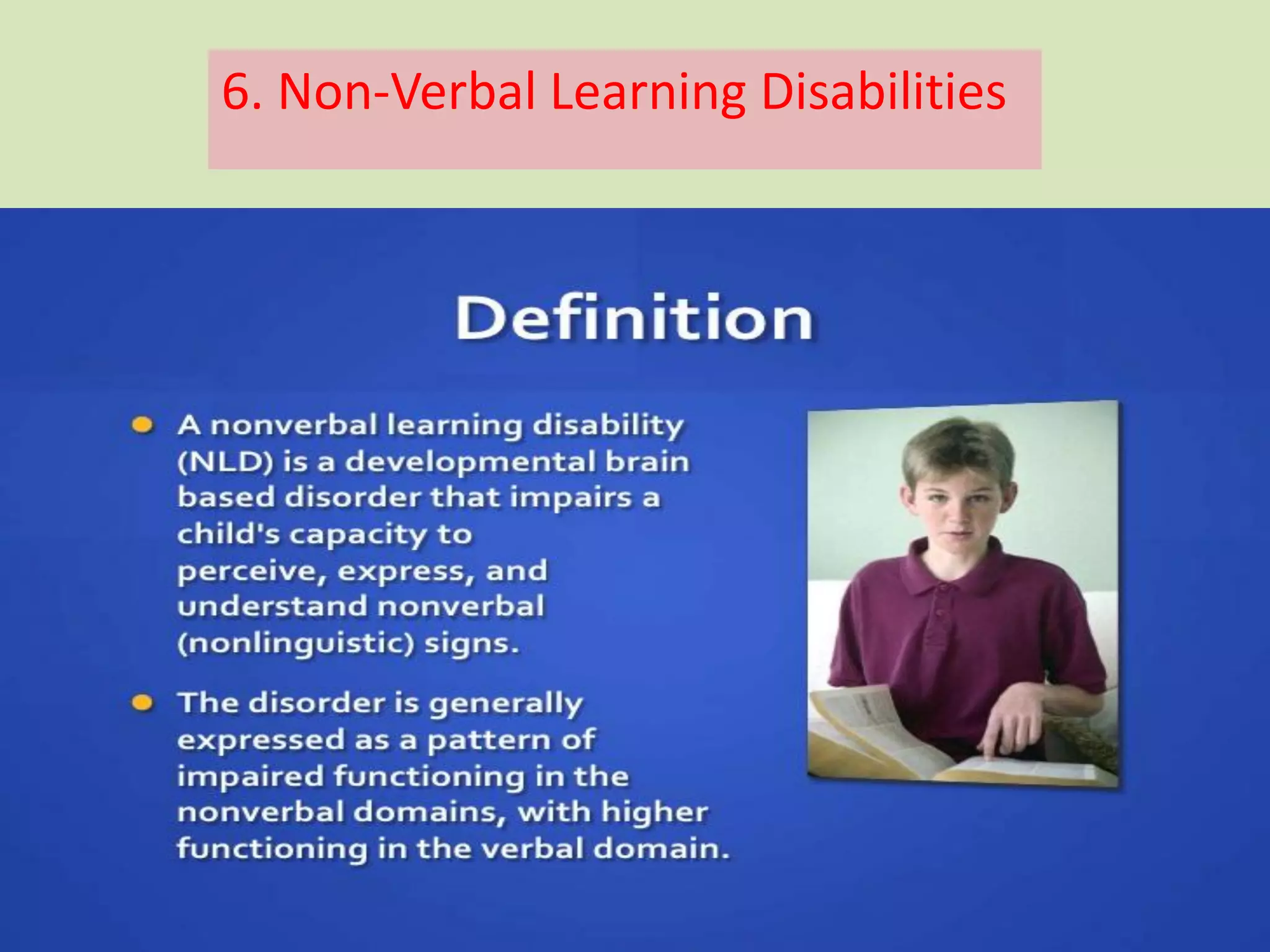
6. Non-Verbal Learning Disabilities
7. Visual Perceptual/Visual Motor Deficit
A disorder that affects the understanding of
information that a person sees, or the ability to
draw or copy. A characteristic seen in people
with learning disabilities such as Dysgraphia or
Non-verbal LD, it can result in missing subtle
differences in shapes or printed letters, losing
place frequently, struggles with cutting, holding
pencil too tightly, or poor eye/hand
coordination.
8. Attention deficit hyperactivity disorder (ADHD)
Attention-deficit/hyperactivity
disorder (ADHD) is a brain
disorder marked by an ongoing
pattern of inattention and/or
hyperactivity-impulsivity that
interferes with functioning or
development.
9. Dyspraxia
A disorder that is characterized by
difficulty in muscle control, which
causes problems with movement
and coordination, language and
speech, and can affect learning.
Although not a learning disability,
dyspraxia often exists along with
dyslexia, dyscalculia or ADHD.
LAYANA.K
MATHEMATICS

Learning disability

  • 1.
  • 2.
  • 3.
    Learning disabilities are neurologically-based processingproblems. These processing Problems can interfere with learning basic skills such as reading, writing and/or math.
  • 4.
    TYPES OF LEARNINGDISABILITY 1. Auditory Processing Disorder (APD) 2. Dyscalculia 3. Dysgraphia 4. Dyslexia 5. Language Processing Disorder 6. Non-Verbal Learning Disabilities 7. Visual Perceptual/Visual Motor Deficit 8. Attention deficit hyperactivity disorder (ADHD) 9. Dyspraxia
  • 5.
    1. Auditory ProcessingDisorder (APD) This is also known as Central Auditory Processing Disorder, this is a condition that adversely affects how sound that travels unimpeded through the ear is processed or interpreted by the brain.
  • 6.
    2. Dyscalculia This isdifficulty in learning or comprehending arit hmetic, such as difficulty in understanding numbers, learning how to manipulate numbers, and learning facts in mathematics
  • 7.
    3.Dysgraphia Dysgraphia is aspecific learning disability in which the ability to express oneself through written language is impaired. Simply put, dysgraphia describes difficulty with writing.
  • 8.
    4. Dyslexia A specificlearning disability that affects reading and related language-based processing skills. The severity can differ in each individual but can affect reading fluency, decoding, reading comprehension, recall, writing, spelling, and sometimes speech and can exist along with other related disorders.
  • 9.
    A specific typeof Auditory Processing Disorder (APD) in which there is difficulty attaching meaning to sound groups that form words, sentences and stories 5. Language Processing Disorder
  • 10.
  • 11.
    7. Visual Perceptual/VisualMotor Deficit A disorder that affects the understanding of information that a person sees, or the ability to draw or copy. A characteristic seen in people with learning disabilities such as Dysgraphia or Non-verbal LD, it can result in missing subtle differences in shapes or printed letters, losing place frequently, struggles with cutting, holding pencil too tightly, or poor eye/hand coordination.
  • 12.
    8. Attention deficithyperactivity disorder (ADHD) Attention-deficit/hyperactivity disorder (ADHD) is a brain disorder marked by an ongoing pattern of inattention and/or hyperactivity-impulsivity that interferes with functioning or development.
  • 13.
    9. Dyspraxia A disorderthat is characterized by difficulty in muscle control, which causes problems with movement and coordination, language and speech, and can affect learning. Although not a learning disability, dyspraxia often exists along with dyslexia, dyscalculia or ADHD.
  • 14.