Facility Management
By
Dr. Abdul Waheed Mughal
Dean, Faculty of Arts,
Social Sciences &
Education
01-11-2014
Facility Managers
 A facility manager’s most important
constituents(citizen) are the customers and
employees.
 Facility managers must report to numerous
(several) stakeholders.
 A. Politicians,
 B. Independent parties
 Govt. officials
 Sports Leaders
What is Facility Management?
 Managing sport and public assembly facilities
is often referred to as facility management,
and the people who perform the task/duties are
called facility managers.
 The art and science of managing a facility to
help meet the facility’s objectives, goals, and
mission.
What is Facility Management?
 Facility management entails(involves) a
broad(wide,comrehensive) array(range) of
disciplines including, but not limited to:
 Planning:
 Pre-Constructional Planning
 Post Constructional Planning
 Building Management
 Building systems, administration, markiting,
budgeting, human resources
 Event Management
 Event planning coordination, execution, logistics,
arrangements
What is Facility Management?
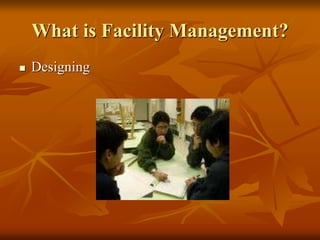
 Designing
What is Facility Management?
 Leasing:
What is Facility Management?
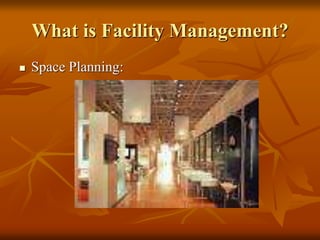
 Space Planning:
What is Facility Management?
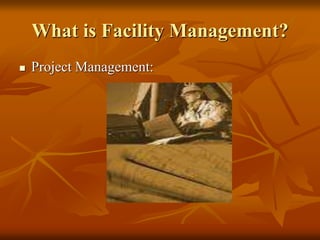
 Project Management:
What is Facility Management?
 Capital Management
What is Facility Management?
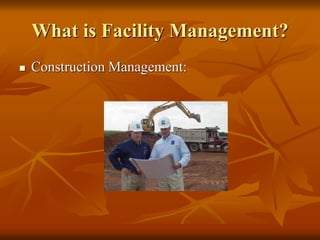
 Construction Management:
What is Facility Management?
 Property Management:
What is Facility Management?
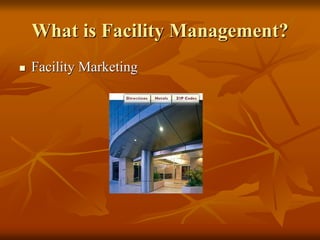
 Facility Marketing
What is Facility Management?
 Building and Operation Management:
What is Facility Management?
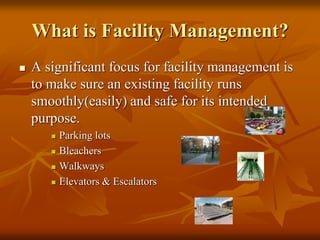
 A significant focus for facility management is
to make sure an existing facility runs
smoothly(easily) and safe for its intended
purpose.
 Parking lots
 Bleachers
 Walkways
 Elevators & Escalators
Facility Management
 Summary
 Facility management entails every aspect of
making sure a building is operating efficiently
in terms of safety, revenue production, tenant
satisfaction, and preventive maintenance.
The Facility Manager
 Is the person responsible for coordinating all
the employees and involved in the facility to
ensure that they work on behalf of the facility
and help meet its short and long term goals and
objectives.
The Facility Manager
 In a small facility, the facility owner may be
the manager and can be responsible for
opening and closing the facility.
The Facility Manager
 For a large facility may have several hundred
full – and part-time employees handling
everything, from cleanup crews to ushers and
ticket takers.
 Because of the diverse duties each facility
manager faces, facility management can be
considered both an art and a science.
Responsibilities
According to the International Facility Management
Association (IFMA), facility managers are the critical element
to implement any facility management plan and they need to
understand and appreciate several distinct functions including:
 Planning-both long and short-term;
 Financial forecasting;
 Property acquisition and disposal;
 Specifying work responsibility and space utilization;
 Architectural and engineering planning and management;
 Managing all phases of construction and renovation work;
 Managing maintenance systems and protocols;
 Managing all operations from administrative functions to
security protocols.
Management and Organization
 Planning all facility activities
 Organizing all personnel in appropriate departments
that optimize effectiveness
 Develop short intermediate and short terms plans
 Develop an inventory of available space and manage
that space
 Have a strong appreciation and understanding of
building design/planning, architectural design,
engineering design.
 Managing furniture and equipment for such area as
concessions, locker rooms, and press box
Management and Organization
 Focus significant effort on budgeting, accounting, and
economic forecasting
 Managing construction projects or moving from one
area of facility to another
 Spend significant time on operations, maintenance,
and repairs
 Deal with security and life safety concerns
 Supervise general administrative department
FACILITY MANAGEMENT
When surveyed, facility mangers have
highlighted that maintenance in fact absorbs
the greatest amount of their time (17%)
followed by space management (14%), interior
design (11%), and budgeting and forecasting
(9%).
Constituents
 Customers
 promoters
 Tenants
 Ticket buyers
 Attending the event
 Make sure that people can attend events within
the facility in a safe and secure manner.
Constituents
 Internal Constituents
 Boards/owners
 Employees
 Coworkers
 Interest in the facility
 Mission and meets its goals
 Motivating
 Decisions making
Constituents
 External Constituents
 Bankers Executives
 Politicians Others/influence the facility
 Media
 The facility manager must reach beyond the
facility to those who can exert influence on the
facility.
Managerial Functions
 Mission
 The overall ideal the facility wants to achieve;
it focuses on general terms such as
profitability, quality service, and workplace.
 It is impossible to plan without knowing what is to
be accomplished.
 It should states the end result envisioned by the
facility ‘s owner and encompasses the goals and
objectives critical for the facility’s success.
Managerial Functions
 Planning
 Focuses on setting goals and objectives and
then developing the plan to reach those goals
and objectives.
 Short and long terms goals
 What to do, when to do it and how to do it
 Blueprint for the future
Managerial Functions
 Planning
 Strategic plans –
 are designed to help achieve the highest-level
goals and objectives for the facility; that is why
they are often called master plan.
Managerial Functions
 Operational plans –
 Are more detailed and are used to help carry out
the strategic plans. Operational plans can include
single-use operational plans that may apply to a
one-time event.
Managerial Functions
 Contingency plan –
 Are plans that can be used if one of the other plans
fail and the facility has to pursue another strategy.
Managerial Functions
 Goals and Objectives
 Goals are a specific directive and objectives
focuses on how to reach a goal.
Managerial Functions
 Strategic goals –
 Are set by the highest-level managers and are
introduced to affect and empower the overall
facility for the log run.
 Often focus on broader aspect such as market
share, profitability, industry leader position, or
changes in the facility.
Managerial Functions
 Tactical goals –
 Are often introduced by midlevel managers and
focus on what needs to be accomplished to reach
the strategic goals.
Managerial Functions
 Operational goals –
 Are set by low-level managers and are more short-
term
Managerial Functions
 Management by Objective (MBO)
 Managers and employees can work together to
develop realistic and achievable objectives that
make both parties happy
Managerial Functions
 Short-Term Planning
 Typically cover less than one year and focus on
activities that may have a sense of emergency.
 Long –Term Planning
 Focus on long-term projections, which can be
influenced by political, geographical, and
economic trends.
Managerial Functions
 Organizing
 Refer to a blend of human resource management and
leadership.
 One of the most difficult tasks for a manager is to assign the
right person with the right skills and interests to a given job.
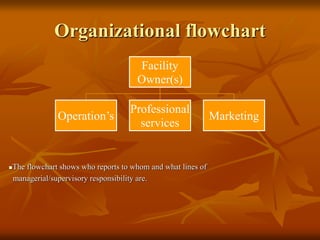
Organizational flowchart
Facility
Owner(s)
Operation’s
Professional
services
Marketing
The flowchart shows who reports to whom and what lines of
managerial/supervisory responsibility are.
Managerial Functions
 Implementing
 Refers to executing goals and objectives with
the appropriate personnel.
 Controlling
 Involves evaluating the results for individuals
who report to the manager and providing
appropriate feedback, whether positive or
negative.
Space Planning and Allocation
 Developing an inventory of available space
 Allocating available space
 Managing existing space
 Forecasting the possible future demand for
space
Architectural/Engineering Planning
and Design
 All facets of building design and planning
 Architectural design of the building
 Engineering design of building systems
 Estimating construction costs
 Planning future maintenance needs
 Planning for disasters that
 Documenting all phases of the design and estimating process
 Planning for renovations and future construction projects
Workplace Planning, Allocation, and
Management
 Workplace planning and design
 Furniture, equipment, and furnishing
specifications, acquisition, and management
 Analyzing maintenance needs and establishing
appropriate maintenance programs
 Planning concession, locker room, press box,
and related areas
 Art and memorabilia acquisition and
management
Budgeting, Accounting and
Economic Forecasting
 Budgeting for both the short and long-term
 Developing and implementing capital,
administrative, operations and maintenance
budgets
 Implementing appropriate accounting and
expense tracking systems
 Insuring economic justifications are accurate
and making any necessary changes
Real Estate Acquisition,
Management and Disposal
 Site selection, evaluation, and acquisition
 Facility purchase or leasing
 Facility or land sale/disposal
Construction Project Management
 Interviewing and hiring the right professionals,
construction and trade personnel
 Total project, construction, and procurement
management
 Preparation of “as built” documentation
Alteration, Renovation, and
Workplace Installations
 Alteration and renovation management
 Installing furniture, data communication
wiring, voice communication wiring, and
security related wiring and equipment
 Customizing and final touches
 Move management
Operations, Maintenance, and
Repairs
 Exterior maintenance of the building envelope (shell), roof, and windows
 Implementing various maintenance systems such as preventive, breakdown,
cyclical, grounds, road, and custodial maintenance
 Pest and rodent control
 Crowd management and ticketing disputes
 Trash and recycling disposal
 Hazardous (chemicals, asbestos, air quality, PCBs, etc…) management and
disposal
 Energy management to reduce costs
 Inventory management and procurement
 Repair of system components
 Disaster recovery and prevention
Telecommunications and Other
Technology Management
 Maintaining wiring and equipment
 Providing appropriate ventilation and security
for computer rooms
 Network management and documentation
Part 2
FACILITY MANAGEMENT
TOTAL FACILITY MANAGEMENT
PACKAGE (TFMP)
• Planning
• Administration
• Operation
• Marketing
• Finance
• Legal
PLANNING A FACILITY
Guiding principles:
 Facilities are built as a result of needs
 Cooperative planning is essential to the design
and construction of quality facilities
PRINCIPLES FOR
FACILITY PLANNING
 Plan for participants & users
 Plan for multiple & shared use
 Plan for health, safety, legal, practicality, & attractiveness
 Plan for long-term
 Economical, easy to maintain
 Plan community collaboration
HEALTH CONSIDERATION IN
FACILITY PLANNING
 The site
 The building
 Lighting
 Climate control (hvac)
 Plant sanitation
 Acoustics
DETERMINING TEACHING
STATION NEEDS
 Elementary schools
 Secondary schools
 Colleges and universities
 Athletic training facilities
 Other gymnasium space
THE TEAM APPROACH TO
FACILITY PLANNING
 The planning team
 Architects and consultants
 Faculty, staff, participants, students, and community
 Visit & gather information from comparable facilities
 Approval of higher management
WORKING WITH THE
ARCHITECT
 Educational specifications
 Meeting with the architect
 Designing the facility
 Further critique with the architect
 Final processing
INDOOR FACILITIES
 Locker, shower & drying rooms
 Gymnasiums
 Special activity areas
 Indoor swimming pools
 Athletic training and sports medicine
facilities
 Office and storage areas
GUIDELINES FOR
GYMNASIUMS
 The roof and ceilings
 The floor
 The walls
 Lighting
 Acoustics
SPECIAL ACTIVITY AREAS
 Adapted activities
 Weight rooms
 Racquet courts
 Dance and rhythms
 Wrestling and combative
 Gymnastics and tumbling
OUTDOOR FACILITIES
 Elementary school
 Junior high / middle school
 Senior high school
 University and college
 Outdoor swimming pools
 Outdoor pursuit
MANDATES ON FACILITIES FOR PERSONS
WITH DISABILITIES
 Architecture barriers act [1968]
 Section 504 - rehabilitation act
 Americans with disabilities act (ADA) [1990]
 Individuals with disabilities education act (IDEA)
[1997]
CONSTRUCTION TRENDS IN
PHYSICAL EDUCATION AND SPORT
FACILITIES
 Air-supported structures
 Minigyms and fitness corners
 Climbing walls
 Movable pool floors/walls
 Synthetic ice and snow
 Convertible roofs and walls
SHARED FACILITIES
 SCHOOLS AND PARK DISTRICTS
 SCHOOLS AND YMCAS
 COMMUNITY SWIMMING POOLS
 COMMUNITY TENNIS FACILITIES
 COMMUNITY ICE ARENAS
 COMMUNITY SKI FACILITIES
 COMMUNITY SOCCER FIELDS
GUIDELINES FOR
SHARED FACILITIES
 Contractual agreements
 Written policies
 Consent forms/permission slips
 Liability insurance
 Management oversight to ensure compliance
w/contract
 Proper supervision at all times
THE END

Facility management in Sports

  • 2.
    Facility Management By Dr. AbdulWaheed Mughal Dean, Faculty of Arts, Social Sciences & Education 01-11-2014
  • 3.
    Facility Managers  Afacility manager’s most important constituents(citizen) are the customers and employees.  Facility managers must report to numerous (several) stakeholders.  A. Politicians,  B. Independent parties  Govt. officials  Sports Leaders
  • 4.
    What is FacilityManagement?  Managing sport and public assembly facilities is often referred to as facility management, and the people who perform the task/duties are called facility managers.  The art and science of managing a facility to help meet the facility’s objectives, goals, and mission.
  • 5.
    What is FacilityManagement?  Facility management entails(involves) a broad(wide,comrehensive) array(range) of disciplines including, but not limited to:  Planning:  Pre-Constructional Planning  Post Constructional Planning  Building Management  Building systems, administration, markiting, budgeting, human resources  Event Management  Event planning coordination, execution, logistics, arrangements
  • 6.
    What is FacilityManagement?  Designing
  • 7.
    What is FacilityManagement?  Leasing:
  • 8.
    What is FacilityManagement?  Space Planning:
  • 9.
    What is FacilityManagement?  Project Management:
  • 10.
    What is FacilityManagement?  Capital Management
  • 11.
    What is FacilityManagement?  Construction Management:
  • 12.
    What is FacilityManagement?  Property Management:
  • 13.
    What is FacilityManagement?  Facility Marketing
  • 14.
    What is FacilityManagement?  Building and Operation Management:
  • 15.
    What is FacilityManagement?  A significant focus for facility management is to make sure an existing facility runs smoothly(easily) and safe for its intended purpose.  Parking lots  Bleachers  Walkways  Elevators & Escalators
  • 16.
    Facility Management  Summary Facility management entails every aspect of making sure a building is operating efficiently in terms of safety, revenue production, tenant satisfaction, and preventive maintenance.
  • 17.
    The Facility Manager Is the person responsible for coordinating all the employees and involved in the facility to ensure that they work on behalf of the facility and help meet its short and long term goals and objectives.
  • 18.
    The Facility Manager In a small facility, the facility owner may be the manager and can be responsible for opening and closing the facility.
  • 19.
    The Facility Manager For a large facility may have several hundred full – and part-time employees handling everything, from cleanup crews to ushers and ticket takers.  Because of the diverse duties each facility manager faces, facility management can be considered both an art and a science.
  • 20.
    Responsibilities According to theInternational Facility Management Association (IFMA), facility managers are the critical element to implement any facility management plan and they need to understand and appreciate several distinct functions including:  Planning-both long and short-term;  Financial forecasting;  Property acquisition and disposal;  Specifying work responsibility and space utilization;  Architectural and engineering planning and management;  Managing all phases of construction and renovation work;  Managing maintenance systems and protocols;  Managing all operations from administrative functions to security protocols.
  • 21.
    Management and Organization Planning all facility activities  Organizing all personnel in appropriate departments that optimize effectiveness  Develop short intermediate and short terms plans  Develop an inventory of available space and manage that space  Have a strong appreciation and understanding of building design/planning, architectural design, engineering design.  Managing furniture and equipment for such area as concessions, locker rooms, and press box
  • 22.
    Management and Organization Focus significant effort on budgeting, accounting, and economic forecasting  Managing construction projects or moving from one area of facility to another  Spend significant time on operations, maintenance, and repairs  Deal with security and life safety concerns  Supervise general administrative department
  • 23.
    FACILITY MANAGEMENT When surveyed,facility mangers have highlighted that maintenance in fact absorbs the greatest amount of their time (17%) followed by space management (14%), interior design (11%), and budgeting and forecasting (9%).
  • 24.
    Constituents  Customers  promoters Tenants  Ticket buyers  Attending the event  Make sure that people can attend events within the facility in a safe and secure manner.
  • 25.
    Constituents  Internal Constituents Boards/owners  Employees  Coworkers  Interest in the facility  Mission and meets its goals  Motivating  Decisions making
  • 26.
    Constituents  External Constituents Bankers Executives  Politicians Others/influence the facility  Media  The facility manager must reach beyond the facility to those who can exert influence on the facility.
  • 27.
    Managerial Functions  Mission The overall ideal the facility wants to achieve; it focuses on general terms such as profitability, quality service, and workplace.  It is impossible to plan without knowing what is to be accomplished.  It should states the end result envisioned by the facility ‘s owner and encompasses the goals and objectives critical for the facility’s success.
  • 28.
    Managerial Functions  Planning Focuses on setting goals and objectives and then developing the plan to reach those goals and objectives.  Short and long terms goals  What to do, when to do it and how to do it  Blueprint for the future
  • 29.
    Managerial Functions  Planning Strategic plans –  are designed to help achieve the highest-level goals and objectives for the facility; that is why they are often called master plan.
  • 30.
    Managerial Functions  Operationalplans –  Are more detailed and are used to help carry out the strategic plans. Operational plans can include single-use operational plans that may apply to a one-time event.
  • 31.
    Managerial Functions  Contingencyplan –  Are plans that can be used if one of the other plans fail and the facility has to pursue another strategy.
  • 32.
    Managerial Functions  Goalsand Objectives  Goals are a specific directive and objectives focuses on how to reach a goal.
  • 33.
    Managerial Functions  Strategicgoals –  Are set by the highest-level managers and are introduced to affect and empower the overall facility for the log run.  Often focus on broader aspect such as market share, profitability, industry leader position, or changes in the facility.
  • 34.
    Managerial Functions  Tacticalgoals –  Are often introduced by midlevel managers and focus on what needs to be accomplished to reach the strategic goals.
  • 35.
    Managerial Functions  Operationalgoals –  Are set by low-level managers and are more short- term
  • 36.
    Managerial Functions  Managementby Objective (MBO)  Managers and employees can work together to develop realistic and achievable objectives that make both parties happy
  • 37.
    Managerial Functions  Short-TermPlanning  Typically cover less than one year and focus on activities that may have a sense of emergency.  Long –Term Planning  Focus on long-term projections, which can be influenced by political, geographical, and economic trends.
  • 38.
    Managerial Functions  Organizing Refer to a blend of human resource management and leadership.  One of the most difficult tasks for a manager is to assign the right person with the right skills and interests to a given job.
  • 39.
    Organizational flowchart Facility Owner(s) Operation’s Professional services Marketing The flowchartshows who reports to whom and what lines of managerial/supervisory responsibility are.
  • 40.
    Managerial Functions  Implementing Refers to executing goals and objectives with the appropriate personnel.  Controlling  Involves evaluating the results for individuals who report to the manager and providing appropriate feedback, whether positive or negative.
  • 41.
    Space Planning andAllocation  Developing an inventory of available space  Allocating available space  Managing existing space  Forecasting the possible future demand for space
  • 42.
    Architectural/Engineering Planning and Design All facets of building design and planning  Architectural design of the building  Engineering design of building systems  Estimating construction costs  Planning future maintenance needs  Planning for disasters that  Documenting all phases of the design and estimating process  Planning for renovations and future construction projects
  • 43.
    Workplace Planning, Allocation,and Management  Workplace planning and design  Furniture, equipment, and furnishing specifications, acquisition, and management  Analyzing maintenance needs and establishing appropriate maintenance programs  Planning concession, locker room, press box, and related areas  Art and memorabilia acquisition and management
  • 44.
    Budgeting, Accounting and EconomicForecasting  Budgeting for both the short and long-term  Developing and implementing capital, administrative, operations and maintenance budgets  Implementing appropriate accounting and expense tracking systems  Insuring economic justifications are accurate and making any necessary changes
  • 45.
    Real Estate Acquisition, Managementand Disposal  Site selection, evaluation, and acquisition  Facility purchase or leasing  Facility or land sale/disposal
  • 46.
    Construction Project Management Interviewing and hiring the right professionals, construction and trade personnel  Total project, construction, and procurement management  Preparation of “as built” documentation
  • 47.
    Alteration, Renovation, and WorkplaceInstallations  Alteration and renovation management  Installing furniture, data communication wiring, voice communication wiring, and security related wiring and equipment  Customizing and final touches  Move management
  • 48.
    Operations, Maintenance, and Repairs Exterior maintenance of the building envelope (shell), roof, and windows  Implementing various maintenance systems such as preventive, breakdown, cyclical, grounds, road, and custodial maintenance  Pest and rodent control  Crowd management and ticketing disputes  Trash and recycling disposal  Hazardous (chemicals, asbestos, air quality, PCBs, etc…) management and disposal  Energy management to reduce costs  Inventory management and procurement  Repair of system components  Disaster recovery and prevention
  • 49.
    Telecommunications and Other TechnologyManagement  Maintaining wiring and equipment  Providing appropriate ventilation and security for computer rooms  Network management and documentation
  • 51.
  • 52.
    TOTAL FACILITY MANAGEMENT PACKAGE(TFMP) • Planning • Administration • Operation • Marketing • Finance • Legal
  • 53.
    PLANNING A FACILITY Guidingprinciples:  Facilities are built as a result of needs  Cooperative planning is essential to the design and construction of quality facilities
  • 54.
    PRINCIPLES FOR FACILITY PLANNING Plan for participants & users  Plan for multiple & shared use  Plan for health, safety, legal, practicality, & attractiveness  Plan for long-term  Economical, easy to maintain  Plan community collaboration
  • 55.
    HEALTH CONSIDERATION IN FACILITYPLANNING  The site  The building  Lighting  Climate control (hvac)  Plant sanitation  Acoustics
  • 56.
    DETERMINING TEACHING STATION NEEDS Elementary schools  Secondary schools  Colleges and universities  Athletic training facilities  Other gymnasium space
  • 57.
    THE TEAM APPROACHTO FACILITY PLANNING  The planning team  Architects and consultants  Faculty, staff, participants, students, and community  Visit & gather information from comparable facilities  Approval of higher management
  • 58.
    WORKING WITH THE ARCHITECT Educational specifications  Meeting with the architect  Designing the facility  Further critique with the architect  Final processing
  • 59.
    INDOOR FACILITIES  Locker,shower & drying rooms  Gymnasiums  Special activity areas  Indoor swimming pools  Athletic training and sports medicine facilities  Office and storage areas
  • 60.
    GUIDELINES FOR GYMNASIUMS  Theroof and ceilings  The floor  The walls  Lighting  Acoustics
  • 61.
    SPECIAL ACTIVITY AREAS Adapted activities  Weight rooms  Racquet courts  Dance and rhythms  Wrestling and combative  Gymnastics and tumbling
  • 62.
    OUTDOOR FACILITIES  Elementaryschool  Junior high / middle school  Senior high school  University and college  Outdoor swimming pools  Outdoor pursuit
  • 63.
    MANDATES ON FACILITIESFOR PERSONS WITH DISABILITIES  Architecture barriers act [1968]  Section 504 - rehabilitation act  Americans with disabilities act (ADA) [1990]  Individuals with disabilities education act (IDEA) [1997]
  • 64.
    CONSTRUCTION TRENDS IN PHYSICALEDUCATION AND SPORT FACILITIES  Air-supported structures  Minigyms and fitness corners  Climbing walls  Movable pool floors/walls  Synthetic ice and snow  Convertible roofs and walls
  • 65.
    SHARED FACILITIES  SCHOOLSAND PARK DISTRICTS  SCHOOLS AND YMCAS  COMMUNITY SWIMMING POOLS  COMMUNITY TENNIS FACILITIES  COMMUNITY ICE ARENAS  COMMUNITY SKI FACILITIES  COMMUNITY SOCCER FIELDS
  • 66.
    GUIDELINES FOR SHARED FACILITIES Contractual agreements  Written policies  Consent forms/permission slips  Liability insurance  Management oversight to ensure compliance w/contract  Proper supervision at all times
  • 67.