
Teaching Students with Learning Disabilities
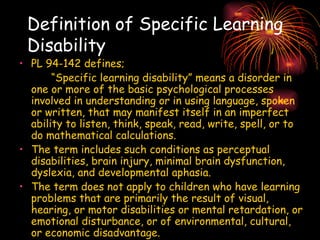
Definition of Specific Learning Disability PL 94-142 defines; “ Specific learning disability” means a disorder in one or more of the basic psychological processes involved in understanding or in using language, spoken or written, that may manifest itself in an imperfect ability to listen, think, speak, read, write, spell, or to do mathematical calculations.  The term includes such conditions as perceptual disabilities, brain injury, minimal brain dysfunction, dyslexia, and developmental aphasia. The term does not apply to children who have learning problems that are primarily the result of visual, hearing, or motor disabilities or mental retardation, or emotional disturbance, or of environmental, cultural, or economic disadvantage.
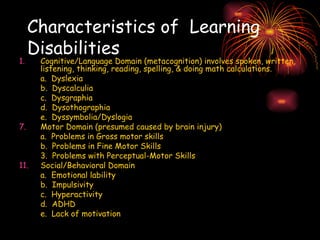
Characteristics of  Learning Disabilities Cognitive/Language Domain (metacognition) involves spoken, written, listening, thinking, reading, spelling, & doing math calculations. a.  Dyslexia b.  Dyscalculia c.  Dysgraphia d.  Dysothographia e.  Dyssymbolia/Dyslogia Motor Domain (presumed caused by brain injury) a.  Problems in Gross motor skills b.  Problems in Fine Motor Skills 3.  Problems with Perceptual-Motor Skills Social/Behavioral Domain a.  Emotional lability b.  Impulsivity c.  Hyperactivity d.  ADHD e.  Lack of motivation
Cognitive Teaching Strategies for LD Cognitive Training – a group of training procedures designed to change thoughts or thoughts patterns. Components involved in C.T. a.  Changing thought processes b.  Providing strategies for learning c.  Teaching self-initiative. Techniques under cognitive training  Self-instruction – a type of cognitive training technique that requires individuals to talk aloud and then to themselves as they solve problems. Mnemonic Keyword Method – used to help students with memory problems and remember curriculum content. Scaffolded Instruction – a cognitive approach to instruction in which the teacher provides temporary structure or support while students are learning a task; the support is gradually removed as the students are abler to perform the task independently.
Teaching Strategies for LD Direct Instruction – a method of teaching academics, especially reading and math; emphasizes drill and practice and immediate feedback; lessons are precisely sequenced, fast-paced, and well-rehearsed by the teacher. Multisensory Method – is based on the premise that some children learn best when content is presented in several modalities such as: a) visual b) auditory c) kinesthetic d) tactile
General Teaching Strategies Provide framework for learning.  Ex. Advance Organizer Model the processes and strategies. Ex.  Cognitive Training (Direct  Instruction) Present information in multiple ways. Ex.  Modeling/Story Telling Allow students to demonstrate learning in multiple ways. Ex. Concept maps, oral test, role play Teach students to use memory strategy Ex.  Categorization, keyword method Teach self-management & self-monitoring. Use learning tool and aids. Ex.  Use of computers Adjust workload and time. Mastery is more important!
Causes of ADHD a. Environmental Agents Studies have shown a possible correlation between the use of cigarettes and alcohol during pregnancy and risk for ADHD in the offspring of that pregnancy. b. Brain Injury Some children who have suffered accidents leading to brain injury may show some signs of behavior similar to that of ADHD, but only a small percentage of children with ADHD have been found to have suffered a traumatic brain injury. c. Food Additives and Sugar d. Genetics Attention disorders often run in families, so there are likely to be genetic influences.
Treatment for ADHD a. The Multimodal Treatment Study of Children with Attention Deficit Hyperactivity Disorder . 1) medication management alone (2) behavioral treatment alone (3) a combination of both or  (4) routine community care   Other Treatments Available to Help the Family and the ADHD Child. a. Psychotherapy b. Behavioral Therapy (BT) c. Social Skills Training d. Support Groups e. Parenting Skills Training f. Structure   g. Stress Management
Teaching Strategies How to Implement the Strategy: Three Components of Successful Programs for Children with ADHD Successful programs for children with ADHD integrate the following three components: Academic Instruction  Behavioral Interventions  Classroom Accommodations
Academic Instruction Introducing Lessons Provide an advance organizer.   Review previous lessons.   Set learning expectations.   Set behavioral expectations.   State needed materials. .  Explain additional resources.   Simplify instructions, choices, and scheduling. .
Academic Instruction Conducting Lessons Be predictable.   Support the student's participation  in the classroom.  Use audiovisual materials.   Check student performance.   Ask probing questions.   Perform ongoing student evaluation.   Help students correct their own mistakes.   Help students focus.   Follow-up directions.   Oral directions Written directions.   Lower noise level.   Divide work into smaller units.   Highlight key points.   Eliminate or reduce frequency of timed tests.   Use cooperative learning strategies.   Use assistive technology. .
Academic Instruction Concluding Lessons Provide advance warnings.   Check assignments. .  Preview the next lesson.
Behavioral Interventions Define the appropriate behavior while giving praise.   Give praise immediately.  Vary the statements given as praise.   Be consistent and sincere with praise.   In addition to verbal reinforcement, the following set of generalized behavioral intervention techniques has proven helpful with students with ADHD as well: Selectively ignore inappropriate behavior.   Remove nuisance items.   Provide calming manipulatives.   Allow for "escape valve" outlets.   Activity reinforcement.   Hurdle helping.   Parent conferences.   Peer mediation.
Behavioral Interventions Effective teachers also use behavioral prompts with their students. These prompts help remind students about expectations for their learning and behavior in the classroom. Three, which may be particularly helpful, are the following: Visual cues. .  Proximity control. .  Hand gestures.   In some instances, children with ADHD benefit from instruction designed to help students learn how to manage their own behavior: Social skills classes.   Problem solving sessions.   Functional Behavioral Assessment (FBA) . FBA is a systematic process for describing problem behavior and identifying the environmental factors and surrounding events associated with problem behavior.  Positive Behavioral Interventions and Supports  (PBIS). This method is an application of a behaviorally based systems approach that is grounded in research regarding behavior in the context of the settings in which it occurs.  Behavioral contracts and management plans.  Identify specific academic or behavioral goals for the child with ADHD, along with behavior that needs to change and strategies for responding to inappropriate behavior.  Tangible rewards.  Use tangible rewards to reinforce appropriate behavior.  Token economy systems.  Use token economy systems to motivate a child to achieve a goal identified in a behavioral contract (Barkley, 1990).  Self-management systems.  Train students to monitor and evaluate their own behavior without constant feedback from the teacher.
Classroom Accommodations Special Classroom Seating Arrangements for ADHD Students One of the most common accommodations that can be made to the physical environment of the classroom involves determining where a child with ADHD will sit. Three special seating assignments may be especially useful: Seat the child near the teacher.   Seat the child near a student role model.   Provide low-distraction work areas.   Instructional Tools and the Physical Learning Environment Skilled teachers use special instructional tools to modify the classroom learning environment and accommodate the special needs of their students with ADHD. They also monitor the physical environment, keeping in mind the needs of these children. The following tools and techniques may be helpful:  Pointers.   Egg timers.   Classroom lights.   Music.   Proper use of furniture.

Teaching students with Learning Disabilities

  • 1.
    Teaching Students withLearning Disabilities
  • 2.
    Definition of SpecificLearning Disability PL 94-142 defines; “ Specific learning disability” means a disorder in one or more of the basic psychological processes involved in understanding or in using language, spoken or written, that may manifest itself in an imperfect ability to listen, think, speak, read, write, spell, or to do mathematical calculations. The term includes such conditions as perceptual disabilities, brain injury, minimal brain dysfunction, dyslexia, and developmental aphasia. The term does not apply to children who have learning problems that are primarily the result of visual, hearing, or motor disabilities or mental retardation, or emotional disturbance, or of environmental, cultural, or economic disadvantage.
  • 3.
    Characteristics of Learning Disabilities Cognitive/Language Domain (metacognition) involves spoken, written, listening, thinking, reading, spelling, & doing math calculations. a. Dyslexia b. Dyscalculia c. Dysgraphia d. Dysothographia e. Dyssymbolia/Dyslogia Motor Domain (presumed caused by brain injury) a. Problems in Gross motor skills b. Problems in Fine Motor Skills 3. Problems with Perceptual-Motor Skills Social/Behavioral Domain a. Emotional lability b. Impulsivity c. Hyperactivity d. ADHD e. Lack of motivation
  • 4.
    Cognitive Teaching Strategiesfor LD Cognitive Training – a group of training procedures designed to change thoughts or thoughts patterns. Components involved in C.T. a. Changing thought processes b. Providing strategies for learning c. Teaching self-initiative. Techniques under cognitive training Self-instruction – a type of cognitive training technique that requires individuals to talk aloud and then to themselves as they solve problems. Mnemonic Keyword Method – used to help students with memory problems and remember curriculum content. Scaffolded Instruction – a cognitive approach to instruction in which the teacher provides temporary structure or support while students are learning a task; the support is gradually removed as the students are abler to perform the task independently.
  • 5.
    Teaching Strategies forLD Direct Instruction – a method of teaching academics, especially reading and math; emphasizes drill and practice and immediate feedback; lessons are precisely sequenced, fast-paced, and well-rehearsed by the teacher. Multisensory Method – is based on the premise that some children learn best when content is presented in several modalities such as: a) visual b) auditory c) kinesthetic d) tactile
  • 6.
    General Teaching StrategiesProvide framework for learning. Ex. Advance Organizer Model the processes and strategies. Ex. Cognitive Training (Direct Instruction) Present information in multiple ways. Ex. Modeling/Story Telling Allow students to demonstrate learning in multiple ways. Ex. Concept maps, oral test, role play Teach students to use memory strategy Ex. Categorization, keyword method Teach self-management & self-monitoring. Use learning tool and aids. Ex. Use of computers Adjust workload and time. Mastery is more important!
  • 7.
    Causes of ADHDa. Environmental Agents Studies have shown a possible correlation between the use of cigarettes and alcohol during pregnancy and risk for ADHD in the offspring of that pregnancy. b. Brain Injury Some children who have suffered accidents leading to brain injury may show some signs of behavior similar to that of ADHD, but only a small percentage of children with ADHD have been found to have suffered a traumatic brain injury. c. Food Additives and Sugar d. Genetics Attention disorders often run in families, so there are likely to be genetic influences.
  • 8.
    Treatment for ADHDa. The Multimodal Treatment Study of Children with Attention Deficit Hyperactivity Disorder . 1) medication management alone (2) behavioral treatment alone (3) a combination of both or (4) routine community care Other Treatments Available to Help the Family and the ADHD Child. a. Psychotherapy b. Behavioral Therapy (BT) c. Social Skills Training d. Support Groups e. Parenting Skills Training f. Structure g. Stress Management
  • 9.
    Teaching Strategies Howto Implement the Strategy: Three Components of Successful Programs for Children with ADHD Successful programs for children with ADHD integrate the following three components: Academic Instruction Behavioral Interventions Classroom Accommodations
  • 10.
    Academic Instruction IntroducingLessons Provide an advance organizer. Review previous lessons. Set learning expectations. Set behavioral expectations. State needed materials. . Explain additional resources. Simplify instructions, choices, and scheduling. .
  • 11.
    Academic Instruction ConductingLessons Be predictable. Support the student's participation in the classroom. Use audiovisual materials. Check student performance. Ask probing questions. Perform ongoing student evaluation. Help students correct their own mistakes. Help students focus. Follow-up directions. Oral directions Written directions. Lower noise level. Divide work into smaller units. Highlight key points. Eliminate or reduce frequency of timed tests. Use cooperative learning strategies. Use assistive technology. .
  • 12.
    Academic Instruction ConcludingLessons Provide advance warnings. Check assignments. . Preview the next lesson.
  • 13.
    Behavioral Interventions Definethe appropriate behavior while giving praise. Give praise immediately. Vary the statements given as praise. Be consistent and sincere with praise. In addition to verbal reinforcement, the following set of generalized behavioral intervention techniques has proven helpful with students with ADHD as well: Selectively ignore inappropriate behavior. Remove nuisance items. Provide calming manipulatives. Allow for "escape valve" outlets. Activity reinforcement. Hurdle helping. Parent conferences. Peer mediation.
  • 14.
    Behavioral Interventions Effectiveteachers also use behavioral prompts with their students. These prompts help remind students about expectations for their learning and behavior in the classroom. Three, which may be particularly helpful, are the following: Visual cues. . Proximity control. . Hand gestures. In some instances, children with ADHD benefit from instruction designed to help students learn how to manage their own behavior: Social skills classes. Problem solving sessions. Functional Behavioral Assessment (FBA) . FBA is a systematic process for describing problem behavior and identifying the environmental factors and surrounding events associated with problem behavior. Positive Behavioral Interventions and Supports (PBIS). This method is an application of a behaviorally based systems approach that is grounded in research regarding behavior in the context of the settings in which it occurs. Behavioral contracts and management plans. Identify specific academic or behavioral goals for the child with ADHD, along with behavior that needs to change and strategies for responding to inappropriate behavior. Tangible rewards. Use tangible rewards to reinforce appropriate behavior. Token economy systems. Use token economy systems to motivate a child to achieve a goal identified in a behavioral contract (Barkley, 1990). Self-management systems. Train students to monitor and evaluate their own behavior without constant feedback from the teacher.
  • 15.
    Classroom Accommodations SpecialClassroom Seating Arrangements for ADHD Students One of the most common accommodations that can be made to the physical environment of the classroom involves determining where a child with ADHD will sit. Three special seating assignments may be especially useful: Seat the child near the teacher. Seat the child near a student role model. Provide low-distraction work areas. Instructional Tools and the Physical Learning Environment Skilled teachers use special instructional tools to modify the classroom learning environment and accommodate the special needs of their students with ADHD. They also monitor the physical environment, keeping in mind the needs of these children. The following tools and techniques may be helpful: Pointers. Egg timers. Classroom lights. Music. Proper use of furniture.