Speech &
Language
Impairments
Mariah Thomas
Mallory O’Mara
Savannah Quade
Definition according to IDEA
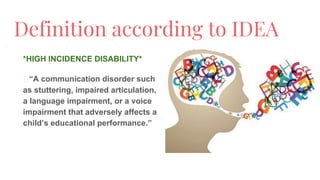
*HIGH INCIDENCE DISABILITY*
“A communication disorder such
as stuttering, impaired articulation,
a language impairment, or a voice
impairment that adversely affects a
child’s educational performance.”
Speech vs. Language
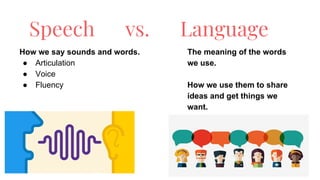
How we say sounds and words.
● Articulation
● Voice
● Fluency
The meaning of the words
we use.
How we use them to share
ideas and get things we
want.
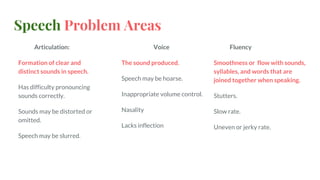
Speech Problem Areas
Articulation:
Formation of clear and
distinct sounds in speech.
Has difficulty pronouncing
sounds correctly.
Sounds may be distorted or
omitted.
Speech may be slurred.
Voice
The sound produced.
Speech may be hoarse.
Inappropriate volume control.
Nasality
Lacks inflection
Fluency
Smoothness or flow with sounds,
syllables, and words that are
joined together when speaking.
Stutters.
Slow rate.
Uneven or jerky rate.
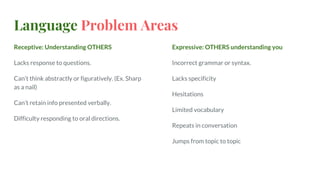
Language Problem Areas
Receptive: Understanding OTHERS
Lacks response to questions.
Can’t think abstractly or figuratively. (Ex. Sharp
as a nail)
Can’t retain info presented verbally.
Difficulty responding to oral directions.
Expressive: OTHERS understanding you
Incorrect grammar or syntax.
Lacks specificity
Hesitations
Limited vocabulary
Repeats in conversation
Jumps from topic to topic
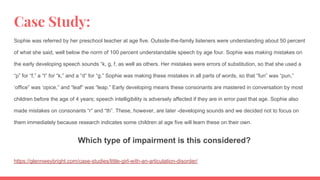
Case Study:
Sophie was referred by her preschool teacher at age five. Outside-the-family listeners were understanding about 50 percent
of what she said, well below the norm of 100 percent understandable speech by age four. Sophie was making mistakes on
the early developing speech sounds “k, g, f, as well as others. Her mistakes were errors of substitution, so that she used a
“p” for “f,” a “t” for “k,” and a “d” for “g.” Sophie was making these mistakes in all parts of words, so that “fun” was “pun,”
‘office” was ‘opice,” and “leaf” was “leap.” Early developing means these consonants are mastered in conversation by most
children before the age of 4 years; speech intelligibility is adversely affected if they are in error past that age. Sophie also
made mistakes on consonants “r” and “th”. These, however, are later -developing sounds and we decided not to focus on
them immediately because research indicates some children at age five will learn these on their own.
Which type of impairment is this considered?
https://glennweybright.com/case-studies/little-girl-with-an-articulation-disorder/
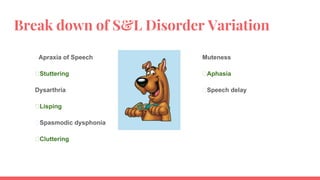
Break down of S&L Disorder Variation
Apraxia of Speech
Stuttering
Dysarthria
Lisping
Spasmodic dysphonia
Cluttering
Muteness
Aphasia
Speech delay
Partner Decoding
Use the link in your email to work with your elbow partner to
decode what your assigned individual is saying.
● Decide what type of impairment they might have.
● How can you teach others to understand this individuals
speech?
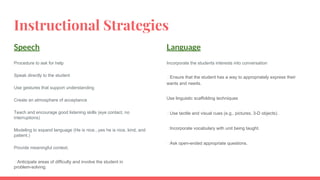
Instructional Strategies
Speech
Procedure to ask for help
Speak directly to the student
Use gestures that support understanding
Create an atmosphere of acceptance
Teach and encourage good listening skills (eye contact, no
interruptions)
Modeling to expand language (He is nice...yes he is nice, kind, and
patient.)
Provide meaningful context.
Anticipate areas of difficulty and involve the student in
problem-solving.
Language
Incorporate the students interests into conversation
Ensure that the student has a way to appropriately express their
wants and needs.
Use linguistic scaffolding techniques
Use tactile and visual cues (e.g., pictures, 3-D objects).
Incorporate vocabulary with unit being taught.
Ask open-ended appropriate questions.
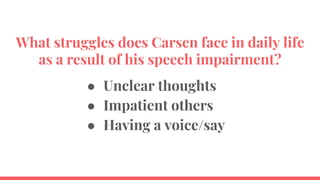
● Unclear thoughts
● Impatient others
● Having a voice/say
What struggles does Carsen face in daily life
as a result of his speech impairment?
Group Case Study
In your small group, read the study and create a small poster
highlighting the following information to share with the class:
1. Students name and diagnosis
2. Common problems faced
3. Instructional strategies to consider
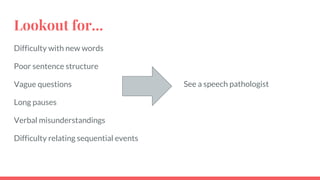
Lookout for...
Difficulty with new words
Poor sentence structure
Vague questions
Long pauses
Verbal misunderstandings
Difficulty relating sequential events
See a speech pathologist

Speech and Language Impairments

  • 1.
  • 3.
    Definition according toIDEA *HIGH INCIDENCE DISABILITY* “A communication disorder such as stuttering, impaired articulation, a language impairment, or a voice impairment that adversely affects a child’s educational performance.”
  • 4.
    Speech vs. Language Howwe say sounds and words. ● Articulation ● Voice ● Fluency The meaning of the words we use. How we use them to share ideas and get things we want.
  • 6.
    Speech Problem Areas Articulation: Formationof clear and distinct sounds in speech. Has difficulty pronouncing sounds correctly. Sounds may be distorted or omitted. Speech may be slurred. Voice The sound produced. Speech may be hoarse. Inappropriate volume control. Nasality Lacks inflection Fluency Smoothness or flow with sounds, syllables, and words that are joined together when speaking. Stutters. Slow rate. Uneven or jerky rate.
  • 7.
    Language Problem Areas Receptive:Understanding OTHERS Lacks response to questions. Can’t think abstractly or figuratively. (Ex. Sharp as a nail) Can’t retain info presented verbally. Difficulty responding to oral directions. Expressive: OTHERS understanding you Incorrect grammar or syntax. Lacks specificity Hesitations Limited vocabulary Repeats in conversation Jumps from topic to topic
  • 8.
    Case Study: Sophie wasreferred by her preschool teacher at age five. Outside-the-family listeners were understanding about 50 percent of what she said, well below the norm of 100 percent understandable speech by age four. Sophie was making mistakes on the early developing speech sounds “k, g, f, as well as others. Her mistakes were errors of substitution, so that she used a “p” for “f,” a “t” for “k,” and a “d” for “g.” Sophie was making these mistakes in all parts of words, so that “fun” was “pun,” ‘office” was ‘opice,” and “leaf” was “leap.” Early developing means these consonants are mastered in conversation by most children before the age of 4 years; speech intelligibility is adversely affected if they are in error past that age. Sophie also made mistakes on consonants “r” and “th”. These, however, are later -developing sounds and we decided not to focus on them immediately because research indicates some children at age five will learn these on their own. Which type of impairment is this considered? https://glennweybright.com/case-studies/little-girl-with-an-articulation-disorder/
  • 9.
    Break down ofS&L Disorder Variation Apraxia of Speech Stuttering Dysarthria Lisping Spasmodic dysphonia Cluttering Muteness Aphasia Speech delay
  • 10.
    Partner Decoding Use thelink in your email to work with your elbow partner to decode what your assigned individual is saying. ● Decide what type of impairment they might have. ● How can you teach others to understand this individuals speech?
  • 11.
    Instructional Strategies Speech Procedure toask for help Speak directly to the student Use gestures that support understanding Create an atmosphere of acceptance Teach and encourage good listening skills (eye contact, no interruptions) Modeling to expand language (He is nice...yes he is nice, kind, and patient.) Provide meaningful context. Anticipate areas of difficulty and involve the student in problem-solving. Language Incorporate the students interests into conversation Ensure that the student has a way to appropriately express their wants and needs. Use linguistic scaffolding techniques Use tactile and visual cues (e.g., pictures, 3-D objects). Incorporate vocabulary with unit being taught. Ask open-ended appropriate questions.
  • 13.
    ● Unclear thoughts ●Impatient others ● Having a voice/say What struggles does Carsen face in daily life as a result of his speech impairment?
  • 14.
    Group Case Study Inyour small group, read the study and create a small poster highlighting the following information to share with the class: 1. Students name and diagnosis 2. Common problems faced 3. Instructional strategies to consider
  • 15.
    Lookout for... Difficulty withnew words Poor sentence structure Vague questions Long pauses Verbal misunderstandings Difficulty relating sequential events See a speech pathologist