
Polymerase
Chain Reaction
Dr. Karthikeyan Pethusamy
Polymerase chain reaction
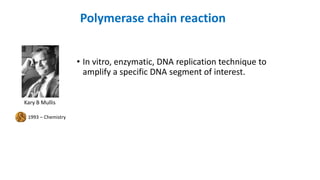
• In vitro, enzymatic, DNA replication technique to
amplify a specific DNA segment of interest.
1993 – Chemistry
Kary B Mullis
Polymerase chain reaction
• Multiple rounds of amplification of DNA using template DNA,
specific primers and the enzyme DNA dependent DNA polymerase
• Products of the previous rounds act as template for the subsequent
rounds, hence chain reaction
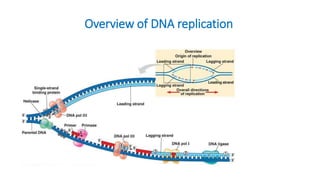
Overview of DNA replication
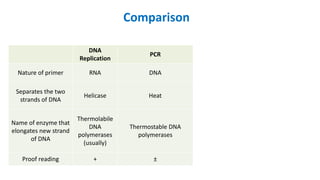
Comparison
DNA
Replication
PCR
Nature of primer RNA DNA
Separates the two
strands of DNA
Helicase Heat
Name of enzyme that
elongates new strand
of DNA
Thermolabile
DNA
polymerases
(usually)
Thermostable DNA
polymerases
Proof reading + ±
Components of PCR
1. Template DNA
2. Pair of DNA Primers
3. Thermostable DNA polymerase
4. dNTPs
5. Buffer with divalent cation
Template DNA
• 50-100 ng of pure DNA is needed.
• Should be free of proteins and lipids.
• Can be isolated from blood, tissues, cultured cells, hair etc.
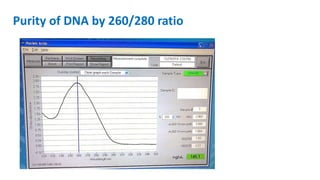
Purity of DNA by 260/280 ratio
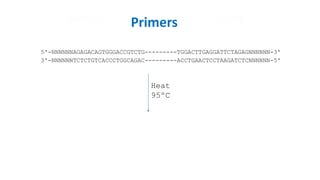
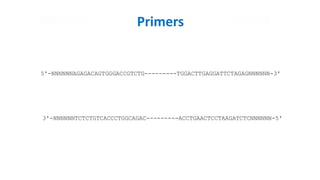
5'-NNNNNNAGAGACAGTGGGACCGTCTG---------TGGACTTGAGGATTCTAGAGNNNNNN-3'
3'-NNNNNNTCTCTGTCACCCTGGCAGAC---------ACCTGAACTCCTAAGATCTCNNNNNN-5'
Primers
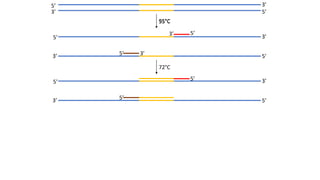
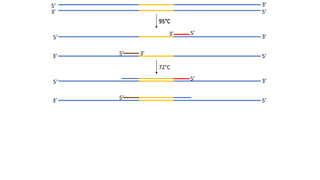
Heat
95ºC
5'-NNNNNNAGAGACAGTGGGACCGTCTG---------TGGACTTGAGGATTCTAGAGNNNNNN-3'
3'-NNNNNNTCTCTGTCACCCTGGCAGAC---------ACCTGAACTCCTAAGATCTCNNNNNN-5'
Primers
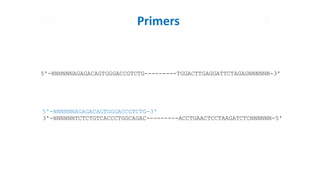
5'-NNNNNNAGAGACAGTGGGACCGTCTG---------TGGACTTGAGGATTCTAGAGNNNNNN-3'
3'-NNNNNNTCTCTGTCACCCTGGCAGAC---------ACCTGAACTCCTAAGATCTCNNNNNN-5'
Primers
5'-NNNNNNAGAGACAGTGGGACCGTCTG-3'
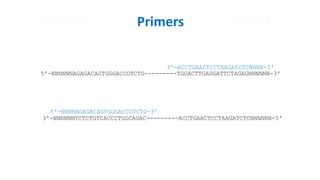
5'-NNNNNNAGAGACAGTGGGACCGTCTG---------TGGACTTGAGGATTCTAGAGNNNNNN-3'
3'-NNNNNNTCTCTGTCACCCTGGCAGAC---------ACCTGAACTCCTAAGATCTCNNNNNN-5'
Primers
5'-NNNNAGAGACAGTGGGACCGTCTG-3'
3'-ACCTGAACTCCTAAGATCTCNNNN-5'
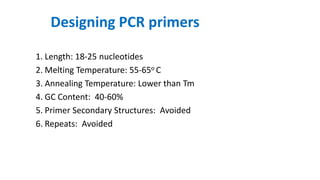
Designing PCR primers
1. Length: 18-25 nucleotides
2. Melting Temperature: 55-65o C
3. Annealing Temperature: Lower than Tm
4. GC Content: 40-60%
5. Primer Secondary Structures: Avoided
6. Repeats: Avoided
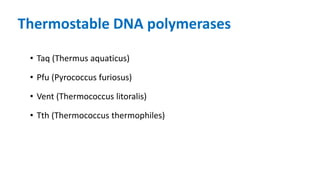
Thermostable DNA polymerases
• Taq (Thermus aquaticus)
• Pfu (Pyrococcus furiosus)
• Vent (Thermococcus litoralis)
• Tth (Thermococcus thermophiles)
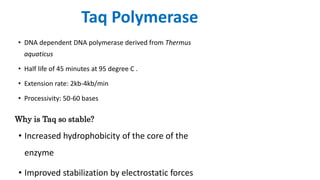
Taq Polymerase
• DNA dependent DNA polymerase derived from Thermus
aquaticus
• Half life of 45 minutes at 95 degree C .
• Extension rate: 2kb-4kb/min
• Processivity: 50-60 bases
Why is Taq so stable?
• Increased hydrophobicity of the core of the
enzyme
• Improved stabilization by electrostatic forces
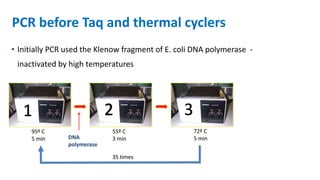
PCR before Taq and thermal cyclers
• Initially PCR used the Klenow fragment of E. coli DNA polymerase -
inactivated by high temperatures
95º C
5 min
35 times
55º C
3 min
72º C
5 minDNA
polymerase
1 22 3
dNTPs
• Equimolar concentrations of
• dATP
• dCTP
• dGTP
• dTTP
Buffer
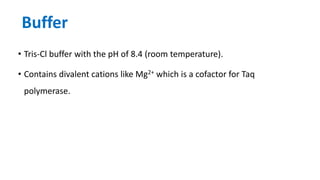
• Tris-Cl buffer with the pH of 8.4 (room temperature).
• Contains divalent cations like Mg2+ which is a cofactor for Taq
polymerase.
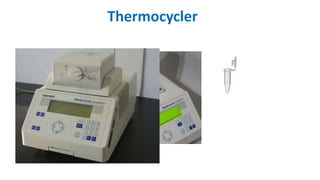
Thermocycler
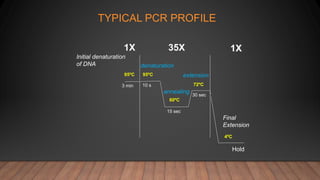
TYPICAL PCR PROFILE
annealing
95ºC 95ºC
60ºC
72ºC
4ºC
3 min 10 s
15 sec
30 sec
Hold
Initial denaturation
of DNA
1X 35X 1X
extension
Final
Extension
denaturation
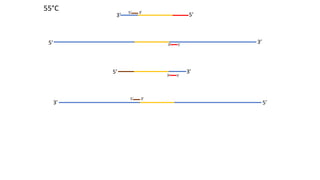
5’
5’3’
3’
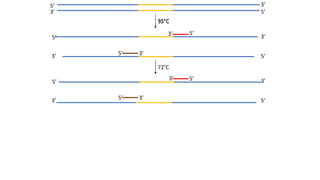
95°C
5’
5’3’
3’
5’ 3’
5’3’
55°C
72°C
5’
5’3’
3’
5’ 3’
5’3’
5’
5’3’
3’
95°C
5’
5’3’
3’
5’ 3’
5’3’
55°C
72°C
5’
5’3’
3’
5’
5’
5’
5’3’
3’
95°C
5’
5’3’
3’
5’ 3’
5’3’
55°C
72°C
5’
5’3’
3’
5’
5’
5’
5’3’
3’
95°C
5’
5’3’
3’
5’ 3’
5’3’
55°C
72°C
5’
5’3’
3’
5’
5’3’
3’
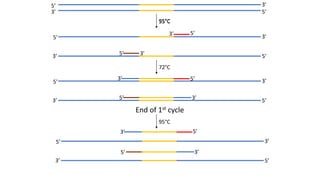
End of 1st cycle
95°C
5’
5’3’
3’
3’
5’3’
5’
5’ 3’
5’3’
5’3’
3’5’
5’ 3’
5’3’
5’3’
3’5’
5’ 3’
5’ 3’
3’ 5’
3’ 5’
55°C
5’ 3’
5’3’
3’
3’5’
5’
5’
5’
5’
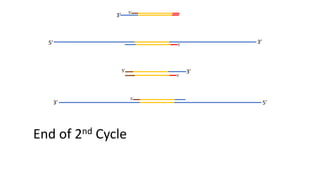
End of 2nd Cycle
5’ 3’
3’
3’5’
5’
5’
5’
5’
3’
3’
3’
3’
5’
5’ 3’
3’
3’5’
5’
5’
5’
5’
3’
3’
3’
3’
5’
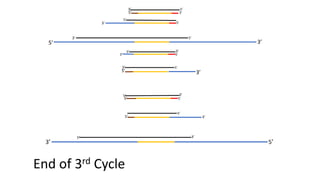
End of 3rd Cycle
5’
5’
5’
5’
5’
5’
5’
3’
3’
3’
3’
5’
3’
3’
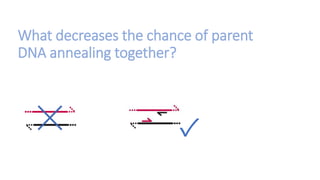
What decreases the chance of parent
DNA annealing together?
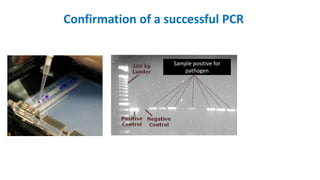
Confirmation of a successful PCR
Sample positive for
pathogen
Advantages of PCR
• PCR is exquisitely sensitive. A single DNA molecule
can be amplified and detected.
• PCR can be made highly specific using the stringency
of hybridization at relatively high temperature.
• The sequence of the target need not be known. Only
the flanking sequence need to be known.
• Targets larger than 10 kb can also be amplified by PCR.
Reverse transcriptase PCR
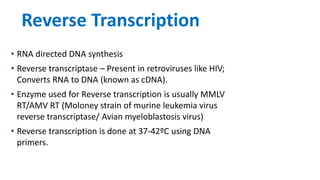
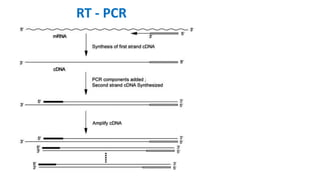
Reverse Transcription
• RNA directed DNA synthesis
• Reverse transcriptase – Present in retroviruses like HIV;
Converts RNA to DNA (known as cDNA).
• Enzyme used for Reverse transcription is usually MMLV
RT/AMV RT (Moloney strain of murine leukemia virus
reverse transcriptase/ Avian myeloblastosis virus)
• Reverse transcription is done at 37-42ºC using DNA
primers.
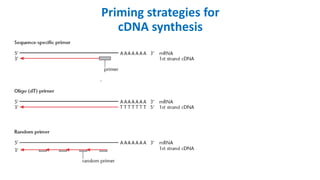
Priming strategies for
cDNA synthesis
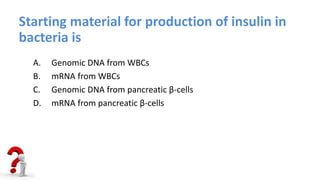
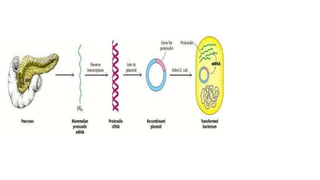
Starting material for production of insulin in
bacteria is
A. Genomic DNA from WBCs
B. mRNA from WBCs
C. Genomic DNA from pancreatic β-cells
D. mRNA from pancreatic β-cells
RT - PCR
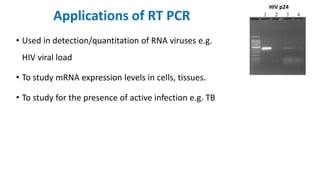
Applications of RT PCR
HIV p24
• Used in detection/quantitation of RNA viruses e.g.
HIV viral load
• To study mRNA expression levels in cells, tissues.
• To study for the presence of active infection e.g. TB
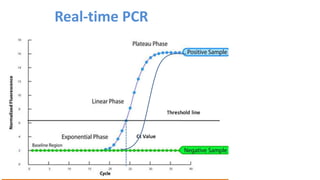
Real time PCR (qPCR)
• Traditional PCR has advanced from detection at the
end-point of the reaction to detection while the
reaction is occurring (Real-Time).
• Real-time PCR uses a fluorescent reporter signal to
measure the amount of amplicon as it is generated.
This kinetic PCR allows for data collection after each
cycle of PCR instead of only at the end of the 20 to 40
cycles.
• PCR mixture is prepared along with dsDNA binding dye
(e.g. SYBR green).
• After each cycle, the level of fluorescence is measured.
• Machine has fluorescence detectors which captures the
signals and convert them to graphical representation on
the screen.
• Ct values (cycle number at which threshold
fluorescence is achieved) are calculated.
• With reference to a standard dilution, the dsDNA
concentration in the PCR can be determined.
Real time PCR
Real-time PCR
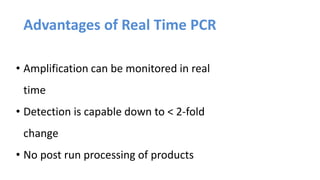
Advantages of Real Time PCR
• Amplification can be monitored in real
time
• Detection is capable down to < 2-fold
change
• No post run processing of products
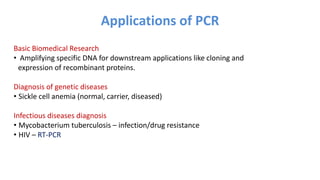
Basic Biomedical Research
• Amplifying specific DNA for downstream applications like cloning and
expression of recombinant proteins.
Diagnosis of genetic diseases
• Sickle cell anemia (normal, carrier, diseased)
Infectious diseases diagnosis
• Mycobacterium tuberculosis – infection/drug resistance
• HIV – RT-PCR
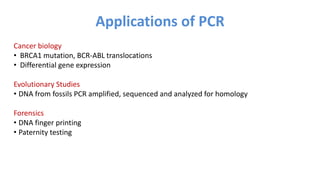
Applications of PCR
Cancer biology
• BRCA1 mutation, BCR-ABL translocations
• Differential gene expression
Evolutionary Studies
• DNA from fossils PCR amplified, sequenced and analyzed for homology
Forensics
• DNA finger printing
• Paternity testing
Applications of PCR
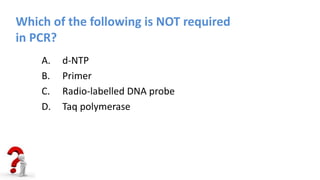
Which of the following is NOT required
in PCR?
A. d-NTP
B. Primer
C. Radio-labelled DNA probe
D. Taq polymerase
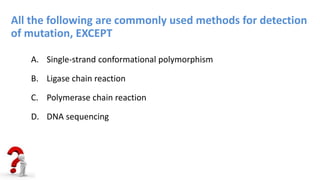
All the following are commonly used methods for detection
of mutation, EXCEPT
A. Single-strand conformational polymorphism
B. Ligase chain reaction
C. Polymerase chain reaction
D. DNA sequencing
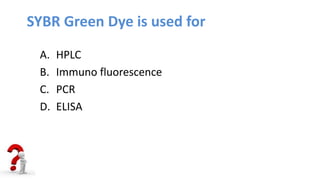
SYBR Green Dye is used for
A. HPLC
B. Immuno fluorescence
C. PCR
D. ELISA
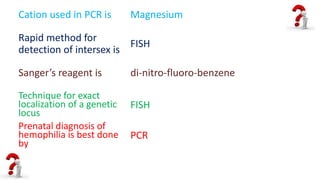
Cation used in PCR is Magnesium
Rapid method for
detection of intersex is
FISH
Sanger’s reagent is di-nitro-fluoro-benzene
Technique for exact
localization of a genetic
locus
FISH
Prenatal diagnosis of
hemophilia is best done
by
PCR

Polymerase Chain Reaction

Editor's Notes

  • #2 3 billion base pairs  2 meters of DNA
  • #8 Average weight of a DNA basepair (sodium salt) = 650 daltons (1 dalton equals the mass of a single hydrogen atom, or 1.67 x 10⁻²⁴grams) Molecular weight of a double-stranded DNA molecule = (# of basepairs x 650 daltons) Total weight of the human genome = 3.3 x 109 bp x 650Da = 2.15 X 10¹² Da. One dalton is 1.67 x 10⁻²⁴grams, so the human genome weighs 3.59 x 10⁻¹² grams (10-12 grams is also known as a picogram).
  • #10 Adjacent sequence
  • #14 Ta Opt = 0.3 x (Tm of primer) + 0.7 x(Tm of product) - 14.9
  • #19 1.5 mM
  • #42 P24 – nucleocapsid protein