WELCOME
Safayet Hossain sobuj
Dept : CSE
Daffodil International University
Parsimony method
for
Phylogenetic tree analysis
Introduction
• A phylogenetic tree or evolutionary tree is a branching diagram or
"tree’’showing the inferred evolutionary relationships among
various biological species
or,
other entities—their phylogeny—based upon similarities and
differences in their physical or genetic characteristics.
• Phylogenetic trees are central to the field of phylogenetics.
WHAT DOES THIS TREE LOOK
LIKE?
• There are many different ways to represent the information found in a
phylogenetic tree.
• The basic format of a tree is generally in one of the two forms shown,
although there are other ways to represent the data.
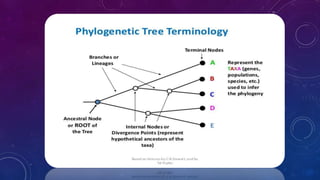
Phylogenetic tree
Rooted Unrooted
Kinds
“ROOTED” &“UNROOTED”
TREE
• A rooted tree is used to make inferences about the most
common ancestor of the leaves or branches of the tree.
Most commonly the root is referred to as an “outgroup”.
• An unrooted tree is used to make an illustration about
the leaves or branches, but not make assumption
regarding a common ancestor.
THE BIFURCATING TREE
• A tree that bifurcates has a
maximum of 2 descendants arising
from each of the interior nodes.
Diagram:
There are several methods of constructing phylogenetic trees
- the most common are:
• Distance methods
• Parsimony methods
• Maximum likelihood methods
• Neighbor-joining or UPGMA
All these methods can only provide estimates of what a
phylogenetic tree might look like for a given set of data. Most
good methods also provide an indication of how much
variation there is in these estimates.
Construction
WHAT DOES PARSIMONY MEAN
• Parsimony - principle in science where the
simplest answer is the preferred.
• In phylogeny: The preferred phylogenetic tree is
the one that requires the fewest evolutionary
steps.
THINGS TO KNOW ABOUT PARSIMONY
METHOD
• Parsimony analysis is the second primary way to estimate phylogenetic
trees from aligned sequences.
• The maximum parsimony method is good for similar sequences, a
sequences group with small amount of variation
• This method does not give the branch length, only the branch order
• Parsimony may be used to estimate "species" or "gene" phylogenies.
STEPS
1. Identify all informative sites in the multiple alignment
2. For each possible tree, calculate the number of changes at
each informative site.
3. Sum the number of changes for each possible tree.
4. Tree with the smallest number of changes is selected as the
most likely tree
PARSIMONY METHOD
• Parsimony is a fundamental principle to phylogenetic
inference in which the phylogeny of a group of species is
inferred to be the branching pattern requiring the smallest
number of evolutionary changes.
PHYLOGENETIC INFERENCE USING PARSIMONY PROCEEDS IN
TWO STAGES:
• 1. Infer the unrooted tree for a set of species. An unrooted tree
shows the branching relations between the species but does not
show the position of the deepest common ancestor. It is a
phylogenetic tree with the time dimension removed.
• 2. Locate the root. This means finding the position of the deepest
ancestor, or 'root' within the tree.
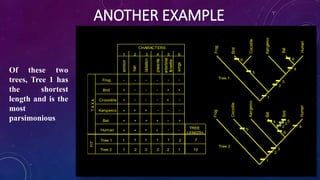
Example:
Frog
Bird
Crocodile
Kangeroo
Bat
Human
amnion
hair
wings
antorbital
fenestra
placenta
lactation
Tree 1
Tree 2
TAXAFIT
-
-
-
-
--
+
-
+
-
+
-
+
-
+
-
+
-
+
-
+
-
+
-
+
-
+
-
+ -
+
-
CHARACTERS
1 2 3 4 5 6
+
+
+
+
1
1
TREE
LENGTH
1 1 1 1 2 7
2 2 2 2 1 10
Frog
Cocodile
Kangeroo
Bat
Bird
Human
1
2
3
6
4
4
5
5
2
3
Tree 2
Cocodile
Kangeroo
Frog
Bird
Bat
Human
1
Tree 1
2
3
4
66
5
ANOTHER EXAMPLE
Of these two
trees, Tree 1 has
the shortest
length and is the
most
parsimonious
PARSIMONY - ADVANTAGES
• It is a simple method - easily understood
operation
• It does not seem to depend on an explicit model
of evolution
• It gives both trees and associated hypotheses of
character evolution
• This method should give reliable results if the
data is well structured and homoplasy is either
rare or widely (randomly) distributed on the tree
PARSIMONY - DISADVANTAGES
• May give misleading results if homoplasy is common or
concentrated in particular parts of the tree, e.g:
- thermophilic convergence
- base composition biases
- long branch attraction
• Underestimates branch lengths
• Model of evolution is implicit - behaviour of method not
well understood
• Parsimony often justified on purely philosophical grounds -
we must prefer simplest hypotheses - particularly by
morphologists
THANK YOU

Parsimony methods

  • 1.
  • 2.
    Safayet Hossain sobuj Dept: CSE Daffodil International University
  • 3.
  • 4.
    Introduction • A phylogenetictree or evolutionary tree is a branching diagram or "tree’’showing the inferred evolutionary relationships among various biological species or, other entities—their phylogeny—based upon similarities and differences in their physical or genetic characteristics. • Phylogenetic trees are central to the field of phylogenetics.
  • 5.
    WHAT DOES THISTREE LOOK LIKE? • There are many different ways to represent the information found in a phylogenetic tree. • The basic format of a tree is generally in one of the two forms shown, although there are other ways to represent the data.
  • 7.
  • 8.
    “ROOTED” &“UNROOTED” TREE • Arooted tree is used to make inferences about the most common ancestor of the leaves or branches of the tree. Most commonly the root is referred to as an “outgroup”. • An unrooted tree is used to make an illustration about the leaves or branches, but not make assumption regarding a common ancestor.
  • 10.
    THE BIFURCATING TREE •A tree that bifurcates has a maximum of 2 descendants arising from each of the interior nodes. Diagram:
  • 11.
    There are severalmethods of constructing phylogenetic trees - the most common are: • Distance methods • Parsimony methods • Maximum likelihood methods • Neighbor-joining or UPGMA All these methods can only provide estimates of what a phylogenetic tree might look like for a given set of data. Most good methods also provide an indication of how much variation there is in these estimates. Construction
  • 12.
    WHAT DOES PARSIMONYMEAN • Parsimony - principle in science where the simplest answer is the preferred. • In phylogeny: The preferred phylogenetic tree is the one that requires the fewest evolutionary steps.
  • 13.
    THINGS TO KNOWABOUT PARSIMONY METHOD • Parsimony analysis is the second primary way to estimate phylogenetic trees from aligned sequences. • The maximum parsimony method is good for similar sequences, a sequences group with small amount of variation • This method does not give the branch length, only the branch order • Parsimony may be used to estimate "species" or "gene" phylogenies.
  • 14.
    STEPS 1. Identify allinformative sites in the multiple alignment 2. For each possible tree, calculate the number of changes at each informative site. 3. Sum the number of changes for each possible tree. 4. Tree with the smallest number of changes is selected as the most likely tree
  • 15.
    PARSIMONY METHOD • Parsimonyis a fundamental principle to phylogenetic inference in which the phylogeny of a group of species is inferred to be the branching pattern requiring the smallest number of evolutionary changes.
  • 16.
    PHYLOGENETIC INFERENCE USINGPARSIMONY PROCEEDS IN TWO STAGES: • 1. Infer the unrooted tree for a set of species. An unrooted tree shows the branching relations between the species but does not show the position of the deepest common ancestor. It is a phylogenetic tree with the time dimension removed. • 2. Locate the root. This means finding the position of the deepest ancestor, or 'root' within the tree.
  • 17.
  • 18.
    Frog Bird Crocodile Kangeroo Bat Human amnion hair wings antorbital fenestra placenta lactation Tree 1 Tree 2 TAXAFIT - - - - -- + - + - + - + - + - + - + - + - + - + - + - +- + - CHARACTERS 1 2 3 4 5 6 + + + + 1 1 TREE LENGTH 1 1 1 1 2 7 2 2 2 2 1 10 Frog Cocodile Kangeroo Bat Bird Human 1 2 3 6 4 4 5 5 2 3 Tree 2 Cocodile Kangeroo Frog Bird Bat Human 1 Tree 1 2 3 4 66 5 ANOTHER EXAMPLE Of these two trees, Tree 1 has the shortest length and is the most parsimonious
  • 19.
    PARSIMONY - ADVANTAGES •It is a simple method - easily understood operation • It does not seem to depend on an explicit model of evolution • It gives both trees and associated hypotheses of character evolution • This method should give reliable results if the data is well structured and homoplasy is either rare or widely (randomly) distributed on the tree
  • 20.
    PARSIMONY - DISADVANTAGES •May give misleading results if homoplasy is common or concentrated in particular parts of the tree, e.g: - thermophilic convergence - base composition biases - long branch attraction • Underestimates branch lengths • Model of evolution is implicit - behaviour of method not well understood • Parsimony often justified on purely philosophical grounds - we must prefer simplest hypotheses - particularly by morphologists
  • 21.