An introduction to Central Dogma of Molecular
Biology and Polymerase Chain Reaction
XX
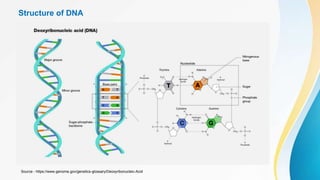
Structure of DNA
Source - https://www.genome.gov/genetics-glossary/Deoxyribonucleic-Acid
https://twitter.com/BMCBiology/status/920603314978476033
Rosalind Franklin -
Best known for her contributions to the discovery of the
molecular structure of deoxyribonucleic acid (DNA)
(https://www.britannica.com/biography/Rosalind-Franklin)
James Watson and Francis Crick with a model of DNA Helix
(https://www.sciencephoto.com/media/914842/view/watson-and-crick-with-
their-dna-model)
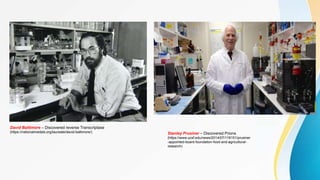
David Baltimore – Discovered reverse Transcriptase
(https://nationalmedals.org/laureate/david-baltimore/) Stanley Prusiner – Discovered Prions
(https://www.ucsf.edu/news/2014/07/116151/prusiner
-appointed-board-foundation-food-and-agricultural-
research)
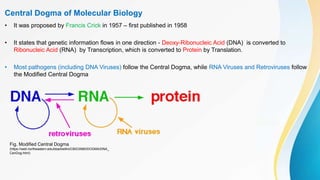
Central Dogma of Molecular Biology
• It was proposed by Francis Crick in 1957 – first published in 1958
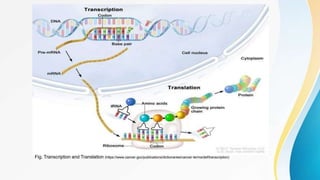
• It states that genetic information flows in one direction - Deoxy-Ribonucleic Acid (DNA) is converted to
Ribonucleic Acid (RNA) by Transcription, which is converted to Protein by Translation.
• Most pathogens (including DNA Viruses) follow the Central Dogma, while RNA Viruses and Retroviruses follow
the Modified Central Dogma
Fig. Modified Central Dogma
(https://web.northeastern.edu/bbarbiellini/CBIO3580/DOGMA/DNA_
CenDog.html)
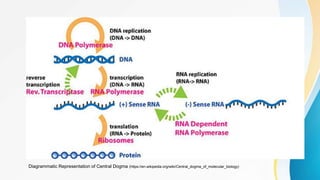
Diagrammatic Representation of Central Dogma (https://en.wikipedia.org/wiki/Central_dogma_of_molecular_biology)
Fig. Transcription and Translation (https://www.cancer.gov/publications/dictionaries/cancer-terms/def/transcription)
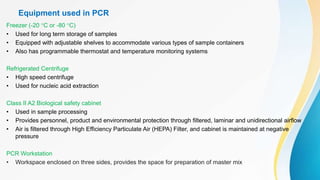
Equipment used in PCR
Freezer (-20 °C or -80 °C)
• Used for long term storage of samples
• Equipped with adjustable shelves to accommodate various types of sample containers
• Also has programmable thermostat and temperature monitoring systems
Refrigerated Centrifuge
• High speed centrifuge
• Used for nucleic acid extraction
Class II A2 Biological safety cabinet
• Used in sample processing
• Provides personnel, product and environmental protection through filtered, laminar and unidirectional airflow
• Air is filtered through High Efficiency Particulate Air (HEPA) Filter, and cabinet is maintained at negative
pressure
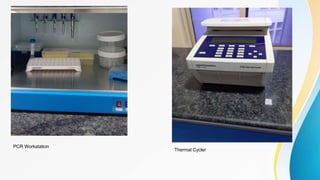
PCR Workstation
• Workspace enclosed on three sides, provides the space for preparation of master mix
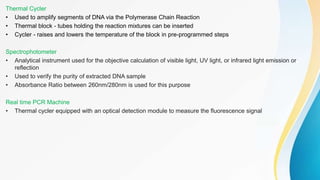
Thermal Cycler
• Used to amplify segments of DNA via the Polymerase Chain Reaction
• Thermal block - tubes holding the reaction mixtures can be inserted
• Cycler - raises and lowers the temperature of the block in pre-programmed steps
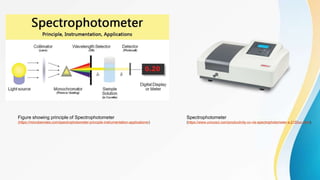
Spectrophotometer
• Analytical instrument used for the objective calculation of visible light, UV light, or infrared light emission or
reflection
• Used to verify the purity of extracted DNA sample
• Absorbance Ratio between 260nm/280nm is used for this purpose
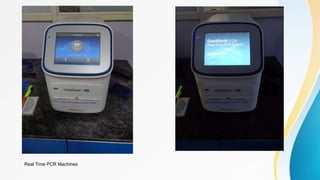
Real time PCR Machine
• Thermal cycler equipped with an optical detection module to measure the fluorescence signal
PCR Workstation
Thermal Cycler
Figure showing principle of Spectrophotometer
(https://microbenotes.com/spectrophotometer-principle-instrumentation-applications/)
Spectrophotometer
(https://www.unicosci.com/productivity-uv-vis-spectrophotometer-s-2150uv.html)
Real Time PCR Machines
Principle of PCR
 Overview
• Polymerase Chain Reaction is a laboratory technique used for the production of a large number of copies DNA
segment
• Developed by Kary Mullis in the 1980s
• Principle – Based on the ability of DNA polymerase enzyme to synthesize a new strand of DNA complementary to
the offered template strand
 A nucleotide can only be added to a pre-existing 3’-OH group, thus a primer to which it can attach is needed –
permits the delineation of a specific sequence to be amplified
 Components of PCR
• DNA template : Sample DNA with target sequence : Exposed to high temperature to separate strands
• Thermostable DNA Polymerase enzyme : Can be obtained from Thermus aquaticus (Taq DNA Polymerase) or
Pyrococcus furiosus (Pfu DNA Polymerase)
Heat resistant enzymes, and can generate new strands using primers
• Primer : short single stranded nucleotide sequence, required for initiating the reaction
- new DNA nucleotides are synthesized from ends of primers
• Deoxy-nucleotidetriphosphates : Used for the synthesis of the new DNA strand
• Buffer solution : maintains chemical environment for reaction process
• Bivalent/Monovalent Cations : Either Mg2+ , Mn2+ , K+ or could be used
 The reaction is carried out in Small Reaction Tubes (0.2-0.5 mL) in a Thermal Cycler (used to maintain high
temperatures)
 Process
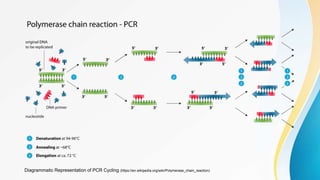
• Denaturation
Reaction is heated to 94-98 °C for 20-30 seconds – causes denaturation of DNA (separation of DNA strands due to
breakage of Hydrogen bonds between strands)
• Annealing
Reaction chamber is cooled to 50-65 °C for 20-40 seconds, to allow the attachment of primer to the separated DNA
strands
• Extension/Elongation
Temperature is maintained at 72-75 °C - A new DNA strand complementary to template strand is created by adding
free dNTPs in the 5'-to-3' direction
Diagrammatic Representation of PCR Cycling (https://en.wikipedia.org/wiki/Polymerase_chain_reaction)
 The first 3 steps (Denaturation, Annealing, Extension) are considered as 1 cycle of the reaction – Number of
copies of DNA produced = 2n (Here n is the number of cycles)
Normally 30-40 cycles are performed
• Final elongation
The reaction temperature is kept at 70-74 °C for 5-15 minutes, it ensures that any remaining strands of ssDNA are
fully elongated
• Final Hold
Reaction temperature is reduced to 4-15 °C. The obtained DNA samples may be stored at 4 °C for short periods,
stored at -20 °C or - 80 °C for long term storage
 Stages of PCR replication (PCR Amplification curve)
1. Exponential amplification - At every cycle, the amount of product is doubled (assuming 100% reaction efficiency)
2. Levelling off - The reaction slows as the DNA polymerase loses activity and as consumption of reagents, such as
dNTPs and primers, causes them to become more limited
3. Plateau - No more product accumulates due to exhaustion of reagents and enzyme
 Visualization
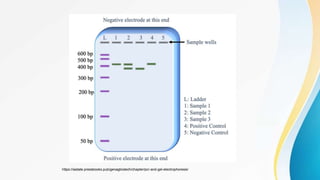
• Agarose based Gel Electrophoresis – separates DNA fragments based on size (2% Agarose Gel is used)
• Fluorescent based
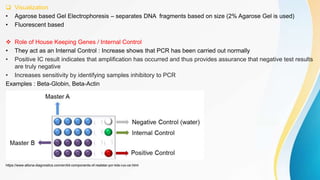
 Role of House Keeping Genes / Internal Control
• They act as an Internal Control : Increase shows that PCR has been carried out normally
• Positive IC result indicates that amplification has occurred and thus provides assurance that negative test results
are truly negative
• Increases sensitivity by identifying samples inhibitory to PCR
Examples : Beta-Globin, Beta-Actin
https://www.altona-diagnostics.com/en/kit-components-of-realstar-pcr-kits-ruo-ce.html
https://iastate.pressbooks.pub/genagbiotech/chapter/pcr-and-gel-electrophoresis/
Variations of PCR
• Since the technique was invented in the 1980s, PCR has been adapted and modified in many ways, giving rise
to many variations
• To date, there are 37 different variants of PCR used for both diagnostic and research purposes
1. Amplified fragment length polymorphism (AFLP)
PCR
2. Allele-specific PCR
3. Alu PCR
4. Assembly PCR
5. Asymmetric PCR
6. COLD PCR
7. Colony PCR
8. Conventional PCR
9. Digital PCR (dPCR)
10. Fast-cycling PCR
11. High-fidelity PCR
12. High-Resolution Melt (HRM) PCR
13. Hot-start PCR
14. In situ PCR
15. Intersequence-specific (ISSR) PCR
16. Inverse PCR
17. LATE (linear after the exponential) PCR
18. Ligation-mediated PCR
19. Long-range PCR
20. Methylation-specific PCR (MSP)
21. Miniprimer PCR
22.Multiplex-PCR
23.Nanoparticle-Assisted PCR (nanoPCR)
24.Nested PCR
25.Overlap extension PCR
26.Real-Time PCR (quantitative PCR or qPCR)
27.Repetitive sequence-based PCR
28.Reverse-Transcriptase (RT-PCR)
29.Reverse-Transcriptase Real-Time PCR (RT-qPCR)
30.RNase H-dependent PCR (rhPCR)
31.Single cell PCR
32.Single Specific Primer-PCR (SSP-PCR)
33.Solid phase PCR
34.Suicide PCR
35.Thermal asymmetric interlaced PCR (TAIL-PCR)
36.Touch down (TD) PCR
37.Variable Number of Tandem Repeats (VNTR) PCR
Other Variations of PCR
Multiplex PCR
• Involves amplifying multiple sequences in a single reaction – by using several pairs of primers annealing to
different target sequences
• Very useful for DNA fingerprinting, study of genetic mutations, microsatellites and SNPs
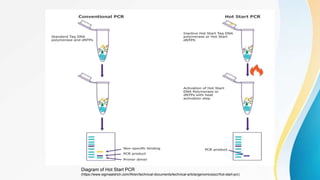
Hot Start PCR
• Optimizes the yield of amplified product and suppresses nonspecific amplification and formation of primer dimers
• Done by – inactivating/inhibiting Taq Polymerase and late addition
• Increases product yield
• Provides higher specificity and sensitivity
Reverse Transcriptase PCR (RT-PCR)
• Sample RNA is converted to cDNA (complementary DNA), which is then subjected to PCR cycling and detection
• Useful for detecting RNA viruses in a given sample
• More efficient than Northern Blot method (used for RNA quantification)
Diagram of Hot Start PCR
(https://www.sigmaaldrich.com/IN/en/technical-documents/technical-article/genomics/pcr/hot-start-pcr)
Real Time PCR
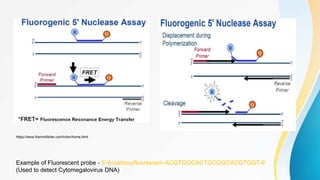
 It is a laboratory technique used to monitor the amplification of DNA during the reaction, and not at the end
 This is done by 2 methods
1. Adding non specific fluorescent dyes that bind to dsDNA
2. Sequence specific DNA probe with fluorescent reporter that is detected only after hybridization (FRET)
 Non Specific Fluorescent Dyes
• A DNA binding dye is added – binds to dsDNA, therefore increase in dsDNA (product) amount will cause
increased fluorescence intensity
 Fluorogenic Resonance Energy Transfer (Fluorescent reporter probe)
• PCR is prepared, and reporter probe is added - both probe and primers anneal to the DNA target
• Polymerization begins, and once polymerase reaches the probe, its 5'-3'-exonuclease degrades the probe,
separating the fluorescent reporter
• Fluorescence is detected and measured in a real-time PCR machine
Example of Fluorescent probe - 5′-6-carboxyfluorescein-ACGTGGCACTGCGGCACGTGGT-6
(Used to detect Cytomegalovirus DNA)
https://www.thermofisher.com/in/en/home.html
Nested PCR
• Used to increase the specificity of DNA amplification - Two sets of primers are used in two successive reactions
• One pair of primers generates DNA products
• Products from 1st PCR are used as template in 2nd PCR – using two different primers whose binding sites are
located (nested) within the 1st set
• Minimizes non-specific products
Semi-Nested PCR
• Similar to Nested PCR, but 1 primer is common to forward and reverse steps
Asymmetric PCR
• Asymmetric PCR preferentially amplifies one strand of the target DNA - amplified linearly and no longer
exponentially
• Used in some sequencing methods and hybridization probing, to generate one DNA strand as product
• Thermocycling done with a limiting amount of primers
Quantitative PCR
• Used to detect the number of copies of DNA / Pathogen Load
• Two types 1. Absolute Quantitative PCR – Provides absolute measurement of starting copy number
2. Relative Quantitative PCR – Provides accurate discrimination between relative amounts of copy number
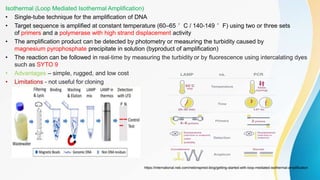
Isothermal (Loop Mediated Isothermal Amplification)
• Single-tube technique for the amplification of DNA
• Target sequence is amplified at constant temperature (60–65 °C / 140-149 °F) using two or three sets
of primers and a polymerase with high strand displacement activity
• The amplification product can be detected by photometry or measuring the turbidity caused by
magnesium pyrophosphate precipitate in solution (byproduct of amplification)
• The reaction can be followed in real-time by measuring the turbidity or by fluorescence using intercalating dyes
such as SYTO 9
• Advantages – simple, rugged, and low cost
• Limitations - not useful for cloning
https://international.neb.com/nebinspired-blog/getting-started-with-loop-mediated-isothermal-amplification
References
• https://www.ncbi.nlm.nih.gov/pmc/articles/PMC124832/
• https://www.ncbi.nlm.nih.gov/pmc/articles/PMC87935/
• https://www.sigmaaldrich.com/IN/en/technical-documents/technical-article/genomics/pcr/hot-start-pcr
• https://www.frontiersin.org/articles/10.3389/fbioe.2022.1045154/full
• https://www.ncbi.nlm.nih.gov/probe/docs/techpcr/
• https://www.ncbi.nlm.nih.gov/probe/docs/distrperlegen/
• https://www.ncbi.nlm.nih.gov/Class/MLACourse/Modules/MolBioReview/central_dogma.html
• https://pubmed.ncbi.nlm.nih.gov/29717051/
• https://pubmed.ncbi.nlm.nih.gov/31160389/
• https://pubmed.ncbi.nlm.nih.gov/17417022/
• https://pubmed.ncbi.nlm.nih.gov/22664923/
• https://pubmed.ncbi.nlm.nih.gov/11835531/
• https://pubmed.ncbi.nlm.nih.gov/8908518/
• https://pubmed.ncbi.nlm.nih.gov/1456447/
• https://pubmed.ncbi.nlm.nih.gov/22065442/
Thank You

Introduction to PCR.pptx

  • 1.
    An introduction toCentral Dogma of Molecular Biology and Polymerase Chain Reaction XX
  • 2.
    Structure of DNA Source- https://www.genome.gov/genetics-glossary/Deoxyribonucleic-Acid
  • 3.
    https://twitter.com/BMCBiology/status/920603314978476033 Rosalind Franklin - Bestknown for her contributions to the discovery of the molecular structure of deoxyribonucleic acid (DNA) (https://www.britannica.com/biography/Rosalind-Franklin) James Watson and Francis Crick with a model of DNA Helix (https://www.sciencephoto.com/media/914842/view/watson-and-crick-with- their-dna-model)
  • 4.
    David Baltimore –Discovered reverse Transcriptase (https://nationalmedals.org/laureate/david-baltimore/) Stanley Prusiner – Discovered Prions (https://www.ucsf.edu/news/2014/07/116151/prusiner -appointed-board-foundation-food-and-agricultural- research)
  • 5.
    Central Dogma ofMolecular Biology • It was proposed by Francis Crick in 1957 – first published in 1958 • It states that genetic information flows in one direction - Deoxy-Ribonucleic Acid (DNA) is converted to Ribonucleic Acid (RNA) by Transcription, which is converted to Protein by Translation. • Most pathogens (including DNA Viruses) follow the Central Dogma, while RNA Viruses and Retroviruses follow the Modified Central Dogma Fig. Modified Central Dogma (https://web.northeastern.edu/bbarbiellini/CBIO3580/DOGMA/DNA_ CenDog.html)
  • 6.
    Diagrammatic Representation ofCentral Dogma (https://en.wikipedia.org/wiki/Central_dogma_of_molecular_biology)
  • 7.
    Fig. Transcription andTranslation (https://www.cancer.gov/publications/dictionaries/cancer-terms/def/transcription)
  • 8.
    Equipment used inPCR Freezer (-20 °C or -80 °C) • Used for long term storage of samples • Equipped with adjustable shelves to accommodate various types of sample containers • Also has programmable thermostat and temperature monitoring systems Refrigerated Centrifuge • High speed centrifuge • Used for nucleic acid extraction Class II A2 Biological safety cabinet • Used in sample processing • Provides personnel, product and environmental protection through filtered, laminar and unidirectional airflow • Air is filtered through High Efficiency Particulate Air (HEPA) Filter, and cabinet is maintained at negative pressure PCR Workstation • Workspace enclosed on three sides, provides the space for preparation of master mix
  • 9.
    Thermal Cycler • Usedto amplify segments of DNA via the Polymerase Chain Reaction • Thermal block - tubes holding the reaction mixtures can be inserted • Cycler - raises and lowers the temperature of the block in pre-programmed steps Spectrophotometer • Analytical instrument used for the objective calculation of visible light, UV light, or infrared light emission or reflection • Used to verify the purity of extracted DNA sample • Absorbance Ratio between 260nm/280nm is used for this purpose Real time PCR Machine • Thermal cycler equipped with an optical detection module to measure the fluorescence signal
  • 10.
  • 11.
    Figure showing principleof Spectrophotometer (https://microbenotes.com/spectrophotometer-principle-instrumentation-applications/) Spectrophotometer (https://www.unicosci.com/productivity-uv-vis-spectrophotometer-s-2150uv.html)
  • 12.
    Real Time PCRMachines
  • 13.
    Principle of PCR Overview • Polymerase Chain Reaction is a laboratory technique used for the production of a large number of copies DNA segment • Developed by Kary Mullis in the 1980s • Principle – Based on the ability of DNA polymerase enzyme to synthesize a new strand of DNA complementary to the offered template strand  A nucleotide can only be added to a pre-existing 3’-OH group, thus a primer to which it can attach is needed – permits the delineation of a specific sequence to be amplified  Components of PCR • DNA template : Sample DNA with target sequence : Exposed to high temperature to separate strands • Thermostable DNA Polymerase enzyme : Can be obtained from Thermus aquaticus (Taq DNA Polymerase) or Pyrococcus furiosus (Pfu DNA Polymerase) Heat resistant enzymes, and can generate new strands using primers • Primer : short single stranded nucleotide sequence, required for initiating the reaction - new DNA nucleotides are synthesized from ends of primers
  • 14.
    • Deoxy-nucleotidetriphosphates :Used for the synthesis of the new DNA strand • Buffer solution : maintains chemical environment for reaction process • Bivalent/Monovalent Cations : Either Mg2+ , Mn2+ , K+ or could be used  The reaction is carried out in Small Reaction Tubes (0.2-0.5 mL) in a Thermal Cycler (used to maintain high temperatures)  Process • Denaturation Reaction is heated to 94-98 °C for 20-30 seconds – causes denaturation of DNA (separation of DNA strands due to breakage of Hydrogen bonds between strands) • Annealing Reaction chamber is cooled to 50-65 °C for 20-40 seconds, to allow the attachment of primer to the separated DNA strands • Extension/Elongation Temperature is maintained at 72-75 °C - A new DNA strand complementary to template strand is created by adding free dNTPs in the 5'-to-3' direction
  • 15.
    Diagrammatic Representation ofPCR Cycling (https://en.wikipedia.org/wiki/Polymerase_chain_reaction)
  • 16.
     The first3 steps (Denaturation, Annealing, Extension) are considered as 1 cycle of the reaction – Number of copies of DNA produced = 2n (Here n is the number of cycles) Normally 30-40 cycles are performed • Final elongation The reaction temperature is kept at 70-74 °C for 5-15 minutes, it ensures that any remaining strands of ssDNA are fully elongated • Final Hold Reaction temperature is reduced to 4-15 °C. The obtained DNA samples may be stored at 4 °C for short periods, stored at -20 °C or - 80 °C for long term storage  Stages of PCR replication (PCR Amplification curve) 1. Exponential amplification - At every cycle, the amount of product is doubled (assuming 100% reaction efficiency) 2. Levelling off - The reaction slows as the DNA polymerase loses activity and as consumption of reagents, such as dNTPs and primers, causes them to become more limited 3. Plateau - No more product accumulates due to exhaustion of reagents and enzyme
  • 17.
     Visualization • Agarosebased Gel Electrophoresis – separates DNA fragments based on size (2% Agarose Gel is used) • Fluorescent based  Role of House Keeping Genes / Internal Control • They act as an Internal Control : Increase shows that PCR has been carried out normally • Positive IC result indicates that amplification has occurred and thus provides assurance that negative test results are truly negative • Increases sensitivity by identifying samples inhibitory to PCR Examples : Beta-Globin, Beta-Actin https://www.altona-diagnostics.com/en/kit-components-of-realstar-pcr-kits-ruo-ce.html
  • 18.
  • 19.
    Variations of PCR •Since the technique was invented in the 1980s, PCR has been adapted and modified in many ways, giving rise to many variations • To date, there are 37 different variants of PCR used for both diagnostic and research purposes 1. Amplified fragment length polymorphism (AFLP) PCR 2. Allele-specific PCR 3. Alu PCR 4. Assembly PCR 5. Asymmetric PCR 6. COLD PCR 7. Colony PCR 8. Conventional PCR 9. Digital PCR (dPCR) 10. Fast-cycling PCR 11. High-fidelity PCR 12. High-Resolution Melt (HRM) PCR 13. Hot-start PCR 14. In situ PCR 15. Intersequence-specific (ISSR) PCR 16. Inverse PCR 17. LATE (linear after the exponential) PCR 18. Ligation-mediated PCR 19. Long-range PCR 20. Methylation-specific PCR (MSP) 21. Miniprimer PCR 22.Multiplex-PCR 23.Nanoparticle-Assisted PCR (nanoPCR) 24.Nested PCR 25.Overlap extension PCR 26.Real-Time PCR (quantitative PCR or qPCR) 27.Repetitive sequence-based PCR 28.Reverse-Transcriptase (RT-PCR) 29.Reverse-Transcriptase Real-Time PCR (RT-qPCR) 30.RNase H-dependent PCR (rhPCR) 31.Single cell PCR 32.Single Specific Primer-PCR (SSP-PCR) 33.Solid phase PCR 34.Suicide PCR 35.Thermal asymmetric interlaced PCR (TAIL-PCR) 36.Touch down (TD) PCR 37.Variable Number of Tandem Repeats (VNTR) PCR
  • 20.
    Other Variations ofPCR Multiplex PCR • Involves amplifying multiple sequences in a single reaction – by using several pairs of primers annealing to different target sequences • Very useful for DNA fingerprinting, study of genetic mutations, microsatellites and SNPs Hot Start PCR • Optimizes the yield of amplified product and suppresses nonspecific amplification and formation of primer dimers • Done by – inactivating/inhibiting Taq Polymerase and late addition • Increases product yield • Provides higher specificity and sensitivity Reverse Transcriptase PCR (RT-PCR) • Sample RNA is converted to cDNA (complementary DNA), which is then subjected to PCR cycling and detection • Useful for detecting RNA viruses in a given sample • More efficient than Northern Blot method (used for RNA quantification)
  • 21.
    Diagram of HotStart PCR (https://www.sigmaaldrich.com/IN/en/technical-documents/technical-article/genomics/pcr/hot-start-pcr)
  • 22.
    Real Time PCR It is a laboratory technique used to monitor the amplification of DNA during the reaction, and not at the end  This is done by 2 methods 1. Adding non specific fluorescent dyes that bind to dsDNA 2. Sequence specific DNA probe with fluorescent reporter that is detected only after hybridization (FRET)  Non Specific Fluorescent Dyes • A DNA binding dye is added – binds to dsDNA, therefore increase in dsDNA (product) amount will cause increased fluorescence intensity  Fluorogenic Resonance Energy Transfer (Fluorescent reporter probe) • PCR is prepared, and reporter probe is added - both probe and primers anneal to the DNA target • Polymerization begins, and once polymerase reaches the probe, its 5'-3'-exonuclease degrades the probe, separating the fluorescent reporter • Fluorescence is detected and measured in a real-time PCR machine
  • 23.
    Example of Fluorescentprobe - 5′-6-carboxyfluorescein-ACGTGGCACTGCGGCACGTGGT-6 (Used to detect Cytomegalovirus DNA) https://www.thermofisher.com/in/en/home.html
  • 24.
    Nested PCR • Usedto increase the specificity of DNA amplification - Two sets of primers are used in two successive reactions • One pair of primers generates DNA products • Products from 1st PCR are used as template in 2nd PCR – using two different primers whose binding sites are located (nested) within the 1st set • Minimizes non-specific products Semi-Nested PCR • Similar to Nested PCR, but 1 primer is common to forward and reverse steps Asymmetric PCR • Asymmetric PCR preferentially amplifies one strand of the target DNA - amplified linearly and no longer exponentially • Used in some sequencing methods and hybridization probing, to generate one DNA strand as product • Thermocycling done with a limiting amount of primers Quantitative PCR • Used to detect the number of copies of DNA / Pathogen Load • Two types 1. Absolute Quantitative PCR – Provides absolute measurement of starting copy number 2. Relative Quantitative PCR – Provides accurate discrimination between relative amounts of copy number
  • 25.
    Isothermal (Loop MediatedIsothermal Amplification) • Single-tube technique for the amplification of DNA • Target sequence is amplified at constant temperature (60–65 °C / 140-149 °F) using two or three sets of primers and a polymerase with high strand displacement activity • The amplification product can be detected by photometry or measuring the turbidity caused by magnesium pyrophosphate precipitate in solution (byproduct of amplification) • The reaction can be followed in real-time by measuring the turbidity or by fluorescence using intercalating dyes such as SYTO 9 • Advantages – simple, rugged, and low cost • Limitations - not useful for cloning https://international.neb.com/nebinspired-blog/getting-started-with-loop-mediated-isothermal-amplification
  • 26.
    References • https://www.ncbi.nlm.nih.gov/pmc/articles/PMC124832/ • https://www.ncbi.nlm.nih.gov/pmc/articles/PMC87935/ •https://www.sigmaaldrich.com/IN/en/technical-documents/technical-article/genomics/pcr/hot-start-pcr • https://www.frontiersin.org/articles/10.3389/fbioe.2022.1045154/full • https://www.ncbi.nlm.nih.gov/probe/docs/techpcr/ • https://www.ncbi.nlm.nih.gov/probe/docs/distrperlegen/ • https://www.ncbi.nlm.nih.gov/Class/MLACourse/Modules/MolBioReview/central_dogma.html • https://pubmed.ncbi.nlm.nih.gov/29717051/ • https://pubmed.ncbi.nlm.nih.gov/31160389/ • https://pubmed.ncbi.nlm.nih.gov/17417022/ • https://pubmed.ncbi.nlm.nih.gov/22664923/ • https://pubmed.ncbi.nlm.nih.gov/11835531/ • https://pubmed.ncbi.nlm.nih.gov/8908518/ • https://pubmed.ncbi.nlm.nih.gov/1456447/ • https://pubmed.ncbi.nlm.nih.gov/22065442/
  • 27.