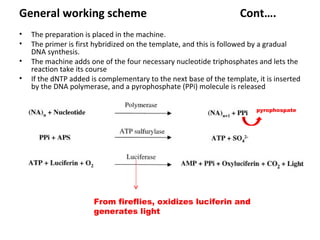
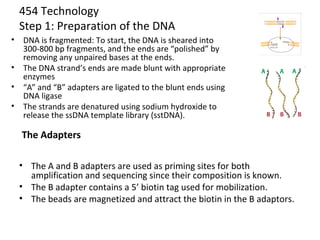
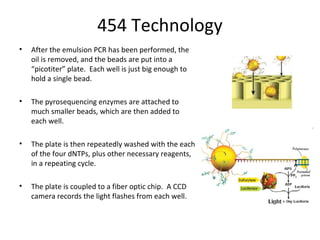
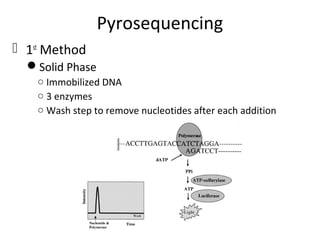
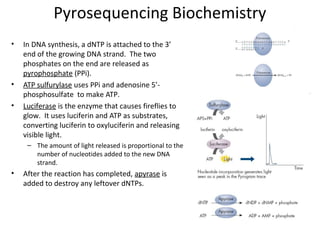
Pyrosequencing is a sequencing method that detects DNA polymerase activity by measuring the release of pyrophosphate using a cascade of enzymatic reactions that generate visible light. It utilizes emulsion PCR to amplify DNA fragments on beads in microreactors. The beads are then loaded into wells and sequenced by sequentially adding nucleotides and detecting light produced upon incorporation using a CCD camera. Key advantages are its accuracy, high throughput of up to 48,000 probes per day, and ease of automation. However, it requires specialized equipment and software.

![General working scheme
• DNA fragment is amplified with PCR: one of the two primers used is
labeled with biotin
• Streptavidin-bound beads are taken
• Amplified DNA is coupled with Streptavidin-bound beads and
denatured with NaoH
• The biotin labeled chain remained bound to pellets
• Washing step: complementary chain is washed, single strand left
(biotin labeled)
• Template is pipetted onto a microtiter plate.
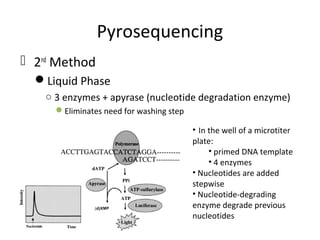
– Sequencing primer, substrate mixture (i.e., adenosine-5’
phosphosulfate [APS] and luciferin), enzymes (i.e., DNA polymerase,
ATP sulfurylase, luciferase, and apyrase ) are added](https://image.slidesharecdn.com/pyrosequencing-180209114248/85/Pyrosequencing-4-320.jpg)